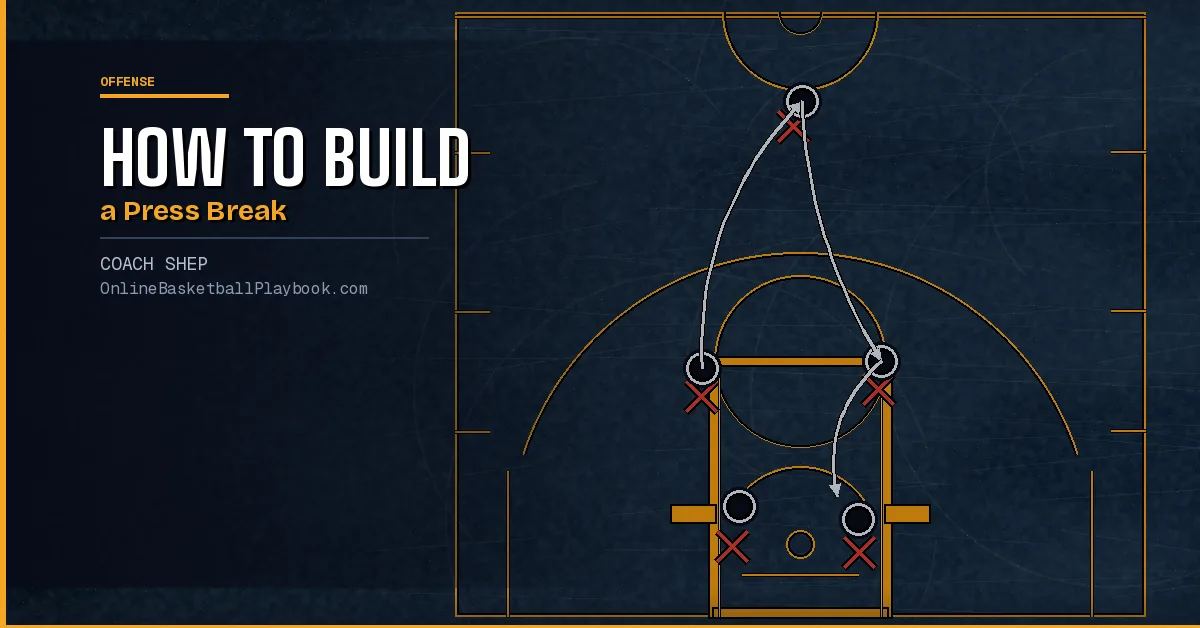
Full-court pressure rattles unprepared teams. These press break drills teach your players to stay calm, find the open man, and attack the defense for layups, not just survive to half court.
Why Press Break Drills Matter
Full-court pressure defense is one of the most disruptive weapons a coaching staff can deploy. A well-executed full court press defense forces turnovers, changes tempo, and breaks a team's offensive rhythm before they even reach half court. The only reliable answer is daily, repetitive drilling of press break concepts. Not chalk talks, not film alone, but reps under controlled pressure that build the decision-making instincts your players need when it counts.
The goal of press break basketball is not simply to advance the ball. That thinking produces passive players who just want to "get it up the floor." The mindset your drills must develop is attack. When the defense commits two players to trap the ball, they are voluntarily leaving a numbers advantage behind that trap. Your players need to see that advantage and exploit it every time. Drills that rehearse passive escape reinforce the wrong habit; drills that reward layup opportunities reinforce the right one.
Press break also builds basketball IQ faster than almost any other practice activity. Players must read defenders, communicate under pressure, make quick decisions in limited space, and execute fundamentals. All at the same time. A well-designed press break drill sequence gives you all of that in a compact block of your practice time.
Spacing Fundamentals Every Drill Must Reinforce
Before running a single drill, your players need to understand the spacing rules that make every press break work. Skipping this step means your drills will look like controlled chaos even after weeks of reps.
The Three-Outlet Rule
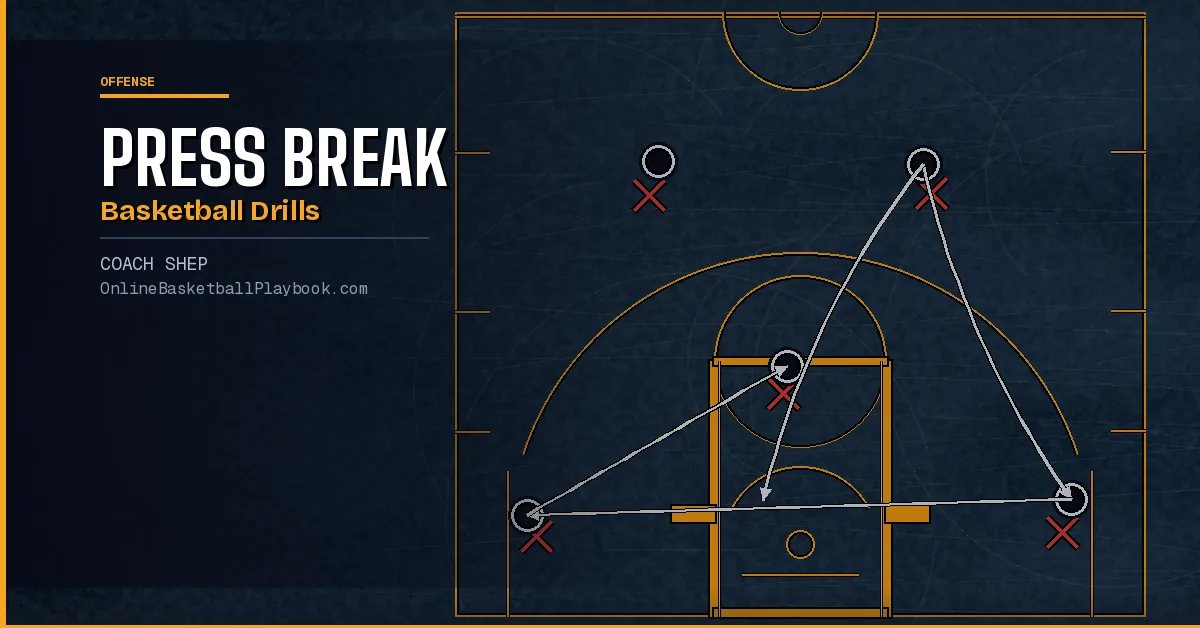
Any time the ball is trappable (near the sideline, in a corner, against the baseline), the ball handler must have three outlets available: a sideline outlet, a middle outlet, and a reverse outlet. Two defenders cannot cover all three directions simultaneously. When your players internalize this rule and hold their spacing, the trap becomes an opportunity rather than a threat. Drills that allow cutters to drift close to the ball handler or cluster near the same sideline are training the wrong thing. Enforce the three outlets every single rep.
Come Back to the Ball
When a ball handler is being run down or is in trouble, teammates must "come back to the ball." Shorten the pass angle rather than standing stationary. This is a habit that must be drilled deliberately. Walk through it first. Make players feel where to go when the handler is under duress. Then add pressure and increase speed. The movement should become automatic so that in a game, teammates respond the moment the trap closes without needing a call.
Eyes Up, Chin to Shoulder
The pull-back dribble is only effective if the handler's eyes find the floor as they create space. Teach your players to turn their shoulders and bring their chin to the top shoulder to see the full court while pulling back. This simple cue ("chin to shoulder") gives handlers a concrete action to perform instead of just "look up," which is too vague to execute under pressure.
Core Press Break Drills
1. Outlet-and-Go (2-on-0)
Start with two players at the baseline. One player inbounds, the other pops to the nearest outlet position. The inbounder delivers the pass, then sprints the middle lane while the outlet receiver pushes the ball up the sideline. When they reach the wing, the outlet hits the cutter in the middle lane for a layup. This drill builds the habit of immediate movement after the inbound, both from the inbounder and the receiver. Run it both sides, 10 reps each side per session. Once players can do it cleanly at full speed with no mistakes, you are ready to add a third player and a defender.
2. 3-on-2 Half-Court Finish
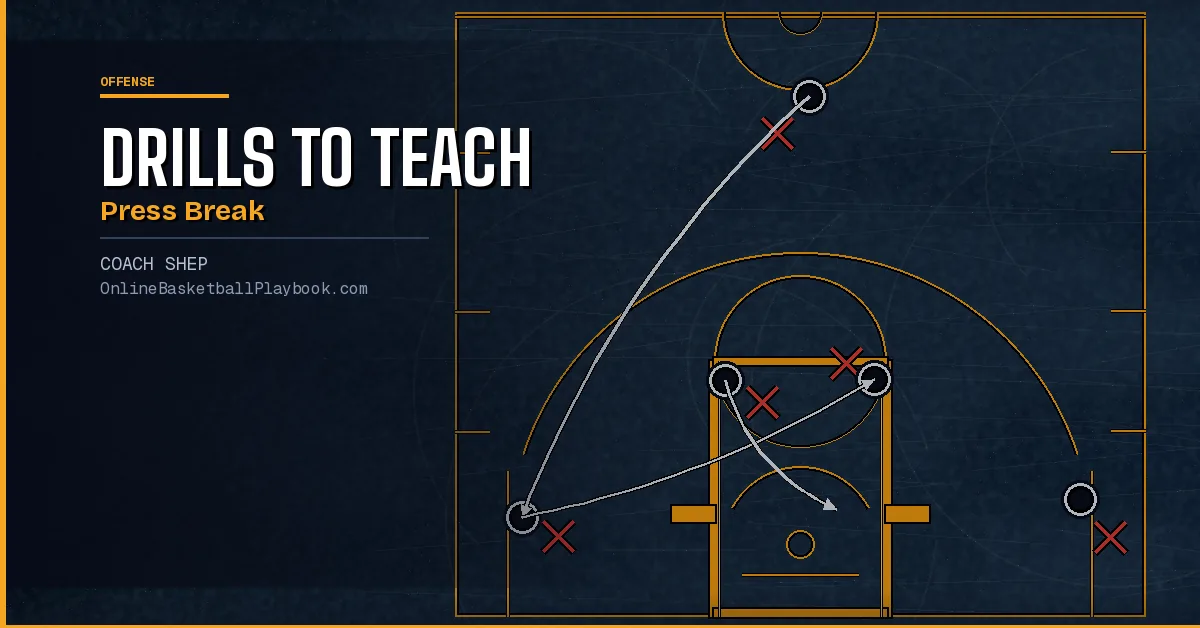
Set up three offensive players at half court against two defenders between them and the basket. The ball starts with the middle player. The drill teaches players to read the trap and finish the 3-on-2 advantage the press leaves behind every time two players commit. Emphasis: do not settle for a pull-up jumper. Make your players attack until they earn a layup or a kick-out for an open three. Rotate so every player plays every position. This drill directly rewards the "attack to score" mindset rather than the "survive" mindset.
3. Middle-Reverse Drill (3-on-1)
Place a ball handler at the sideline near half court with a lone defender closing in. Two offensive players position themselves, one in the middle of the floor and one on the weak-side wing. The handler must use either the middle outlet or the reverse outlet before the defender arrives. The player who catches continues to a layup with the third player trailing. This drill isolates the two most important outlets and sharpens the handler's recognition of which to use based on defender positioning.
4. Inbound 5-on-5 Shell Press Break
This is the full alignment drill. Run your base press break alignment (whether a 1-4 spread or a 1-2-2 formation) against your scout defense running a zone or man press. The offense's goal is not just to cross half court but to get a quality shot attempt within eight seconds of the inbound. This time constraint forces urgency and prevents passive ball movement. Track how often your team converts a layup or open three versus how often they settle for a contested midrange shot or turn it over. Use that data to identify which outlet or spacing assignment is breaking down.
Trap Escape and Pull-Back Drills
Trap escape is the skill most teams undercoach. They teach spacing, they teach outlets, but they never specifically isolate the moment when the trap is closing and the handler must execute. These drills fill that gap.
The Gauntlet Drill
Set up two pairs of defenders at different spots on the sideline, one pair near the baseline and one near half court. A ball handler must dribble through both traps, using the pull-back dribble and an outlet pass before the trap closes each time. One receiver trails the handler and receives each outlet pass, then returns the ball. This drill is exhausting and intense, which is exactly the point. The handler must execute technique (pull-back, chin-to-shoulder, find the outlet) while fatigued and under pressure, because that is when traps happen in real games.
Trap Recognition and Decision Drill
Place a ball handler at the sideline near the three-quarter-court line. Three defenders stand at different positions, one plays the on-ball defender, one simulates a trap partner, and one guards the middle outlet. Before the drill starts, the coach signals which two defenders will trap and which will guard the outlet. The handler reads the signal and makes the correct pass to the open outlet. This drill sharpens the handler's pre-pass reads so they are not reacting after the trap closes but anticipating before it does. Progress from walk-through to game speed over two weeks.
2-on-1 Deep Safety Attack
After any outlet pass that breaks the initial trap line, there is typically a 2-on-1 against the deep safety defender. This drill isolates that moment. Two offensive players start at half court, one defender starts at the top of the key. The two offensive players must score. No pull-up jumpers unless the defender completely takes away the drive and the kick. Run this drill every day. It builds the habit of finishing after the press is broken rather than losing momentum after escaping the trap, which is one of the most common mistakes teams make when they first install a press break.
Live Press Break Reps and Progressions
Once individual and small-group drills are clean, you need live reps (real pressure from a full defense) to complete the development cycle. Structured progressions prevent teams from jumping straight to chaotic 5-on-5 before the habits are locked in.
Week-by-Week Progression
Week one: all drills are 2-on-0 and 3-on-0. Establish spacing habits with no defensive pressure. Correct every spacing error immediately. Week two: introduce passive defenders. They guard zones but do not trap aggressively. This exposes players to movement without chaos. Week three: live trapping defenders at 75 percent intensity. Week four: full press at game intensity, both zone and man, alternating so your players never know what look they are getting. This mirrors real game conditions where a diamond press or a man press can come at any time.
Tracking Progress
Keep simple stats during live press break reps: layups and open threes earned, contested shots settled for, and turnovers. After two weeks of live reps, your layup and open-three percentage should be climbing and your turnovers should be dropping. If turnovers are staying high, the spacing is still breaking down, usually because receivers are drifting toward the ball when they should be holding their outlets. If your team is getting across but not scoring, the issue is the 2-on-1 finish drill: they are escaping but not attacking the deep safety.
Connecting to Your Transition Offense
The best press break teams flow directly from the break into their transition offense. Once the press is broken and you have a 2-on-1 or 3-on-2, those numbers must be finished before the defense recovers. Teach your players that the press break and the fast break are the same possession. The press break just starts earlier. When your team thinks of it that way, they will not slow down after crossing half court. They will push all the way through to a shot attempt.
Run your press break drills at the start of practice when players are fresh, not at the end when fatigue causes sloppy habits. The spacing decisions and pull-back technique require clear thinking, and the first 10 minutes of practice are when those habits get hardwired.
Integrating Press Break Into Practice
A press break that only gets practiced occasionally will never be reliable in a game. It needs to be a consistent fixture in your basketball practice plan, especially during the weeks leading up to opponents known for pressing. Here is a framework for building it into your regular schedule without sacrificing other priorities.
Daily Minimum (10 Minutes)
Every practice should include at least one press break drill. Rotate through the core drills across the week so all elements get attention. Monday: outlet-and-go and middle-reverse drill. Tuesday: trap escape gauntlet. Wednesday: 3-on-2 finish. Thursday: 2-on-1 deep safety attack. Friday: full 5-on-5 live press break. This rotation keeps skills sharp without requiring a dedicated block every day.
Scout Week Preparation
When you are facing a pressing team, expand the press break block to 20 minutes daily for that week. Show your players the specific press look they will face (zone or man, full-court or three-quarter) and run live reps against it every day. Use film from the opponent to show your scouts how their trappers rotate, where they gamble, and what the deep safety does when the first outlet is made. Players who can picture the defense they will face execute press break concepts with far more confidence.
Building Poise as a Program Habit
The biggest mistake teams make when installing a press break is treating it as a scheme problem when it is actually a poise problem. Your players will execute the drill correctly in a gym setting and fall apart in a game because the crowd, the scoreboard, and the fatigue strip away their composure. Build poise by creating pressure in your drills. Use noise, use time limits, use consequences for turnovers. Make the drill environment more uncomfortable than the game, and your players will be steady when it matters. Pair your press break work with passing drills that emphasize accuracy under pressure, because most press break turnovers are not spacing errors. They are rushed passes.
- Always enforce three outlets: sideline, middle, and reverse. No clustering near the ball handler
- Teach the pull-back dribble with "chin to shoulder" as the verbal cue for eyes up and floor vision
- After the trap is broken, push all the way to a layup attempt. Don't let players slow down at half court
- Track layups earned vs. turnovers in live reps; high turnovers usually mean spacing is collapsing, not scheme failure
- Run press break drills at the start of practice when decision-making habits are sharpest and freshest
- Progress from 0-defender reps to passive defenders to live trapping over a four-week installation cycle
- Alternate zone and man press looks in live reps so players never know what is coming, which mirrors real game conditions
Get free play diagrams, drills, and coaching guides delivered weekly.
Draw this play free in the play drawer →
Membership: the full library, playbook packs, and Pro drawing tools →
Keep Building
Related breakdowns
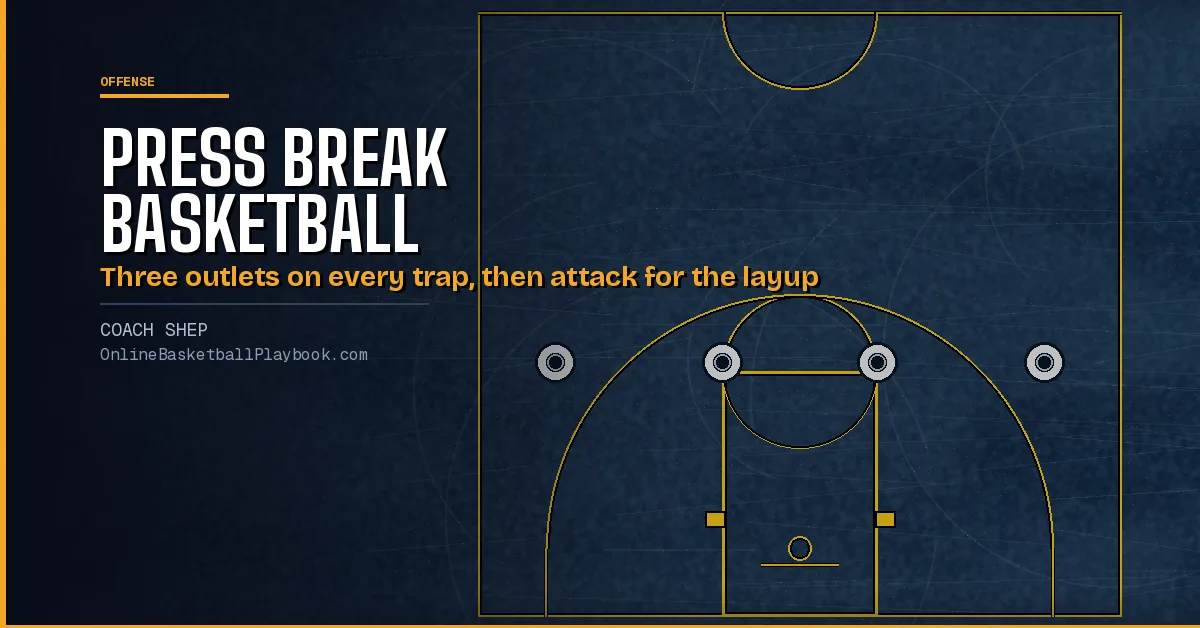
Press Break Basketball: Alignments, Reads and Drills
Press break basketball guide with the 1-4, 80-60-40 and 4-across alignments, reads against the 2-2-1, diamond and 2-1-2 press, and where coaches disagree.