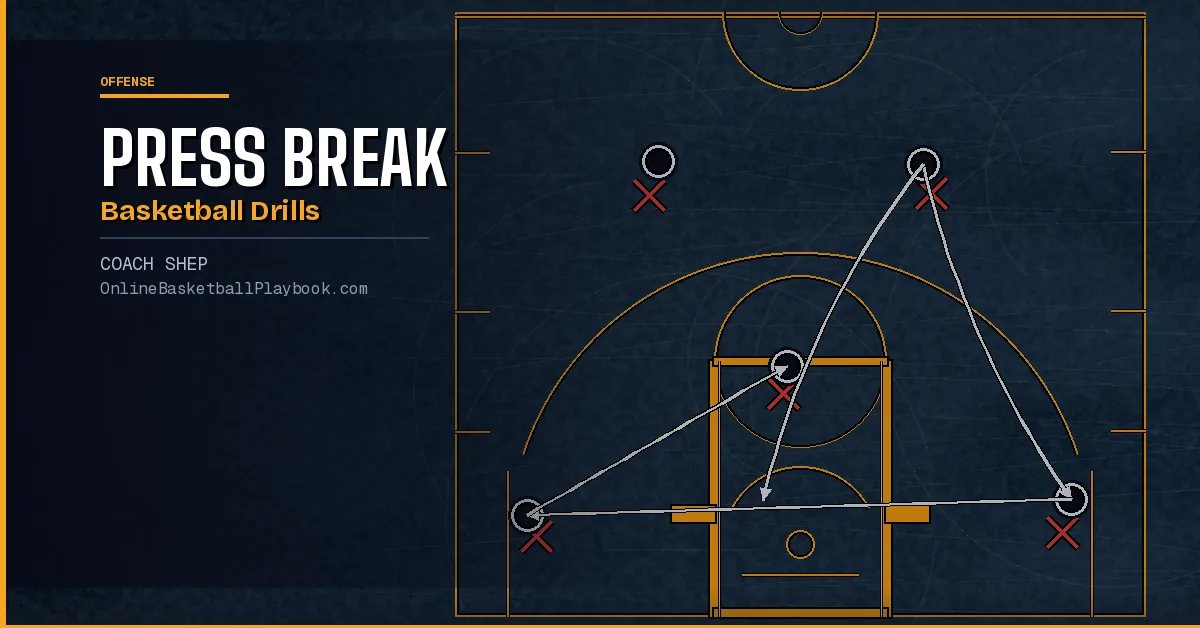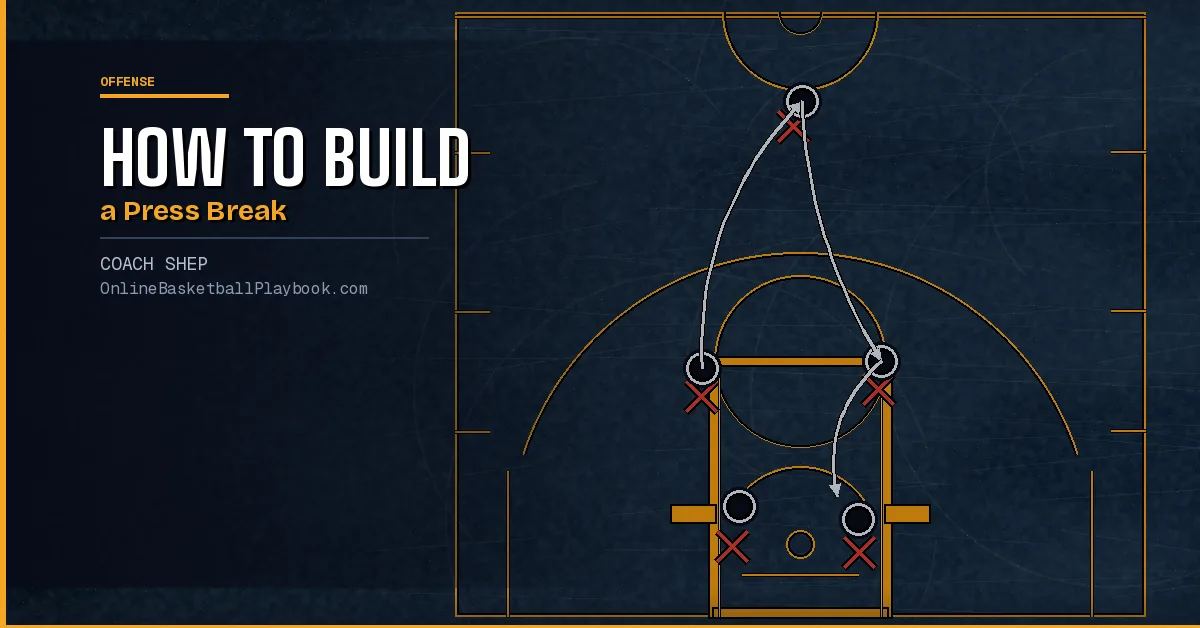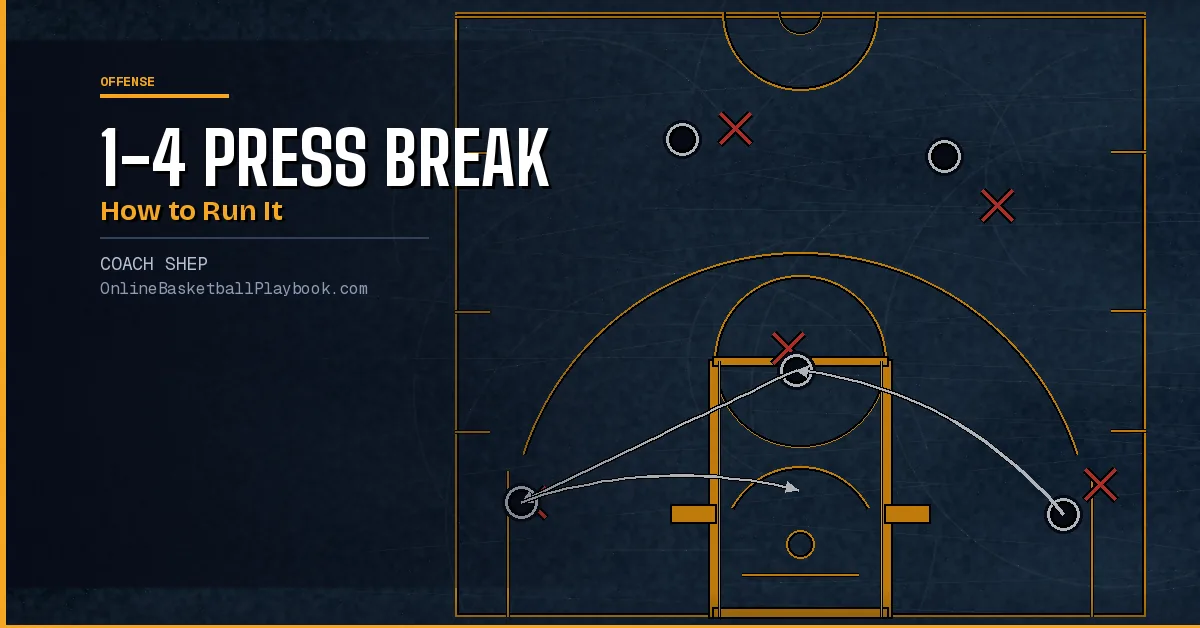
The 1-4 press break is one alignment that works against any full-court pressure, man or zone, without a sideline call. Players know their spots, their outlets, and how to attack the trap for a layup.
Why the 1-4 Alignment Works Against Any Press
Most teams run two or three different press-break sets and spend the whole timeout trying to figure out which press they're facing before calling one. That costs time, creates hesitation, and plays right into the defense's hands. The 1-4 press break solves that problem by design. It is one alignment that your players learn cold, and it handles every full-court look a defense can throw at it.
The "1-4" name comes from the alignment at the inbound: one player behind the baseline with the ball (the inbounder), and four players spread level with the free-throw line, the same set drawn on the press break guide. From that row, players break to their outlets, and one of the four can break deep. Bringing all four receivers high also pulls the defense's posts away from the basket, so they have to defend in open court or give up the inbound.
The other reason coaches lean on this formation is consistency. Your players don't need to read the defensive scheme before reacting. The reads are built into the alignment itself. If you're facing a full-court press defense, the 1-4 gives you the same principles regardless of whether the other team is running a 1-2-1-1, a 2-2-1, or a straight man-to-man press. Your players execute the same spacing, the same outlet reads, and the same attack angles every time.
That consistency also matters for your weaker ball handlers. When players know exactly where to go and where to look, the moment slows down for them.
The 1-4 also naturally flows into your transition defense after a score. Because you're spread out and moving with a purpose, getting back is built into the structure rather than bolted on as an afterthought. That matters against teams that attack in transition off turnovers.
Personnel and Position Assignments
Running the 1-4 well starts with getting the right people in the right spots. This isn't about jersey numbers. It's about matching the skills each position demands.
The Inbounder (typically your 4 or 5)
Your inbounder is your most underappreciated piece. You want a player who can throw a sharp, accurate pass under pressure and who won't panic when a defender is in their face. A big man who can step in and deliver a bullet to the sideline outlet is ideal. After a made basket he can run the baseline, which lets him use both sides of the floor and shortens the cross-court throw. The inbounder should never force anything. If the initial outlet is covered, reset with a timeout or an alternate entry.
The Point Guard (Position 1)
Your primary ball handler starts in the row at the free-throw line, on the ball side, and breaks to the ball for the inbound. Their job: receive the inbound cleanly, make the press read, and push the tempo before the defense can rotate. This player needs composure, not just speed. Ball handling drills in pressure situations, not just open-court dribbling, are what prepare a point guard for this role.
Wing Outlets (Positions 2 and 3)
Your wings start in the same row at the free-throw line, outside the point guard, and break toward the sidelines when the ball is in. They are the immediate relief valves when the point guard is pressured. Their cuts need to be sharp, not drifting, not jogging. When the trap comes, they sprint to an open seam and present a target. If neither wing is open, the ball reverses and the alignment resets.
The Deep Trailer (Position 5 or your longest passer's target)
One of the four breaks deep from the row, on the diagonal from the ball. This is the "home run" target: if the press overloads one side, a single skip pass over the top turns a defensive stunt into a layup. That player must sprint deep as soon as the ball is live and stay disciplined. No drifting back toward the ball, no helping a teammate by vacating the deep spot.
The Three-Outlet Spacing Rule
Everything in the 1-4 press break comes back to one foundational concept: at any moment when the ball can be trapped, the ball handler must have three clear outlets: sideline, middle, and reverse. Two defenders cannot cover all three at the same time. That's the math the press break lives on.
Let's walk through what each outlet means in the context of the 1-4.
Sideline outlet: The near-side wing crashes toward the ball handler's sideline, giving a short, safe pass option. This is the first read and usually the easiest. If the defense allows it, the ball moves quickly and the press loses a step.
Middle outlet: If the sideline is covered, the middle of the court becomes the attack lane. A trailing player or a cutting big can fill this lane. Getting the ball to the middle is especially dangerous for the press because it faces defenders sideways. They're now chasing rather than trapping.
Reverse outlet: When both the sideline and middle are contested, the ball comes back to the inbounder or a reset player near half court. This isn't a failure. It's a reset that forces the press to readjust, and often that readjustment creates an opening one pass later.
The single biggest mistake teams make in press-break situations is reducing their outlets from three to one. A ball handler who dribbles to the sideline with no middle option and no reverse outlet is essentially trapped before any defender has touched them. Spacing is everything.
How to Attack the Trap for Layups
Most coaches teach the press break as a survival exercise: get the ball across half court without a turnover. That's the wrong mindset, and it makes your team easier to press. The correct goal is to score, to attack the press so aggressively that the other team stops using it.
Here's why the trap is actually an opportunity: two defenders just left their assignments to trap the ball. That means three defenders are covering four remaining offensive players somewhere behind the ball. The press has created a numbers disadvantage for itself, and the offense's job is to find it and exploit it.
When the trap comes, your ball handler should not panic, should not pick up their dribble early, and should not force a pass under pressure. Instead, they use the pull-back dribble, a deliberate retreat with their chin up, scanning the floor, to buy just enough space for a clear look at the open teammate. That teammate may be in the middle, at the far sideline, or streaking deep. The trap doesn't care which one you hit, as long as you hit someone quickly.
Once the ball reaches a player who is 2-on-1 against the deep safety, the offense finishes the play. That's a layup, not a contested three. A team that only tries to survive takes the risk off the defense, and the defense keeps pressing.
For players who need to develop the composure to read traps in real time, pairing basketball IQ development work with live press break reps is the fastest way to build that skill.
Adjustments: Man Press vs. Zone Press
A true 1-4 press break doesn't require you to identify the defense before the inbound. The principles hold regardless. But there are small adjustments that help you attack each look more efficiently once your players have the system down.
Against a Man-to-Man Full-Court Press
Man pressure is about denying your best ball handler and forcing the inbound to a weaker player. Counter this by having your point guard clear out and then cut sharply back toward the ball. The defender following them creates a natural passing lane. Screen action near the inbound, a simple back-screen for the wing outlet, is also legal and highly effective against man coverage that is playing aggressively.
Against man press, you have the additional option of using a direct dribble-push. If the defender is overplaying the passing lane, the point guard receives the ball and simply attacks the defense's pressure before a second defender can rotate. A guard who can use footwork to attack off the catch is a nightmare for man press because they punish the very aggression the defense is trying to use.
Against a Zone Press (1-2-1-1 or 2-2-1)
Zone presses are designed to funnel the ball to the sideline and trap it there. The wing outlets in the 1-4 are already in position to beat this. Your near-side wing catches the ball and immediately looks for the middle player, who is almost always open against a zone that has shifted to the sideline trap.
The deep trailer is especially valuable against zone presses. Zone pressure typically overloads the front of the press, leaving one or at most two defenders responsible for the entire back half of the court. A well-timed pass over the top to the deep trailer, followed by a sprint from a trailing player, produces a 2-on-1 against a deep defender who started too far under the basket to cover it.
The key adjustment against zone presses: use skip passes. Zone defenses rotate laterally. A quick ball reversal, sideline to middle to opposite sideline, outruns any zone rotation and usually produces a layup off a skip pass that lands ahead of the nearest rotating defender.
Practice Drills to Build Press-Break Poise
Installing the 1-4 press break isn't a one-practice job. It requires enough repetitions that the spacing and reads become automatic so that when the other team sprints out in a 1-2-1-1 trap with 90 seconds left and you're down one, your players are calm because they've been here a hundred times in practice.
These drills build that poise systematically. Pair them with your overall basketball practice plan so the press break gets live reps at least twice per week during the season.
3-on-2 Press Break Recognition
Set up three offensive players against two defenders at the half-court line. The offense inbounds and attacks; the two defenders simulate a trap. The offensive players must find the open man and finish at the rim. This drill isolates the read-and-attack habit without the complexity of a full five-on-five simulation.
Full 5-on-5 Continuous Press Break
Run full-court, game-condition press break reps. The defensive group uses three different press looks in rotation (man, 1-2-1-1, 2-2-1) and the offense cannot call timeout to identify which press they're facing. They must read and react on the fly, exactly as they will in games. Award points for layups off trap reads, not just for crossing half court.
Pull-Back Dribble Under Pressure
Two defenders overload the ball handler at the inbound. The ball handler must use the pull-back dribble to create space, scan the floor, and deliver a clean pass to one of three stationary targets. The drill is short (30 seconds per rep), high-pressure, and repeated a minimum of ten times each session until the handler's composure under the double-team is consistent.
Skip-Pass Decision Drill
Place five offensive players in the 1-4 alignment against a five-person zone. The coach calls "trap!" at any point after the inbound and the ball handler must skip-pass to the appropriate outlet within two dribbles. This trains the connection between the trap cue and the correct skip-pass target without requiring a full-speed live situation to develop it.
Before adding new plays or personnel changes, check whether all five players are hitting their 1-4 spots every time. A ball handler who panics often misses the player left open down the floor, so drill the break with eyes up and all three outlets on every trap.
- Set all five players in 1-4 spots before the inbound. Spacing is locked in before the ball is live
- Ball handler reads sideline first, then middle, then reverse. Three outlets, in order, every time
- Pull-back dribble creates space against the trap; never pick up the dribble early under pressure
- Deep trailer stays deep. No drifting toward the ball. This is the home-run look against overloaded zone presses
- Attack for the layup, not just to cross half court. Trap reads that end in a shot punish the press and stop it from coming
- Against man press, use a back-screen or sharp cut near the inbound to free the primary ball handler
- Against zone press, use skip passes to outrun lateral rotation and find the open cutter ahead of defenders
Get free play diagrams, drills, and coaching guides delivered weekly.
Draw this play free in the play drawer →
Membership: the full library, playbook packs, and Pro drawing tools →
Keep Building
Related breakdowns
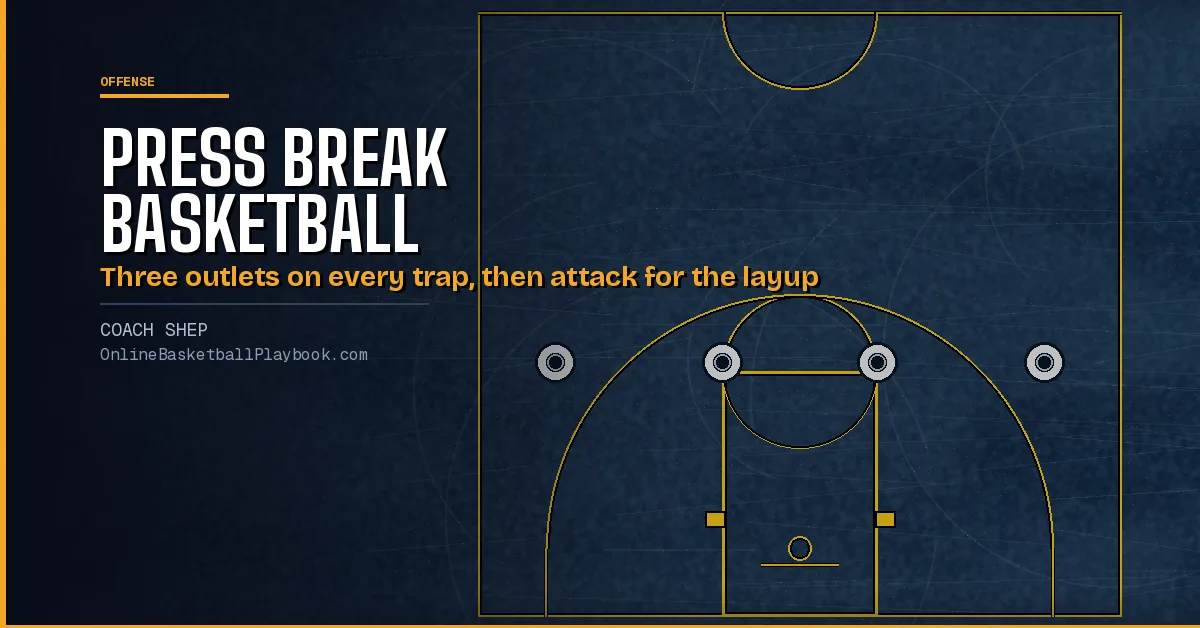
Press Break Basketball: Alignments, Reads and Drills
Press break basketball guide with the 1-4, 80-60-40 and 4-across alignments, reads against the 2-2-1, diamond and 2-1-2 press, and where coaches disagree.