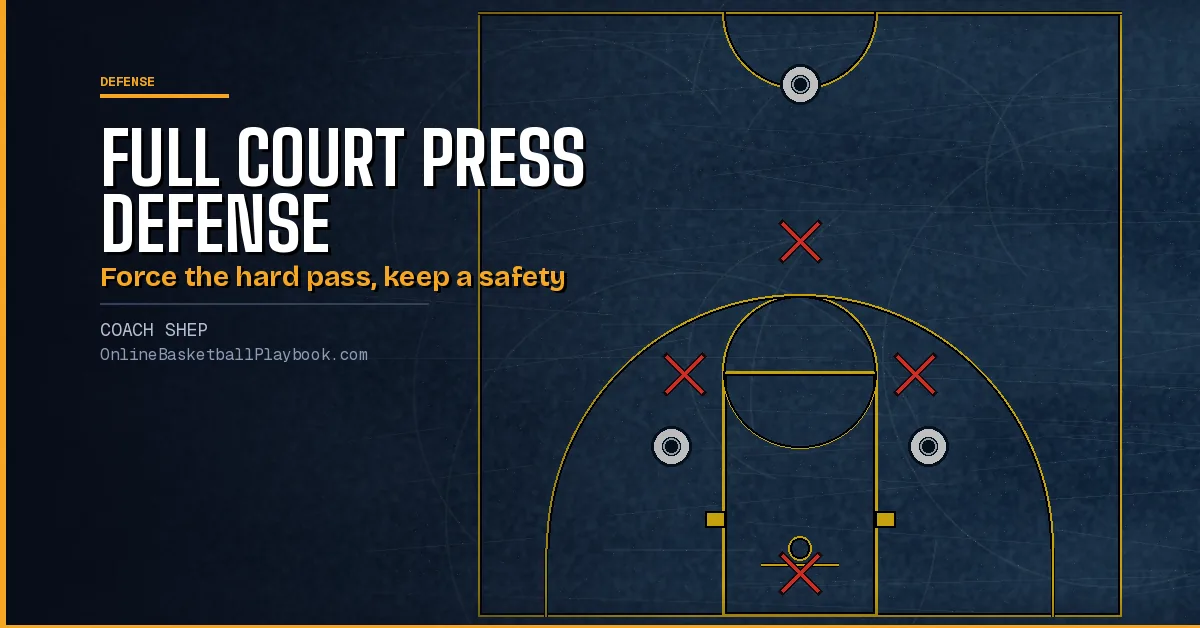
A full court press defense extends the defense the length of the floor to trap the ball, force a hard pass and dictate tempo. Some presses trap early and some only trap in set spots. Others use a switch instead of a double team. All of them ask a team to trade some safety for pressure. This guide covers why coaches press, the press families, the rules every press follows, trap mechanics, the roster and fitness cost, the install order and the drills, and where coaches split.
Full Court Press Defense at a Glance
| Question | Answer |
|---|---|
| What is the goal? | A hard pass and a disrupted offense. Turnovers are a byproduct |
| Where does the ball go? | Out of the middle and toward a sideline |
| How many trap? | Two defenders. The other three cover passing lanes |
| Who is always back? | A safety who protects the basket |
| What does it cost? | Fitness, depth, fouls and practice time |
| What happens when it breaks? | Sprint to the paint, then find a man |
Why Coaches Press
Turnovers come first on most lists, but they are not the only payoff. A press can dictate tempo, force rushed shots, waste shot clock, fire up your own team, stop a run without a timeout, wear an opponent down mentally or physically against a short bench and take a star point guard out of the game. Tempo is the most overlooked reason, because the discomfort lingers after the press is dropped. Some coaches describe a press as an equalizer, a defense in which every player has a clear job.
The press is not a panic button. Coaches split on pressing when behind. The warning is that pressing while losing is the wrong time to gamble. The other answer keeps a zone press as a comeback tool when trailing late. Situations that fit are a team with poor decision-making guards, a limited bench, a strong half-court offense whose rhythm you want to break and your own need for a burst of energy.
The Press Families
Pick the family first, then the formation.
- Zone presses. 1-2-1-1, 1-2-2, 2-2-1, 2-1-2 and 1-3-1. Each places defenders in set lines and traps in set spots.
- Man press. Every defender guards a man across the whole floor. Some man presses run without any trap. Run-and-jump lives here, and so do SOS pressure defense and the hand-call scramble press.
- Match-up and read presses. The defense matches up and traps only on a trigger, such as an uncontrolled dribble. More on match-up press.
- Half-court and three-quarter versions. The pickup point is a risk dial. A press started farther from your own basket gives up more when it breaks, and half-court presses carry less risk. More on three-quarter court press.

The 1-2-1-1 traps early. A 2-2-1 lets the inbound happen first.

The 2-2-1 turns the ball to a sideline and traps there. A 1-2-2 built on three rules (the ball stays out of the middle third, no pass goes forward, the dribbler is made uncomfortable) doubles automatically in a trap area on each side of half court. The 2-1-2 puts a plug in the middle to close the center of the floor. The 1-3-1 traps at the half-court sideline, and the three across the middle prevent reversal passes. See the full guides on 1-2-1-1 Diamond Press, How to Coach the 2-2-1 Press, 1-3-1 Full Court Press and Best Full Court Press.
Run and jump. Instead of a double team, a second defender jumps the dribbler and the original on-ball defender rotates to the man the jumper left. It is the lowest-risk member of the press family and a good fit against a strong dribble penetrator. A slow big is not part of it, and it works best when it is a surprise. See How to Coach the Run and Jump Press.

The Rules Every Press Follows
Most press versions land on the same short list.
- Force a difficult pass, not a steal. The goal is to disrupt.
- Keep the ball out of the middle. No passes to the middle of the floor and no straight-line passes.
- Never get beaten up the sideline. The dribbler is steered toward a sideline on purpose, but nobody lets him go around.
- Never foul the trap. Fouling produces free throws and wastes the trap. The trap is a lure to force a lob to intercept.
- Rotate behind the trap. Steals happen there.
- Always keep a safety. The deepest defender protects the basket.
- Sprint back the moment the press is broken. Never let the ball get ahead of you.
Also communicate on every possession. Some staffs chart the press, logging the inbound sector and the next pass so they can move the trap point at halftime.
Trap Mechanics
- Two defenders, never more. The other three play the passing lanes.
- The first defender stops and steers, the second closes. Do not run wildly at the handler. He can go around you.
- Knees together, hands at the height of the ball. Close the gap with the legs so the handler cannot split, and keep the arms up and out. Do not reach.
- Trap at set spots. The deep backcourt corners and the sideline about halfway up the floor. The boundary line acts as a defender that never makes a mistake.
- Trap the right dribbler. Trap the uncontrolled dribbler, not one looking up to pass.
- The interceptors play 50/50. Half toward the first available pass and half toward the middle. Steals belong to them, so train them first.
- Do not trap a man running at you. Stunt, fake the trap and recover.
- Sprint out of the trap. The trap is a moment, not a home.

Get the next coaching guide in your inbox
One email when a new guide or diagram set goes up. Free.
Roles and Personnel
Build the press from the roster. Find the one spot the press lives or dies on and fill it first. In a diamond press the interceptor is assigned first, then the two bigs, then the wings. In a 1-3-1 the top is the most important spot and the back should be the best rim defender, not the tallest. In a 2-1-2 the middle is the crucial spot, filled by the most agile player. In a 2-2-1 the back-line interceptor is the best anticipator. A press that names its five spots as jobs is on Vance Walberg full court press.
- Point man. In one 1-2-2 model he is the smartest player and not the most athletic. He keeps the ball out of the middle and plays cat and mouse.
- Wings. They invite cross-court passes and sprint on the flight of the pass.
- Interceptor. The best anticipator, reading the passer's eyes or shoulders.
- Safety. The rim protector who can handle a 2-on-1. A safety who can do that buys the press more aggression.
Teach one press and adjust the pressure within it rather than adding several. If your roster changes the scheme, let it. In one 2-2-1 with a slow big, the weak-side middle player becomes the main interceptor and the second trap is dropped, trading steals for a covered rim.
The Price of Pressing
A press is costly and the same costs come up in every version. A broken press gives up easy baskets. Fouls hurt twice because a press needs depth. And it eats practice time. A press is a commitment of the whole roster and not a starters-only call. Fitness decides how long it stays effective.
A checklist before installing any press has four items. Quickness, conditioned athletes, a good bench and buy-in.
Youth teams deserve a caution. Zone presses often work at that age because young players cannot pass over them, so the win comes from size and strength and not from tactics. Some youth guides use full-court man pressure with no trapping and no gambling instead.
How to Install a Press
Work from small to large. Start with one-on-one fundamentals, then two-on-two, three-on-three and four-on-four sequential drills, then five-on-five pressure scenarios. Another way is whole-part-whole. Teach trap zones, double-teaming, closeouts and high-post defense individually, then run 4-on-4 double-team reps, then half-court scrimmages for stops and defense into the break. Keep daily reinforcement drills short once the fundamentals are set.
- Circle trap drill. Three players per team stand around a circle. Two adjacent opponents trap on the pass and the third gaps the passing lanes. Trappers keep feet wide and arms up and out. The trapped player may not dribble and must pass fake and pivot without raising the ball overhead.
- Deny and trap corner drill. The dribbler is sent baseline and the trappers stay knee to knee, hands matched to the ball height, looking for a deflection, bad pass, five-second call or tie-up.
- Back-tip drill. Sprint and tip from behind with the hand low.
- Three-team drill. The team that just scored sets its press at once and holds it until half court.
Pressure also starts at the outlet. The instant a rebound is secured, put hands high on the rebounder, find the point guard and then pressure the ball up a sideline. More reps are on Full Court Press Defense Drills.
Where Coaches Split on the Full Court Press
- When to trap. Some presses trap on the first catch. Others wait for the dribble, because a standing ball handler is harder to trap than a moving one. One press never traps before the ball crosses midcourt. Another treats a backcourt reversal as no problem because the ten-second count keeps running.
- A second trap. Coaches split on a second trap. Trap again on a reversal or a lob down the sideline, or call the press broken once the ball reaches the middle. Treat a second trap as a choice.
- Pickup point. Full court starts at the inbounder, three-quarter court around the free-throw line extended, and half court as the ball crosses. Pressure started farther from your basket gives up more when it breaks.
- When to drop it. Drop the press after the opponent breaks it or scores easy layups, bring it back as a surprise and drop it with a comfortable late lead. Or keep the system running with the bench.
- One press or several. One view is to teach one press and change the intensity. Another runs one skeleton at three intensities, with a call for each. Define the team's color code once, because programs use the same color for different jobs. A disguise starts in one look and turns into a different defense, on disguised press defense.
Coach Cheatsheet
- Force a hard pass and keep the ball out of the middle.
- Two trap and three cover lanes. A safety always stays back.
- No fouling in the trap.
- Fill the key spot first and teach one press.
- Check quickness, conditioning, bench and buy-in before installing.
- When it breaks, sprint to the paint, then find a man.
- Write down when the press is on and when it is dropped.
Questions Coaches Ask About the Full Court Press
What is a full court press in basketball?
It is a defense that pressures the ball across the whole floor, usually with traps, to force a hard pass and dictate tempo.
When should you use a full court press?
Coaches use it against poor decision-making guards, a thin bench or a strong half-court offense, and when their own team needs energy. Some also keep a press as a comeback tool late in a game.
What is the best full court press?
It depends on the roster. Pick the press whose key spot you can fill, and teach one press well before adding another.
What do you do when the press is broken?
Slow the ball with the closest defender and sprint to the paint before finding a man. An open outside shot is better than an uncontested layup.
How do you break a full court press?
That is the offense's job. See our press break guides for the offensive side.
All defense pages sit under the Defense hub. Related guides include Types of Defense in Basketball, How to Break the Full Court Press, Basketball Press Terminology Guide and How to Beat a Full Court Press.
Want the printable playbook packs?
OBP Pro members get the premium playbook packs: the zone attack, out of bounds and practice plan PDFs, plus each new pack as it is finished. The membership page lists what is in each one. Or draw your own version free in PlayDraw.
See what OBP Pro includesMore Coaching Guides
- Basketball Player Development: Workouts and Skill Progressions
- Motion Offense: Spacing, Rules, Actions and How to Install It
- Man-to-Man Defense: Stance, Positioning, Help and Drills
- Basketball Shot Fake (Pump Fake): How to Do It and Teach It
Back to Types of Defense and every Defense page.
Keep Building
Related breakdowns
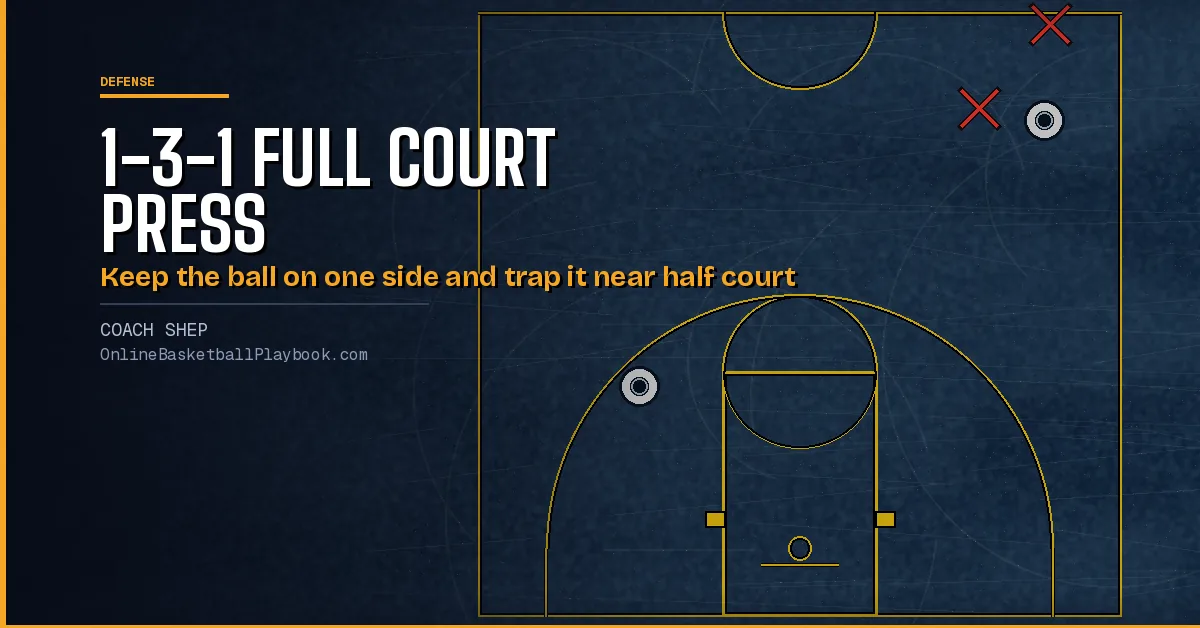
1-3-1 Full Court Press: Roles, Traps and Rotations to Install
The 1-3-1 full court press from setup to frontcourt trap: each role, the reversal rotations, an aggressive version, the costs and when coaches call it.
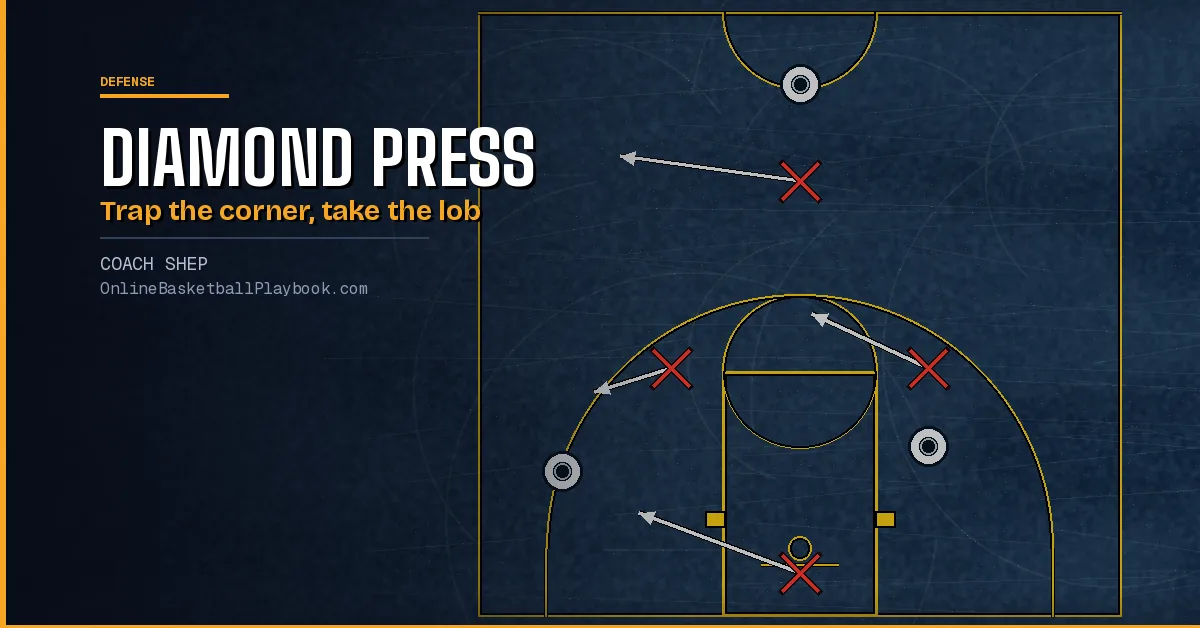
1-2-1-1 Diamond Press Basketball: Roles, Traps and Install
How to run the diamond press in basketball: who plays each role, how to trap the corner, what to do on the reversal and the lob, and how to install it step by step.
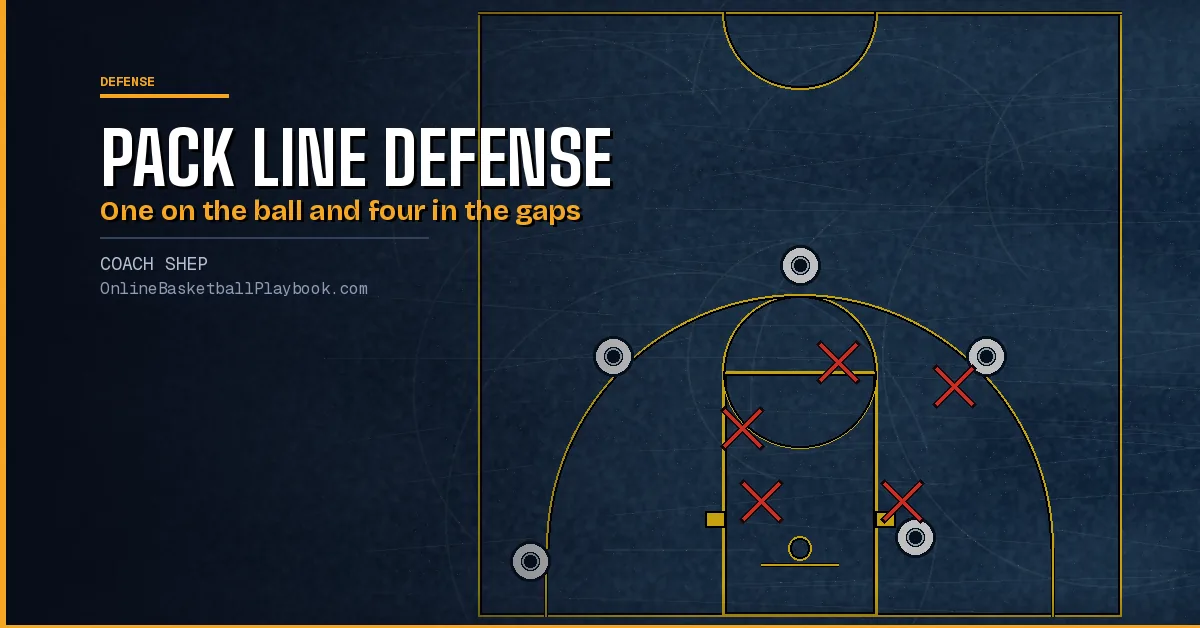
Pack Line Defense: Rules, Post Coverage and How to Install It
Pack line defense as coaches run it: where the line sits, on-ball and gap rules, post doubles, screens, dead balls, the costs and an install order.