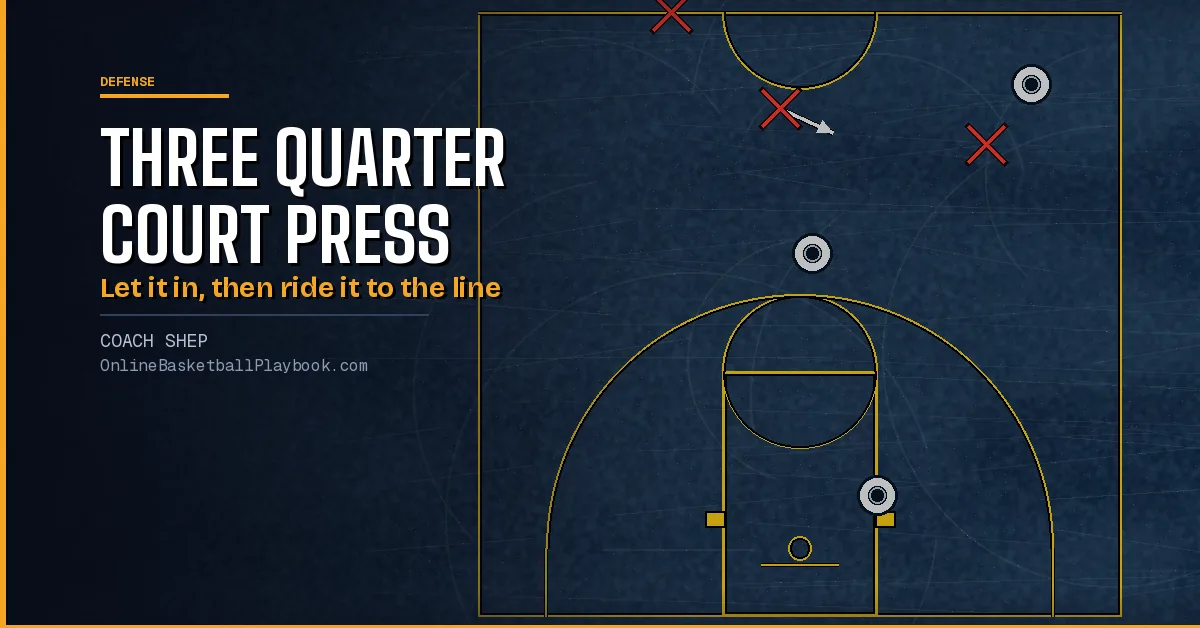
A three quarter court press lets the offense inbound the ball, picks it up in the backcourt around the free-throw line extended, and traps somewhere between there and just past half court. It is not a new system. Most coaches run the same shapes they use full court, the 2-2-1, the 1-2-2, the 1-3-1 and the 1-2-1-1, from a deeper start. In numbered depth language this is the "60" pickup.
Coaches use it to control tempo, burn clock, wear down ball handlers and force bad passes while giving up fewer layups than a press that traps the inbound. This page covers where the pickup line sits, what to do with the inbound, the shapes, the trap near half court, the rotation behind it, reversals and the exits when it breaks.
The offense's side is on how to break a three quarter press. It sits under full court press defense in the defense section.
Three Quarter Court Press: Same Press, Later Pickup
Most coaches treat the three-quarter press as a full-court press started deeper. The full-court presses are compared on best full-court press.
- Same rules, later trigger. A 1-2-1-1 runs at three-quarter court with the same rules as the full-court press, only triggered later.
- Call into a 1-3-1. A match-up press has a call that rotates it into a three-quarter 1-3-1.
- Move the trigger. A 2-2-1 tempo press moves the same press between full-court, three-quarter and half-court triggers.
- Start the front line back. Jim Calhoun's UConn staff ran a retreat version of its 2-2-1 by starting the front line back toward half court.
That makes the three-quarter press a pickup depth inside the press families, not a family of its own. The families are compared on full court press defense, and the trap mechanics every press shares are on trap defense basketball.
Run the press you already know and change only where it starts.
Where the Pickup Line Sits
Coaches do not agree on one landmark.
| Landmark | Pickup line |
|---|---|
| Free-throw line extended | The "60" pickup sits around the free-throw line extended in the backcourt. UConn's regular 2-2-1 starts its front line at the foul line extended, and a tempo press starts its front defenders near the elbows. |
| Toward half court | UConn's retreat version starts the front line back toward half court, and sometimes backs off until the 10-second line. |
| A read line, not a pickup | A 1-2-1-1 uses the volleyball line as a read line, not a pickup point: below it the defender on the inbounder traps with the ball-side wing, above it the press rotates into another look. Vance Walberg splits the court into quarters with the volleyball lines. |
| Numbered depth | Numbered depth runs 80 for full court, 60 for three-quarter, 40 for half court and 20 for the base defense, with a trailing 1 for a deny press. A 1-2-2 uses "80" for its three-quarter trapping press, so the same number means a different depth there. |
The call words for each depth are collected on press terminology.
Pick your landmark in practice so every defender points to the same line.
The Inbound: Let It In or Deny It
The usual three-quarter press does not fight the inbound.
Let it in
- A "60" press puts no pressure on the inbounder.
- The traditional 2-2-1 lets the ball in, UConn does not contest the first pass to either side, and further front lines allow the first pass.
- A tempo press starts with early denial, never over-denies, and then releases so the ball comes in.
Deny it
- A 1-2-2 ball press may deny the ball in or play three-quarter court.
- A trailer trap press pressures the inbounder and denies the pass to the point guard.
- A match-up press adds a "61" call: a three-quarter press that denies the inbound.
Decide before the game whether the ball comes in free or is denied.
The Shapes Coaches Run at Three-Quarter Court
The same four shapes work from a deeper start, each with its own pickup and trap.

| Shape | Approach | How it picks up and traps |
|---|---|---|
| 2-2-1 | Elbows start, half-court trap | Guards on the elbows, bigs a step or two from half court, the back man near the arc. First trap between the free-throw line and half court, second trap on a lob down the line. |
| 2-2-1 | Jim Calhoun's UConn staff | First pass free, traps in the sideline alleys, likes the trap just after half court. A bump rotation, a match-up option and a retreat version. |
| 2-2-1 | Tempo press | Front spots, bluff spots and a protector. Sideline trap near half court, with the trigger moved between full, three-quarter and half court. |
| 2-2-1 | Trap, then retreat to a 2-3 | Sideline and backcourt traps, then a retreat into a 2-3 zone. |
| 2-2-1 | One trap, then a 3-2 zone | Covers the middle before anyone steps up on the ball, one trap, sprint back, then a 3-2 zone. |
| 1-2-2 | Containment with a rim protector | Low-risk containment with a rim protector always home, a sideline trap and a second trap from behind on a completed sideline pass. |
| 1-2-2 | Trap, float, float-then-trap | The trap press is the aggressive three-quarter trapping press, the float press floats with no trap, and the float-then-trap press looks like the float and then traps the corner after half court. |
| 1-3-1 | Sideline trap at half court | Picks up after the inbound and traps along the sideline near half court with one goaltender home. |
| 1-2-1-1 | Full-court rules, later trigger | The full-court rules, triggered at three-quarter court. |
| One trap | Gary Williams | One trap at three-quarter court, with a man-to-man pressure option and "run jump" and "run trap" options. |
| Trailer trap | A big trails and traps | A big trails the play and traps with the front defender, and the other big stays home. |
Each shape's full-court version has its own page: the 2-2-1 press, the 1-2-2 press, the 1-3-1 full court press and the 1-2-1-1 diamond press. The run and jump options are on the run and jump press.
Who plays where
| Press | Front | Middle | Back |
|---|---|---|---|
| 2-2-1, elbows start | The two guards | The two bigs | The best anticipator, picked before the bigs |
| 2-2-1, UConn | The best on-ball defenders | Contain the sideline dribble, trap, and rotate to the basket | Usually the best interceptor, sideline to sideline |
| 2-2-1, tempo press | Quick guards, good on the ball | Forwards, a taller wall for the sideline trap | The tallest or best anticipator who does not gamble |
| 1-2-2, containment | Quick and long | The best anticipators | Usually the posts |
| 1-3-1, sideline trap | The most important spot, athletic | Very quick | The best rim defender, not the tallest |
Pick the shape first, then fill each spot with the player it needs.
Keep It Out of the Middle and Ride the Sideline
Every three-quarter press puts the middle first.
- Never leave the middle open. A press that repeats "Never leave the middle open!!" splits the job: the weak-side guard owns everything about 30 feet and in, the weak-side forward everything 30 feet and out.
- Treat the middle as the end. A tempo press calls the press doomed once the ball reaches the middle.
- Cover it first. A one-trap 2-2-1 covers the middle before anyone steps up on the ball.
- Hold the middle denier. A 1-2-2 adds that the middle denier does not leave to trap until the weak-side defender at the front of the press has rotated to take the middle away.
The front defender turns the ball to a sideline and does not get beaten back to the middle. Coaches teach it differently:
- Face the sideline. The on-ball defender's body faces the sideline and ties the front two together as if on a string.
- Take the inside shoulder. A tempo press sends its front defender to the inside shoulder to take away vision and the cross-court pass.
- Split the inside foot. UConn's alley drill has the front defender split the ball handler's inside foot.
- Give a little room. A 2-2-1 pressures from a bit more than an arm's length.
- Loose, then tight. A 1-2-2 contains loosely at first, then closes tight as the ball nears half court.
Turn the ball to the sideline and the middle stays closed.
Trapping Near Half Court
The trap sits near half court because the line takes away space. A tempo press uses the half-court line as an extra defender on its sideline trap. UConn prefers a trap just after half court because there is less ground to cover if it breaks. The sideline and half court act as a sixth defender.

When to spring it is a coach's choice.
| Trigger | Trap timing |
|---|---|
| The uncontrolled dribble | Rick Pitino backs off a handler under control. Tubby Smith traps only the second dribble. UConn's alley drill traps when the handler's head is down. |
| At a spot | A 2-2-1 traps as the dribbler nears the middle line, anywhere from the free-throw line to half court. |
| On crossing | A 1-2-2 traps once the ball crosses half court, and the float-then-trap press lures it across before trapping the corner. |
| At once | In the 1-2-2 trap press the front defender may trap right away or wait for the dribble. |
| Herd, then trap | Jim Larranaga's slow trap gives no trap right away and herds the dribbler first. His other one-trap looks are on scramble press. |
| On distraction | The second trapper goes when the handler is watching the first. |
The second trapper often shows space before he closes.
- Back off, then run. A tempo press backs its second trapper off a few steps so the path looks open, then runs at the ball.
- Fake and retreat. The strong-side forward fakes a step forward and takes two quick steps back.
- Cat and mouse. UConn's second line plays cat and mouse.
Show the space, then take it away.

Get the next coaching guide in your inbox
One email when a new guide or diagram set goes up. Free.
The Rotation Behind the Trap
Every trap needs clear jobs and clear rules.
- Name the roles. A match-up press makes every trap two trappers, two interceptors and one goaltender, and its goaltender is the last to commit. Jim Larranaga names trapper, interceptor and goaltender roles in his slow trap.
- Split the bigs. A press never lets its 4 and 5 trap together.
- Stay in the trap. Never release from the middle until your partner tells you to, and the worst thing is letting the man out of the trap.
The defenders off the ball guess the escape pass.
- Read eyes and shoulders. The 1-2-2 interceptors read eyes and shoulders, and so do Tubby Smith's.
- Lean with the eyes. Gary Williams has the players not in the trap lean toward where the handler is looking.
- Leave one open. A tempo press leaves the cross-court player farthest from the ball open on purpose.
The deep defender's job splits four ways.
- Interceptor. A 2-2-1 puts its best anticipator at the back because most steals come from there.
- Home. A conservative 2-2-1 keeps the back man home for a slow big, and a 1-3-1 back player never goes past the top of the key.
- Bait. A 1-2-2 weak-side back man plays as high as his speed allows and can bait the deep pass.
- Shade. The back defender always shades to the ball side.
Coaches split on how many traps to spring.
- One trap and out. A 2-2-1, Gary Williams and Jim Larranaga.
- A second trap on a completed sideline pass. A 2-2-1 doubles a lob down the line, a 1-2-2 traps from behind, and Vance Walberg looks for a second trap in the middle third of the floor.
- Several traps against weaker teams. UConn.
- No traps. A retreat 2-2-1, "70," and UConn's faked traps.
Know your job in the trap before the ball arrives.
Reversals and the Pass Back to the Inbounder
In a ball press the reversal is the pass the team will allow.
- Eat the count, then bump. UConn lets the reversals eat the 10-second count, then rebuilds the shape with the bump: one front defender pinches to the middle and bumps his partner over to pressure the ball. That is one on the ball and four in a box behind him.
- Flip the coverage. In a 1-2-2 the whole coverage flips and the front defender puts his hands in the lane for the return pass.
The pass back to the inbounder gets its own rule, because offenses use it.
- Force him left. A tempo press has its front defender pick up the inbounder, often a big, and force him left while a teammate traps from behind.
- Let it go back. A trailer trap lets the ball go back to the big on purpose and pressures him, because a big is usually uncomfortable handling in the backcourt.
- Go to straight man. Jim Larranaga's slow trap goes back to straight man on a reversal.
Have an answer for the pass back before the offense finds it.
When It Breaks
A ball in the middle usually means the press is beaten. Every press has an exit, and the exits differ.

| Exit | Press |
|---|---|
| Retreat to a 2-3 zone | The trap-and-retreat 2-2-1 |
| Flow into a 3-2 zone | The one-trap 2-2-1 |
| Closest man contains, everyone back to man | The contain-and-recover 2-2-1 |
| The two guards double from behind, the middle line intercepts | The contain-and-recover 2-2-1's alternative |
| The deep defender mirrors the ball, the coach signals man or zone | UConn |
| Four to the key, then find a man | The young-team rule |
Gary Williams says a good pressure team has to be a good transition team: know when to drop out, and never let a dribbler have the middle. The sprint back that follows a broken press is on transition defense.
Know your exit before you start the press.
Why and When Coaches Call It
The reasons coaches give:
- Tempo. Full-court pressure speeds the game up while three-quarter and half-court trapping slow it down. The tempo press, the trap-and-retreat press and UConn all say their 2-2-1 can do either, depending on how hard it is played.
- Less floor. The float-then-trap 1-2-2 was more effective than the trap press for the teams that ran both, because it covered less floor.
- Safety. UConn calls its 2-2-1 very safe because it is not an early trap press, and the 2-2-1 is the usual pick for most high school teams.
- Wear. The 1-2-2 often pays off in the fourth quarter.
When to call it differs too.
- After a score or violation. Press after a made basket, a made free throw, its own violation and its own missed free throw.
- After any stoppage. Press after misses, makes, free throws and any dead ball.
- After a free throw. Gary Williams calls the moment after a free throw a great time to press.
- Protect a late lead. The retreat look of the 2-2-1 protects a late lead.
- Move the trigger. A tempo press changes the trigger point every time unless the last one produced a steal and a score.
It concedes things on purpose. The trade-offs by shape:
- 2-2-1. Few steals against patient teams.
- 1-3-1. Beaten by quick reversal.
- 1-2-2. Less pressure on the inbound.
- Early sideline trap. A tempo press warns that its early sideline trap may only work a few times before opponents adjust.
- A quick inbound. Gary Williams says a team that gets the ball in quickly is tough to press.
Call it for a reason, and know what it costs.
Install and Drills
Teach it one of two ways:
- A competitive ladder. Install the whole five-man approach first, then 1 on 1 with defenders in the middle, 1 on 2, 2 on 3 trapping half the floor and 3 on 4 trapping both sides, every drill with a winner and a loser, about 20 minutes a day.
- Five breakdown drills. UConn runs 1 on 1 full court on one side, a 1 on 2 alley drill, 2 on 2 for the bump, 2 on 4 with a coach inbounding, and 3 on 4 with a middle man added.
A tempo press adds a guard denial drill of six to eight minutes with coaches as the inbounders. More setups are on full court press defense drills, and the offense's answers to drill against are on press break.
Whichever way you install it, keep every drill a competition.
Questions Coaches Ask
What is a three quarter court press?
A press that lets the inbound pass in, picks up the ball in the backcourt around the free-throw line extended, and traps between there and just past half court. Most coaches run their full-court shapes from that deeper start.
What is the difference between a full court press and a three quarter court press?
Where it picks up. A full-court press can pressure or trap the inbound pass. A three-quarter press usually lets the ball in and engages farther up the floor.
What is the best three quarter court press?
Coaches do not name one. More of the three-quarter presses on this page are 2-2-1s than any other shape, and the 2-2-1 is the usual pick for most high school teams. The 1-2-2, 1-3-1 and 1-2-1-1 are run at the same depth.
Where do you trap in a three quarter court press?
Usually on the sideline near half court, where the half-court line acts as an extra defender. A trap can also come only after the ball crosses half court.
What does a 60 press mean?
In one numbering system, 60 is the three-quarter pickup depth, between 80 for full court and 40 for half court. Other systems use different numbers for the same depth.
Want the printable playbook packs?
OBP Pro members get the premium playbook packs: the zone attack, out of bounds and practice plan PDFs, plus each new pack as it is finished. The membership page lists what is in each one. Or draw your own version free in PlayDraw.
See what OBP Pro includesMore Core Coaching Guides
- Trap Defense Basketball: When, Where and Who to Trap
- Transition Defense Basketball: Get Back, Stop the Ball, Match Up
- How to Defend Inbounds Plays: Baseline and Sideline Options
- Basketball Clock Management: Foul Up 3, Two for One, Last Shot
Back to Full Court Press Defense and every Defense page.
Keep Building
Related breakdowns
1-3-1 Full Court Press: Roles, Traps and Rotations to Install
The 1-3-1 full court press from setup to frontcourt trap: each role, the reversal rotations, an aggressive version, the costs and when coaches call it.
2-2-1 Press: Setup, Traps, Rotations and Drills
How to run the 2-2-1 press: who plays each spot, how coaches trap the sideline, the rotations after a reversal, how it breaks, how offenses attack it and the drills.
1-2-2 Press: Roles, Traps, Rotations and Breakdowns
1-2-2 press guide covering who plays the top, middle and back line, where each version traps, how it rotates on a reversal and what to do when it breaks.