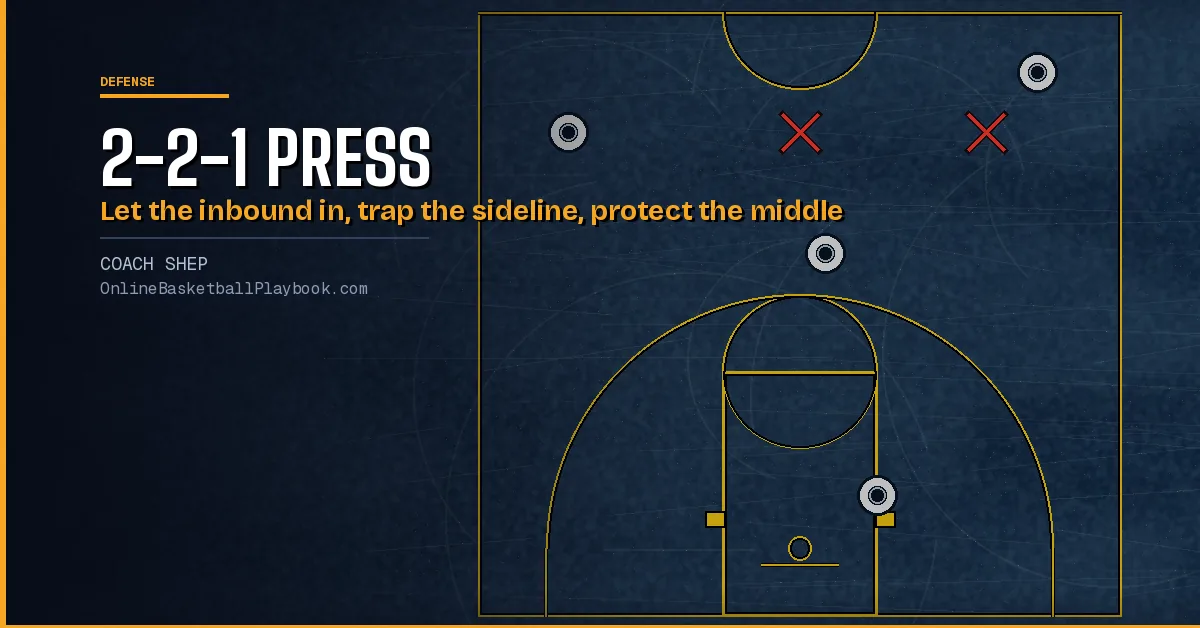
The 2-2-1 press is a full-court or three-quarter-court zone press with two defenders on the front line, two on a second line near half court and one deep. Most coaches treat it as the safe end of the press family. It usually lets the first inbound pass happen, keeps the ball out of the middle, steers it up a sideline, traps there near half court and sprints back when the press breaks. This guide covers the setup, the traps, the rotations, the versions coaches run, how offenses attack it and the drills that install it.
The 2-2-1 Press at a Glance
| Line | Spots | Main jobs |
|---|---|---|
| Front line (X1, X2) | The two guards, near the elbows | Pressure the catch, force the ball to a sideline, sink to take away the middle on the weak side |
| Second line (X3, X4) | Near half court | Trap the sideline with the front-line guard, play the passing lanes, cover short and deep middle |
| Deep (X5) | Deep behind the second line | Protect the basket, call out cutters and cover the long pass |
Why coaches run it. The containment view says it works best against teams without a true point guard or good passers, because it gets the ball out of the point guard's hands. The denial version leaves the inbounder unguarded, so the defense plays 5 on 4 before the pass, and it looks like man-to-man until the catch. That disguise can leave an offense that prepared for a zone facing a man look. The middle-trap version uses the press to tire the opposing guards, and the patient version says to let the opponent give you the ball.
2-2-1 Press Setup and Who Plays Where

Coaches name the spots differently, and the choice of player at each one is a real split. Each version below is named for what it does.
- Center-rotation version. Quick guards on the front line to force the sideline and recover to the middle, forwards on the second line and a center called possibly the most important piece.
- Three-read version. X1 and X2 at the corners of the lane, X3 and X4 near half court and the bigger X5 just outside the defensive three-point line.
- Tempo version. Top spots, bluff spots and a protector. The bluff spots stand 7 to 10 feet above half court and the protector is as deep as the last offensive player.
- Interceptor-first version. Choose the interceptor first, because most steals come from the back, and put the two bigs on the middle line.
The back-line player is where the versions split. The role names are defined on basketball press terminology. The interceptor-first version puts its best anticipator deep and keeps a conservative version for a slow big. The tempo version puts the tallest or best-anticipating player deep and tells him not to gamble. Personnel ideas split too. The big-guard view says the bigger the guards the better the defense. The center-rotation version asks for athleticism and quickness. The tempo version says the press does not need very quick players.
The Inbound Pass
Most versions let the first pass in. The ball-side front-line guard then pressures and forces the sideline, while the weak-side guard sinks to short middle. The center-rotation version's second line plays cat and mouse on the strong side and does not allow the sideline pass, and the weak-side forward takes deep middle. In the tempo version the top spot jumps to the inside shoulder, takes away vision and the cross-court pass and must not be beaten to the middle.
Other versions defend the inbound like man-to-man. In the denial version, each of the four front defenders denies the nearest receiver in a box, which leaves the inbounder free and keeps the 5 back for the lob. UConn's match-up option has X2 pressure the ball after the inbound while X1 guards the inbounder and denies the reversal, which is close to a man press that still traps. The center-rotation version lists denying the first pass only as a variation, and treats the version where every defender stays with his man as all or nothing.
The Sideline Trap

The trap is set near half court along the sideline. Coaches disagree on when and where.
| Approach | Where and how the trap forms |
|---|---|
| UConn | In the alleys along the sideline, with a preference for a trap just past half court because a broken trap leaves less floor to cover. The goal is a good trap, not an early one. |
| Center-rotation version | On the sideline with locked feet so the trap cannot be split. It takes away the sideline release, short middle and deep middle. |
| Interceptor-first version | The first trap is set between the free-throw line and half court by the ball-side guard and the ball-side middle player. |
| Tempo version | The second bluff defender retreats a few steps to make the alley look open, then runs at the ball, so the trap forms near half court with the line as an extra defender. |
| Alley-lead version | The front line leads the ball handler up the alley into the trap and uses legs, not hands. |
| Partner-rule version | It does not matter where on the floor the trap is set. |
| Middle-trap version | Allows the sideline and traps any middle dribble. The press takes away the sideline pass and the middle pass, so the guard has to speed dribble the length of the floor. A role press that starts from a 2-2-1 is on Vance Walberg full court press. |
The denial version also treats the reversal as bait. Every time the ball goes back to the middle, the guards trade, the second line comes back up and the 5 stays in line. The denial version's trap lane is the first 5 feet from the sideline in the backcourt, with a second trap zone once the ball gets past half court on the sideline. The coaches who speak to fouls agree. Trap with the feet and the body, keep the hands high and do not reach. A reach turns a good trap into free throws.
2-2-1 Press Rotations After a Reversal

When the ball is reversed, the press has to rotate back into shape. The same idea gets taught several ways.
- UConn's bump. On a reversal X1 pinches to the middle and bumps X2 over to pressure the ball on the strong side. The weak-side second-line player drops to short middle, the strong-side second-line player uses hedge and recover and the 5 rotates to the basket as deep middle. UConn calls it the 1-4 principle. One defender pressures the ball and the other four form a box of help behind him.
- Denial version's Tag. The middle guard does not leave the gut until his partner physically tags him.
- Partner-rule version's partner rule. Never release from the middle until your partner tells you to.
- Center-rotation version's rotation. When the sideline trap is set, the center rotates over, the weak-side forward drops to deep middle and the weak-side guard takes short middle. If the ball is released, the strong-side forward follows and sets a second trap while the others drop to the blocks and the strong-side guard sprints to the junction.
- Three-read version's three reads. It separates a pass reversal, a dribble reversal and middle penetration, each with a different rotation. It teaches a second phase for when the first trap breaks, and wants it drilled, not just the first trap.
- Middle-trap switch. On a cross-court dribble or pass the taker and the middle man must switch assignments. That is the spot where the press breaks down if it is not a practice staple.
Who Covers the Long Pass
| Approach | The deep player |
|---|---|
| Partner-rule version | X5 always shades the ball side. Only passes back and diagonal lobs are allowed. |
| UConn | UConn puts the 5 behind the middle man's shoulder for the long diagonal, and its deep man mirrors the ball if a trap breaks. |
| Center-rotation version | The center anticipates the sideline trap and rotates over to steal the "up" release pass, then sprints back if the press breaks. |
| Denial version | The 5 stays in a direct line with the ball as the quarterback, calling cutters and deep passes. He does not have to be the center. A quick guard can play back against teams that look for a deep inbounds lob. |
| Interceptor-first version | The interceptor stays in line with the ball and is the main communicator. |
| Three-read version | A backstop whose first job is no easy layup. |
| Middle-trap version | A teaser who protects the basket like a goaltender. |
When the 2-2-1 Press Breaks

Once the ball reaches the middle, the press is called over. The tempo version says it is doomed there and the interceptor-first version says it is broken. The closest defender slows the ball and everyone else sprints toward the basket. The denial version's gut pass triggers a full retreat to the paint, and the center-rotation version sprints back into a quarter-court zone if the ball goes deep. The interceptor-first version offers two answers. The two guards can double from behind while the middle line intercepts, or the closest player contains and everyone gets back into man. It prefers the second as simpler.
For young teams that version asks the closest player to stop the ball and the other four to get to the key before finding a man. A wide-open outside shot is better than an uncontested layup.
What follows the press is a choice too. The tempo version says the usual advice is a zone after a zone press, picked by who the protector is. A post player in that spot suggests a 2-3 or 2-1-2, and a guard or long athletic wing suggests a 1-2-2 or 1-3-1. The 3-2 drop version drops into a 3-2 zone. The center-rotation version sprints back into a quarter-court zone. The denial version flags the move into the half-court defense as the most vulnerable moment and says many teams skip drilling it. See the 2-3 zone, the 3-2 and the 1-2-2 zones.
Versions of the 2-2-1 Press Side by Side
| Approach | Idea | Used by |
|---|---|---|
| Containment | Concede the inbound and the reversal, trap the sideline, keep the middle closed | UConn, the center-rotation version, the three-read version and the interceptor-first version |
| Tempo press | Slows the game by forcing long reversal passes. It can be played soft to slow or hard to speed up | Tempo version |
| Denial | Face the receivers before the inbound, force lobs and use the Tag on reversals | Denial version. Five-day install plan |
| Match-up | Match whoever is in your area and switch everything in the backcourt | The middle-trap version. UConn's option has X1 on the inbounder |
| Middle-trap version | Allow the sideline, trap a middle dribble and sub every two minutes to tire the opposing guards | The middle-trap version |
| Retreat | UConn starts the front line back toward half court to change the look and slow a running team. The partner-rule version's retreat sets no traps and protects a late lead | UConn, the partner-rule version |

The retreat version is drawn from UConn's description, which moves the front line from the foul line extended back toward half court. UConn says this changes the look and slows teams that like to run. The partner-rule version's retreat 2-2-1 protects a late lead with no traps at all.
Coaches also differ on what the press is for. The partner-rule version lists both speeding a game up and slowing it down. The tempo version treats it as a tempo press that usually slows the game. The middle-trap version uses it to tire the other team's guards. The alley-lead version says a conservative 2-2-1 gets more effective as the shot clock gets shorter. A system that ties its press to its offense, with the reasons for each role, is on press on both ends.
Get the next coaching guide in your inbox
One email when a new guide or diagram set goes up. Free.
How Offenses Attack the 2-2-1 Press

The press takes the sideline, so the offense attacks the middle. A four-across break uses a guard screen to free the point guard, a long-then-back cut up the side and a safety kept behind the ball. The three-read version shows two counters a good offense will find, the cross-court kick out of the trap and the reset back to the inbounder. Know them before your players meet them. Read How to Break the Full Court Press and Press Break Basketball Drills for the offense's side.
Drills to Install the 2-2-1 Press
UConn and the partner-rule version both build the press with a ladder from one on one to three on four, and the alley-lead version's ladder stops at two on three. The ladder below is UConn's.
- 1 on 1 full court. One side only, with coaches at the boundary giving help, and a post up to finish.
- 1 on 2 alley drill. X1 splits the inside foot of the ball handler to force the sideline and X2 steps up once and back twice. They trap when the ball handler's head is down and he is out of control. Once committed, stay committed.
- 2 on 2 full court. It teaches the bump, with both defenders at or above the level of the ball on the weak side.
- 2 on 4. A coach inbounds to a good ball handler.
- 3 on 4. Add a middle man to practice short and deep middle rotations.
- Alley Force. The center-rotation version's drill forces the ball up the sideline and then plays live one on one at the opposite three-point line. Variations add a high post entry, a reverse and recover, and a sideline rotation.
- Tempo version's drills. Guard Covers Middle, Back 3 Shifts, Top Spot Ride, Guard Denial with coaches as inbounders for six to eight minutes, and Man in the Middle, a three-player shadowing drill that counts deflections.
- Denial version's five-day install. Day 1 walks the whole press and scrimmages. Day 2 is the Trap and Deny drill. Day 3 is Ride and Slide. Day 4 repeats Trap and Deny and adds the Tag and 6-on-5. Day 5 adds inbounds denial and a full scrimmage.
The partner-rule version suggests about 20 minutes a day on breakdown drills to build communication, with every drill competitive and a winner and a loser. For more press work see Full Court Press Defense Drills.
When to Press
The center-rotation version presses after made free throws and made baskets, after its own backcourt violation and as a surprise after missed free throws. The partner-rule version presses after misses, makes, free throws and any dead ball. The tempo version uses a hard or scramble version sparingly, for example at the end of a quarter, out of a timeout or when the other team's backup point guard is in. It also changes the trigger point between full court, three-quarter court and half court, and changes it each time unless a steal and a score just happened. It warns that an early sideline trap may only work a few times before an opponent adjusts.
For comparison, the 1-2-1-1 diamond press attacks the inbound pass and traps early, while the 2-2-1 concedes it and traps late. Other presses in the family are in Full Court Press Defense. The Defense hub lists the rest.
Questions Coaches Ask About the 2-2-1 Press
What is a 2-2-1 press in basketball?
A zone press with two defenders on the front line, two on a second line near half court and one deep. It usually lets the inbound happen, turns the ball to a sideline and traps there.
Is the 2-2-1 press a good press?
It is called the safe press. It concedes the first pass, keeps one defender back at the basket and does not need elite athletes. Denial and middle-trap versions are more aggressive.
Where should the 2-2-1 press trap?
On the sideline near half court, with the front-line guard and the second-line player on that side. Coaches disagree on whether the trap should come early, just past half court or anywhere.
What is the biggest weakness of the 2-2-1 press?
The middle of the floor. Once the ball gets there, the press is broken and the team has to sprint back.
How do you beat a 2-2-1 press?
Attack the middle with a four-across set, a guard screen and a cut up the side. Throw the cross-court pass out of a trap or reset to the inbounder.
Can you run the 2-2-1 press with slow players?
The tempo version says the 2-2-1 does not need very quick players. The big-guard view says the bigger the guards the better. The conservative version trades fewer steals for a safe rim.
Want the printable playbook packs?
Playbook packs: zone attack, press break, press defense, out of bounds, quick hitters, practice plans and the youth turnover cure, each a printable PDF. Or draw your own version free in PlayDraw.
See the playbook packsRelated Guides
- 1-2-2 Zone Defense: Rotations, Weak Spots and Drills
- Basketball Passing Drills for Beginners and Full Teams
- Basketball Practice Plan: Template, Youth Plans and Examples
- Technical Foul in Basketball: Rule, Penalties and Calls by Level
Back to Full Court Press Defense and every Defense page.
Keep Building
Related breakdowns
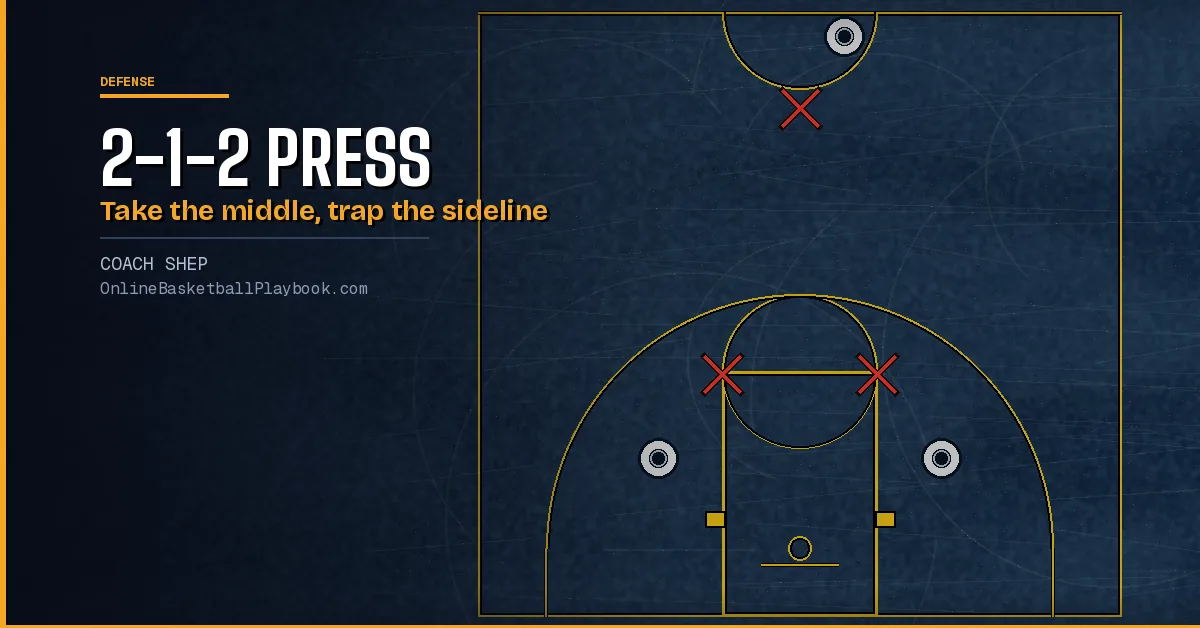
2-1-2 Press: Setup, Traps and Rotations of the Full Court Press
The 2-1-2 press explained: the full court setup, each line's job, the inbound, the first and second sideline traps, reversals and the match-up and tempo versions.
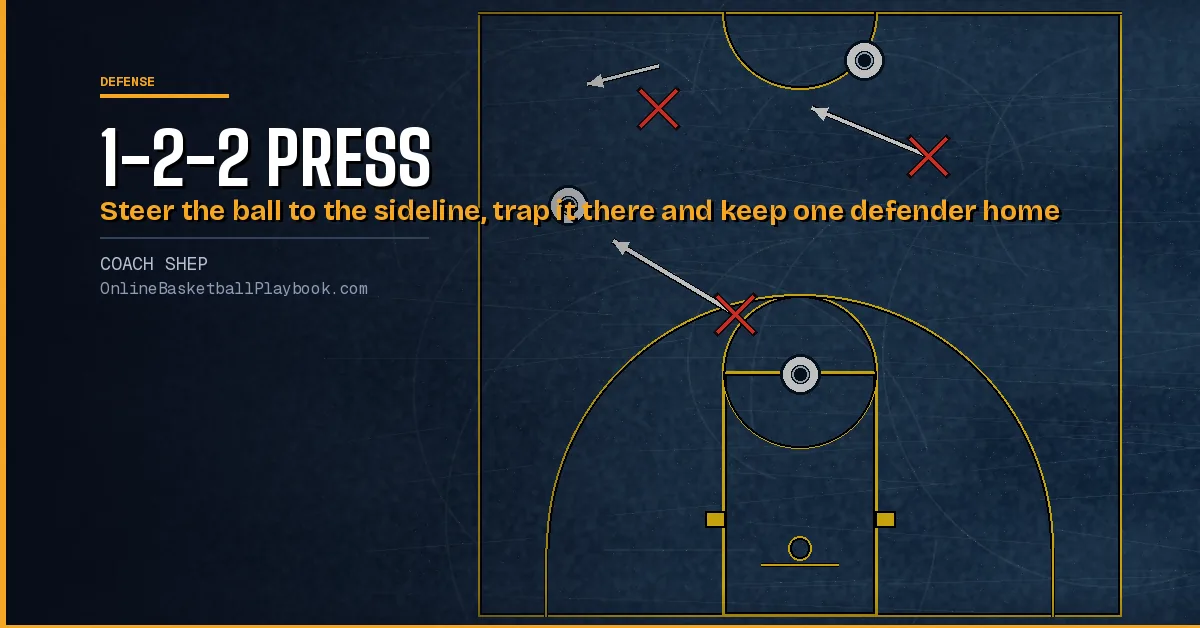
1-2-2 Press: Roles, Traps, Rotations and Breakdowns
1-2-2 press guide covering who plays the top, middle and back line, where each version traps, how it rotates on a reversal and what to do when it breaks.
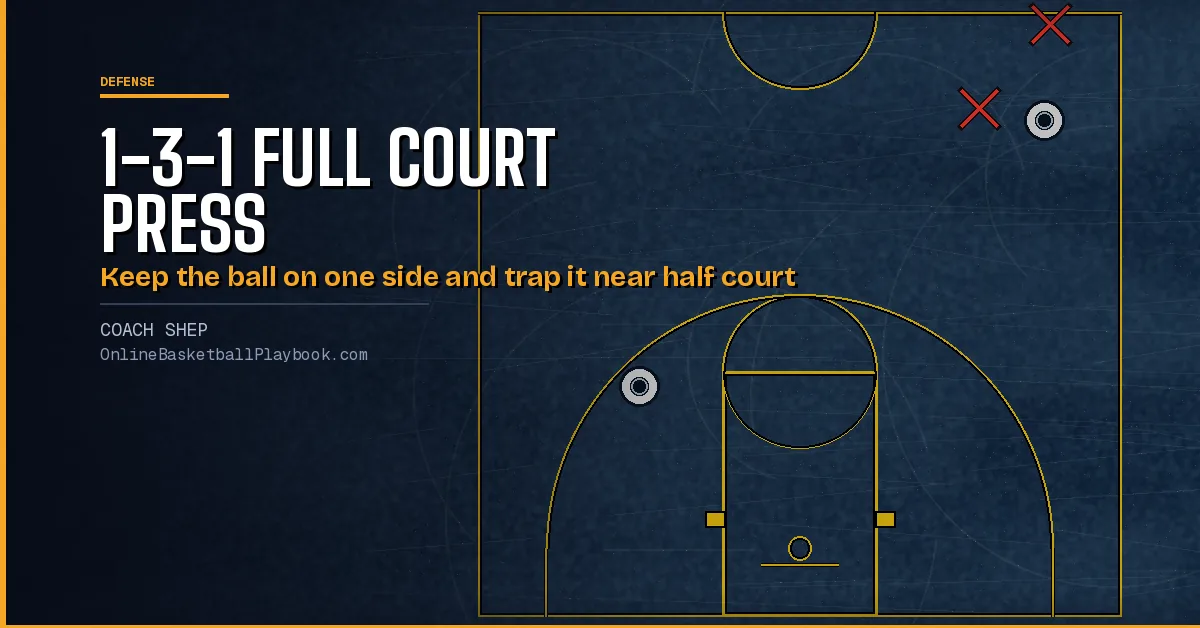
1-3-1 Full Court Press: Roles, Traps and Rotations to Install
The 1-3-1 full court press from setup to frontcourt trap: each role, the reversal rotations, an aggressive version, the costs and when coaches call it.