
The diamond press is one of the most disruptive full-court defenses in basketball. Run it correctly and you force turnovers, control tempo, and demoralize opponents before they cross half court.
What Is the Diamond Press?
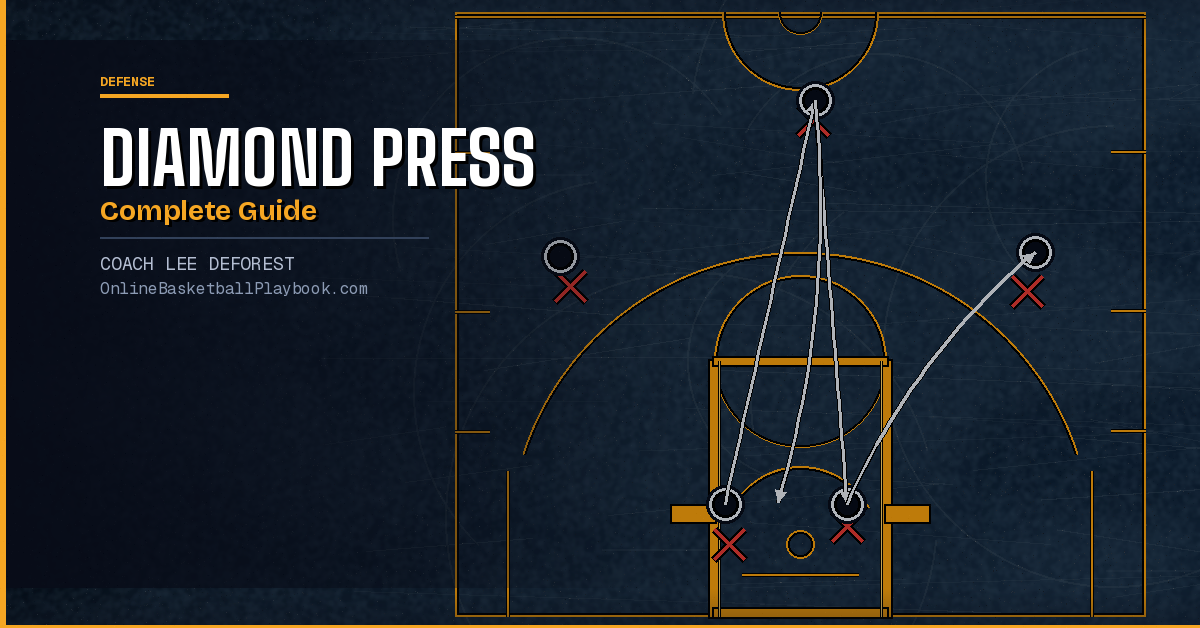
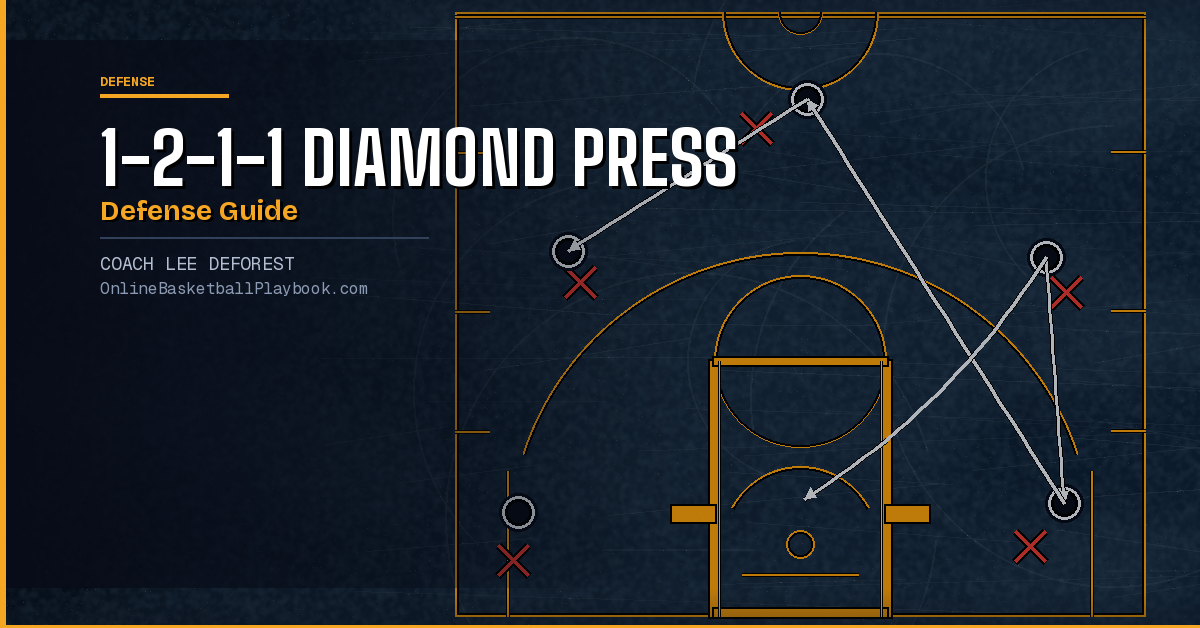
The diamond press — also called the 1-2-1-1 press — is a full-court zone pressure defense that arranges five defenders in a diamond shape from the inbounds spot to the basket. The "1" at the top pressures the ball, two players flank as wing traps, one player sits in the middle as the interceptor, and a lone defender protects the basket. The shape is designed to funnel every inbounds pass into a predictable lane where traps spring automatically.
Unlike a man-to-man press, the diamond press does not require your best athlete to shadow their best ball handler the length of the floor. Instead, it uses geometry. Players occupy zones, react to ball position, and rotate on a set of read rules. That makes the diamond press highly teachable — even at the youth and high school levels — because once players understand the three or four triggers that initiate a trap, the defense runs itself.
The historical roots of this press trace through Georgetown's 1-2-1-1 scheme, where the entire defensive philosophy centered on one idea: "when we use this defense we want the ball." That aggression — the intentional invitation for the opponent to inbound, then attacking the receiver — defines the diamond press's identity. You are not retreating. You are setting a trap and waiting for the ball to arrive.
At the college and professional level, coaches use the diamond press situationally: to open games and establish an aggressive tone, to press in the final two minutes when trailing, or to extend runs after a string of turnovers. At the high school level, many programs run it as their base defense for entire games, substituting heavily to maintain the energy level the press demands. Understanding what the diamond press is — and what it is not — is the first step toward installing it correctly.
"When we use this defense we want the ball."
— Georgetown 1-2-1-1 press philosophy (Esherick), via the Pressing Systems coaching vault
Personnel and Positional Roles
The diamond press is only as good as the players you put in each spot. Miscast one position and the entire structure collapses. Before you teach a single rotation, you need to identify your personnel for each of the five roles.
The Point (Position 1 — Top of the Diamond)
Your point is the player at the inbounds line, the first line of pressure. This is not necessarily your fastest player — it is your smartest. The point's job is to influence where the inbounds pass goes. He funnels the ball toward one sideline, denies the middle, and sets the trap in motion. If your point chases every ball and guesses, the press breaks down before it starts. You want composure and basketball IQ here over pure speed.
The Wings (Positions 2 and 3 — Middle of the Diamond)
Your two wing players are your athletes. They line up roughly at the free-throw-line extended on each side, and their job is twofold: deny the quick pass up the sideline early, then sprint to complete the first trap with the point man. Great wings have lateral quickness, active hands, and the discipline not to gamble early. The temptation to jump a pass before the trap is set kills more presses than any press break a coach can diagram.
The Stealer (Position 4 — Middle of the Diamond, Deep)
This is the most exciting role and the one that produces the highlight turnovers. The stealer sits near half court in the center of the floor, reading the eyes of the trapped ball handler and anticipating skip passes. A true stealer has elite instincts, long arms, and the ability to make one great play without fouling. If your stealer gambles and misses, your basket defender is isolated in a two-on-one. The best stealers in a diamond press are controlled — they read, they anticipate, and they only break on passes they are certain to intercept.
The Basket Protector (Position 5 — Bottom of the Diamond)
Your basket protector is the last line of defense. This player never gambles, never helps steal, and never abandons the paint. In most programs, this is your center or your most reliable post defender. If the press breaks down and a ball gets over the top, the basket protector must make a rotation stop without fouling. This player's mentality is defensive, not opportunistic.
Rotations and Trapping Rules
The diamond press is built on a short list of clear trigger rules. When players know the triggers, rotations happen automatically. The fewer rules you have, the faster and more confident the press runs. Here is the core rotation framework.
The First Trap
The first trap forms immediately after the inbounds pass is caught. As soon as the ball is received on one side of the floor, the nearest wing rotates hard to the ball and joins the point to form a two-man trap on the sideline. The goal is to make the ball handler feel the trap within one or two dribbles of receiving. Do not allow the receiver to settle. Do not allow a comfortable catch-and-survey. The trap must be fast and physical without fouling.
The trapping rule is simple: contain the ball handler between the sideline and the two trappers. The sideline is the third defender. Neither trapper reaches; instead, they form a wall, staying chest-to-chest with the ball and cutting off the escape angle. The trap succeeds not by stealing the ball directly but by forcing a lob pass, a bounce pass, or a scramble pass under pressure — all of which the stealer and opposite wing are positioned to intercept.
The Stealer's Read
Once the first trap is set, the stealer reads the ball handler's eyes and shoulders. Most trapped ball handlers telegraph their escape passes. If the stealer reads a skip pass to the far side, he breaks on the flight of the ball — not after the catch. Timing is everything. A stealer who breaks late gets a deflection. A stealer who reads correctly gets a steal and a layup going the other way.
Rotating Out of the Trap
When the ball escapes the first trap — either through a pass or a dribble out of trouble — the wings rotate to new positions based on ball position. The rule is simple: whoever is farther from the ball becomes the new stealer; whoever is nearest attacks the new ball position with the point. The basket protector does not move until the ball crosses half court. These rotations must be drilled until they are automatic, because a half-second of hesitation in transition allows an open three or a layup.
Countering Common Press Breaks
Every team your program faces will have some version of a press break installed. Before you can scout specific teams, you need to understand the three most common structural attacks on the diamond press, and how your rotations answer each one.
The Middle Runner
The most common diamond press attack is a single player who sprints the middle of the floor immediately after the inbounds. The offense is trying to get the ball into the middle before your trap forms, then push into a two-on-one or three-on-one advantage. The answer is simple in theory and hard in practice: the point must prevent the middle entry pass before worrying about anything else. If the ball enters the middle, your press is broken. The point's first job is to wall off that lane. The stealer helps by sitting just off center to threaten any pass toward the middle.
The Long Pass Over the Top
Some teams will simply throw a baseball pass over the top of the press to a sprinting wing or trailer. You cannot prevent every long pass — but you can make them difficult. The basket protector must be alert to the long pass and should never creep up toward the ball. The stealer can jump long passes that are thrown short, but the basket protector is the safety net against the perfect throw. Defensively, you accept that some long passes will succeed and focus your energy on making the inbounds and first-pass zones as difficult as possible.
The Quick Reset
A composed point guard will catch the inbounds, face the first trap, and immediately look for the weak-side reset — a teammate positioned on the far side who can receive a cross-court pass before your rotations adjust. The wing on that side must sprint to close on this receiver the moment the cross-court pass is in the air. "Sprint on air-time" is the coaching cue: by the time the ball arrives, your wing should already be in position. If your wing waits to see where the ball lands before sprinting, the receiver has a free catch and a full second to advance the ball.
Practice Drills and Installation Sequence
Installing the diamond press takes a deliberate practice sequence. Coaches who try to run five-on-five press drills in the first week end up with confused rotations and bad habits that are hard to unlearn. Build the press in parts and progress only when each layer is clean.
Week 1: Positional Stance and Alignment
Before any live ball work, walk all five players through their starting positions. No ball. Just alignment. Each player identifies their zone, their first responsibility, and their initial movement trigger. Do this slowly and repeatedly until players can set their alignment without direction. You are building a mental map.
Week 2: Two-Man Trap Work
Run the point and one wing against a single ball handler. No other defenders. The objective is purely to form the trap correctly — angles, footwork, no reaching. This drill sharpens trap mechanics without the complexity of full rotations. Run it on both sides of the floor. Most teams trap better on one side and get lazy on the other. Identify and fix that asymmetry early.
Week 3: Five-on-Three Shell
Add the stealer and basket protector, but run only three offensive players — the inbounder, the receiver, and one outlet. Now players practice full rotations in a controlled environment where the offense cannot fully exploit the press. This stage is about reading ball movement and rotating on the correct triggers.
Week 4: Five-on-Five Live
Now run full five-on-five press situations. At this stage, you will see which rotations need the most repetition. Keep a simple tracking system — every trap that holds and forces a bad pass goes in the win column, regardless of whether you get a steal. A trap that makes the offense use all five seconds of the shot clock counts as a defensive success even without a turnover.
- Point job: funnel ball to sideline, deny the middle, set the trap with the near wing
- Wing job: deny the early outlet, sprint to trap on the catch, rotate to new ball on escape
- Stealer job: read eyes and shoulders, break on the flight of the pass, never gamble on 50/50 balls
- Basket protector job: guard the paint, never chase the ball, stop the layup if the press breaks
- Trap rule: sideline is the third defender — contain, do not reach, force a lob or scramble pass
- Rotation cue: "sprint on air-time" — be in position before the ball arrives, not after
When to Use the Diamond Press
The diamond press is not a defense you turn on and leave on autopilot for 32 minutes. It costs energy. Defenders who trap aggressively for six possessions in a row are spent. The best press teams manage this carefully — they choose their press spots, sub generously to keep legs fresh, and time their press bursts for moments when the energy invested produces the biggest swing.
The three best situational uses of the diamond press are: at the start of the game to immediately establish an aggressive identity and test how the opponent handles pressure; after your team scores to deny the opponent a chance to run their half-court sets; and in the final two minutes of a half when trailing, when desperation is justified and a steal or forced timeout can change the game's momentum entirely.
Avoid running the diamond press when your team is physically outmatched by the opponent's size and strength — bigger guards can absorb traps and throw over them easily. Also avoid it late in close games when your team is ahead — a broken press that leads to a wide-open layup is a demoralizing gift to a team that was about to lose.
The most successful press coaches treat the diamond press as a weapon with a specific range. Used in the right situations, it creates chaos and energy that carry into your half-court defense. Used indiscriminately, it wears your team down and gives good offensive teams easy looks. Install it, practice it to a high level, and then be surgical about when you deploy it.
Substitution management is part of press installation. Identify eight or nine players who know the rotations, not just your starting five. The press only works at maximum intensity when your players are fresh. A tired trapper becomes a foul waiting to happen. Build your rotation so your second unit can run the same press without a drop in execution, and you will have a defense that opponents cannot simply outlast.
Want more defensive systems, press drills, and breakdown practice plans?
Join the Online Basketball Playbook newsletter →See it drawn up
Related diagrams
Keep Building
Related breakdowns
Three-Quarter Court Press: Complete Coaching Guide
Three-Quarter Court Press: Complete Coaching Guide