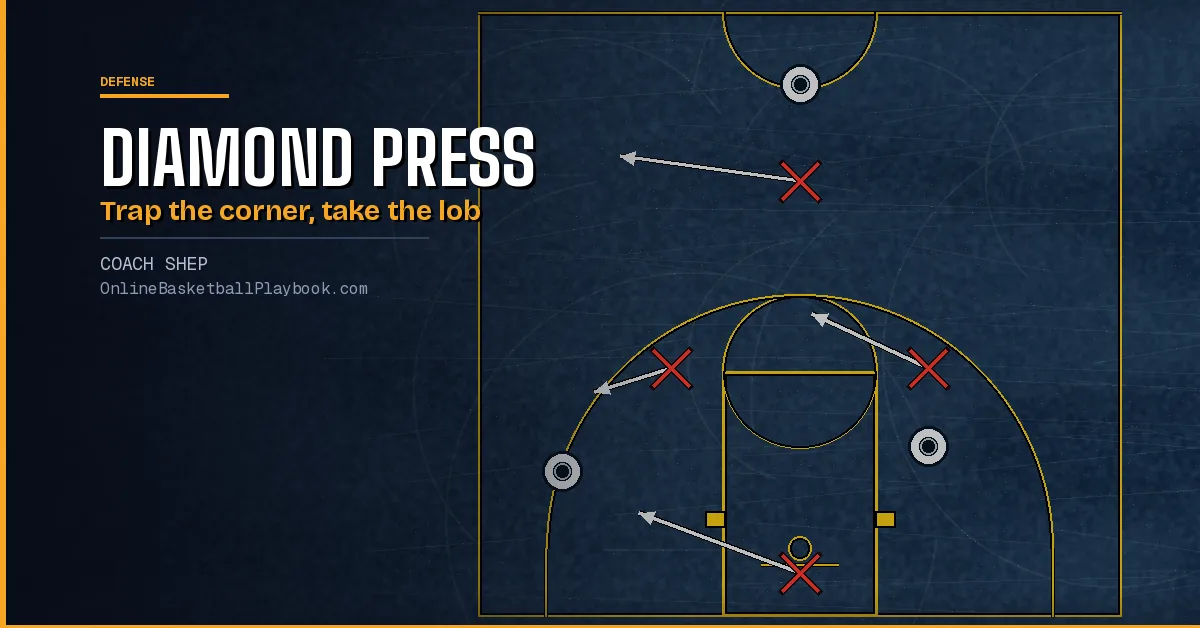
Diamond press basketball is the 1-2-1-1 full-court zone press. One defender attacks the inbounder, two wings sit behind the nearest receivers, one interceptor holds the middle of the floor and one safety stays deep. From above, the five make a diamond with a tail. It is the aggressive end of the zone press family. It pressures the inbound pass, steers the catch to a corner, traps early and lives on the lob that comes out of the trap. This guide covers the roles, the assignment order, the trap, the reversal, the calls, how offenses attack it and how to install it.
The Diamond Press at a Glance
| Role | Where he starts | Main job |
|---|---|---|
| Disruptor (X4) | On the inbounder | Steer the pass to a corner, count the five seconds, trap the catch |
| Wings (X1, X2) | Behind the nearest receivers | Strong side traps, weak side takes the middle and the return pass |
| Interceptor (X3) | Lined up with the inbounder, about halfway between the arc and half court | Read the lob, stop the dribbler who breaks the trap |
| Safety (X5) | Deep, as far back as the last offensive player | Protect the rim and cover the long pass |
How the diamond compares with the other main presses is on best full-court press.
Diamond Press Roles and Who Plays Them

Most coaches put a forward on the ball, not a guard. He is near the end line after every rebound, so he gets to the inbounder faster than the inbounder gets there. He needs length, footwork and a willingness to run. Several well-known coaches use a power forward in this role, and the power-forward version treats him as the heart of the press. The disruptor must not jump at the inbounder, because a jump slows the sprint to the trap.
Pick players in this order. Choose the interceptor first. He is the best anticipator, usually a guard or wing, and he makes the steals. Split your bigs next, with the more athletic one as disruptor and the slower one as safety. Fill the wings from the remaining guards. The weak-side wing has the most variation in the press, so pick the patient one for it.
Coaches disagree on one choice. One view names the interceptor first. Another picks the disruptor first and makes the point guard the interceptor who stays free of traps. Either order works if the interceptor reads the lob.
A numbered version uses different labels for the same jobs. It calls the forward on the ball the 4 man, the wings the 1 and the 3, the interceptor the stealer and the deep player the 5, who clogs the middle and keeps the layup away. Pick one vocabulary and keep it. The press terminology guide lists the common terms.
The Inbound Pass
The disruptor wants the strong-side corner to be the only easy pass. He sets his feet at about 45 degrees and never squares to the ball, so the pass goes to the near sideline. His hands go up and touch to block the inbounder's vision. The right-hand version has him attack the inbounder's right hand, since most inbounders are right-handed. He counts the five seconds out loud.
The wings start behind the nearest receivers, not in front of them, which makes the corner pass look open. A pass to the weak-side corner is fine. It only makes the disruptor run farther. In the intercept-stance version every other defender takes a receiver and plays away from him and toward the ball in an intercept stance, seeing both ball and man.
The Trap

The disruptor and the strong-side wing trap the corner catch. The wing closes under control so the receiver cannot beat him down the sideline. The disruptor arrives with high hands to stop the middle pass. The other three become two interceptors, one in the middle and one in line with the lob, and a safety. Never trap with more than two players, and the two bigs never trap together, because that leaves nobody at the rim.
Trappers take space with the lower body and keep their arms out. Nobody reaches. Fouling in the trap gives away the point of the press. The interceptor, not the trappers, makes the steal.
Timing is the biggest split between coaches.
| Timing | How it works | Pick it when |
|---|---|---|
| Trap at once (call: Fist) | Trap the inbound catch immediately | You are installing it for the first time |
| Delay the trap (call: Flat) | The disruptor denies the return pass until the receiver dribbles, then traps | The team has the immediate trap down and wants a change for a couple of possessions a game |
| Read line | Trap only a pass thrown in below a set line, such as the volleyball line, unless a call says otherwise | You want the press to pick its spots |
| Trap the dribble | Trap only a speed or uncontrolled dribble and tip the middle | You want to trap the sideline and tip the middle |
The number of traps differs too. The one-and-done version is lucky to trap once. The re-trap version traps a second reversal. The spacing-first version does not trap at all if the spacing will not allow a good one. After the first trap the shape usually changes to a 2-2-1.
Three Rules and the Trap Principles
Three rules govern every rotation. Nobody dribbles down the sideline past the wing. Nobody passes into the middle. Nobody fouls on the trap.
- Keep two trappers, two interceptors and one safety on the floor, and never trap with more than two players.
- Cover the man and do not reach. Reaching turns a good trap into free throws.
- Do not run too fast at the ball handler, or he goes around you.
- The second trapper matches his hand height to the ball, high if it is held high and low if it is held low, which denies both the overhead and the bounce pass.
- The defenders who are not trapping gap the passing lanes between the trapped player and his teammates.
The Reversal

The only open pass out of a good trap is back to the inbounder, often a big who does not handle pressure well. The weak-side wing stunts at the ball to buy the disruptor time, and young teams can skip the stunt. The disruptor then guards the inbounder one on one, everyone else denies, and the defense plays toward an 8 or 10 second count. A second reversal is trapped again by the disruptor and the other wing. The weak wing must stay patient. A wing who comes up too fast gets the ball thrown over his head.
Over the Top

The offense will lob over the trap. The interceptor gets in front of the receiver and stops the sideline. The wing from that side arrives to trap, and the weak wing and the disruptor sprint back into the passing lanes. The safety may come up for the ball only if someone else gets back to cover him. The safety defends two on one and must not give up a layup.
The press is over when the ball reaches the middle or crosses half court. The closest player slows the ball, everyone sprints back and a defender from behind taps at it on the way. A broken press leaves the team a man down, so the sprint back is the first press rule.
Get the next coaching guide in your inbox
One email when a new guide or diagram set goes up. Free.
Calls and Variations
One diamond look can carry several presses. The box-diamond version names eight calls, and a game starts on the first.
- Read. The default. The disruptor reads the inbound.
- Trap. Trap the first catch.
- Rotate. Bump the weak wing back for a 2-2-1 or 2-1-2 look.
- Squeeze. The weak wing takes the inbounder so the disruptor can trap.
- Stay. The disruptor fakes the trap and stays on the inbounder to deny the return pass.
- Face. Both wings face guard to encourage a lob. Other presses use Face for other jobs, such as the zone-to-man switch on disguised press defense, so write the job next to the call.
- Slide and X. Bump the strong-side wing back for a 2-2-1 or a 2-1-2.
A second call set starts from a normal version. In its deny-back version the weak wing denies the pass back to the inbounder instead of taking the middle, which forces a forward pass. The deny-back version works well against youth teams and against a team that starts with a guard inbounding. The same set adds two more calls. In Full denial both wings face guard for a quick steal or a five-second count. In Deny a specific player the wings match up, the disruptor face guards the star, and the weaker guard may catch and is then doubled by the disruptor.
A three-call trap set works the same way. The trap-at-once call traps the first pass. The trap-the-dribble call waits until the receiver puts the ball on the floor. The sideline call traps the ball handler along the sideline in the backcourt or the frontcourt. If an opponent keeps beating the press up the sideline, that set switches to a 1-2-2 look in which two other defenders take over the sideline pass and the drive.
When the Press Breaks
Keep one player back in prevent mode at all times. If a fast break gets through as a two on one or three on one, the lone defender gives up the outside jumper before the layup, because the jumper is the lower-percentage shot and may produce a rebound.
Name the exit with the press call. The press-to-zone version attaches a named half-court zone to every press, so the press call also sends the team into that zone once the ball clearly crosses half court. Read Basketball Press Break for how offenses try to force that moment.
When to Press
- After a made basket or a made free throw. The free-throw version treats it as a good time to press and to match up first.
- To speed up a slow team, disrupt rhythm or take the ball from a hot scorer.
- To change the press by what the opponent just scored. The shot-based version runs a matchup press after a jump shot, the all-out diamond after a layup and a half-court trap after a three.
- After a miss. Coaches split. The makes-only version never presses on a missed shot. The misses-too version builds the offense so the team can press after misses as well as makes.
- When you can sprint back. Without that, a broken press costs a layup.
How Offenses Attack the Diamond Press
The weak spot is the ball-side sideline near half court. A common break from a 1-2-2 look keeps a receiver there, uses the same post player to inbound every time and feeds the best passer, who looks to the middle first. The receiver near half court moves toward the ball, because a pass to a player moving away is easier to intercept. A flood break sends both guards away from the ball first, fills the arcs with the posts and has the point guard cut back to the middle for the pass. Know these, because your wing and interceptor spots decide which one hurts. Read How to Break the Full Court Press and Press Break Basketball Drills for the offense's side.
How to Install the Diamond Press
Start with the roles and the stance, then the trap, then the escape. Teach the reversal before you press live, because the pass back to the inbounder is the main escape.
- Stance, push, run. Everyone on a sideline, with the coach calling the three words.
- Trap, trace, turn. Trappers sprint to form the trap, trace the ball without reaching and open their hips toward a pass out.
- Read drill. The disruptor reads where the inbound goes.
- Tip drill. Chase a speed dribbler and tip the ball with the near hand, then score off the turnover.
- Second trap and fire drill. When the dribble beats the first trap, the trappers become tippers.
- Weak wing drill. Be patient on the reversal.
- Wing recovery. Two on one against the safety.
- Reversal rotation. A big inbounds. The weak wing stunts, the disruptor guards the ball and everyone denies toward an 8 or 10 second count.
- Game-day scout team. Imitate the opponent's press break.
- Circle trap. Six players, three per team, spaced around a circle. The coach passes to one player and the two adjacent defenders trap him at once while the third gaps the other two as an interceptor. The trapped player cannot dribble and must pass fake and pivot. When the ball moves, the old interceptor sprints out to trap and the other defender becomes the interceptor.
- Deny and trap the corner. A coach holds the ball at a wing while the on-ball defender slides over and back, touching the ball and calling deny. On the third rep the coach dribbles before he can touch it. The defender forces him toward the baseline and two defenders trap knee to knee in the corner.
- Back-tip. Two defenders chase one speed dribbler and tip the ball from behind with a low hand. Tipping down from above usually draws a foul.
Coaches who want a less aggressive press can compare the 2-2-1 press, which concedes the inbound and traps late.
Questions Coaches Ask About the Diamond Press
What is the diamond press in basketball?
A 1-2-1-1 full-court zone press that puts one defender on the inbounder, two wings, an interceptor in the middle and a deep safety. It traps the inbound pass to a corner and tries to steal the lob.
Is the diamond press the same as the 1-2-1-1 press?
Yes. The diamond is the shape of the 1-2-1-1 from above. Some coaches also run it as a box-diamond that looks like a box when the ball is on the sideline and a diamond when it is in the middle.
Is the diamond press good for youth teams?
The immediate trap is the version to install first. Young teams also struggle to throw the long pass, so the safety can cheat up, and the deny-back version works well.
Who plays the disruptor in the diamond press?
A tall, long, mobile forward who can sprint to the trap. He should not jump at the inbounder.
How do you beat a diamond press?
Keep a receiver on the ball-side sideline near half court, look to the middle first and have a plan for the pass back to the inbounder. Use a flood break to space the floor.
When should I run the diamond press?
After made baskets and made free throws, against a slow team or a team that depends on one ball handler. Coaches differ on pressing after a miss.
Is there a diamond press PDF?
A one-page sheet is only a start. Put the roles, the five-second count and your calls on it, and print the diagrams from this page for the binder.
The diamond press is one of several in the full court press defense family, and the Defense hub lists the rest. Other presses to compare are the 1-2-2 press, the 1-3-1 full court press and the run and jump press. For terms see the press terminology guide, and for practice work see Full Court Press Defense Drills.
Want the printable playbook packs?
OBP Pro members get the premium playbook packs: the zone attack, out of bounds and practice plan PDFs, plus each new pack as it is finished. The membership page lists what is in each one. Or draw your own version free in PlayDraw.
See what OBP Pro includesMore Offense and Press Guides
- Princeton Offense: Cuts, Reads and Sets
- Triangle Offense Basketball: Reads, Spacing and Entries
- 4 Out 1 In Motion Offense: Rules, Spacing and Sets
Back to Full Court Press Defense and every Defense page.
Keep Building
Related breakdowns
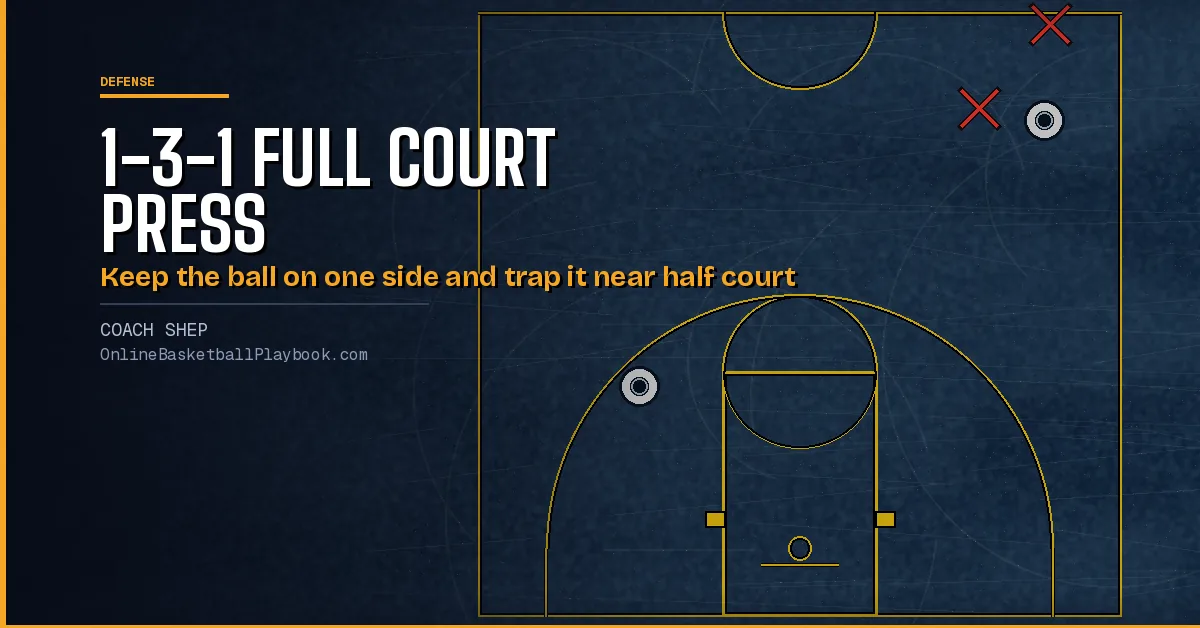
1-3-1 Full Court Press: Roles, Traps and Rotations to Install
The 1-3-1 full court press from setup to frontcourt trap: each role, the reversal rotations, an aggressive version, the costs and when coaches call it.
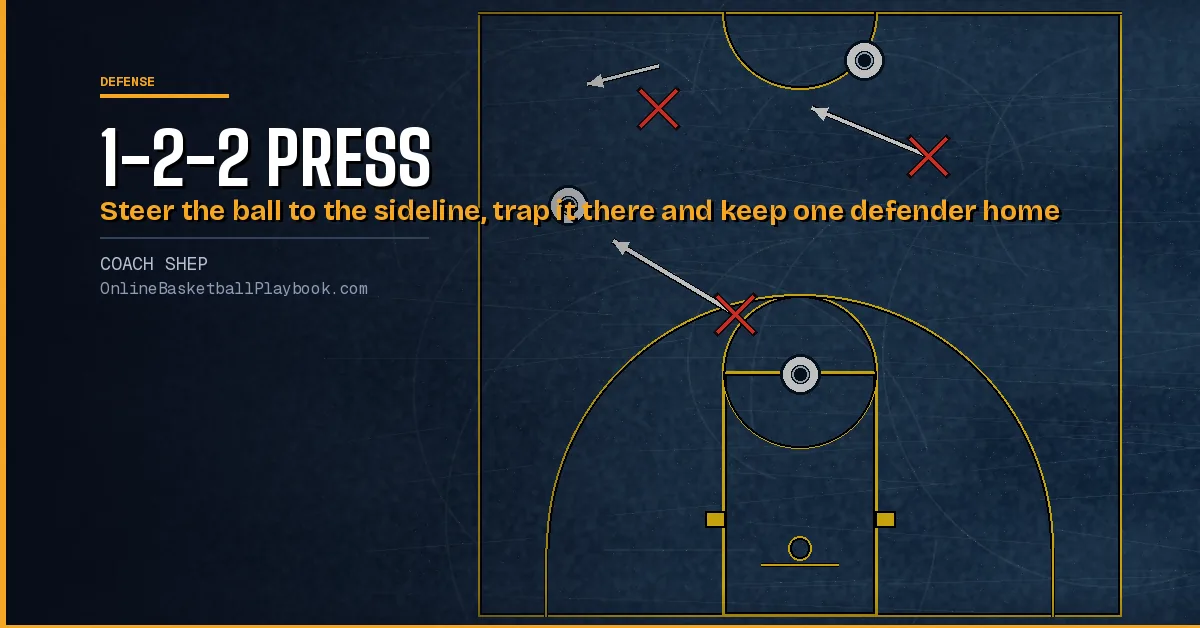
1-2-2 Press: Roles, Traps, Rotations and Breakdowns
1-2-2 press guide covering who plays the top, middle and back line, where each version traps, how it rotates on a reversal and what to do when it breaks.
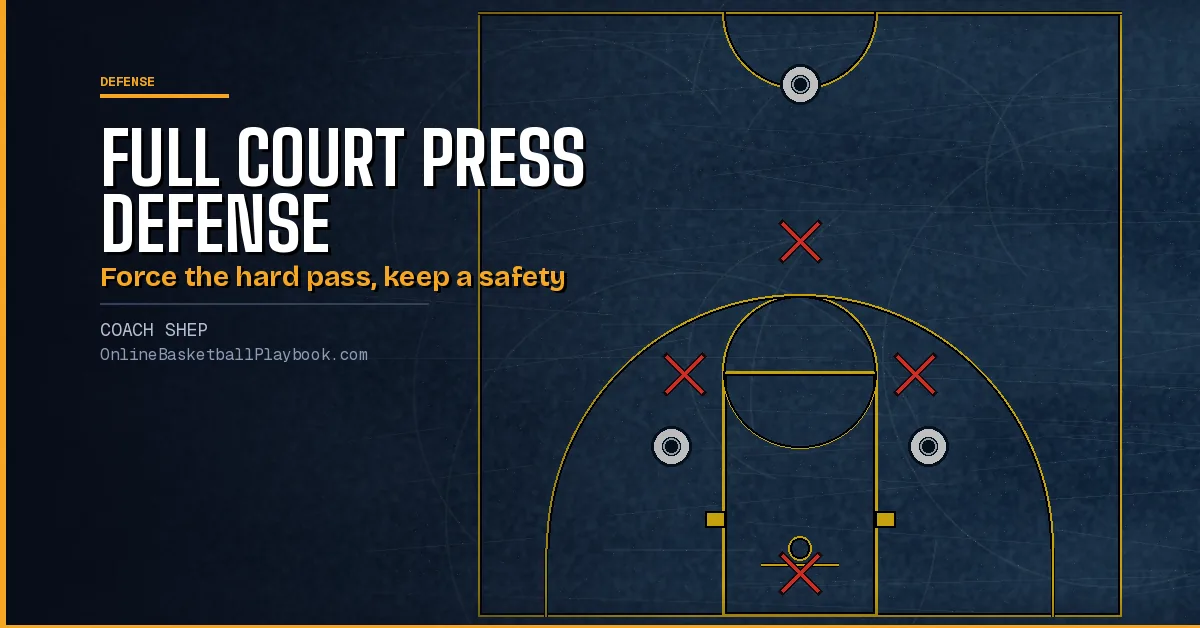
Full Court Press Defense: Types, Rules and How to Install It
Full court press defense pressures the ball for 94 feet. See the press families, shared rules, trap mechanics, the cost, the install order and drills.