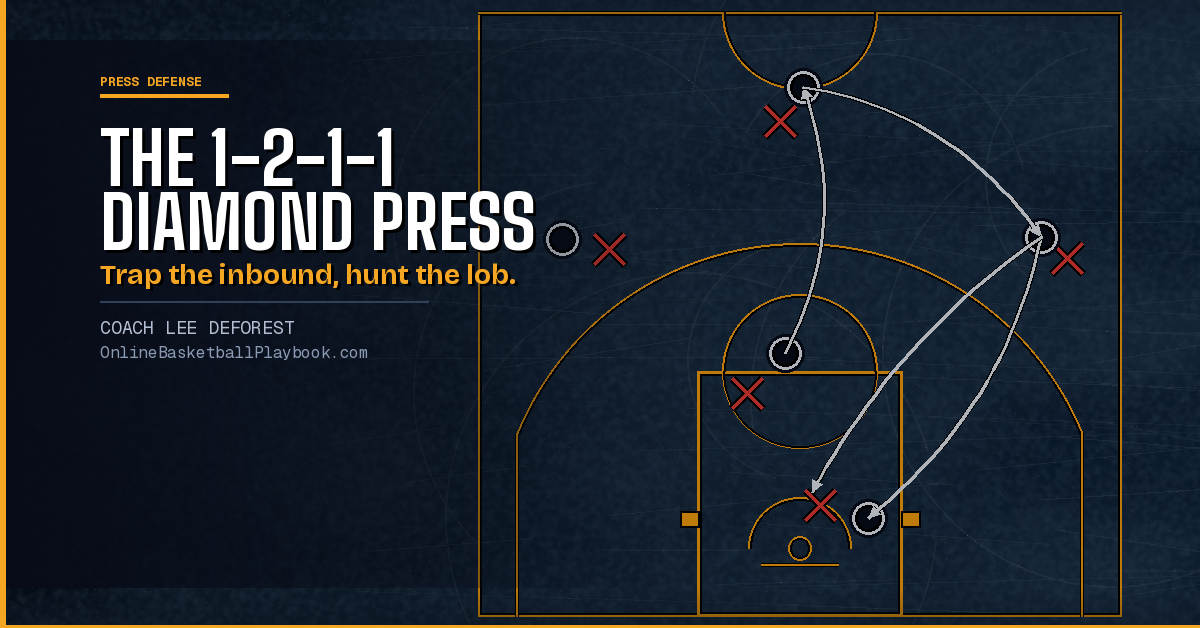

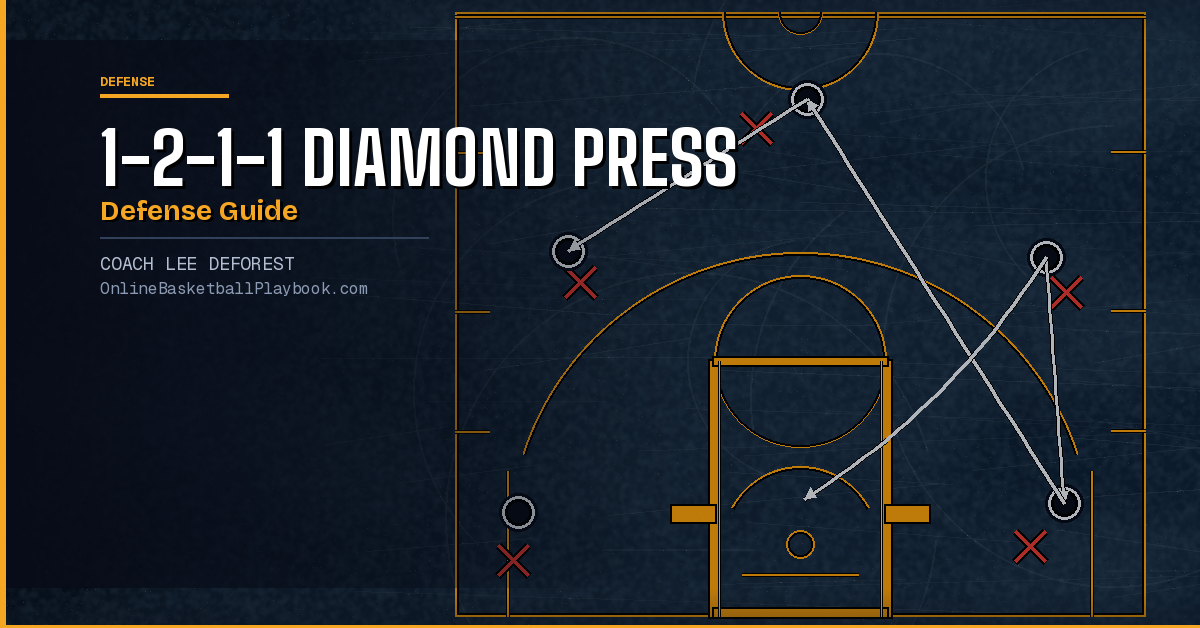
The 1-2-1-1 diamond press is a full-court zone built to trap the ball handler on the inbounds and create turnovers before the offense reaches half-court. Run it with defined roles and it is a comeback tool. Run it without them and it gives up layups.
The Diamond Shape and the Five Roles
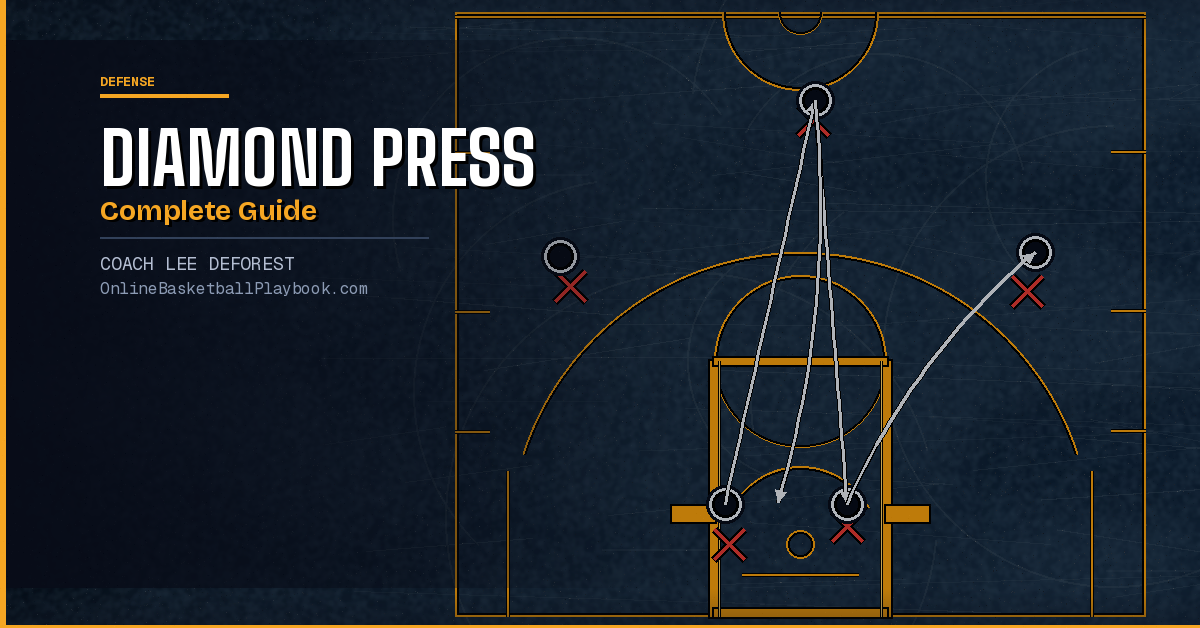
The 1-2-1-1 alignment places one defender at the top of the press (the point), two defenders as wings in the middle zone (the stealer positions), one defender at half-court (the interceptor), and one defender back near the basket (the safety). The diamond shape seen from above is not incidental — it describes the trapping geometry. Every trap forms because two adjacent corners of the diamond converge on the ball while the other three defenders sprint to cut off the three available outlets.
The point (1): the first pressure on the inbounds receiver. The point's job is to make the first catch difficult, funnel the ball to one side of the floor, and initiate the trap. In the Georgetown system, this position deploys a four-player "on the ball" mentality — the point is the aggressor, not a passive first line.
The wings (2): positioned roughly at the one-third line on each side. These are the stealer positions. The wings do not chase the ball — they sprint to cut off the first outlet pass on the far side and intercept. Against a poised ball handler who breaks the first trap, the wing's interception attempt is the press's second turnover opportunity.
The interceptor (1): positioned near the half-court line, reading the whole floor. When the first trap springs, the interceptor slides to deny the middle pass that exits the press. This is the most read-heavy position — it requires anticipating where the ball is going, not reacting to where it has been.
The safety (1): stationed near the basket. The safety protects against the long pass that exits the press cleanly and provides the last line of defense against a transition layup. In the Georgetown system, this is the basket protector — the one defender whose job is never to gamble, never to trap, and never to leave the paint unoccupied.
"Georgetown 1-2-1-1 (Esherick) — 4-man on the ball, 1/3 wings, 2 = stealer, 5 = back/basket protector; 'when we use this defense we want the ball.'" — Georgetown press system, on the aggressive intent of the 1-2-1-1 alignment
The Georgetown 1-2-1-1 System
The Georgetown 1-2-1-1 is defined by a single philosophical commitment: when this defense is on the floor, the intent is to take the ball, not to contain it. That intent shapes every role, every rotation, and every trap trigger.
The system pairs the point with the first-side wing to form the initial trap — as soon as the inbounds receiver catches and dribbles, those two defenders converge. The opposite-side wing (the "stealer") sprints immediately to the most dangerous outlet lane — not the ball, not the nearest player, but the lane where the escape pass will arrive. The interceptor reads the trap and takes away the middle. The safety holds.
Three situational triggers define when the trap fires:
- After the inbounds catch: the point applies immediate ball pressure and the ball-side wing springs to trap. This is the highest-percentage trap — the inbounds receiver has just caught the ball and has not yet read the floor.
- On a dribble toward the sideline: the ball handler has committed to one side, eliminating the reverse option. The trap forms with the sideline as the third defender.
- At half-court: if the offense advances the ball past the first trap without turning it over, the press looks to re-trap at the half-court line. The wings squeeze from both sides and the interceptor rotates to deny the middle. This is the second-trap opportunity and requires the fastest decision-making in the defense.
Three Rules That Govern Every Rotation
The 1-2-1-1 diamond press, regardless of the specific system being run, is governed by three rules that apply universally across all rotations and all ball locations.
Rule 1 — The ball stays out of the middle. A pass through the center of the floor beats the press instantly because the diamond trap is built on the sideline. The press works by using the boundary as the fifth defender; the middle lane removes that constraint. Every rotation the press makes is built around denying the middle pass. When the ball gets to the middle, the press has already lost the possession.
Rule 2 — Never allow a pass forward in the ball's zone. The ball handler may escape the trap laterally or backward, but a pass forward in the same court third eliminates two or three defenders from the press simultaneously. The wings and interceptor are positioned specifically to make forward passes impossible — not just contested, but impossible from the ball handler's position after the trap closes.
Rule 3 — Make the dribbler uncomfortable enough to speed-dribble. A ball handler who speed-dribbles under pressure is not reading the floor — they are reacting to the trap. Speed-dribbling into the corner of the court produces the second trap automatically. The press goal is not always a steal; it is disruption. A ball handler who is forced to speed-dribble the full length of the floor is exhausted and out of position by the time the offense sets up in the half court. Wes Miller's 1-2-2 system articulates this goal as "dictate / control / disrupt" — turnovers are a byproduct, not the primary measure of the press's success.
Where and When to Trap
Trap location is the most consequential decision in press design. Trapping in the wrong area produces transition layups; trapping in the right area produces turnovers and shot-clock pressure even when the offense escapes.
The sideline trap: the primary trap zone for every diamond press variant. The sideline acts as the third defender — the ball handler cannot dribble through it and cannot pass behind it. The trap pinches from the ball-side wing and the point. Against a poised team, the sideline trap may produce an outlet pass rather than a steal; against an anxious ball handler, it produces a five-second call or a blind reversal that the interceptor picks off.
The half-court trap area: in the Wes Miller 1-2-2 identity system, the automatic double-team fires in the "trap area" roughly six to eight feet on each side of half-court. The point man keeps the ball out of the middle through the entire backcourt, then the trap area triggers the two-on-one automatically when the ball handler reaches it. This removes judgment from the press — the trap fires on a location, not a coach's call.
The coffin corner (Billy Donovan / Florida): the only automatic trap in Donovan's disruption press is the coffin corner — ball-side below the block, where the boundary creates a dead end. The power forward is on the ball, three defenders are left of center, two are right. The geometry traps the ball handler against two boundaries with no dribble escape available. Donovan's press is explicitly not a full-court denial — it is ball pressure designed to disrupt the primary ball handler before the half-court offense can set up, with the coffin corner as the one unavoidable trap.
The most important press installation decision is whether the trap fires automatically (on a location or a coverage trigger) or on a player's read. Automatic traps — half-court trap area, coffin corner, sideline — are easier to install and more consistent under fatigue. Read traps (trap only the uncontrolled dribble, trap the first catch at a specific spot) are more efficient and produce fewer layups, but require experienced players who can make real-time decisions. At the development level, automatic triggers produce better results because they remove hesitation. At the experienced level, read traps waste fewer possessions.
The Dunlap Standards: Absolutes Before Rotations
Mike Dunlap (Metro State, longtime NBA assistant) coaches full-court zone pressure as a daily defensive standard, not an occasional look. His four non-negotiable absolutes apply to every player on every possession — they must be in place before any rotation is taught.
Stance: every defender earns their stance every single possession. No lazy feet between rotations. Against a well-run press break, the difference between a steal and a clean catch is half a step; that half-step comes from stance discipline between plays, not in-play athleticism.
High Hands: hands up on every close-out, gap coverage, and trap — and Dunlap makes a counterintuitive claim that coaches rarely articulate: hands are more important than feet. A defender who is half a step out of position but has high hands can still force a lob, create a deflection, and distort the pass. A defender with perfect feet and low hands gives up a clean catch and a direct advantage. High hands on every close-out is the press's most underdeveloped habit at most levels.
Jump to Ball: on every pass, every defender rotates toward the new ball position before their assigned player moves. Anticipate, do not react. The interceptor and safety positions are built entirely on this principle — they are reading where the ball is going, not where it is.
Block Off: every player finds and seals a body before pursuing the ball after a shot. Rebounding assignments are non-negotiable even while trapping. A press that creates a turnover attempt and then gives up an offensive rebound because no one blocked out has spent physical energy with no defensive result.
Flowing Into the Half-Court Defense
A press without a paired half-court fallback is a free transition layup waiting to happen. Every press system must designate a specific half-court defense that players drop into automatically when the press is broken — before the ball crosses half-court, not after.
The most common and practical pairing: the 1-2-1-1 diamond press drops into a 2-3 zone when broken. The two wings recover to the top of the 2-3, the point drops to the back line, and the interceptor and safety already have their positions. This drop requires one practiced signal and two practiced rotations — it is not complicated, but it must be drilled so the conversion is automatic at game speed.
Tubby Smith's "Black / White" press system builds this pairing explicitly. Black (a box press after a perimeter make) and White (a diamond press after a layup) each have a named half-court defense they convert to on a single call — "Black / White to 5," where "5" is the half-court call. The press and the half-court defense are packaged together, not taught separately. Against a poised team that breaks the press cleanly, the transition to the half-court set is already in progress before the ball arrives at the three-point line.
- Point: apply pressure on the inbounds catch; funnel ball to the sideline; initiate the first trap
- Ball-side wing: spring to trap with the point; no reaching — two hands up, arms wide
- Off-side wing (stealer): sprint to the outlet pass lane — not the ball, the lane
- Interceptor: deny the middle pass; read the floor; take the second trap opportunity at half-court
- Safety: never gamble, never trap, never leave the paint — protect the rim on every broken press
Why Press — and When Not To
The decision to press must be grounded in a specific purpose, not a general desire to "speed up the game." Tom Davis (Boston College) frames the fundamental question as: why are you pressing? — and the answer must be specific to the opponent, the game situation, or a personnel mismatch being exploited.
The five legitimate reasons to press: speed up a slow, methodical offense that is comfortable in half-court sets; disrupt the rhythm of a team that has been executing cleanly; force turnovers when trailing late; keep the ball away from a hot scorer by trapping their primary ball handler; wear down a team that carries no experienced backup point guard (the Walberg conditioning case — after roughly 80 trips, press the team with no backup primary handler hard).
When not to press: against a poised, experienced ball-handling team that has been coached to attack presses — they will find the 4-on-3 behind every trap and score easier layups than they would get against a half-court defense. Against a team with a dominant finisher who can be set up off a press break. When your own personnel is not ready — a press with two untrained rotators produces transition layups at a higher rate than the turnovers it creates. Davis's principle: pressing without a specific purpose just puts your own defense in an unfavorable position.
NKU's "94 Feet Both Ways" system offers three distinct press calls that match different game situations: White (base press with coffin-corner-only trap), Blue (face-guard the primary ball handler), and 55-Tough (straight man-to-man with no traps, hunting a five-second call). The ability to switch between these three calls — all from the same base positioning — means the press look does not telegraph the coverage, and the opponent cannot prepare one press-break alignment that answers all three.
Teaching Progressions and Drills
A press cannot be installed with a walkthrough. The rotations must be drilled at full speed against live bodies before the press produces consistent turnovers rather than consistent layup opportunities.
Stage 1 — Role clarity by position: each of the five positions walks through their responsibilities for each trap trigger with no offense on the floor. The stealer wing must be able to articulate: where am I before the inbounds? Where do I sprint when the trap fires? Where do I go if the ball gets to the middle? This verbal confirmation stage is skipped at most levels and is why the press breaks down at the first read that falls outside the base alignment.
Stage 2 — 3-on-2 trap drill: three defenders execute the first trap and one outlet coverage while two offensive players attempt to escape. The drill forces the two non-trapping defenders to choose their outlet lanes correctly — not instinctively — and builds the habit of cutting off the pass before the catch. Run both sidelines. The coaching intervention: stop the drill every time a non-trapping defender gravitates to the ball instead of the lane.
Stage 3 — Full 5-on-5 with break-and-convert: one team runs the press every possession; when the press is broken cleanly (ball crosses half-court without a trap), the press team immediately converts to the designated half-court defense without a call. The only real simulation of the press's most important moment — the break — is live 5-on-5. Score it: one point for a press-forced turnover, minus one for a transition layup off a broken trap.
Zone press defensive drill progressions (Semple) add a useful intermediate step: a 2-on-1 wing drill where the stealer wing must choose the correct lane against two offensive players rotating ball-side and weak-side. This isolates the stealer read in a half-speed environment before adding the complexity of the full press.
Common Mistakes That Give Up Easy Buckets
Three defenders on the ball. The NKU system names this one of the three cardinal sins — "never 3-on-the-ball." When a third defender collapses on the ball handler, only two defenders remain to cover four offensive players. The trap is two defenders only; every other defender is in a passing lane.
Running at a naked ball handler. A second NKU sin: never run straight at a ball handler who has not been trapped by two defenders yet. A single defender sprinting directly at a dribbler gets beaten with one crossover and turns the sprint into a transition advantage for the offense.
Getting split. The third NKU sin: the two-man trap must never allow the ball handler to split between the two defenders. A split beat eliminates both trappers in one dribble move. Trap mechanics — both defenders with arms up, closing from angles rather than head-on, hips to the sideline — prevent the split. Closing head-on invites it.
No half-court fallback installed. The most expensive mistake in press installation is deploying the press without a defined conversion to a half-court defense. Every poised team breaks the press at least twice per game. When the press is broken with no fallback protocol, the five defenders are sprinting back to a position they were never taught — and the best offense in that situation is already past all of them.
Choosing the Right Press for Your Personnel
The pick-one-press principle: select a single press matched to the personnel available, install it completely, and pair it with its half-court fallback. Three practical recommendations from the press family:
Georgetown 1-2-1-1: the best choice when the roster includes one quick big who can play on the ball (the point position). The system's "4-man on the ball" mentality leverages that athleticism in the most impactful position. If there is no player who can credibly be the aggressive on-ball point, the Georgetown system loses its primary advantage.
Burnett Scramble (after Dean Smith): the lowest-risk press addition for a team that does not primarily press. The scramble only activates after a made basket — never off a miss — and converts to a 2-2-1 on every trap. The signal is one call, the conversion is one look, and it costs almost no practice time to install as a change-up. Comes into this press as a single-possession surprise.
Tubby Smith "trap only the uncontrolled dribble": the press for a team that lacks top-end athleticism. The core principle — trap only when the ball handler is genuinely out of control, never when they have their dribble alive and composed — eliminates the highest-risk trap situation. Quickness, anticipation, and desire substitute for sheer athleticism. Smith's principle is that willingness to press matters more than the roster's raw speed.
Get Free Coaching Notes
Join the Online Basketball Playbook newsletter for new playbook breakdowns, drills, and practice-ready install ideas.
Get Free Coaching NotesSee it drawn up
Related diagrams
Keep Building
Related breakdowns
Diamond Press Basketball: Complete Installation Guide
Diamond Press Basketball: Complete Installation Guide
Strategies for Coaching Against Zone Press Defenses
Strategies for Coaching Against Zone Press Defenses