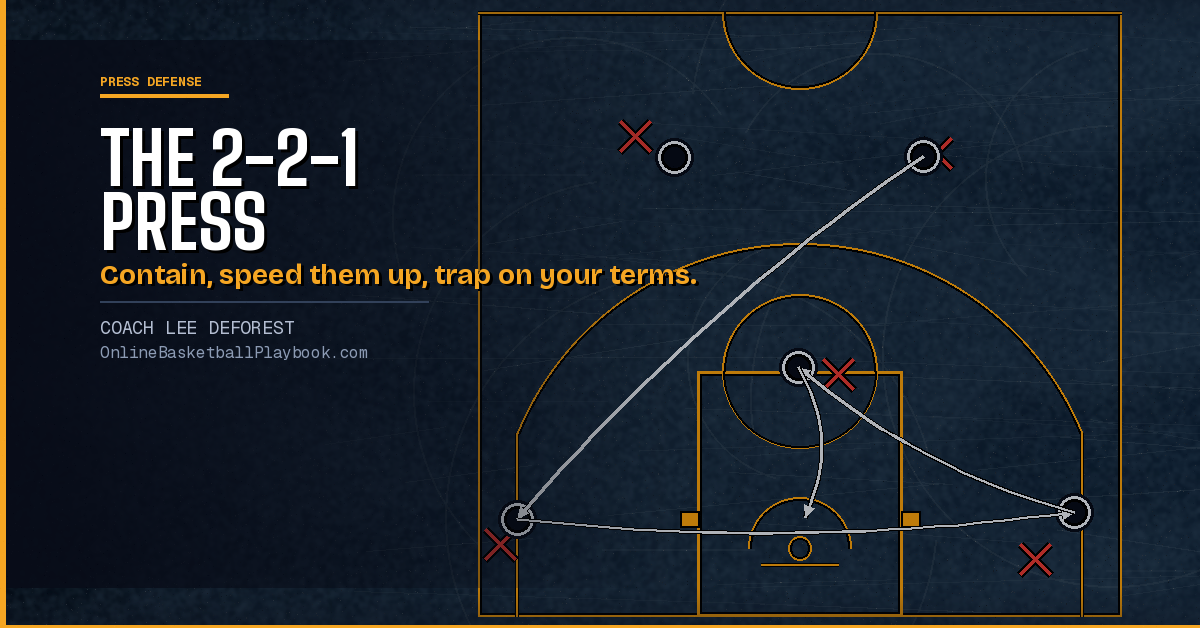
Most coaches treat the press as an all-or-nothing gamble: either you're attacking and chasing steals, or you're sitting in your half-court defense. The 2-2-1 is different. It's a containment press — built to speed the offense up, funnel the ball to the sideline, and trap on your terms, without leaving your back end exposed every time something goes wrong.
Picture this. It's the second half and the other team's best player is their point guard — quick hands, poised, and he's running their offense exactly how he wants. You drop into a 2-2-1 and suddenly he can't catch the ball where he wants it. The front two are taking away the middle, the sideline has teeth, and the clock is ticking. He speeds up, throws a pass a half-beat early, and your middle pair reads the route and tips it away. That's the 2-2-1 working exactly as designed — not a turnover because somebody gambled, but a turnover because the offense got uncomfortable and made a mistake.
This guide covers the whole press: the alignment and what each level does, where the traps happen and what triggers them, the rules that keep it from bleeding layups, how teams break it so you can fix yours, and the drills that get it installed. Teach it in this order and your players will understand why they're doing what they're doing — and that's what makes it stick.
What the 2-2-1 is (and what it isn't)
Two players at the front — roughly at the three-quarter-court line or just inside it. Two more in the middle layer — one each on the ball-side and weak-side halves, near the half-court area. One safety back at the basket. That's the shape.
Here's what it's NOT. It's not the gambler's press where everybody runs at the ball and you pray for a turnover. The 2-2-1 takes away the easy path up the floor and makes the offense choose between bad options. The whole point is to force the ball to the sideline, eliminate the direct center-court lane, and trap when the ball is already in a tight spot. Everything stays in front of you. The safety never over-commits. You're containing, not chasing.
The disguise is also a real weapon. Before the inbounds pass, your front players match up on the potential receivers — it looks like man-to-man. The inbounder is unguarded. The moment the catch is made, you're back in your zone areas. An offense that prepped for a zone can suddenly look at a man and be wrong. An offense that prepped for man suddenly has nobody chasing them across the floor. That confusion adds up.
Why coaches run it
- It speeds a slow, deliberate team up. A team that wants to walk the ball up and run half-court sets can't do that when they're fighting pressure from mid-court. The 2-2-1 disrupts their rhythm without requiring you to trap on every possession.
- It wears down a single ball-handler. When the ball can't come through the middle, the primary guard has to navigate around the press repeatedly. By the fourth quarter, that's in his legs.
- It protects your back end. Because the safety is always home and the traps are set on the sideline — not deep in a corner — you're rarely giving up a straight-line layup off a broken trap.
- The 5-on-4 advantage is real. The inbounder can't come inbounds to receive. That means from the first whistle on a dead ball, you have an extra defender working for you.
- It's a legitimate change-up. Show man-to-man until they relax, drop into the 2-2-1. Show the 2-2-1 all game, switch to your half-court defense at a key moment. The alignment confusion is half the battle.
Match the press to a reason. The 2-2-1 is at its best against a team with one dominant ball-handler and a weak second guard — you can isolate the primary and make him prove he can beat you alone. Against a team with two poised handlers and great spacing, it's harder work. Know why you're running it before you run it.
Where it's soft — be honest
Every press has an answer. Know yours before the other team finds them:
- The center-court lane. If a ball-handler gets the ball in the middle with space to dribble, the press is effectively broken. Your front pair has to seal the middle off. If they let a handler split them, the whole thing unravels.
- A composed point guard who holds the dribble. The press creates pressure through speed. A guard who catches the ball, stops, looks up, and is patient takes your clock away. Teach your players to make him uncomfortable even when he's stationary — choppy feet, hands up, body angled to force the sideline.
- The quick outlet pass over the top. If the inbounder can get the ball to a sprinting wing going over your front pair before they set, it's a 2-on-1 in the frontcourt. The front players have to set quickly and be aware of what's flying over them.
- A patient team with good spacing. The 2-2-1 is a patience-killer for impatient offenses. But a team that simply reverses the ball, reverses it again, and keeps relocating can move the ball faster than your five can shift. You allow the reversal — you just can't let it turn into a layup.
The alignment in detail — three levels, five jobs
Level 1 — The Front Two
These are usually your quickest guards. Their job starts before the inbounds pass: get to the potential receivers and deny them the catch if you can, or at minimum take away the center of the floor. The moment the ball is inbounded, they become zone — the ball-side player takes the ball-handler, the weak-side player seals the middle and is ready to help form a trap if the ball goes to the sideline.
The most important thing the front two do is force the ball to one side. Use the sideline as an extra defender. Everything about this press assumes the ball is on the sideline — get it there first, then the rest of the alignment can do its job.
The front two do NOT chase the ball across the floor. Ball-reversal is allowed. When the ball reverses, the weak-side player becomes the ball-side player and the other one seals the new middle. The switch has to be instant — the moment the pass is in the air, they're already rotating.
Level 2 — The Middle Two
This is where the press gets its teeth. One on the ball side, one on the weak side, both stationed around the half-court line or just below it. Their jobs are different but connected:
The ball-side middle player is the trap partner. When the ball-handler gets close enough and the sideline is there, the front player and the ball-side middle player converge together — that's the trap. The trigger isn't a clock, it's position: when the ball is in the sideline corridor and in the middle player's area, they go get it together.
The weak-side middle player reads the trap and cuts off the most dangerous outlet pass. Usually that's the pass across half court to a weak-side wing trying to get out of the press. He doesn't go look for a steal — he gets into the passing lane, gets his hands up, and forces the decision to be a difficult one. If the ball gets over his head, he pivots and becomes part of the half-court defense.
The toughest moment for the middle pair is a cross-court dribble or pass that switches the ball from one side to the other. They have to switch assignments cleanly — the one who just had the ball side becomes the read-and-rotate player, and vice versa. This transition has to be drilled until it's automatic, because it's the spot where the press breaks down most often.
Level 3 — The Safety
One player, back near your own basket, and they almost never leave that area. The safety is the one who makes the whole thing possible. Because she or he is already home, the front four can press without the fear of a single long pass turning into an uncontested layup.
The safety's job is simple but requires excellent concentration: track the long ball. When the trap happens, the offense is looking over it for a lob or a long pass. The safety doesn't come up to help with the trap — they read the inbounder, the wing, the skip-pass route. Their job is the basket.
A good safety also helps the press stay honest. When the front four are in rotation, the safety calls out what they see — "ball-side," "weak-side skip," "they're coming back." They're the eyes behind the press.
Where the traps happen — and what triggers them
There are two primary trap zones in the 2-2-1. Both are on the sideline. Neither is a guess.
The sideline trap (three-quarter court). When the ball-handler receives the inbounds pass and starts up the floor, the front player angles them toward the sideline. If the ball reaches the sideline corridor and the ball-side middle player is in position, both players converge. The trap is set before the dribble is used, or immediately when the handler picks up. Don't wait for a mistake — set the trap based on position.
The half-court trap. If the ball crosses half court along the sideline, the ball-side middle player and the front player (who has run with the ball) trap it there. This is a little harder to organize because both players have covered distance, but the angle is good — the handler is now on the sideline at half court, which is a tight spot with nowhere comfortable to go.
Both traps share the same setup: two defenders on the ball, the weak-side middle sealing the most dangerous outlet, and the safety protecting the basket. The trap always comes from two sides — never three. Three players on the ball leaves the basket unguarded.
Teach your trappers to close with their hands up, not reaching. A reach foul hands the offense a free pass out and a trip to the line. Step into the trap, crowd the space, make the handler feel the pressure — but keep the hands high and moving. "Deflect it, don't grab it" is the cue that prevents foul trouble.
The four rules that keep the press clean
- No middle, ever. The center lane is the press-breaker. Every player on the floor — front, middle, safety — is responsible for keeping the ball out of it. The moment a handler gets the ball in the center with a clear path to the basket, stop the press, re-set, and figure out what broke down.
- Force the sideline, let them reverse. Ball reversal is fine. What's not fine is the ball going through the middle on a reversal. Funnel it back to the sideline on the other side. Think of it as a channel — side to middle is never allowed, side to side is fine.
- Contain first, steal second. Speed the handler up, make their decisions uncomfortable, and let mistakes happen. Don't gamble. A pressed turnover you earned is better than a stolen-attempt that turns into a layup. The turnovers will come if the containment is working.
- Move while the ball is in the air. Every rotation in this press happens on the flight of the pass. By the time the ball is caught, everyone should already be in their next spot. This is the same cue as your half-court defense — use it everywhere so the language is consistent.
How teams break the 2-2-1
Good offenses attack the 2-2-1 the same way every time. Knowing the answers they're going to look for is how you coach against them before they find them.
- One long pass over the front pair. Two sprinting wings — one on each side — fly behind your press as the inbounder looks to hit one of them. The counter: your front pair has to be tall enough to contest and aware of what's in the air behind them. Don't let both sides go without coverage.
- The patiently-stationary ball-handler. Catch it, stop, and wait. The press is designed for a moving ball — a handler who catches and holds the dribble, looks up, and finds the open man can hurt you. Counter: make him uncomfortable even when standing still. Get in his vision, angle your body to make the center-court pass difficult, and force him to decide.
- The short cross-court pass before the trap closes. Before your two trap players arrive, the handler throws it back across to the opposite guard. Counter: the weak-side middle player has to anticipate this pass and get into the lane early. Don't let them complete this one clean.
- The dribble to the center and drive. The most direct answer to the 2-2-1 is to go straight at it. A handler who can consistently split the front pair and get into the open lane ends the press. Counter: your front two have to stay staggered — not both flat — so one of them is always angled to cut off the center drive.
Run your scout team's press-break against your 2-2-1 in practice every week. The fastest way to fix a press is to let it get attacked and see exactly where the rotation breaks down. You'll find the same problem in the same spot — and then you can drill that spot until it's solid.
Drills to install it
Ride and Slide (2-on-1, sideline corridor)
One offensive ball-handler, one defensive front player. The ball-handler starts near the sideline and tries to go north; the defender rides their outside shoulder and forces them deeper into the sideline. No second defender yet — just teaching the angle and the footwork. The moment the defender gets the handler in the sideline corridor, stop and call it out. That's the trap area. Run this until the front players know the angle in their sleep.
3-on-2 Full-Court Trap
Three offensive players (one ball-handler, two potential outlets) against two defensive players (the front player and the ball-side middle). The offense tries to advance the ball; the defense forces the sideline and completes the trap. No safety yet — you're drilling the trap mechanics. The three offensive players reveal the outlet routes your two defenders need to seal. This is the most important drill in the 2-2-1 installation.
5-on-5 with the "No Middle" Rule
Full-court, live, but with one coaching rule: any time the ball enters the center lane in the backcourt, stop it, back up, and redo the possession. It makes the rule visceral — your players start to feel where the middle is and police themselves. After a week of this, you won't have to call it anymore.
Middle-Pair Switch Drill
Specifically drill the moment a cross-court dribble or pass switches the ball from one side to the other. Middle pair starts on ball-side / weak-side. Ball moves cross-court. They switch. Repeat until the transition is clean and both players know their cue. This is the spot the press breaks down most — give it dedicated time.
The bottom line
The 2-2-1 is the most coachable full-court press there is. It doesn't require you to have five athletes who can run for forty minutes. It doesn't require you to gamble your back end on every trap. It requires five players who understand their area, know where the ball is supposed to go, and rotate while it's in the air.
The containment idea is the whole thing. Speed them up. Channel the ball to the sideline. Set the trap on your terms. Let the safety protect the basket. Do those four things and turnovers will follow — not because you stole anything, but because the offense got uncomfortable and made a mistake. That's a press that holds up in the fourth quarter.
Thanks for everything you do for your players. If there's anything I can help you with — installing this press, running a specific drill, figuring out the right personnel for each spot — let me know.
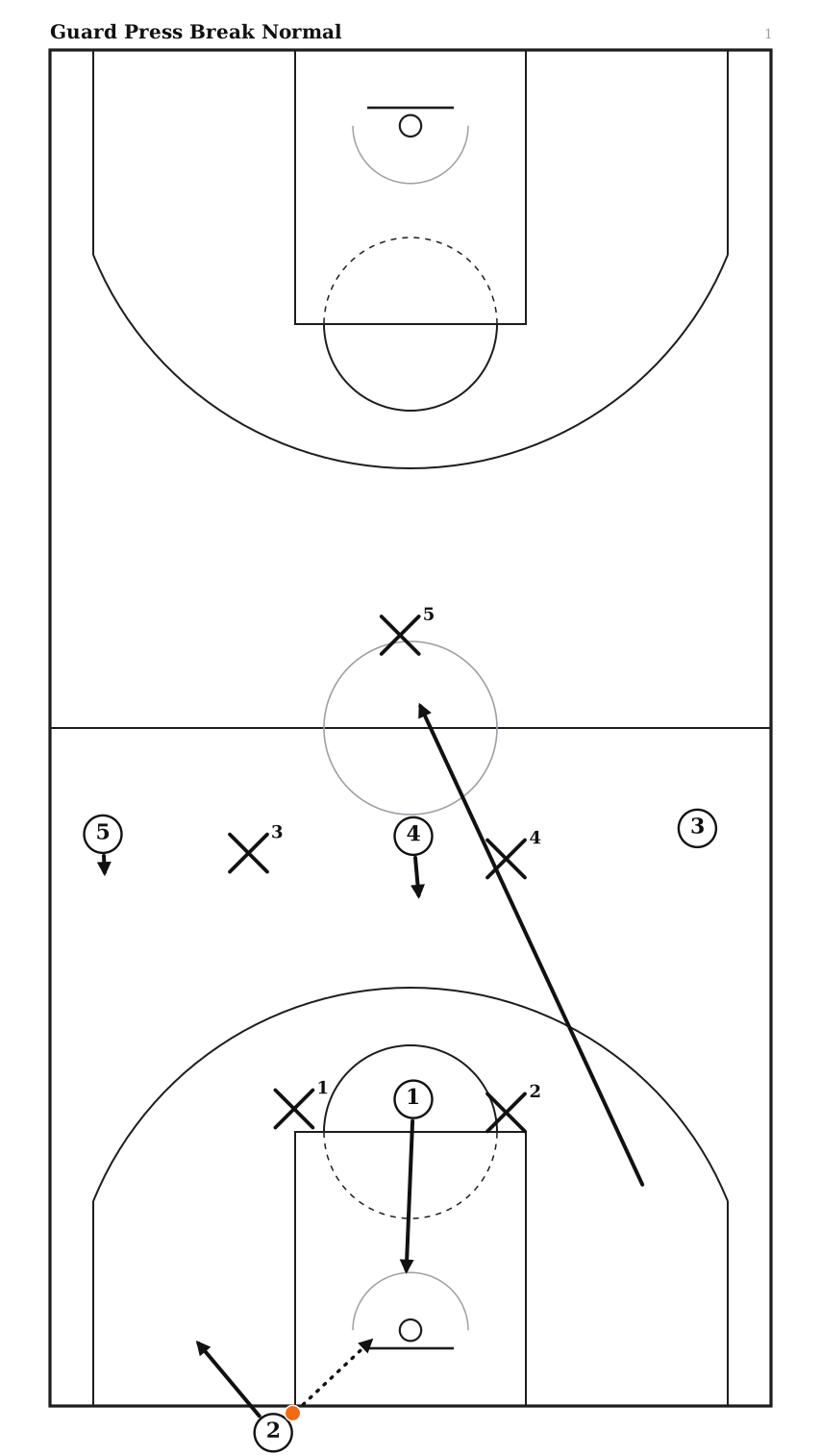
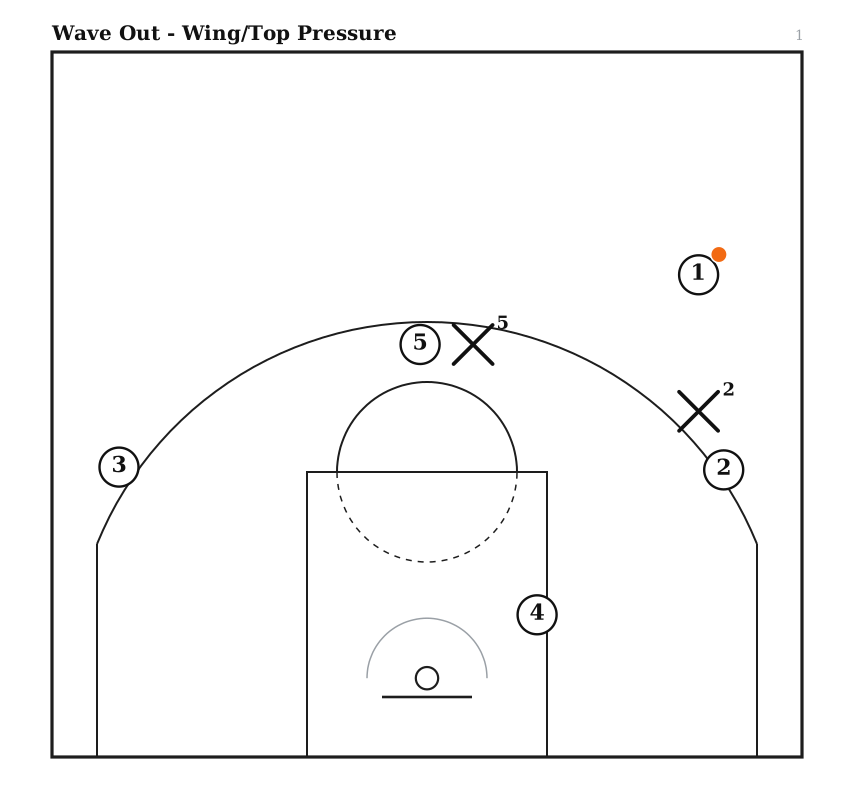
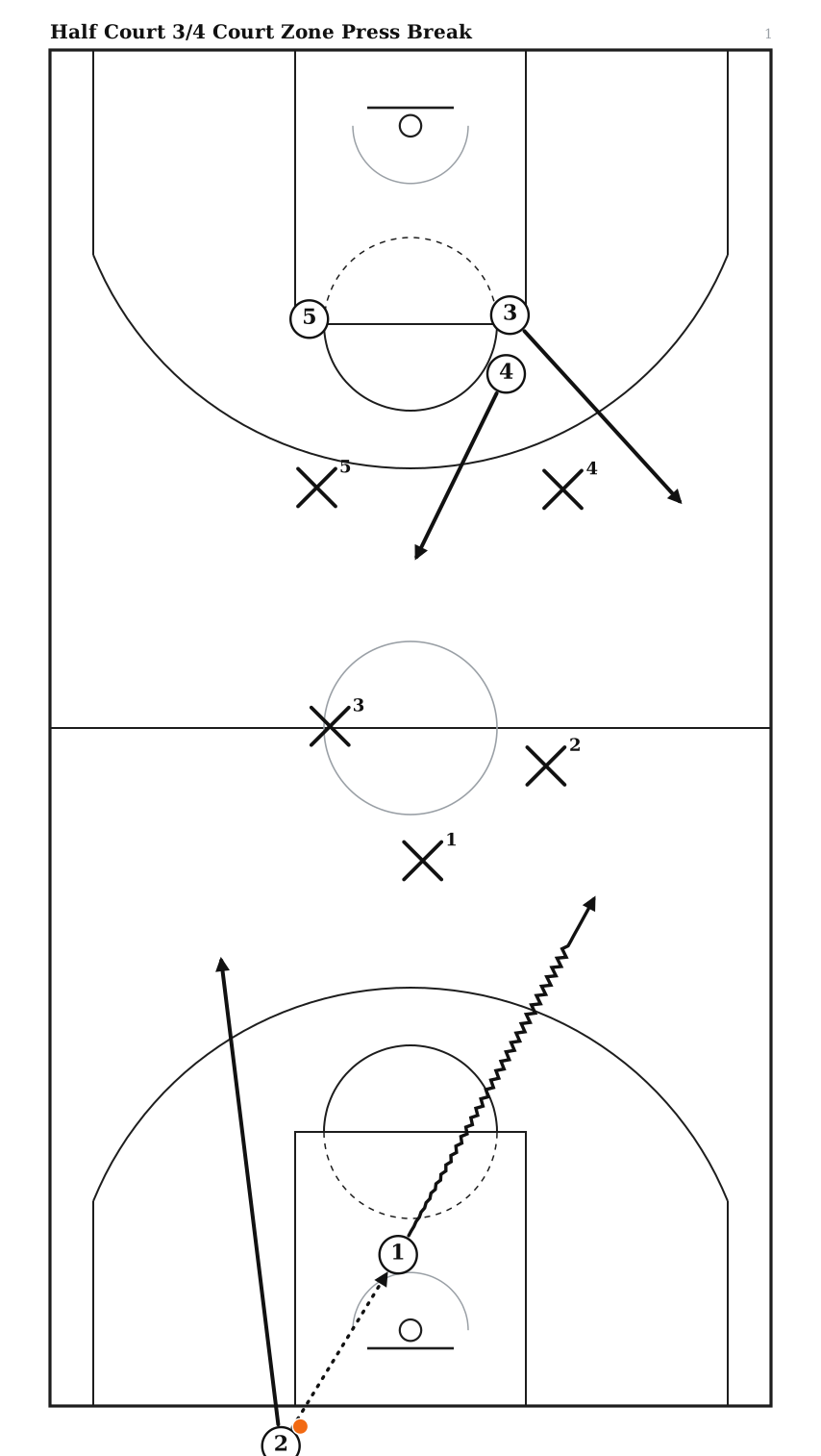
See it drawn up
Related diagrams
Keep Building
Related breakdowns
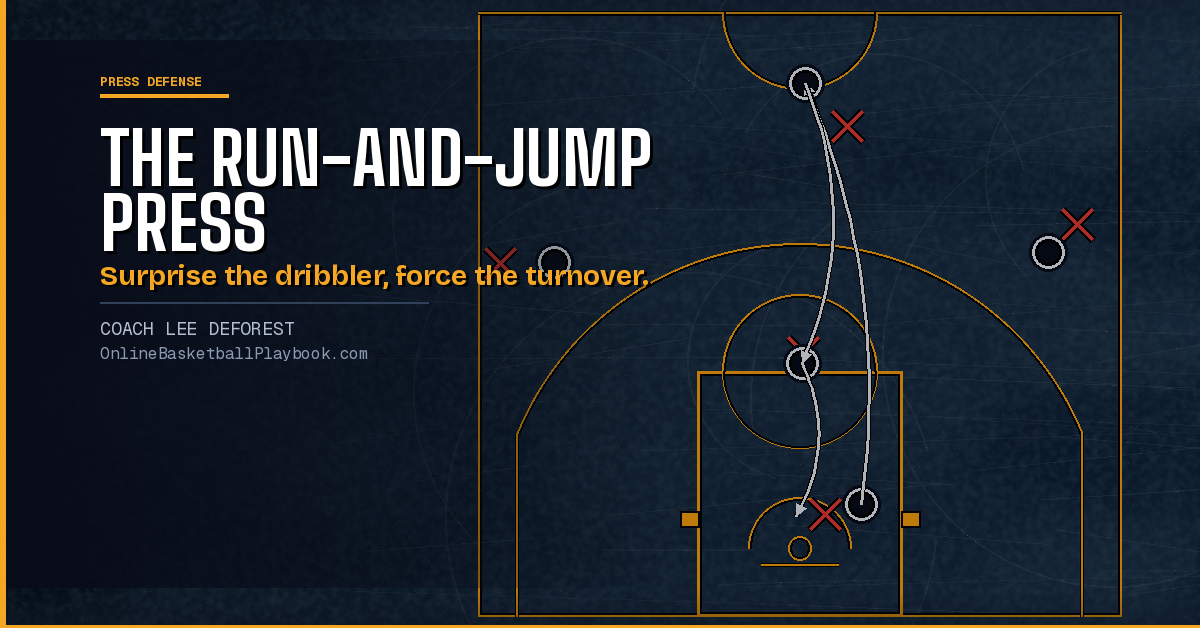
How to Coach the Run-and-Jump Press (Complete Guide)
The full-court man press that wins by surprise instead of numbers — what it is, how every defender moves, and why it's the lowest-risk way to pressure the ball.
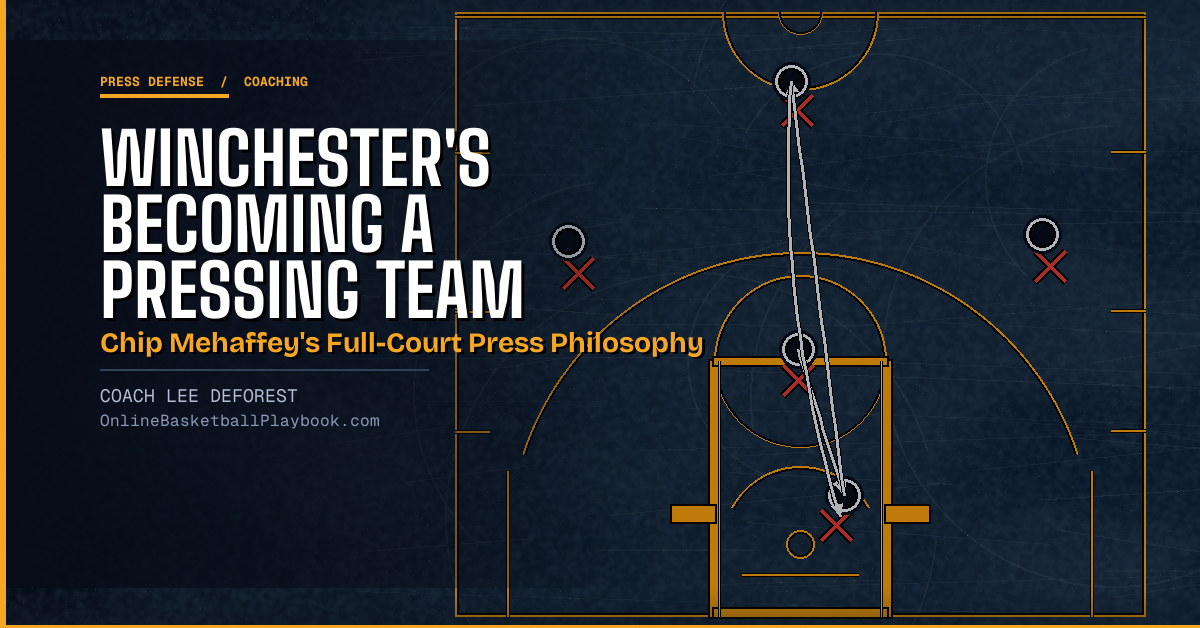
Winchester's Becoming a Pressing Team: Chip Mehaffey's Full-Court Press Philosophy
Chip Mehaffey builds Winchester into a pressing team with one identity goal — trap the backcourt every possession — plus the rules, daily skills, and drills that make it hold up.
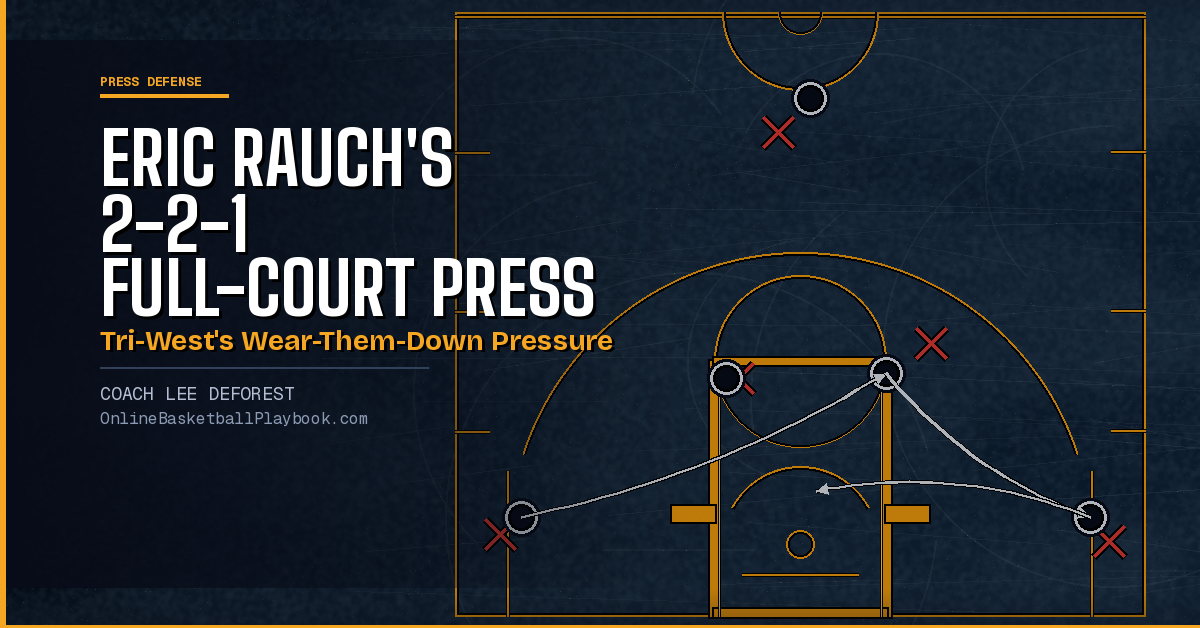
Eric Rauch's 2-2-1 Full-Court Press: Tri-West's Wear-Them-Down Pressure
Constant full-court pressure that sets the pace, forces second-half runs, and wears teams down — without fouling your way to the free-throw line.
More from Online Basketball Playbook
How to Build a Defensive Identity
The mentality and culture that make any press sustainable over a full season.
Basketball Substitution Patterns
Rotating fresh legs into the press keeps the traps coming in the fourth quarter.
How to Coach Defensive Rotations
After the trap, the rotation is where games are won or lost.