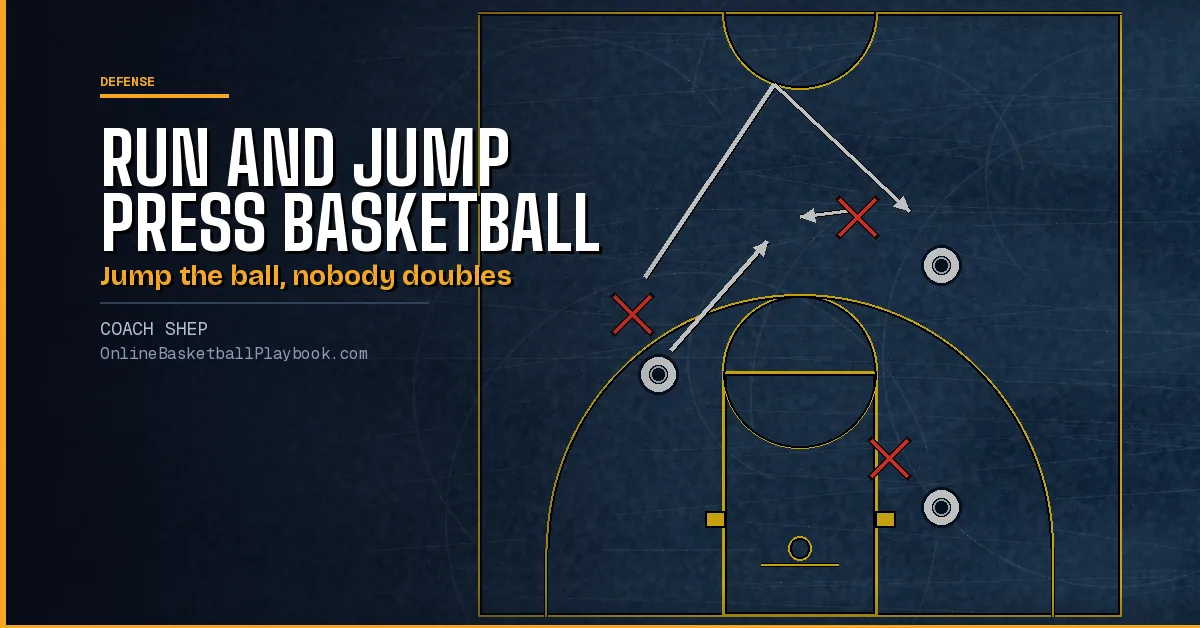
The run and jump press in basketball is a full-court man-to-man press built on one move. A second defender sprints up and takes the dribbler, and the defender who was guarding the ball sprints to the man the jumper left. Nobody doubles the ball on the jump itself.
It is a surprise switch, and its job is to hurry the ball handler into a pickup, a bad pass, a travel or a quick shot. It is usually paired with a trap: jump a dribble that goes to the middle, trap a dribble that goes down the sideline.
This guide covers what the press is, when the jump comes, the middle or sideline choice, the rotation behind the jump, when coaches call it, the price it charges, how offenses attack it and the drills that teach it.
The whole press family sits on full court press defense, and the zone presses it is usually compared with are on pressing defense systems.
Run and Jump Defense: What the Press Is
It is a man press. Each defender picks up a player, and switches or traps happen wherever the rules say, not at a spot drawn on the floor.
The sideline-trap plan calls it run and jump defense, credits it to Dean Smith at North Carolina in the 1970s and describes it as a full-court man press whose rules push players to jump switch and trap. Because there are no set trap spots and no set rotations to scout, the same plan argues an opponent cannot simulate it well in practice.
The same move has more than one label.
- Assignment swap. The jump is also called an assignment swap.
- Scramble press. A scramble press signals it with the arms in a circle and makes it the only one of its five calls with no double team.
- A one-word call or a number. Programs give it their own one-word call or a number, such as the Switch call in SOS pressure defense.
- Help and grab. A 1976-77 NBA jump switch full-court defense uses calls named help and grab.
The call words are collected on basketball press terminology.
The reasons coaches give for running it:
- Surprise. Dean Smith lists surprise first among its advantages, along with stopping planned breaks and offenses, being good against screens, and being fun for players, coaches and fans.
- Pace and quick shots. The pressure keeps a good half-court team out of its offense and pushes it into quicker shots.
- A guard you cannot contain. The scramble press built its jump call for a quick ball handler the closest defender could not stay in front of.
- Man-to-man habits. Working on man principles is listed as a strength. Dean Smith lists hurting regular man-to-man principles as a weakness. The two disagree on this point.
Know why you are pressing before you teach the jump.
The Jump Switch
The move has two halves, and both happen at once.
- The jump. The help defender in the dribbler's path runs at him and closes with high hands, so the dribbler must stop, change direction or throw a tough pass over the top. The jumper calls "jump" or the on-ball defender's name. In the scramble press the next closest defender calls "JUMP" himself and runs at the ball.
- The switch. The defender who was on the ball turns and sprints to the man the jumper left. He keeps a hand in the passing lane as he goes, hunting a deflection, and then settle into help once the pass is gone. In the scramble press this is automatic: the beaten point guard simply runs to the open player.

Where the helper stands decides whether the jump works.
- Near the midline. Put the help defender near the midline, hedging between his own man and the dribbler.
- Not too far. Too far away gives the dribbler time to pass.
- Not too close. Too close lets him lob over the top.
- Full commitment. A jumper who closes slowly leaves an open man and puts the defense at a disadvantage at once.
- The aim. A pickup, a rushed pass that becomes a turnover, or a travel.
All five move with the ball.
- Move toward the ball. The scramble press moves every defender in the direction of the ball.
- Stay above the ball. Keep the help-side defender above the ball at all times. A helper who sags too low toward his own man lets the dribble split the defense.
- Stay above your man. A college press rule has everyone stay above his man in case of a loose ball.
Commit fully to the jump, and move all five with the ball.
Pickup, Inbound and Ball Pressure
The sideline-trap plan starts the press right after a score. Whoever is closest to the rim pressures the inbounder at once, so after a layup it might be a guard, and after an outside shot a big, and if a guard and a post both arrive, it prefers the post. With no set matchups, the other four talk and find a player quickly.
On the inbound, that plan wants the catch below the free-throw line, as close to the baseline as possible, so its front defenders play behind their men and let them catch.
- Switch the screens. Screens on the inbound are switched.
- Stay side by side. The defenders near half court play side by side with their men so they can pick off a pass over the top, and the lob is never allowed.
Other pickups exist:
- Full denial. Deny the inbound to try for a five-second call (check the throw-in count in your level's rulebook).
- Side by side. A side-by-side look allows the corner catch to set up a trap.
- Double the point guard. The inbounds defender leaves the passer to double the point guard.
Then the ball has to be put on the floor. Coaches agree on the goal and differ on how close to play:
- Dean Smith, 45 degrees. Pressure the ball and make the dribbler go at a 45-degree angle. Tight pressure, but do not get beat. Force him right or left and keep the point guard out of the middle.
- Inside hip. Play the dribbler's inside hip and give up the first step on purpose to start an uncontrolled dribble down the sideline, but never get beaten completely.
- One turn. Force a dribble and a backcourt turn. One turn means the job is done, and a defender who gets no turn sits.
- Two or three turns. Turn the ball handler two or three times in the backcourt before any trap.
A pass back to the inbounder is allowed. The sideline-trap plan treats it as a fine result, because the reverse pass usually goes to a player who is not used to bringing the ball up. The help defender steps up and pressures the new ball the same way, and the old on-ball defender falls back into help.
Pressure the ball the moment it is in.

When to Jump: Five Triggers
The hardest question players ask is when. There are five answers:
- Even with the point guard. When the offensive guard draws even with the defensive point guard, the next closest defender calls "JUMP" and runs at the ball.
- Follow, then jump (Dean Smith). When the dribbler approaches the defender one pass away, that defender follows his own man a few steps and then jumps the dribbler.
- Head down toward the middle. There is no perfect time. Start with a point guard dribbling toward the middle with his head down, and let experience build the feel.
- Speed dribble at you. Any speed dribble at a defender sends him at the ball to contain it. If the dribbler then passes, the nearest teammate jumps onto the receiver.
- Only when he cannot see you. Tubby Smith traps only when the ball cannot see you and keeps the traps random. A press that doubles when it sees the back of a dribbler does not go if the handler can see it coming.
The head-down trigger names the factors that change the timing: how good the point guard is, which two defenders are involved, whether the dribbler expects the jump and how fast he is dribbling.
Pick one trigger and let your players build the feel.
Middle or Sideline
Most presses split the floor. A dribble toward the middle gets the jump, a dribble down the sideline gets a trap, the same split the Vance Walberg full court press uses. The sideline-trap plan lists it as one of the two things players must remember most. One cue is "jump the ball, not the man." A simple-rules plan treats one rule as non-negotiable: never allow the dribble up the middle. Coaches do not all agree:
- Either direction. Dean Smith says the direction of the dribble does not matter.
- Jump the middle, trap the sideline. Most of the plans on this page use it, and a press carries it into the half court: baseline drive trap, middle drive run and jump.
- A read off the box. Rick Pitino traps an uncontrolled sideline dribble by default and lists a hedge (fake the trap and recover) or a run and jump as reads, not called plays.
- Ignore direction. Do not worry about middle or sideline, just pressure the ball.
The sideline trap
In the sideline-trap plan, the on-ball defender lets the dribbler have the first step down the sideline, stays on his side, then sprints ahead to cut him off.
- Keep a little space. He keeps a little space so he is not riding the dribbler's hip, which it says always leads to a foul.
- Set a blind-side trap. The first help defender, usually the one who pressured the inbound, chases from behind and sets a blind-side trap.
- Trap just past half court. It prefers the trap there, where the ball handler cannot pass back without a backcourt violation (over-and-back is a violation under NFHS, NCAA and NBA rules).
- Tap on the crossover. If the dribbler crosses over when he is cut off, the trailer tries to tap the ball from behind.
- Trap hard if he stops. If he stops, both defenders set a strong trap.

This plan does not reach on the trap. Its goal is a high pass a teammate can steal. It rejects the middle defender sliding over to trap for three reasons:
- He can see it. The dribbler can see it coming.
- Harder rotations. The rotations behind it are harder.
- Two for one trap. Both helpers can end up going for the same trap.
The middle trap is used in other presses, and a press can use both.
Keep the sideline trap simple and the pass high.
The Rotation Behind the Jump
The jump only works if somebody picks up the man the jump leaves open. The rotation rules differ:
- Automatic. The beaten point guard runs to the open player. No decision.
- Loose and short (Dean Smith). No set rule for picking up the next man. In his sketch X5 takes the next closest player and X1 runs down court to the first unguarded man. Usually only three players switch, and a defender two passes away "should" take an unguarded ball-side player.
- Peel in behind. The beaten defender peels in behind the jump, X3 floats the middle and X4 stays at the basket.
- Switch everything. Every switch in the backcourt is taken, and the gap defender runs and jumps.
- Nearest man after a broken trap. A trapping press turns into run-and-jump man once its first trap is broken. Everyone picks up the nearest man and follows him.
Behind a sideline trap, the sideline-trap plan gives the other three defenders jobs.
- Cover the forward pass. One defender covers the forward pass.
- Protect the rim. The last defender stays back to protect the rim.
- Read the pass. The third reads the pass back or across and tries to intercept it.
For Dean Smith, defenders one pass away stop the easy pass, sag into help when the ball goes away and get ready to jump when it comes at them. Defenders two passes away do the same and get ready to rotate. The scramble press plays its interceptors halfway between the outlet and the middle and never fully commits them.

Getting out
There are exits too.
- One and done. The sideline-trap plan calls the press usually one and done: after a missed trap or a broken press, sprint back to the paint first, then find men, and it sits any player who jogs back. For a younger team it sends everyone to the paint before picking up, and for an older team straight to the right spots.
- Back to straight man. The scramble press goes back to straight man on a skip pass, on a gut pass (any pass to the middle moving toward the basket) or on common sense.
- Sprint out of traps. Sprint the first two or three steps out of every trap and every rotation back to the paint.
The transition defense page covers the get-back that follows.
Make sure every player knows who picks up the man the jump leaves open.
When Coaches Call It
- Only after a made basket. The scramble press never starts off a miss, which keeps its transition defense intact. The point guard makes the call while sprinting toward the ball.
- After makes and misses, all game. A wear-down press looks for traps even after misses and promises 32 minutes of wear-you-down pressure. The simple-rules plan presses all game for pace and conditioning.
- As a surprise. Use the jump switch as a change of pace, especially against smaller lineups.
- Until they score. A selective-trapping system traps the sideline and runs and jumps the middle until the opponent scores or the defense gets the ball, as an answer to delay and pattern teams.
- After free throws. Gary Williams calls after free throws a great time to press.
Coaches can run one press at several heat settings. The sideline-trap plan has four.
- No trap. The jump switch alone, useful for teaching young players and for showing a team that expects a trap something different.
- Full press. The default.
- Double after the inbound. This setting doubles right after the inbound.
- Deny the inbound. This setting fully denies the inbound.
A match-up press layers cut and double, run and jump, and run and double (both defenders stay in the trap if the dribbler picks up the ball) onto its match-up press. Gary Williams mentions run jump and run trap calls, sometimes letting the last man cross half court before trapping.
Pick the heat setting for the opponent, not the other way around.
What It Costs
- A gamble. Dean Smith calls it a gambling defense that needs good rotation and may leave an open jumper.
- Occasional layups. The sideline-trap plan says any aggressive full-court defense gives some up when it is broken.
- Rebounding. After the jump, players guard new men. Dean Smith and the sideline-trap plan both list poor rebounding position. The scramble press demands box outs and tries to switch back mismatches between its 1 and 5.
- Fouls. Foul trouble from reaching in and bumping is listed as a weakness, and a selective-trapping system warns you may foul more.
- Legs and a bench. That selective-trapping system says you must have depth and some speed. The conditioning and the rotations through the bench are also named as part of the appeal.
- A slow big. The scramble press never puts a slow big man in a run and jump.
- Young players. It is hard for youth players to learn, because there is no set starting point and the jump-or-trap decision takes experience.
The scramble press adds a requirement: it only works on a team that can already guard straight up, deny passes, front posts and double on-ball screens. The base defense is on man-to-man defense, and the help rules the rotation depends on are on help defense principles.
Count the cost before you press.
How Offenses Attack It
Knowing how the press gets beaten tells a defensive coach what to drill against. The answers:
- Hit the man the jump left. Dean Smith warns of the open jumper.
- Skip and gut passes. The scramble press ends on a skip pass or a pass to the middle moving toward the basket.
- Split the helpers. A helper who plays too low lets the dribble split the defense.
- A calm handler and a quick inbound. A composed ball handler beats man pressure, and Gary Williams says a team that gets the ball in quickly is tough to press.
- Clear out the point guard. The offense sends everyone but the dribbler and the inbounder up the floor, so there is no helper to jump or trap. The sideline-trap plan gives two answers.
- Double at once. Double the dribbler at once with the inbounds defender.
- Rotate everyone up one. Leave one help defender back and rotate everyone up one, so the open man is the one farthest from the ball. It says this works well in youth basketball, where the long pass to the open man is hard to make.
Against a star guard who picks the press apart, the same plan has two answers.
- Front him. The inbounds defender fronts him while his own defender plays behind, leaving the weaker guard open.
- Trap on the catch. Trap him the moment he catches the inbound.
Press-break answers from the offense's side are on basketball press break.
Drill against the answers before an opponent uses them.
Get the next coaching guide in your inbox
One email when a new guide or diagram set goes up. Free.
Run and Jump Press Drills
Build the press in small groups first. The scramble press sums up its approach in one line: repetition is how it sticks.
2-on-2 run and jump drill
A match-up press teaches the switch this way.
- Speed dribble. 1 speed-dribbles toward the middle at X2, who sprints at him and contains the ball.
- Pass and jump. When 1 passes to 2, X1 jumps to the receiver, because his momentum is already going that way, and X2 now has 1.
- Repeat. Then 2 dribbles at X2 and the same switch happens again, usually three times up the floor before the offense tries to score.
- If the dribbler stops. If the dribbler stops instead of passing, both defenders stay on him as a run and double.

2-on-2 trace drill
Tubby Smith runs four players. The coach calls ball up or ball down and the defense traces, and on "go" the zig-zag dribbler is pressured while the partner jumps to the ball.
A ten-drill progression
The simple-rules plan runs ten breakdown drills every practice:
- 1-on-1 full-court ball pressure.
- 2-on-2 sideline trap, run and jump switch and sprinting out of traps.
- 2-on-2 inbounds defense, with the inbounds defender on and off the ball.
- 3-on-3 inbounds defense: screens, stunting, denying and covering the diagonal pass.
- 4-on-4 and 5-on-5 against diamond and box sets.
- 4-on-4 against a diagonal-cut press break.
- 4-on-4 and 5-on-5 against the clear-out.
- Rotating in the half court when the trap happens in the front court.
- Recovery in transition, from 3 on 2 up to 5 on 4, with a trailer added to each.
- 5-on-5 circle transition.
Other ladders
- 1-on-1 to 5-on-5. A match-up press climbs from 1-on-1 through three 2-on-2 drills (corner trap, cut and double, run and jump), then 3-on-3, 4-on-4 and live 5-on-5 against real press-break shapes.
- The box. Rick Pitino puts the hedge and the run and jump into his 4-on-4 full-court box.
- Teach the jump alone first. The no-trap setting in the sideline-trap plan is the jump switch alone.
- The exit. The scramble press ends its drill work with a transition drill in which the coach shoots, the guards get back and a new offense runs at the recovering defense.
More breakdowns are on full court press defense drills, and building a whole team around pressure is on how to build a pressing team.
Rep the switch in small groups until it is automatic.
Questions Coaches Ask
What is the run and jump press in basketball?
A full-court man-to-man press. When the dribbler comes at a help defender, that defender runs at the ball and takes him, and the defender who was guarding the ball sprints to the man the jumper left. Nobody doubles on the jump, and the press usually traps a dribble that goes down the sideline.
Who invented the run and jump defense?
Dean Smith at North Carolina in the 1970s is credited with it, and rules attributed to him give its advantages, weaknesses and rotations.
Is the run and jump a zone press?
No. Players guard players and there are no fixed trap spots. It is often compared with zone presses such as the 1-2-1-1 diamond press and the 2-2-1 press, which trap at set areas of the floor. All the main presses are compared on best full-court press.
When should the defender jump the dribbler?
There are five triggers: when the dribbler draws even with the defensive point guard, after following your own man a few steps as the dribbler approaches, when the dribbler goes toward the middle with his head down, on any speed dribble at you, or only when the dribbler cannot see you coming.
Is the run and jump good for youth basketball?
It is hard for youth players to learn, because there is no set starting point and the jump-or-trap decision takes experience. The sideline-trap plan suggests its no-trap setting for young players learning the jump switch.
Want the printable playbook packs?
OBP Pro members get the premium playbook packs: the zone attack, out of bounds and practice plan PDFs, plus each new pack as it is finished. The membership page lists what is in each one. Or draw your own version free in PlayDraw.
See what OBP Pro includesMore Guides From This Batch
- Basketball Drills for 10 Year Olds: Shooting, Handling, Offense
- Early Offense Basketball: Pace, First Actions and Drills
- How to Beat a 3-2 Zone Defense: Sets, Screens and Reads
Back to Full Court Press Defense and every Defense page.
Keep Building
Related breakdowns
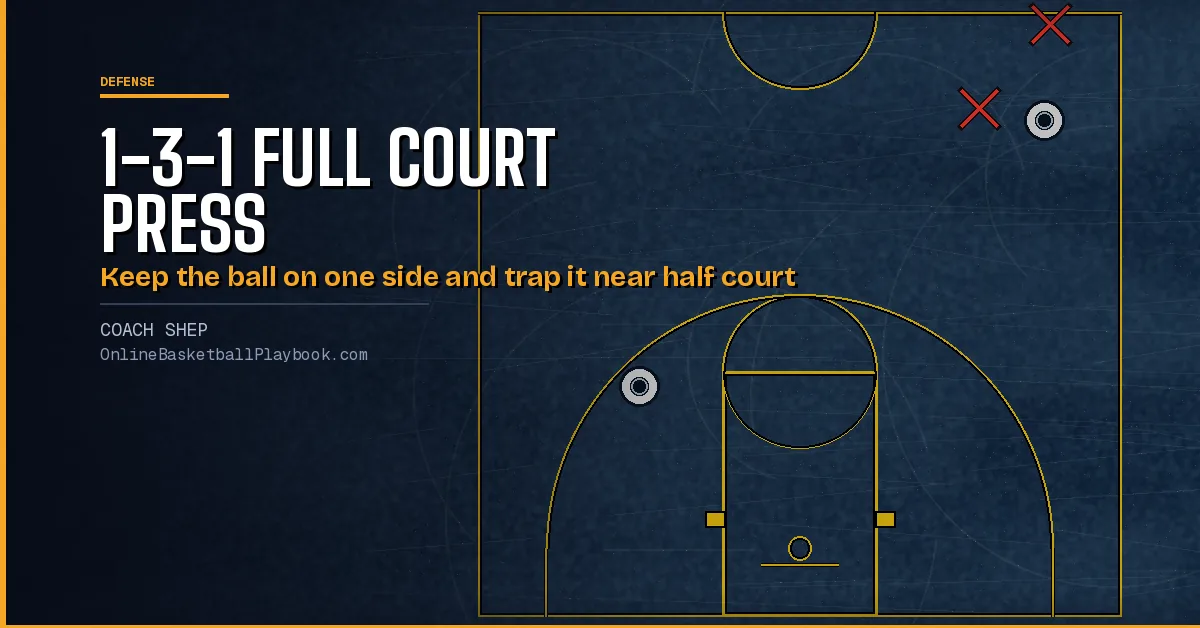
1-3-1 Full Court Press: Roles, Traps and Rotations to Install
The 1-3-1 full court press from setup to frontcourt trap: each role, the reversal rotations, an aggressive version, the costs and when coaches call it.
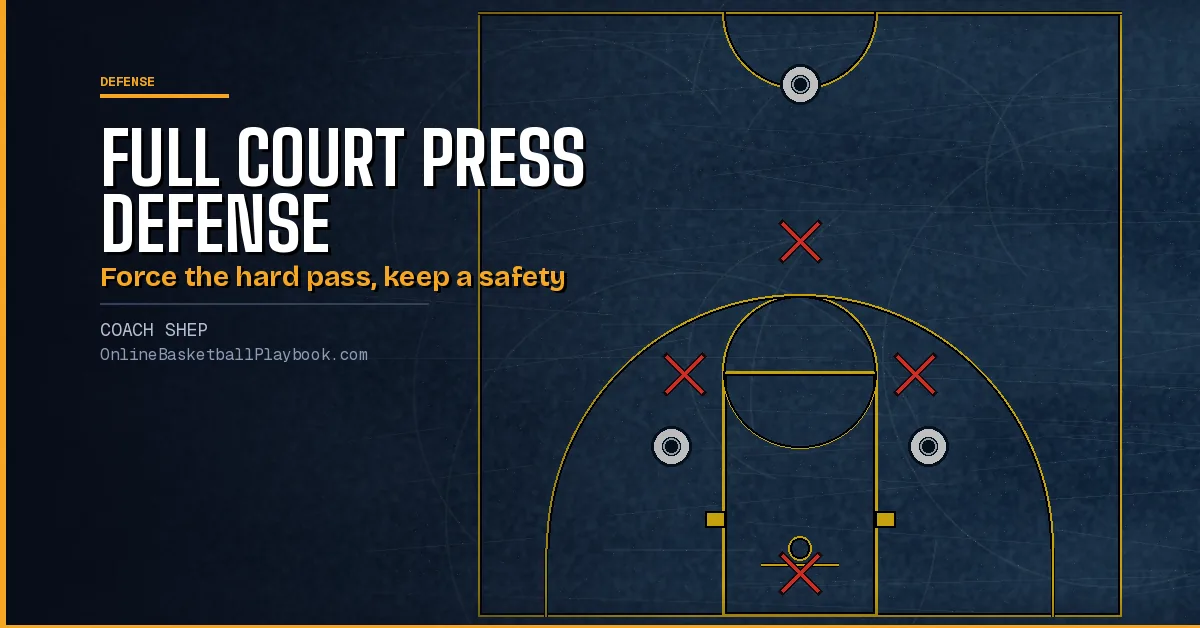
Full Court Press Defense: Types, Rules and How to Install It
Full court press defense pressures the ball for 94 feet. See the press families, shared rules, trap mechanics, the cost, the install order and drills.
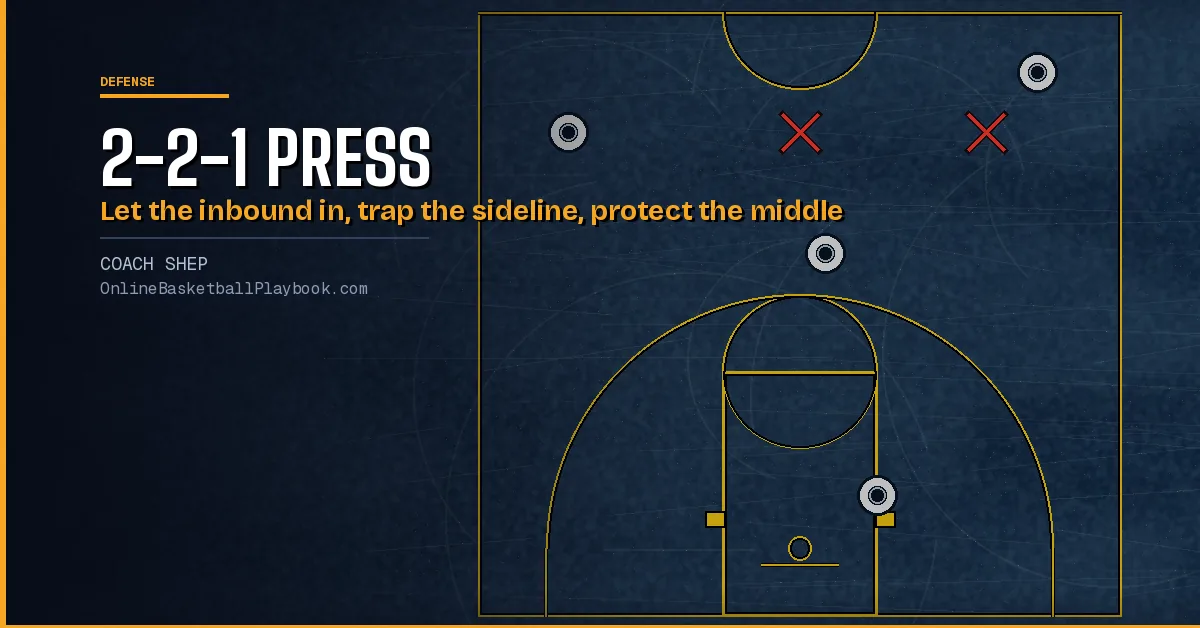
2-2-1 Press: Setup, Traps, Rotations and Drills
How to run the 2-2-1 press: who plays each spot, how coaches trap the sideline, the rotations after a reversal, how it breaks, how offenses attack it and the drills.