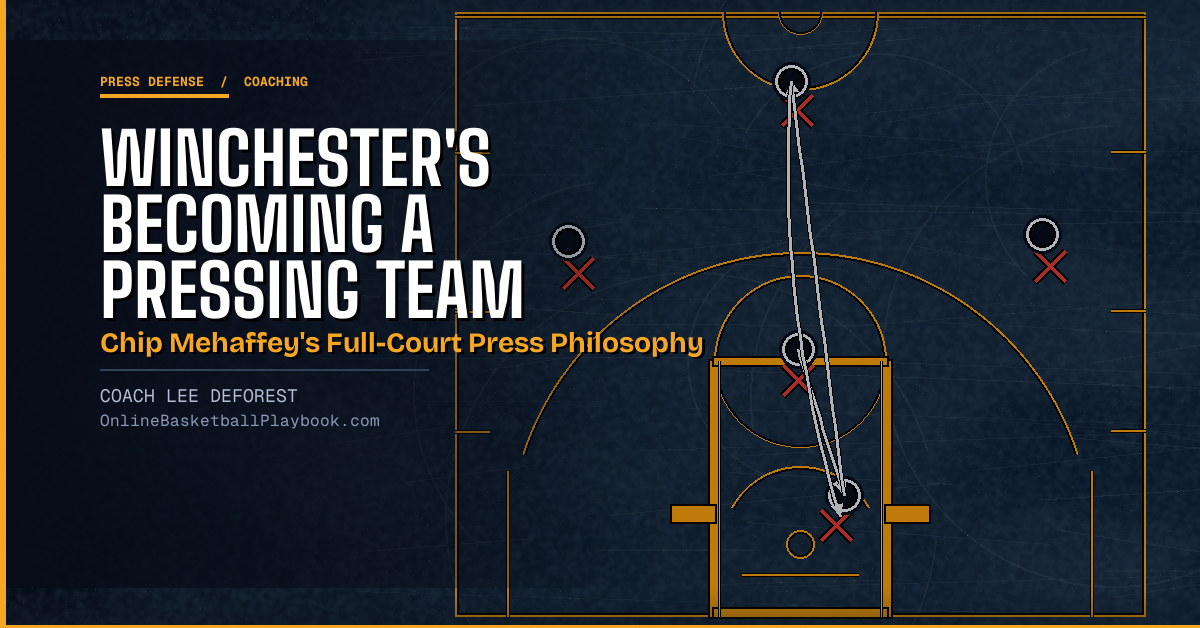
Pressing is not a switch you flip on a bad night. It is who you are. Chip Mehaffey builds Winchester around one identity goal that decides everything else: set at least one trap in the backcourt every possession.
Most coaches treat the press as a gimmick — a panic call when they are down ten with three minutes left. Mehaffey treats it the other way around. The press is the program. You build it in the offseason, you teach it every day, and you commit to it whether the steals show up early or not. Most of all, the press lets you do something a half-court defense cannot.
"Take away the opposing team's best player's game."
Coach's Cheatsheet
- Use this when: you want a defensive identity, not a desperation call — a press you commit to every possession to dictate tempo, tire opponents, and force bad shots.
- The identity goal: set at least one trap in the backcourt every possession, and aim for at least two traps before the ball crosses to your end.
- Trap rule: trap on a dead dribble, then the trapper releases to cover the middle — the trap is the start of the rotation, not the end of the play.
- Anticipate rule: guard sideline-to-sideline on a reversal, and trap the first pass that crosses half court.
- Teach daily: get on the floor, tap the ball from behind, sprint out of every trap, stay low and lock your feet, tip what you cannot intercept, and read eyes and arms.
- Decide first: which way you force the ball, how you rotate, whether you drop into man or zone, how many traps per possession, and whether you are speeding the game up or slowing it down.
Why You Press: The Case for an Identity
Mehaffey's reasons to press are not abstract. Each one is a problem the press solves for you. It makes you less upsettable, because a team that has to fight just to advance the ball cannot settle into the comfortable game that beats favorites. It makes you different, and different is hard for opponents to prepare for in a single scout.
The biggest reason is the one in the quote box above: a press lets you take away the other team's best player. A shooter who lives off screens never gets to his spots when he is busy breaking pressure. A back-to-basket post never touches the ball on the block when his guards cannot get it past half court. You attack the star where he is weakest — out top, handling the ball, away from the rim — instead of waiting to guard him where he is strongest.
The rest stacks up fast. The press creates an uncomfortable tempo, forces bad shots and poor rebounding position, and causes turnovers. It brings the fatigue factor, which is why it helps you get a run when you need one. And it is fun, which lets you play more people. For another full-court system built on the same logic, see Eric Rauch's 1-2-1-1 diamond press.
Sell the identity before you sell the X's and O's. Players will sprint out of traps in the fourth quarter only if they believe pressing is who your team is, not a tactic you tried once. Tell them the turnovers and the fatigue show up late — in the third and fourth quarters, when the other team is worn down — so they keep the pressure honest even when the early steals do not come.
Decide These Before You Press
Before you teach a single trap, Mehaffey settles a list of questions. Skip them and your press will contradict itself, with one guard forcing sideline while another forces middle. Answer them and every player slides off the same plan.
The questions to settle
- Which way do you force the ball? Sideline or middle — pick one and teach it, because the whole rotation hangs on it.
- How do you rotate? Mehaffey keeps the same designated back man every time, so the safety is never a question.
- Man or zone behind the press? Decide whether you drop into man-to-man or a zone once the ball is advanced.
- How many traps per possession? The standard is at least one in the backcourt, and the aim is at least two.
- When do you stop trapping? Know the spot or the score that turns the press off.
- What slides does each position make? Every spot needs its own movement, drilled until it is automatic.
- Are you speeding up or slowing down? The same press can push the pace or kill it — decide which job it is doing tonight.
The Key Principle: a press is a set of decisions before it is a set of slides. Settle which way you force the ball, who the back man is, and how many traps you want — then every rotation in practice teaches the same picture instead of five players guessing.
The Three Press Rules and the Alignment
Mehaffey's press runs on three rules. They are short enough to put on a wristband and blunt enough that a player can self-correct mid-possession. Everything in the drills below exists to make these three automatic.
The three rules
- Set at least one trap in the backcourt. Every possession. This is the identity goal, stated as a rule — no quiet trips, no walking the ball up uncontested.
- Trap on a dead dribble, then release to the middle. When the handler picks up his dribble, spring the trap — and the trapper does not stay stuck to the ball, he releases to cover the middle of the floor.
- Anticipate. Guard sideline-to-sideline on a reversal, and trap the first pass that crosses half court. You are not reacting to the ball; you are arriving where it is going.
Read those three together and you can see the rhythm of a possession. You trap early in the backcourt, the trapper releases to plug the middle the instant the ball is dead, and then your defenders guard the width of the floor and pounce on the first pass that beats half court. That is one trap leading straight into the next — which is how you hit the goal of at least two traps a trip.
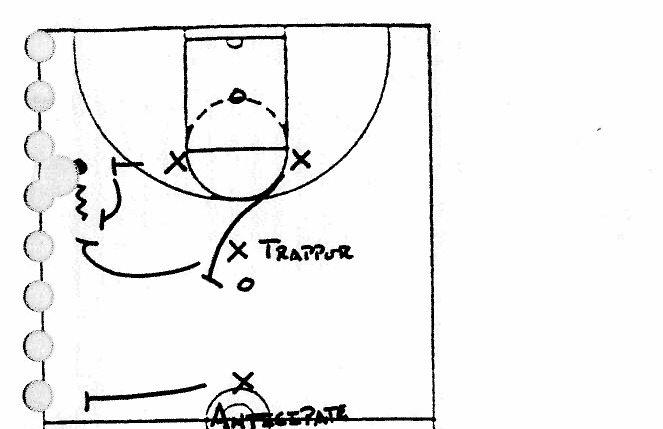
The third rule is where most presses break, because anticipation is a skill, not a wish. A defender who waits to see the pass is always late; a defender who reads the handler's eyes and arms is already moving when the ball is released, and that head start is the entire steal. The same disciplined trapping logic anchors Tri-West's 2-2-1 full-court press, where the trap also springs past half court rather than on a random reach.
Coach the release as hard as you coach the trap. Players love to trap and then admire their work, frozen on the ball while the pass sails over their heads into the middle. The rule is trap on the dead dribble, then get out and cover the middle — so your trap becomes the front end of a rotation instead of a two-man gamble that leaves the floor wide open.
The Press Skills You Teach Daily
A press is a stack of small skills, and Mehaffey teaches them every day — not once in October. These are the habits that separate a real pressing team from a team that just runs at the ball and hopes.
The daily skills
- Get on the floor. Go to the deck for loose balls. The press creates them, and the team that dives owns them.
- Tap the ball from behind. Practice the dive and the back tap so a beaten defender still gets a hand on it from behind.
- Sprint out of all traps. The trap is a sprint in and a sprint out — once the ball moves, you explode to the next job.
- Stay low and lock your feet in a trap. A high, sloppy trap fouls or gets split. Sit down and seal the gap with your feet.
- Tip what you cannot intercept. If you cannot pick the pass clean, deflect it to a teammate — a tip kept alive is still a turnover.
- Read eyes. See the ball from every position so the whole team can react together.
- Read arms. If the throwing arm cocks back, a long pass is coming — adjust and play it before it leaves his hand.
That eyes-and-arms pairing is the engine of anticipation. Reading the arm tells you the kind of pass before it is thrown; reading the eyes tells you where the whole team needs to shift. Together they turn five reactors into five anticipators, and Mehaffey is blunt about how non-negotiable it is.
"Read eyes' of opponent with ball from every position - all players must always see the ball."
Build these skills into your warmup, not a separate press day. Two minutes of back-tap reps, two minutes of diving on loose balls, two minutes of reading a coach's eyes and arms — done daily, they become reflexes by January. A press taught once is a press your players forget by the second road game. For a wider individual-defense menu to layer underneath, work through Greenwood's defensive drill progression.
The Drills That Build the Press
Mehaffey teaches the press the way you would teach anything that has to hold up under chaos: small pieces first, then live. Here is the drill menu, built from one-on-one habits up to a full-court press against the ball.
Ball-pressure and ball-denial — 1-on-1
Start with the individual battle. One defender pressures and denies one offensive player, working three core press skills in isolation: the back tap, taking a charge, and diving on the floor. No rotations yet — just the toughness and technique every later trap is built on.
Deflection-and-recover, intercept-and-score
Next, drill the payoff. Defenders deflect a pass, recover to it, then intercept and score — so the habit is not just to tip the ball but to turn the tip into points the other way. The press exists to score, and this drill connects the deflection to the finish.
3-on-3 at the front of the press
Now add bodies at the point of attack. Three-on-three at the front of the press teaches the trap, the release, and the read in a setting small enough to coach every slide. This is where the trap-and-release rule gets its reps before you ever press five live.
The Rebel Drill
Take it full court with the Rebel Drill, where the coaches handle the ball. With coaches as the offense you control the picture — throw the exact pass you want your players to read, and freeze the rep to correct a late rotation or a missed release.
The Split Drill
Finish with the Split Drill, which trains the answer to a broken trap. The offense splits the initial trap, and the defender recovers and gets a back tap from behind. It teaches your team that a split trap is not a blown possession — it is just the next chance to get a hand on the ball.
Variations and Progressions
Progression 1: Force-Middle Day
Mehaffey's list of questions starts with which way to force the ball. Spend a practice forcing middle instead of sideline so your players feel why the answer matters. The trap zone moves, the back man's reads change, and the team learns the rotation is built on that one decision — not the other way around.
Progression 2: Two-Trap Possessions
The goal is at least two traps a trip, so drill it on purpose. In your 3-on-3 and full-court reps, do not end the possession after the first trap — require a second trap on the first pass that crosses half court. Players stop admiring the opening trap and start hunting the next one.
Progression 3: Press to Slow It Down
One of the decisions is whether you are speeding the game up or slowing it down. Run a rep where the press contains instead of gambles — pressure the ball, deny the middle, and force a long possession rather than a turnover. It is the same identity, dialed to protect a lead instead of chasing a run.
Get Free Coaching Notes
Join the Online Basketball Playbook newsletter for new playbook breakdowns, drills, and practice-ready install ideas.
Get Free Coaching NotesDraw this play free in the play drawer →
Membership: the full library, playbook packs, and Pro drawing tools →
Final Thoughts
Becoming a pressing team is a decision before it is a defense. Mehaffey's blueprint is simple to say and hard to live: make one trap in the backcourt every possession your identity, settle the questions that keep five players on the same plan, trap on the dead dribble and release to the middle, and teach the small skills — the dive, the back tap, the eyes and arms — every single day.
Do that, and the press stops being a gimmick and becomes who you are. The turnovers come, the fatigue does its work, and you take the other team's best player out of his game before he ever touches it where he wants. It takes daily reps and a real commitment, but as Mehaffey puts it, "There are no shortcuts to anywhere worth going" — and a pressing identity is worth going.
Keep Building
Related breakdowns
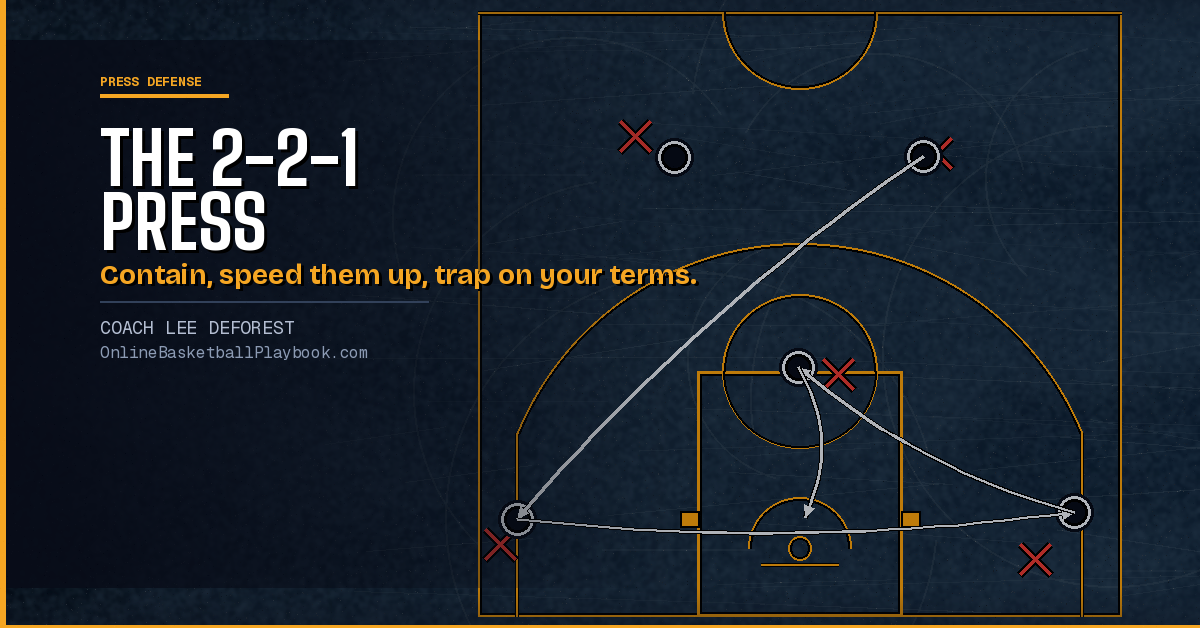
How to Coach the 2-2-1 Full-Court Press (Complete Guide)
The containment press that speeds opponents up and forces turnovers on your terms — without gambling your back end on every possession.
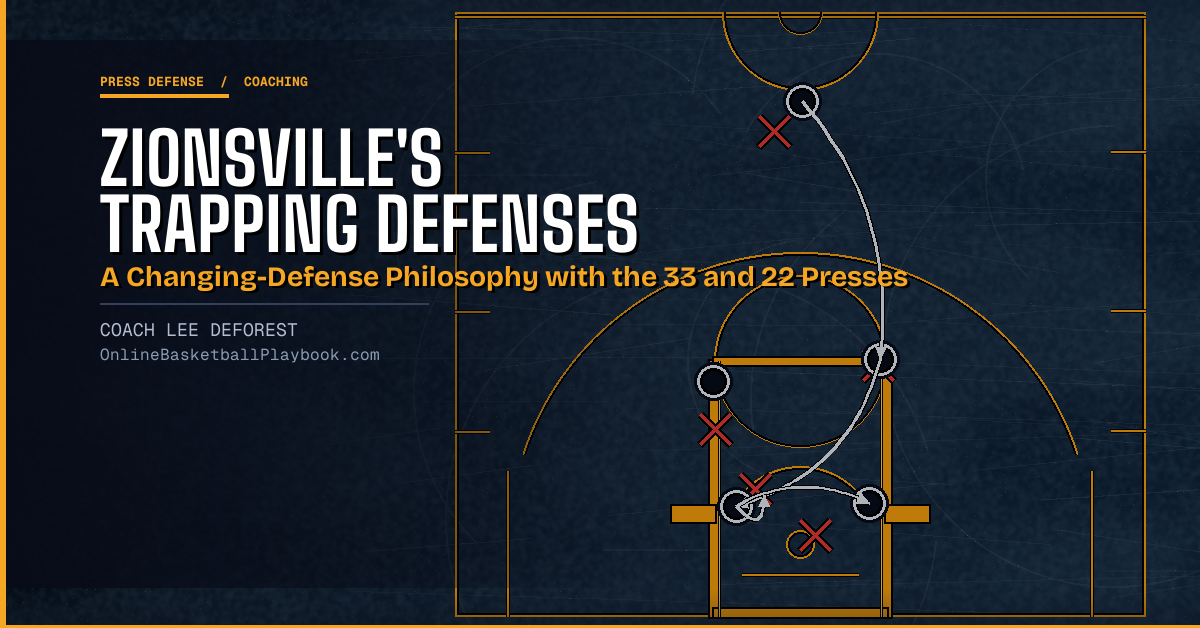
Zionsville's Trapping Defenses: A Changing-Defense Philosophy with the 33 and 22 Presses
Zionsville changes defenses on purpose to tax an opponent's prep time — the 33 three-quarter 1-3-1, the 22 half-court trap, and a Run & Jump variant that ends in deny-everywhere.
Eric Rauch's 2-2-1 Full-Court Press: Tri-West's Wear-Them-Down Pressure
Constant full-court pressure that sets the pace, forces second-half runs, and wears teams down — without fouling your way to the free-throw line.
More from Online Basketball Playbook
How to Build a Defensive Identity
Winchester built a pressing identity before installing a pressing scheme — learn how.
Basketball Conditioning Programs for Teams
Pressing requires elite fitness — here’s how to build it across a full season.
Basketball Substitution Patterns
A pressing team lives and dies by its rotation plan — build one before you press.