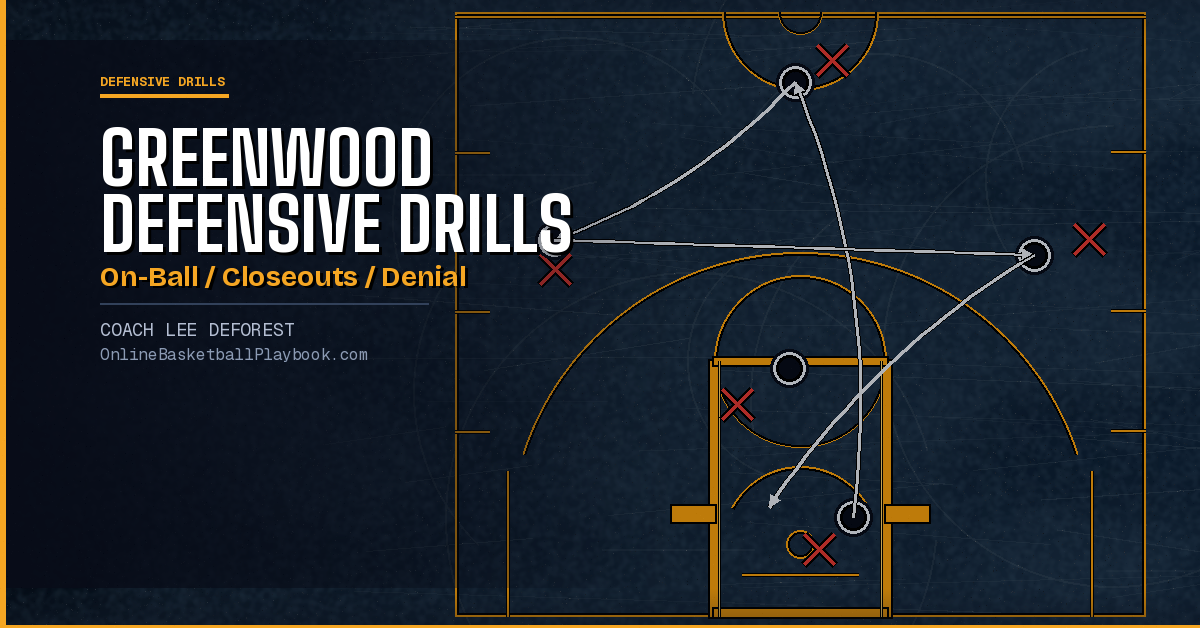
Team defense breaks down in February for a reason: nobody ever drilled the individual fundamentals it's built on. The stance, the closeout, the denial, the help rotation — skip those reps and your shell drill is a house with no foundation.
Greenwood Basketball's answer is a drill menu, not a single drill. It's a progression that starts one defender against one offensive player and builds — closeouts, denial, ballside and helpside position, the post, then a full shell — until five players are moving on the same string. Each layer adds one decision, so nobody is ever guessing.
That order is the whole point. You don't install the shell drill and hope the fundamentals show up inside it. You drill the fundamentals first, in isolation, then stack them into team defense once each piece holds up on its own.
"1 on 1 full court (keep the ball in the alley)"
This breakdown walks the Greenwood menu the way they teach it: on-ball drills, closeout drills, denial drills, help and rotation through the shell, then a Monday plan to install the progression and a set of variations to keep it sharp deeper into the season.
Coach's Cheatsheet
- Use this when: your team defense leaks in games and you trace it back to fundamentals that were never drilled in isolation — stance, closeouts, denial, and help.
- Core teaching point: build the defense one rep at a time — master one-on-one stance and containment before you ever ask five players to read and rotate in the shell.
- On-ball rule: keep the ball in the alley — in one-on-one full court, the defender steers the dribbler down one side instead of letting him cross the floor at will.
- Correction cue: "On the line, up the line" — when you deny the wing, position your body on the passing line and up toward the ball so the easy catch disappears.
- Practice install: one defensive block of roughly 30 minutes — on-ball, closeouts, denial, then a short shell — and add one shell wrinkle (a cut, then penetration, then exchanges) only after the last one holds up.
- Help reminder: helpside defenders keep track of their men — you guard the ball and your man at the same time, jumping to the ball on every pass without losing your assignment.
On-Ball Drills: Stance Before Anything Else
The menu opens on the ball, and it opens with stance — because everything downstream depends on a defender who can sit in a good stance and stay in front. Greenwood drills it in pairs first, then as a full-team mass drill, then live in the full court.
Partner Stance, Hand, and Position Drill
- Pair up, one offense and one defense, no ball needed to start. The defender holds a proper stance — feet wide, knees bent, hands active, weight on the balls of the feet.
- The offensive partner shuffles side to side and up and back; the defender mirrors, holding the stance and keeping his hands in position the whole time.
- Coach checks the three pieces by name — stance, hands, position — so players learn what "good" looks like before any live competition starts.
Mass Stance Drill
- Spread the whole team across the floor facing the coach. On a hand or voice command, everyone slides the called direction in stance.
- This is conditioning and habit at once — every player gets reps in the same stance, and you can see at a glance who stands up and who stays down.
1-on-1 Full Court — Keep the Ball in the Alley
- One offensive player brings the ball up the full court against one defender, sideline to sideline as the "alley."
- The defender's job is to keep the ball in the alley — steer the dribbler down one side and never let him cross the floor freely. Containment, not steals, is the win.
- Play it end to end so the defender learns to stay in front under fatigue, the exact condition team defense fails in.
Keep the on-ball block competitive but contained. The goal in one-on-one full court is not to gamble for a steal — it's to keep the ball in the alley and stay in front for the full ninety-four feet. Reward the defender who never gets beat, not the one who reaches.
Closeout Drills: Sprint, Then Break Down
Once a defender can hold a stance, Greenwood teaches him to arrive in one — the closeout. The progression runs from one-on-one technique to a sideline mass drill, then partner closeouts at every basket, then a two-line version where everyone is involved.
1-on-1 Closeout for Proper Technique
- Defender starts under the basket, ball in the offensive player's hands out on the perimeter. On the coach's cue, the defender closes out.
- Teach the shape: sprint the first two-thirds of the distance, then break down into short choppy steps with a high hand to contest the shot.
- Land balanced and ready to move — a closeout that flies past the shooter is the same mistake as one that never arrives.
Sideline Closeouts (Mass Drill)
- Line the team along a sideline. On command, the whole group sprints out and breaks down into a closeout, then recovers and repeats.
- High-volume reps of the footwork with no offense to read yet — pure technique, every player at once.
Partner Closeouts and Two-Line Closeouts
- Partner closeouts, use all baskets. Spread pairs to every basket in the gym so nobody stands in line. One closes out, partner gives a shot fake or a drive to read.
- Two-line closeouts, everyone is involved. Two lines feed continuous reps — pass out, close out, contest, rotate. Keep the lines moving so reps stay high and rest stays low.
The Key Principle: a closeout is two skills in one rep — a sprint to cover ground and a break-down to stay in control. Drill both halves together, because a closeout that does one without the other gives up a layup or a wide-open three.
Denial Drills: Take Away the Easy Catch
Defense isn't only about the man with the ball — it's about making the next catch hard. Greenwood's denial block moves from one-on-one technique to one-on-one live, then ties denial and closeout together in a two-line drill, then adds ballside pressure two-on-two.
"Two line denial and close out (open when reaching the lane)"
1-on-1 Denial — Technique, Then Live
- For proper technique. Defender guards a wing one pass away. Teach the position: on the line, up the line, with the lead hand and foot in the passing lane and eyes splitting man and ball.
- 1-on-1 live. Now the offensive player tries to get open and catch. The defender denies the catch entirely — force the receiver to give up the spot or go backdoor, where help waits.
Two-Line Denial and Closeout
- Combine the two skills you just built. The defender denies the wing on the line and up the line; when the ball is reversed and his man becomes helpside reaching the lane, he opens up to see ball and man.
- That open-up moment is the whole drill — it's the bridge between denial (one pass away) and help (two passes away), and it's where most defenders get lost.
2-on-2 Ballside With Pressure
- Two offense, two defense, ball on one side. One defender pressures the ball; the other denies the ballside receiver so there's no easy entry pass.
- This is where individual denial becomes a team idea — two defenders taking away the strong side at the same time, forcing the offense to swing the ball and reset.
Help & Rotation: Position and the Shell
Now the menu puts the pieces together. The position block layers ballside and helpside, adds blockout and a closeout from the baseline, drills the post, then arrives at the shell — four-on-four stance, position, movement, and rules.
2-on-2 and 3-on-3 Position
- 2-on-2 ballside and helpside. Close out from the baseline; or start the ball on top and deny the wing from an on-the-line, up-the-line position. One drill teaches the closeout, the other the denial — both inside live position.
- 3-on-3 closeout and blockout. Add a third defender and a shot. Verbalize the whole way — "ball," "deny," "help" — and play until the whistle so the rep ends with a blockout, not a clean miss.
Make verbal calls non-negotiable in the 3-on-3 stage. A silent defense is a guessing defense. Require every defender to call his job out loud — ball, deny, help — and play the possession until the whistle so the habit carries into games, not just into clean drill reps.
4-on-4 Shell Drill — Stance, Position, Movement, Rules
The shell is the capstone. Four defenders, four offense, and you add complexity one rule at a time so the picture never gets ahead of the players:
- No cutters, just ball movement. The offense only passes around the perimeter. Defenders jump to the ball on every pass and adjust ballside-to-helpside position. Nothing else.
- Allow one cut. After passing, a player may cut to the basket. Now defenders have to jump to the ball and bump the cutter through, then recover.
- Allow dribble penetration for quick help. The ball handler can drive a gap. Helpside has to step in for a stop and rotate, then everyone recovers to their man.
- Allow guard-forward exchanges. Add screens and exchanges so defenders communicate and navigate movement away from the ball — the closest thing to a live possession.
Resist the urge to start the shell at full speed with every rule live. Greenwood's order — ball movement, then one cut, then penetration, then exchanges — exists so each new decision lands on a foundation that already holds. Add the next layer only when the current one looks clean.
The position block also folds in post defense — dead-front the post one-on-one, then two-on-two, then three-on-three with the ball starting on top — and a verbalize-everything rule so helpside defenders keep track of their men instead of ball-watching.
Practice Install: Your Monday Plan
Here's how I'd install the Greenwood progression with a team early in the season. One defensive block, about 30 minutes, moving from one player to four.
Block 1 (6 min) — On-Ball Stance and Containment
Start with the partner stance, hand, and position drill, then a quick mass stance drill to get everyone down and sliding. Finish with short 1-on-1 full court reps — keep the ball in the alley, stay in front, no gambling. You're setting the foundation every later drill stands on.
Block 2 (8 min) — Closeouts
Run 1-on-1 closeouts for technique, then move to two-line closeouts so everyone is involved and reps stay high. The only correction that matters here: sprint two-thirds, break down, high hand. A closeout that flies by is a layup; one that pulls up early is an open three.
Block 3 (8 min) — Denial and Ballside Pressure
Drill 1-on-1 denial for technique, then the two-line denial and closeout so players feel the open-up moment when reaching the lane. End with 2-on-2 ballside with pressure so denial becomes a two-man job, not a solo one.
Block 4 (8 min) — Build the Shell
Finish in the 4-on-4 shell. Start with no cutters, just ball movement and jumping to the ball. Add one cut, then dribble penetration for quick help, then guard-forward exchanges — one layer at a time, only advancing when the current rule looks clean. Verbalize the whole way and play until the whistle.
Variations and Progressions
Progression 1: Tighten the Gaps in Pre-Season
Early in the year, play the position and shell drills with very small gaps — defenders sit closer to their men and to the ball than they would in a game. Exaggerating the helpside spacing builds the instinct to be in two places at once before you let the gaps open up for live play.
Progression 2: Put the Scouting Report In
Once the shell holds up, run the offense's specific cuts and actions inside it. Defending the scouting report cuts in this drill turns generic four-on-four reps into preparation for Friday's opponent without adding a new drill — same shell, new wrinkles.
Progression 3: Disadvantage Drills
To stress the rotations, go outnumbered — perimeter defense two-on-five, then four-on-five and four-on-six. With fewer defenders, players must jump to the ball, cover down to the open post, and get quick help on the baseline drive. It is the fastest way to teach urgent, talking help.
Get Free Coaching Notes
Join the Online Basketball Playbook newsletter for new playbook breakdowns, drills, and practice-ready install ideas.
Get Free Coaching NotesDraw this play free in the play drawer →
Membership: the full library, playbook packs, and Pro drawing tools →
Final Thoughts
Greenwood's drill menu isn't complicated, and that's its strength. On-ball stance, closeouts, denial, help — each one drilled in isolation until it holds, then stacked into the shell where five players move on one string. Build the defense one rep at a time and the team defense stops being a hope and starts being a habit.
Pick the block that fits where your team is leaking and start there. Drill the fundamental first, in isolation, then put it back into live position. Do that all season and February's breakdowns turn into February's stops.
Keep Building
Related breakdowns
Ettore Messina's Favorite 5-on-5 Defensive Validation Drill
A brilliant competitive scrimmage that makes points only count when followed by a defensive stop — putting the emphasis on defense without ever saying the word "defense."
Andy Weaver's Man-to-Man Defensive Drills: Western's Defense-Scores-Only System
Andy Weaver's man-to-man drills from Western High School all share one idea — a stop, a deflection, or a rebound is the only way for the defense to score.
Steve Combs' Competitive Defense Drills: Kentucky Privilege & Baseball
Two drills from Steve Combs' Vincennes Lincoln program that make a defensive stop the only way to score — so players finally compete for stops in practice.
More from Online Basketball Playbook
How to Build a Defensive Identity
The drills create habits; the identity tells players why those habits matter.
Basketball Finishing & Footwork Drills
Complete the development loop — finish defensive drill sessions with finishing reps.
Defensive Stance in Basketball
Every drill in the Greenwood system starts with stance — lock it in first.