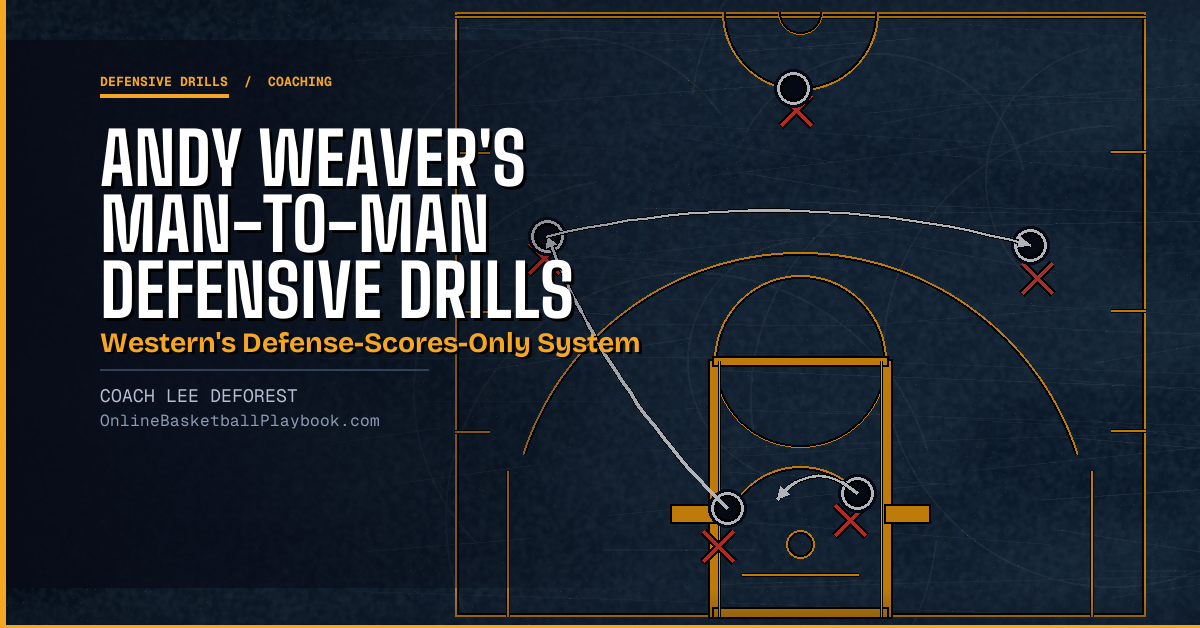
Your players will compete for buckets all day. Getting them to compete for stops is the hard part. Andy Weaver's answer at Western is to build drills where the only way to score is to get a stop.
Weaver coaches man-to-man defense at Western High School in Russiaville, and his practice menu shares one stubborn idea: take scoring away from the offense and hand it to the defense. The offense can run its stuff, screen, cut, and finish — and still come away with nothing. The reward goes to whoever forces the miss, the turnover, or the rebound. The through-line across every drill below is the same: defense scores, offense doesn't.
"A foul on a shooter means a made basket, so defense goes out"
Coach's Cheatsheet
- Use this when: your players compete for offense but coast on defense, and you want a practice menu that makes a stop the only currency.
- Core teaching point: in nearly every drill, the defense scores only by forcing a miss, a turnover, or a deflection — the offense cannot win on its own.
- Recovery rule: when a man goes to touch the baseline, the rest sprint to pick-up points and play emergency help a man down until he recovers weak-side.
- The foul rule: a foul on the shooter counts as a made basket, so the fouling defense rotates out — it removes the cheap-foul escape from your defenders.
- Closeout rule: outside defenders must touch the circle (or close out from the arc) before they engage — you train recovery under a numbers disadvantage.
- Carry it everywhere: even the shooting and conditioning drills have a make-it-or-run consequence, so effort never gets optional.
Why Defense-Scores-Only Changes Practice
Most defensive drills end when the offense scores or the coach blows the whistle, and the defense's reward is a pat on the back for doing its job. That is a weak incentive, and players feel it. Weaver's drills flip the math: a stop is not the absence of a basket — it is the basket. Once a defensive rebound or a forced turnover is the only thing that earns you the next possession, the habits you usually beg for show up on their own. Players box out because the rebound is points. They deny the catch because a deflection is points. They keep their feet on a shot fake because a foul hands the offense a made basket and sends them off the floor.
Tell your team the scoring rule out loud before every rep, then enforce it without flinching. The first time a defender reaches in, fouls the shooter, and you score it as a made basket and rotate him out, the message lands harder than any speech. The rule does the coaching — you just have to let it.
Cover Up and Scottsburg: Defending a Man Down
The first two drills attack the same problem: what happens when your defense is suddenly short a man and has to scramble. Both reward only the stop.
5 Man Cover Up
Run three teams — offense, defense, and a group out. The offense lines up on the baseline with the defenders matched up, and the coach calls one defender's name. That player goes to touch the baseline while the rest recover to their pick-up points. The offense pushes a secondary break five-on-four against the scramble, and the player who touched the baseline races back to recover weak-side.
- What it builds: emergency recovery and team help when you are a man down.
- How the defense scores: only by getting a stop or a turnover. Surviving the five-on-four is the win.
- The rotation: offense to defense to out, so everyone takes a turn scrambling.
Scottsburg 4 on 4
Two teams play to five buckets in a continuous four-on-two. The two outside defenders must touch the circle before they enter the play, which forces a real closeout against numbers. When the defense rebounds or the offense scores, the defense becomes the offense and pushes the other way four-on-two.
- What it builds: transition defense and closeouts under a numbers disadvantage.
- The closeout trigger: touch the circle first — no cheating the recovery.
- The flip: a rebound turns defense into offense, so the rebound is the reward.
The Key Principle: both drills put your defense behind on purpose. A defender is gone, or two are stuck touching the circle, and the only way out is a stop while outnumbered — the moment most defenses quit. Train the scramble and your live defense stops panicking when it loses a man.
Box Passing: Win on a Deflection
Box Passing 4-on-4 is bounded by the volleyball spike line and the end line. Each team is on offense three times, or you run it for time. The offense's job is to complete passes against pressure; the defense's job is to break the chain.
What the offense must do
- V-cut to get open — no standing and reaching for the ball.
- Come off screens tight, shoulder to shoulder, with the screener setting a solid base and finishing with a reverse pivot.
- No dribbling. The ball moves only by the pass.
- Stay strong in triple threat on the catch — the receiver holds the ball ready, not loose.
The scoreboard is completions versus deflections. Ten passes in a row and the offense wins the rep; the defense wins by getting a deflection or a turnover, or by holding the offense under ten.
"10 consecutive passes = offense wins!!!"
Because dribbling is banned, the defense loads up on the pass. Every cut is contested, every catch is pressured, and a single deflection erases the count. For individual-defense work that pairs with this, see Greenwood's on-ball, closeout, and denial progression, or browse the full drills library.
The Gene Keady Block-Out
Rebounding is where defense-scores-only gets literal: the rebound is the point. The Gene Keady Block-Out turns boxing out into a named-defender scramble.
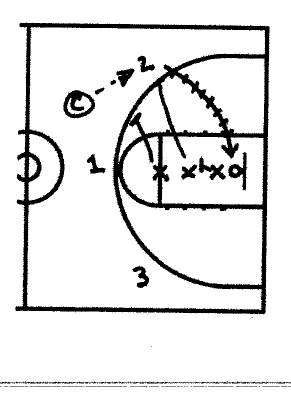
How it runs
- Two teams, played for time or for ten defensive possessions.
- The coach throws the ball and calls a defender's number — 1, 2, or 3.
- The named defender closes out to contest the shot while the other two hold their positions.
- It goes live — three block-outs, three-on-three, until the defense secures the rebound.
- Scoring: one point per stop.
The genius is the closeout-then-block-out sequence. The named defender has to fly at the shooter and still get a body on someone when the shot goes up, while his two teammates hold and seal. Nobody gets the point until the ball is in the defense's hands.
Do not let the rep end on the shot. The block-out is not finished until the ball is secured, so keep it live through the scrum. Players love to admire a good contest and then ball-watch — this drill punishes that instantly, because the offense crashes and scores on the second shot if the block-out is lazy.
The Defense Wins Drill
This is the centerpiece — a half-court, five-on-five drill where only the defense can score. Three teams play to seven, or cap it at ten minutes.
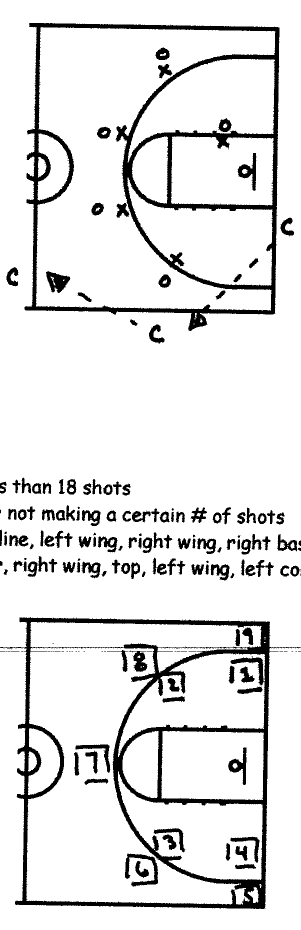
The rules
- Defense scores only via a defensive rebound or a forced turnover. The offense putting the ball in the basket earns the offense nothing on the scoreboard.
- If the offense scores, the offense rotates down to defense and the old defense goes out to midcourt.
- A stop keeps you on defense — you stay and defend again.
- The ball cycles through the teams: C1 to C2 to C3 to offense.
- It is played live, full contact, like a game.
The foul rules that make it honest
Two foul rules close the back door. A foul on the shooter counts as a made basket, so the fouling defense goes out — same as a clean bucket. And every team foul after the second one also counts as a made basket. You cannot hack your way to a stop, which is the point.
The Key Principle: the foul rules are what make defense-scores-only real. Without them, a defender just fouls hard, kills the play, and resets. Scoring a foul as a made basket and rotating the offender out forces clean, disciplined stops — your defense has to guard, not grab.
This is the five-on-five proving ground for everything you teach in the breakdown drills above. If you build practice around competitive blocks, the playbook breakdowns section has more full-team frameworks that fit alongside it.
Conditioning and Shooting With Consequences
The same idea carries into Weaver's conditioning and shooting work: a make-it-or-run consequence. The shooter does not get off the hook by going through the motions. Hit the number or pay for it.
- 55 Second Drill: on the clock, four shots inside the arc (left baseline, left wing, right wing, right baseline) and five threes (right corner, right wing, top, left wing, left corner). Miss the target — around eighteen makes — and run a down-and-back. Those nine marked spots are the map in the diagram above.
- Scudder Shooting: twenty shots, make seventy percent (fourteen of twenty) or run a length for each make you are under. Locations are elbow-to-elbow, wing-to-baseline, and elbow-to-wing; keys are shot-ready hands and feet, game-like reps, and the jump shot over the set shot.
- Champion Shooting: one minute in groups of three — shooter rebounds his own shot, one counts, the third does ball-handling, jump rope, or lane slides. Spot goals: block-to-block (must bank) 20, baseline-to-baseline just outside the paint with no bank 17, wing-to-wing 10, elbow-to-elbow 10.
- 2½ Minute Drill: all threes, shooter rebounds his own shot, groups of three. Attempt thirty (down-and-back for each one under thirty) and make fifteen (down-and-back for each one under fifteen).
Variations and Progressions
Progression 1: Add the Cover Up Scramble to Any Live Drill
Once your team handles 5 Man Cover Up, layer the idea into other live work: call a defender out to touch the baseline mid-possession so the rest play help a man down. The emergency recovery becomes a reflex instead of a once-a-week drill.
Progression 2: Run Defense Wins to Ten or on the Clock
The drill plays to seven, but stretch it to the ten-minute running block when you want a longer grind, or hold the score cap when you want a clean winner. The longer version exposes which players keep getting stops when they are tired.
Progression 3: Tighten the Box Passing Target
Ten consecutive passes is the offense's bar. Against an advanced group the defense should hold them well under it; if the offense hits ten too easily, shrink the floor inside the spike line so the windows close and the deflections come faster.
Get Free Coaching Notes
Join the Online Basketball Playbook newsletter for new playbook breakdowns, drills, and practice-ready install ideas.
Get Free Coaching NotesDraw this play free in the play drawer →
Membership: the full library, playbook packs, and Pro drawing tools →
Final Thoughts
Weaver's menu is not a collection of unrelated drills — it is one philosophy run five ways. Cover Up and Scottsburg train the scramble. Box Passing makes a deflection the win. The Gene Keady Block-Out makes the rebound the point. The Defense Wins drill turns it into a five-on-five where only stops score, with foul rules that refuse to let a defender cheat.
If your players already compete for offense, you do not need to teach them to compete — you need to put the points where the effort should go. Make a stop the only currency in your gym, add a make-it-or-run cost to your shooting, and your defense will work for the same reason your offense always has: because it is the only way to win the rep.
Keep Building
Related breakdowns
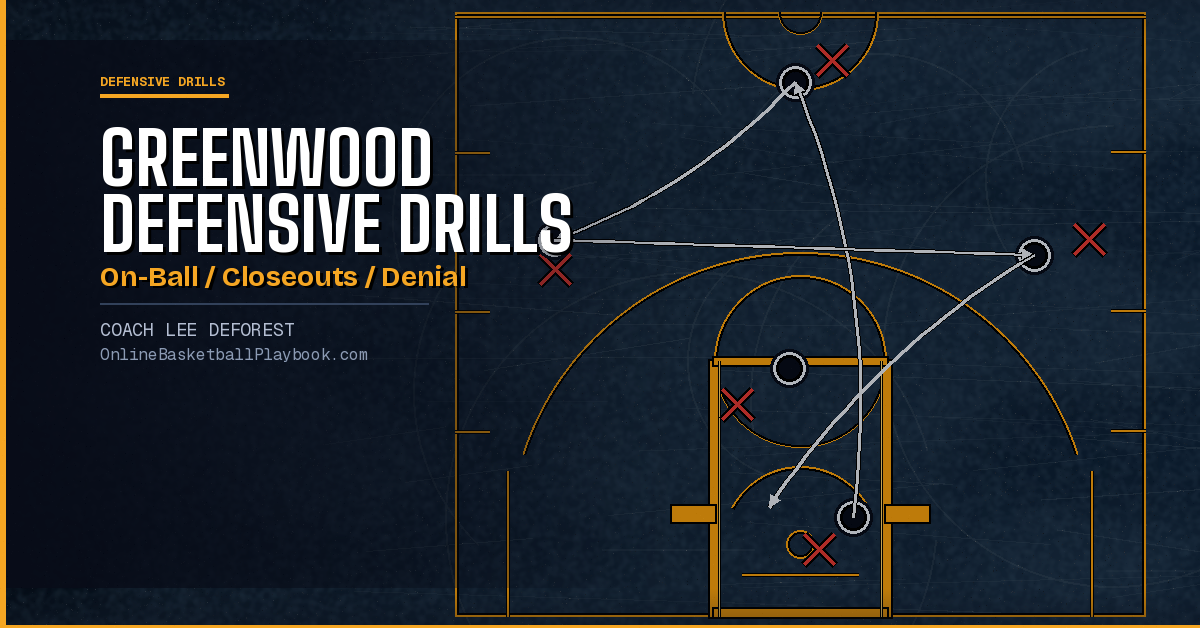
Greenwood's Defensive Drill Progression: On-Ball, Closeouts, and Denial
A complete individual-defense drill menu — stance, closeouts, denial, and help — that builds a defense one rep at a time.
Steve Combs' Competitive Defense Drills: Kentucky Privilege & Baseball
Two drills from Steve Combs' Vincennes Lincoln program that make a defensive stop the only way to score — so players finally compete for stops in practice.
Ettore Messina's Pick-and-Roll Defense Drills: Drag Screen & Side PNR
Two 2-on-2 drills from Messina's clinic notes that fix the biggest reason teams give up easy buckets in transition: letting the ball handler reach the arc before the screen arrives.
More from Online Basketball Playbook
Defensive Stance in Basketball
Every Western Panthers drill builds from stance — master it first.
How to Coach Defensive Rotations
The drills teach technique; rotations teach system — build both together.
How to Build a Defensive Identity
Defensive drills create habits; defensive identity makes those habits show up in games.