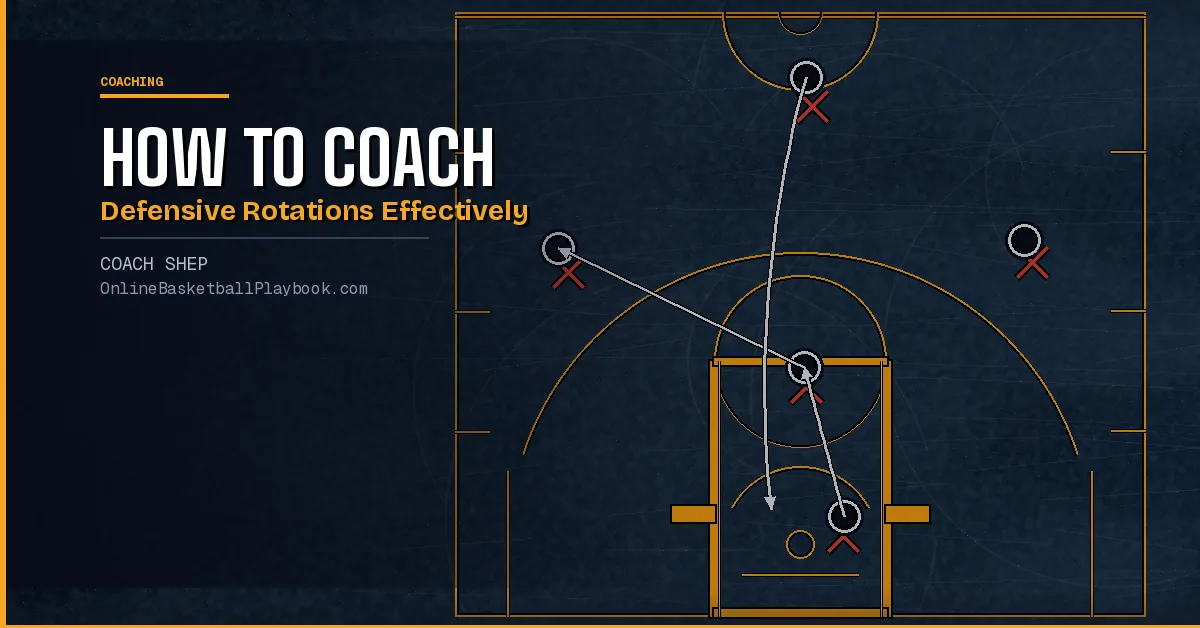
Most defensive breakdowns happen off the ball. This guide covers the help-side principles, rotation rules, and practice habits that turn five individuals into one connected defensive wall.
Why Help-Side Defense Wins Games
Skip Matherly's line cuts to the heart of defensive coaching: "Ball side is for show, help side is for dough." The visible, dramatic work of pressuring the ball gets all the practice time. The invisible half (where defenders stand when the ball is two passes away, how they respond when a teammate gets beat, who covers the cutter flashing across the lane) is where games are actually decided.
Most coaches spend somewhere around 70 percent of their defensive practice time on ball pressure and 30 percent on help-side principles. Matherly argues that ratio needs to be inverted. The three breakdowns that kill defenses most often are all off-ball problems: defending the cutter, defending screens, and rotating when a driver gets into the paint. None of those start with the guy guarding the ball.
That doesn't mean ball pressure is unimportant. It means help defense is the load-bearing structure of your system. Build it first, reinforce it constantly, and your ball-pressure work will compound on top of something solid.
The Foundation: Help-Side Positioning
Before you can teach rotations, players have to be standing in the right spots. Help-side positioning is the pre-condition for everything else.
The Help-Side "I"
When the ball is on one side of the floor, the two defenders on the weak side form a stacked "I" on or just inside the midline of the lane. This is not sagging. It is a precise foot placement that puts them in position to help without any wasted initial movement away from the basket.
The rule adjusts by ball position:
- Ball above the wing: both feet just outside the lane, closed stance facing ball and man simultaneously.
- Ball at or below the wing: one foot in the paint, straddling the lane line, same closed stance.
The "I" is what makes the first step into help fast. A defender standing on the three-point line has to travel to get to the paint; a defender already on the midline simply steps into the play. Teach the position as a habit before you ever teach the rotation itself.
Tail Toward the Baseline
Every help-side defender keeps the backside angled toward the defensive baseline, not toward half court. This single adjustment widens the field of vision so a defender can see both their man and the ball at the same time. When a defender's tail angles toward half court, they go visually blind off the ball within a few seconds. The baseline-tail habit is small to teach and enormous in its returns.
Move on the Pass
Help-side positioning resets on every pass. The discipline is simple: when the ball is thrown, every defender moves on the pass, in the direction of the pass. The baseball analogy makes it concrete: when a pitch is thrown, all nine fielders shift. Same principle in basketball. A team that moves on the pass stays connected. A team that waits until the ball is caught is always one step behind.
Defending Cutters and Flash Cuts
Cutter defense is the highest-frequency help-side breakdown. The good news: one habit eliminates most of the problem before it starts.
Jump to the Ball
"Jump to the ball" means that every pass triggers immediate repositioning. If the ball moves from the top of the key to the right wing, every off-ball defender adjusts their position while the ball is in the air, not after it lands. Matherly's assessment is blunt: this single discipline eliminates roughly 90 percent of cutter breakdowns. The discipline isn't complicated, but it requires constant reinforcement in practice until it is a reflex.
Three Cutter Situations Every Defense Faces
Not all cutters are the same. Your players need a clear answer for each type:
Weak-side flash to ball-side. The most common. This includes post players flashing from the weak side. The help-side "I" position puts the defender right in the path of this cut. The assignment: use a forearm to bump and reroute the cutter. Not an extended arm. That is a foul. A physical forearm that changes the cutter's angle and makes them earn their position.
Backdoor cut from the ball-side wing or corner. This happens when an on-ball defender overcommits to denial and the offensive player reads it. The correction starts with the on-ball defender, but the help-side defender needs to be in the "I" position to cover if the read is late.
Point-to-basket cut after a pass to the wing. After the point guard gives up the ball, they often cut hard to the basket. The defender must "jump to the ball" on the pass, which puts them between the cutter and the ball before the cut starts.
Fronting the Cutter
When a cutter is already moving hard toward the basket, the technique is chest-to-chest: step into the path of the cutter, go chest-to-chest, and stay between the cutter and the ball until the cutter stops moving toward the basket or reverses. This is the one moment where a defender is permitted to briefly turn their back to the ball. Once the cutter stops or reverses direction, the defender opens back up and re-acquires the ball.
Drive Rotations: The Three-Layer System
When a ball-handler beats their defender off the dribble, the rotation has to be instant and layered. If it's improvised, you give up a layup. If it's assigned and practiced, you force a pass back out and stay connected.
The "911" Trigger
"911" is a verbal trigger that means one thing: everyone sprints to the paint. When a drive penetrates the lane or when the ball enters the post, the call goes up and every off-ball defender collapses. The objective is to cut off the drive, force a pass back out, then match up on the pass. Teams that have this call installed and practiced will stop more drives in one week than teams that try to improvise it all season.
First Rotator
The first rotator is the off-ball defender nearest to the ball-side gap, the player already in the "I" who is one step from the paint. Their rule is simple: sprint to the lane and look for a different-colored shirt. Not their man. Not their assignment. Whoever is the first open threat in the paint. This player is the primary stopper on the drive.
Second Rotator: The X-Out
The second rotator takes the first pass out of the paint. Their job is to open to the ball from inside the free-throw line and close out hard to whoever catches the kick-out pass. This player has to be ready to guard a shooter who may receive the ball in rhythm with their feet set. The X-out closes out under control (no flying by) because a ball-fake foul on a kick-out three is one of the most demoralizing defensive breakdowns in basketball.
Third Layer: Rim Protection
The back-side big or the deepest off-ball defender takes the rim and stays there until the first rotator recovers. No cuts between this player and the basket. They are the last line. The instinct to chase a man at the three-point line is dangerous here. Their only job is to prevent a layup or easy cut to the rim while the rotation unfolds.
The Beaten Defender Does Not Quit
This is the rule that separates connected defenses from broken ones: the defender who got beat does not stand and watch. Their rule is to sprint to the lane, find a different-colored shirt, and re-enter the play. As the other rotators shift, an open man will emerge. The beaten defender finds them and covers. This keeps all five players active and prevents the rotation from leaving someone completely unguarded.
Installing a Color-Coded Rotation Vocabulary
One of the most practical tools for teaching rotations is a simple vocabulary system that tells defenders not just how to play the ball, but where to be off the ball. The Red/White/Blue system used by coaches in the Barton/Jarvis tradition gives a complete framework in two-word calls.
Red: Standard Help-and-Recover
Red is the base mode. Deny the next pass. Side the post by ball position. Use the half-way rule: when two or more passes away, be close enough to put a foot in the lane halfway between your man and the ball. Stay below the line of the ball. No switching. No face or inside cuts allowed. This is the default that every player learns first.
White: Lockdown Mode
White means no help. Everyone is locked to their individual man. Every defender is close enough to touch their assignment. No trapping the post. Switch all screens. Used in end-of-game situations or on specific assignment mismatches where one player needs to be taken completely off the ball.
Blue: Sag Mode
Blue means every non-ball defender has one foot in the paint. Still pressure the ball. Deny post entries and trap all post catches. Trap ball screens and dribble hand-offs. Used when the opponent lacks perimeter shooters or when protecting a big who struggles to defend out on the perimeter. Blue intentionally trades perimeter coverage for interior pressure.
Why Vocabulary Matters
The value of this system is not the colors themselves. It is the shared language. When a player hears "Red," they know exactly where their feet go and what their responsibility is off the ball before the possession starts. Without a vocabulary, coaches give different instructions in different games and players are always guessing. With a vocabulary, adjustments happen in a single word on the bench.
Even a simplified two-color system (Red for help mode, White for lockdown) gives a coaching staff a tool for game-planning specific matchups without changing the base defense. Add Blue once Red is automatic.
Drilling Rotations Until They Are Automatic
Understanding rotations conceptually is not enough. The shell drill and its progressions are how you build the automatic responses that hold up in a game when everything speeds up.
Shell Drill: The Starting Point
The shell drill places four offensive players around the perimeter with four defenders. No live dribble to start, just pass-and-cut reads. The objective is to get defenders moving on every pass, maintaining "I" positioning on the weak side and denying the next pass on the strong side. Run it until the movement is a reflex, then add a live dribble.
Drive-and-Rotate Progressions
Once the shell is clean, run a drive-and-rotate series. The ball-handler attacks one side; the first rotator steps in; the offense swings the ball; the X-out closes out. Start with the ball-handler pulling up to pass so the rotation can finish cleanly. Progress to live drives where the first rotator has to make a genuine read. The goal is to make the correct rotation the path of least resistance, the thing players do without thinking.
The Double-Contest Drill
This drill trains the reroute and Defensive GPS concept: when the ball or your man moves, sprint to your "50" / rope spot, not your original position. The drill sends the ball handler one direction, forces a rotation, then swings the ball to the opposite side so defenders have to reroute on the fly. The coaching point is that defenders reroute to their new spot, not back to where they were. This trains the habit of re-anchoring rather than recovering to a stale position.
Verbalizing the Rotation
One underused coaching tool: require players to call their teammate's job, not their own. Instead of yelling "I got ball," the first rotator yells the name of the player who now needs to X-out. This forces active awareness of the full rotation (not just personal responsibility) and catches the second and third rotators before they go wrong. The inverted call is a small habit with an outsized effect on rotation accuracy.
Repetition Over Complexity
Young teams do not need a six-mode color system. They need Red, drilled until it is automatic. Introduce White once Red holds up in a game. Add the vocabulary only as fast as the team can absorb it. A team that runs one rotation perfectly is harder to score on than a team that knows five rotations and executes none of them cleanly.
Start every defensive practice session with two minutes of "I" positioning walks (no ball, no defense, just players finding their correct weak-side spot for various ball locations). This takes almost no time and pays off every game by making the starting position automatic before the ball ever moves.
- Teach "tail to the baseline" on day one. This single postural habit keeps help-side defenders seeing ball and man simultaneously, and it takes about 30 seconds to install.
- Call "911" every time a drive enters the paint. One vocal trigger that collapses all five defenders is more reliable than five players making individual rotation decisions under pressure.
- Move on the pass, in the direction of the pass. Every defender repositions while the ball is in the air (not after it lands) so no one is ever a full step behind.
- The beaten defender re-enters the play. Sprint to the lane, find a different-colored shirt, and cover. Giving up and watching is not an option in any rotation system.
- Prioritize help-side practice time over ball-pressure time. Flip the typical 70/30 split: cutters, drive rotations, and the "I" formation deserve more reps than ball-pressure denial drills in most practice schedules.
Want more basketball coaching strategies and drills?
Join the Online Basketball Playbook newsletter →
Draw this play free in the play drawer →
Membership: the full library, playbook packs, and Pro drawing tools →
Keep Building
Related breakdowns
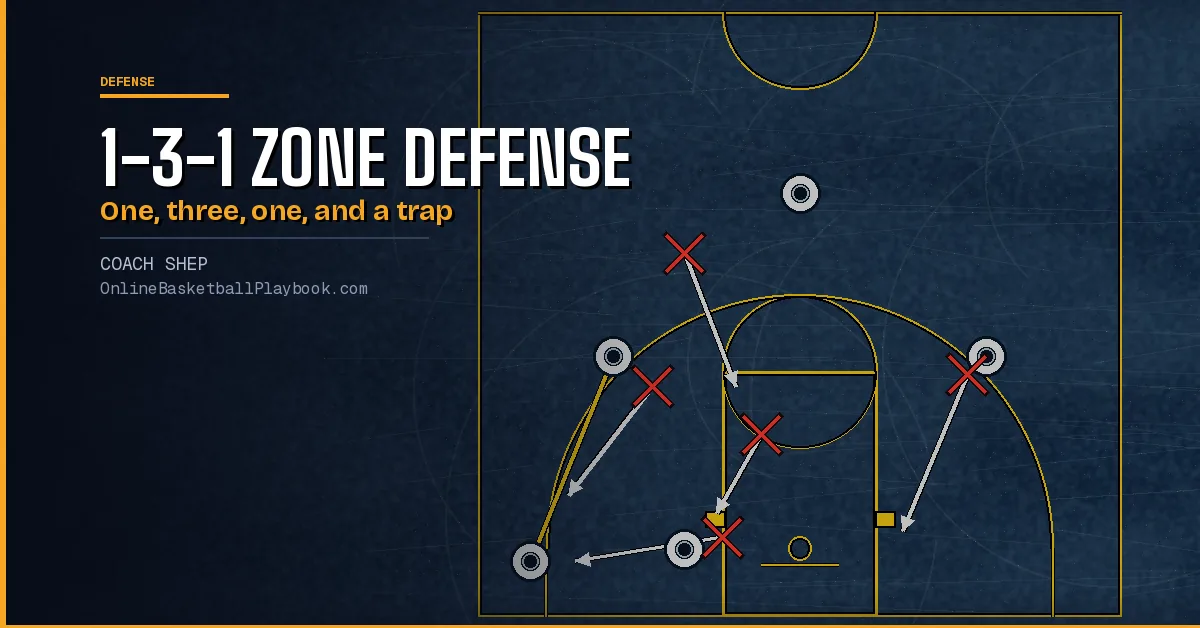
1-3-1 Zone Defense: Traps, Rotations and Drills
How to run the 1-3-1 zone defense: the five roles, the corner and wing traps, the skip pass that beats it, loose and tight depth, and the drills to install it.
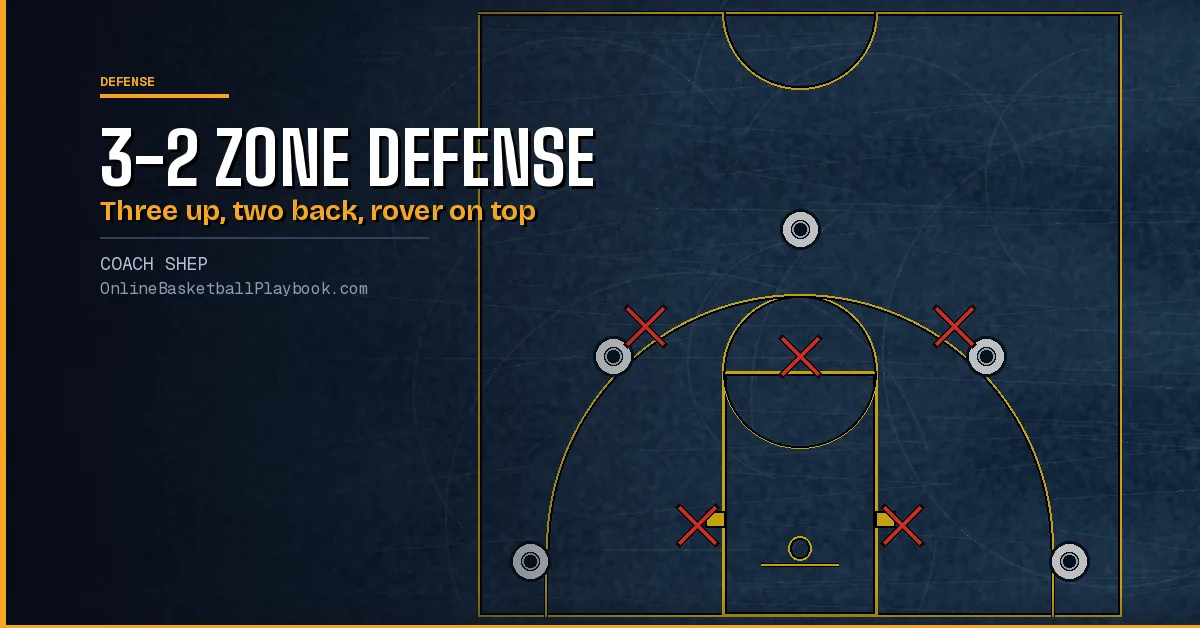
3-2 Zone Defense: Rotations, Weak Spots and Drills
How to run the 3-2 zone defense: the alignment, the rover, every rotation, the weak spots, the 3-2 matchup zone and the drills, plus when to pick it over a 2-3.
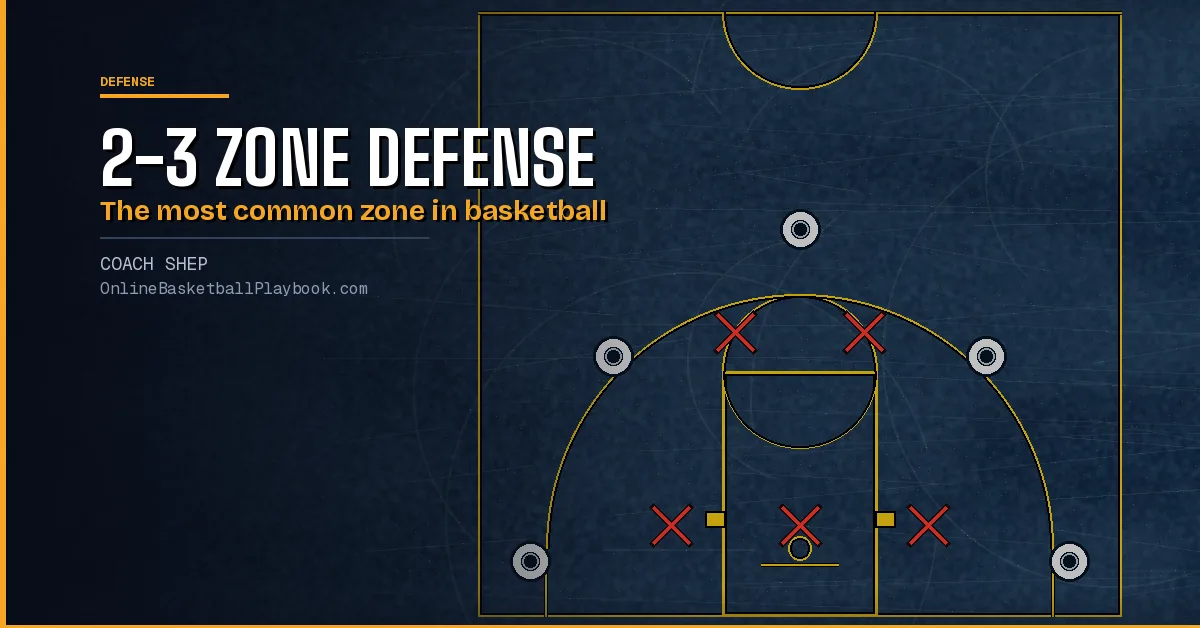
2-3 Zone Defense: Rotations, Weak Spots and Drills
How to play the 2-3 zone defense: the starting positions, how it shifts to the ball, where it leaks, when to trap, and the drills that install it.