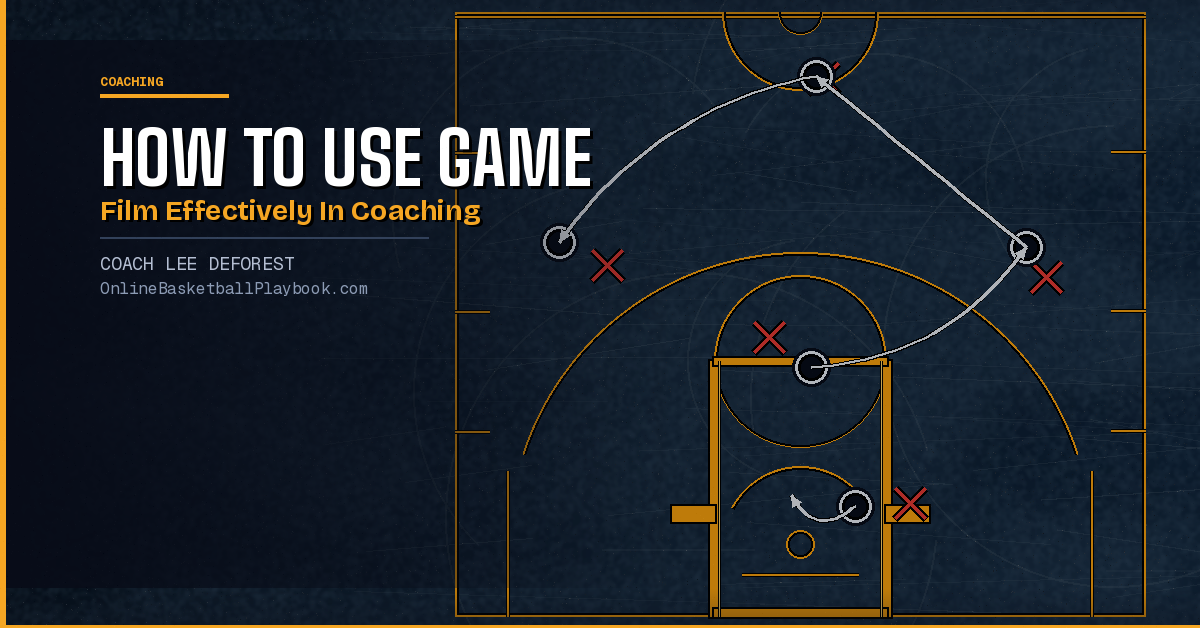

Game film is one of the most underused tools in basketball coaching. When you know how to run a film session, players see themselves clearly, fix problems faster, and buy into your system at a deeper level.
Why Film Works Where Words Fall Short
Every coach has experienced this: you tell a player the same thing three times in practice and they nod along. Then the game happens and they make the exact same read they always make. It is not stubbornness. It is how humans learn. Abstract verbal feedback — "you're late rotating," "you're not seeing the weak side" — hits a wall because the player's internal picture of what they just did does not match what you saw. Film closes that gap.
When a player watches themselves on video, the correction lands with a physical reality that words cannot provide. They see the hedge that came two steps late. They see the skip pass sitting open while they drove into traffic. They see the defensive stance that is upright instead of low. A well-placed clip is worth ten repetitions of the same verbal cue because the player now has a real picture to correct toward. Ashworth's coaching research makes this explicit: "Use video even for youth — kids love seeing themselves and corrections land 10x better."
Film also changes accountability. It is no longer the coach's word against the player's memory. The screen is the neutral third party. That shift in authority removes defensiveness from the conversation. A player cannot argue with footage. They can only decide what to do with what they see.
Setting Up a Film Session That Players Actually Absorb
Most coaches who struggle with film sessions run them wrong from the start. They pull up a full-game recording, let it play, and talk over it for 45 minutes. Players stop watching by the 10-minute mark. Attention drops, and the coach is essentially talking to himself.
The rules for a productive film session are simple.
Keep it short and targeted
Thirty minutes maximum. If you are cutting it right, 20 minutes is enough. The brain retains information in focused bursts. A tight film session with three clear teaching points is worth more than an hour of wandering through tape.
Know your point before you walk in
Every film session needs a stated purpose. "We are watching how we guard ball screens" is a purpose. "Let's look at the game" is not. Pick one or two concepts, pull the relevant clips in advance, and build the session around those clips. Hunting for a clip while 12 players sit there watching you scroll is a session killer.
Use a consistent clip-and-pause rhythm
Play 10 to 20 seconds. Pause. Ask a question before you explain. "What did you see?" or "Where is the help defender supposed to be right there?" Getting players to identify the problem first makes the coaching point stick. They own the answer instead of just receiving it.
End with a forward cue
Wrap every film session with one or two specific behaviors to watch for in the next practice. "When you hedge on a ball screen today, I want you thinking about where we talked about recovering." Connecting film to practice gives players a task that closes the loop between screen and floor.
What to Look For: Offense, Defense, and Habits
New coaches often use film reactively — they watch the game and flag mistakes. Experienced coaches use film proactively — they know what they are looking for before they hit play. Having a consistent checklist helps you pull better clips and run more efficient sessions.
On offense
The first thing to watch is spacing. Where are the off-ball players when the ball is driven or posted? Are they standing in the lane or pinching to the paint, killing driving lanes and cutting options? Spacing problems are invisible during the game but jump out on film. After spacing, look at decision timing — specifically when players choose to shoot versus pass. Late decisions kill offense. Film shows you whether the hesitation is before or after the read window closes, which tells you whether the issue is skill, confidence, or recognition.
Watch for off-ball movement quality. Are players cutting with purpose and timing, or just drifting? The ball moves to where people go; players who drift do not earn the ball and the offense stalls. A quick scan of a half-court possession shows you immediately whether the off-ball side of the floor is alive or dead.
On defense
Rotation timing is the most film-teachable defensive concept. Players almost never feel a late rotation during the game — they are reacting, not calculating. On film, the rotation is visible. You can freeze the frame at the moment the ball is in the air on a skip pass and show every player exactly where they are versus where they need to be. That freeze-frame teaches more than 10 repetitions of verbal instruction on the defensive end in practice.
Also watch ball pressure and stance. Are defenders playing with their weight back? Are they giving the ball handler three feet of space and allowing easy pull-up looks? Stance issues are often habit-based, which makes them film-friendly — the player has to see the pattern in themselves before they believe it is a consistent problem rather than a one-time mistake.
Habits and tendencies
Film is the only place you can track tendencies reliably. A player who always catches with their back to the basket, a guard who telegraphs the skip pass by shoulder-turning early, a big who never seals on misses — these tendencies are invisible in practice because the situations are constructed. Film shows them in real conditions. Keep a short note after each game on one or two tendency patterns you saw. Over four or five games, you have a real picture of what each player actually does under pressure.
How to Deliver Corrections Without Killing Confidence
Film is a powerful tool for confidence if you use it right. It is also a fast way to make players afraid to make mistakes — which is the opposite of what development requires. The delivery of a film correction matters as much as the correction itself.
The first rule is to lead with what you want to see, not only what went wrong. Instead of pausing on a blown rotation and saying "you were completely out of position," pause on the blown rotation and immediately show what the right rotation looks like — either from a previous clip where it was done correctly or by describing it clearly. The player walks away with the right image, not just the wrong one.
The second rule is to name the improvement when it shows up. If a player has been working on reading ball screens and you catch three possessions on film where the hedge is clean and the recovery is fast, pull those clips and show them. Celebrating specific improvement on film — not just success, but evidence that the player is executing the coached behavior — builds the kind of confidence that holds up under pressure. The player now has footage of themselves doing the right thing. That is a mental anchor.
The third rule: shout praise, whisper criticism. When a clip shows a great play, react to it. Let the room respond. When a clip shows a mistake, drop your voice and be precise. "Right here, you're in trail position — let's talk about what changes if you cut a step earlier." A calm, specific correction with a low voice lands better than a frustrated one delivered to the whole room.
Celebrate improvement specifically — "You pivoted on balance all three reps — that's growth" — not just success. Corrections land 10x better when players can see themselves on video.
— Youth Coaching Fundamentals, Basketball Vault
Building a Film Culture Over a Full Season
A one-off film session has limited impact. A film culture — where players expect to see film, know how sessions work, and trust that the process helps them — compounds over a season.
The foundation of that culture is consistency. Run film sessions on a regular schedule. If players know that every Monday they are going to watch 25 minutes of film from the weekend game, they start preparing mentally. They remember what happened. They come in with questions. The session becomes a conversation rather than a lecture.
The second layer is player participation. After a few months of watching film together, start asking players to identify problems before you do. "Somebody tell me what we're seeing on the defensive glass in that third possession." This is not about putting players on the spot — it is about building their ability to see the game. Players who can read film become smarter players. They start doing the film session in their head during the game, anticipating reads instead of reacting to them.
The third layer is individual film. Even 10 minutes of one-on-one film with a player is worth more than 30 minutes of group film for individual skill development. The player gets to see only their own clips, the feedback is private, and the conversation is specific to their role and their growth edge. End-of-season individual conversations about player improvement are more impactful when they are grounded in actual footage from the season — this is one of the most underused development tools in youth and high school basketball.
Over a full season, film builds a shared language on your team. "The rotation we talked about in film" means something specific. "Same thing we saw against Jefferson" connects a lesson learned to a new situation. That shared language is a competitive advantage. Teams that have watched film together think faster and communicate better because they are working from the same mental library.
Before your first film session of the season, tell players explicitly that film is a development tool, not a punishment. Set the expectation that everyone makes mistakes on tape, including returners and your best players. Showing your top player's mistake first — and coaching it the same way you coach everyone else — establishes the tone for the whole year.
Practical Tools and Clip Organization
You do not need expensive software to run effective film sessions. Most programs operate with what they already have. What separates coaches who use film well from those who do not is not the tool — it is the discipline of organizing what they record.
Recording options
A tripod and a smartphone in the corner of the gym at game height gives you a usable angle for most half-court situations. End-line angles are the best for reading spacing. A second camera at mid-court gives you full-court transition looks. If your gym or league records games, request the files. Most programs at the high school level can get game footage within 24 to 48 hours of a game.
Clip organization
The key to fast film sessions is pre-cut clips. If you walk in with the raw footage and hunt for plays in front of your players, you lose them. After each game, spend 20 to 30 minutes cutting the clips you plan to use into a folder organized by concept — "ball screen defense," "transition offense," "rebounding position." When you run your film session, you are navigating a short folder, not a two-hour recording.
Tools like Hudl, Coach's Eye, or even iMovie allow you to timestamp, annotate, and share clips. Hudl is the standard at the high school level and allows players to watch assigned clips on their phones before film sessions, which makes the in-room session more productive. If budget is a constraint, free options like Google Photos shared albums or Dropbox folders of MP4 clips work fine for most programs.
The practice connection
The most effective film programs close the loop between screen and floor within the same week. If Monday's film session identifies a rotation problem on ball screens, Tuesday's practice has a specific ball screen defense drill that targets that exact gap. Players make the connection. They understand that film is not just review — it is the diagnosis that drives what they work on. That connection makes both the film and the practice more purposeful.
- Pre-cut your clips before the session — organize by concept (ball screen defense, transition reads, rebounding position) so you are navigating a focused folder, not hunting through raw footage in front of your players.
- Pause and ask before you explain — freeze the frame and ask "what do you see here?" before delivering the coaching point; players who find the answer retain it far better than players who just receive it.
- Match film to next practice — every film session should produce one or two specific drills or focuses for the next practice session, closing the loop between what players see on screen and what they work on that week.
- Use individual film for your biggest growth opportunities — even 10 minutes of private one-on-one film with a player is more effective than group film for individual skill development and building player trust.
- Show the right play, not just the mistake — always follow a corrective clip with footage of the behavior done correctly, whether from the same game or a previous one, so players leave with the target image, not just the error.
Want more basketball coaching strategies and drills?
Keep Building
Related breakdowns
How to Manage and Utilize Bench Players Effectively
How to Manage and Utilize Bench Players Effectively
How to Coach Basketball Drills More Effectively
How to Coach Basketball Drills More Effectively