Your bench players define your team's depth, culture, and resilience. How you manage them in practice, in games, and in conversation determines whether your roster stays together or slowly fractures under the pressure of uneven minutes.
Why Bench Management Matters More Than Most Coaches Think
Most coaches spend the majority of their planning time on starters: lineups, offensive sets, defensive rotations. The bench gets attention at the end: who comes in first, who backs up the point guard, maybe a situational rotation here or there. That's a mistake that compounds over a season.
The players who aren't starting are watching everything. They see whether the coach fights for them in tough moments, whether they get real reps in practice, whether the rotation is consistent and explainable or random and political. Their attitude in those observations shapes practice energy, locker room chemistry, and how hard the team fights when starters go cold or get in foul trouble.
At every level (youth, high school, college, and professional) teams that win consistently have bench players who are ready, bought in, and understand their specific role. That doesn't happen by accident. It's the result of deliberate management decisions made by the coach every week of the season.
A bench player who feels valued, prepared, and clear on their job will perform that job well when called. A bench player who feels invisible, confused about their role, or resentful of the rotation will struggle even when given open looks, and that failure reverberates through the whole team's confidence. Bench management is player development, team building, and game preparation rolled into one, and the coaches who treat it that way consistently outperform those who don't.
Setting Clear Role Expectations Early
The first conversation about a player's role is the most consequential one you will have with them all season. If you get it right, you set a foundation of trust that makes every subsequent difficult moment easier to navigate. If you get it wrong (or worse, avoid it) you create ambiguity that breeds resentment.
Have individual role conversations before the first game, not after. Sit down with every player who is not in the starting lineup and tell them specifically: what their role is, why it fits them right now, what specific skills or situations you're counting on them for, and what would need to change for their role to expand. Keep it concrete. "You're our energy guy off the bench. You defend, you run the floor, you set hard screens, and you shoot confidently when it's there" is far more actionable than "just stay ready."
Role conversations do two things. First, they give the player something to own. A player with a defined role can practice toward it, improve at it, and take pride in executing it. A player without a defined role is just waiting. Second, explicit role-setting prevents the most common source of bench frustration: players who convinced themselves they deserve more minutes than they're getting because no one ever told them otherwise. When expectations are clear from day one, disagreement is about the facts, not guesswork.
Revisit these conversations every two to three weeks. Roles shift as players develop and as team needs change. A player who started the season as a defensive specialist may earn perimeter shooting opportunities by mid-season. A player who was cracking the rotation in November may have slipped technically by January. Keeping these conversations current prevents stagnation and communicates that you're actually watching and evaluating, not just running the same rotation out of habit.
Keeping Bench Players Engaged During Games
The sideline is where bench management is most visible, and where most coaches lose ground without realizing it. Bench players who are mentally checked out during the game are not ready to contribute when their name is called. The physical side of readiness is obvious: stay warm, stay loose. The mental side is what separates teams that have reliable bench contributions from teams where substitutions feel like chaos.
Give bench players a specific observation job during the game. Don't just tell them to watch. Tell them what to watch. "Track how the 4 is guarding the pick-and-roll every time we run it." "Count how many times they go to the post in the first half." "Watch for when their weakside defender cheats." When players have a cognitive task, they stay tuned in, and the information they gather is useful to you in timeouts and halftime adjustments. This practice builds basketball IQ faster than almost anything else you can do.
Include bench players in huddles as full members of the conversation. Ask a bench player to confirm what they observed. Refer to something a bench player told you. This signals to everyone (starters included) that the people on the bench are part of the team's thinking, not just passengers waiting for their stop. It also builds the bench player's sense of contribution even on nights they don't get significant floor time.
Keep your substitution communication direct and specific. When you call a player off the bench, tell them quickly what you need from them in the next two to three minutes: "Get in there, find a body on every defensive rebound, and let the ball move. We need stops." That one sentence does more to prepare a player than five minutes of pre-game talk. It confirms their role in the current moment and gives them a simple target they can hit immediately.
Creating Meaningful Practice Reps for Every Player
Practice structure is the most direct lever you have on bench player development. If bench players spend most of practice standing in line, serving as live tackling dummies for the starters, or running shells and sets they will rarely see in games, they will not improve, and they will know they are not improving. That knowledge kills motivation faster than anything.
Design practice so that meaningful reps are distributed across the roster, not hoarded by the top eight. This doesn't mean equal reps in every drill. It means every player gets enough meaningful work in their specific skill areas to feel progress. A defensive-specialist bench player should get a disproportionate share of the defensive breakdown work. A player who is developing as a shooter should get real shooting repetitions in game-context situations, not just end-of-practice free throws.
Use split-squad drills intentionally. When you're running a starting unit through a half-court offensive concept, put your bench players through a competitive 1-on-1 or 2-on-2 drill on the side that directly addresses their development needs. This keeps both groups engaged and makes the most of limited gym time. It also prevents the low-energy drift that happens when ten players are watching three work.
Track individual skill progression the same way you track team statistics. Know which bench players are improving their catch-and-shoot percentage in practice. Know which player's defensive positioning has gotten sharper over the last three weeks. When you can name specific improvements to a player in a role conversation, it proves you're watching, and that proof is the foundation of the trust that makes bench players give maximum effort even when the scoreboard says the game is out of reach.
Knowing When and How to Deploy Your Bench
Substitution timing is part science, part feel, and heavily situation-dependent. There is no universal rule that applies to every game, but there are principles that separate coaches who use their bench effectively from those who ride eight players until someone gets hurt.
Use your bench to change the game's pace, not just to give starters a rest. When a game is being played at your opponent's preferred tempo, a bench unit that naturally plays at a different pace can disrupt that rhythm before your starters come back in. When your starters are struggling to score, a bench player known for energy and pressure defense can shift the momentum without requiring a timeout. Think of substitutions as tactical tools, not personnel management chores.
Match bench players to specific situations where their skills create a direct advantage. If you have a bench player who sets elite screens and your opponent's pick-and-roll coverage is soft, that player becomes a weapon in the third quarter when the game is tightest. If you have a bench player with an elite second step on closeouts, get them on the floor when the other team is finding their three-point rhythm. Situational deployment rewards the preparation you've done in bench player development and gives those players high-leverage moments where their specific skills matter.
Avoid the trap of pulling bench players at the first sign of a mistake. Nothing destroys a bench player's confidence faster than being yanked after one turnover or one missed rotation while a starter who makes the same mistake stays on the floor. Hold bench players to the same standard you hold starters, not a stricter one, not a looser one. Consistency in substitution criteria is what allows your bench to play freely instead of cautiously, and free players make better decisions than scared ones.
Before every game, identify two or three specific situations where a bench player's particular skills give you a matchup advantage: screen-setting against a soft coverage, defensive pressure on a ball-dominant guard, or perimeter shooting against a zone that overplays the paint. Call those players' numbers when those situations arise, not just when starters need a rest. Players notice when the rotation has logic behind it, and that recognition builds the trust that carries through a full season.
Building a Bench Culture That Elevates the Whole Team
Bench culture is what you see when the starter hits a big shot: do the bench players leap off their seats, celebrating like it was their own? Or do they offer a polite clap and look away? That reaction tells you everything about the environment you've built, and it tells your starters something too.
Deliberately build rituals around bench energy. Some teams have a specific handshake or acknowledgment for players coming off the floor. Others designate a "bench MVP" each game, a player who brought maximum energy and preparation regardless of minutes. These aren't trivial gestures. They communicate that the bench is a position of active contribution, not passive waiting, and that everyone on the bench has a specific job during the game even when they're not on the floor.
Praise bench players loudly, in front of the team. When a bench player executes their role well (a hard screen that springs a starter, a defensive stop that ends an opponent's run, a corner three that changes the game), name it explicitly in the next team meeting, in the film session, in your postgame remarks. Public recognition signals to everyone watching what the program actually values. Players build their behavior around what gets recognized, so recognize the things you want repeated.
The most durable bench cultures are built on the principle that the scoreboard is a by-product of everyone doing their job, not just the five players who start. When bench players internalize that belief (because the coach has demonstrated it consistently through role conversations, practice design, substitution patterns, and public recognition) they become the source of competitive energy that carries a team through tight games and long seasons. That belief doesn't arrive pre-installed. The coach builds it, day by day, from the first practice of the year.
- Hold individual role conversations before the first game: Tell each bench player specifically what you're counting on them for, why, and what would need to change for their role to expand.
- Give bench players a specific observation task during games: Assign what to watch, then reference what they saw in huddles and halftime. It keeps them mentally in the game and builds basketball IQ fast.
- Design practice so bench players get reps in their development areas: Split-squad drills and targeted work, not endless standing in lines watching starters run sets they'll rarely see.
- Deploy bench players to change pace or exploit specific matchups: Not just to rest starters. Know two or three situations per game where a bench player's specific skill creates a direct advantage.
- Recognize bench contributions loudly and publicly: In team meetings, film sessions, and postgame remarks, players build their behavior around what the coach actually notices and names.
Want more basketball coaching strategies and drills?
Join the Online Basketball Playbook newsletter →
Draw this play free in the play drawer →
Membership: the full library, playbook packs, and Pro drawing tools →
Keep Building
Related breakdowns
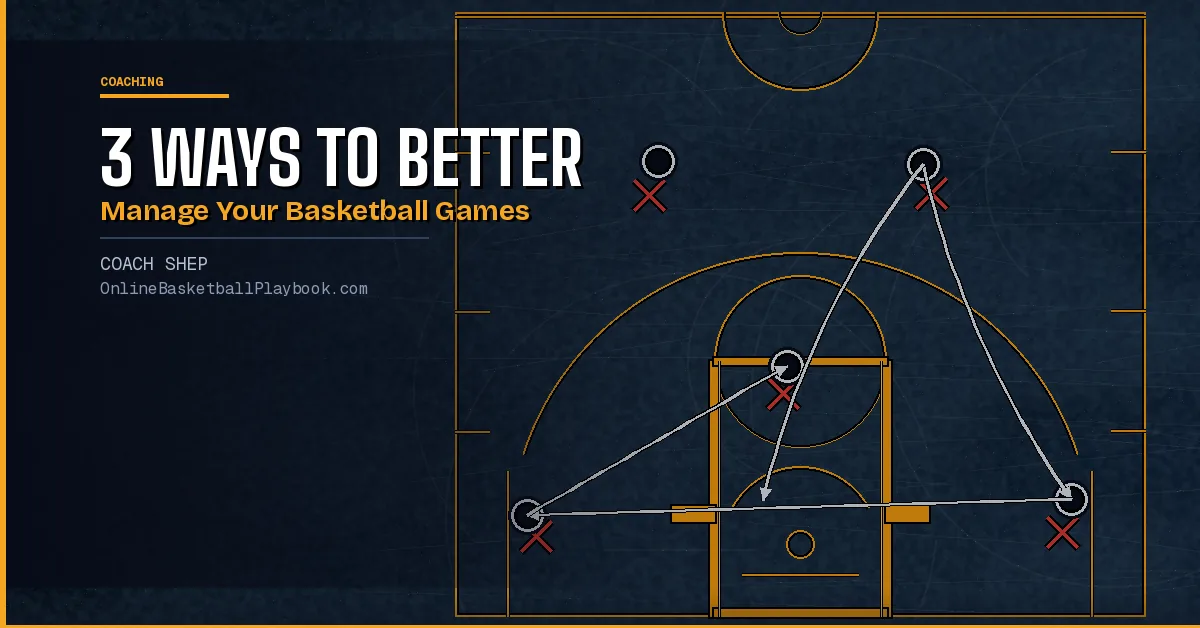
3 Ways to Better Manage Your Basketball Games
3 Ways to Better Manage Your Basketball Games
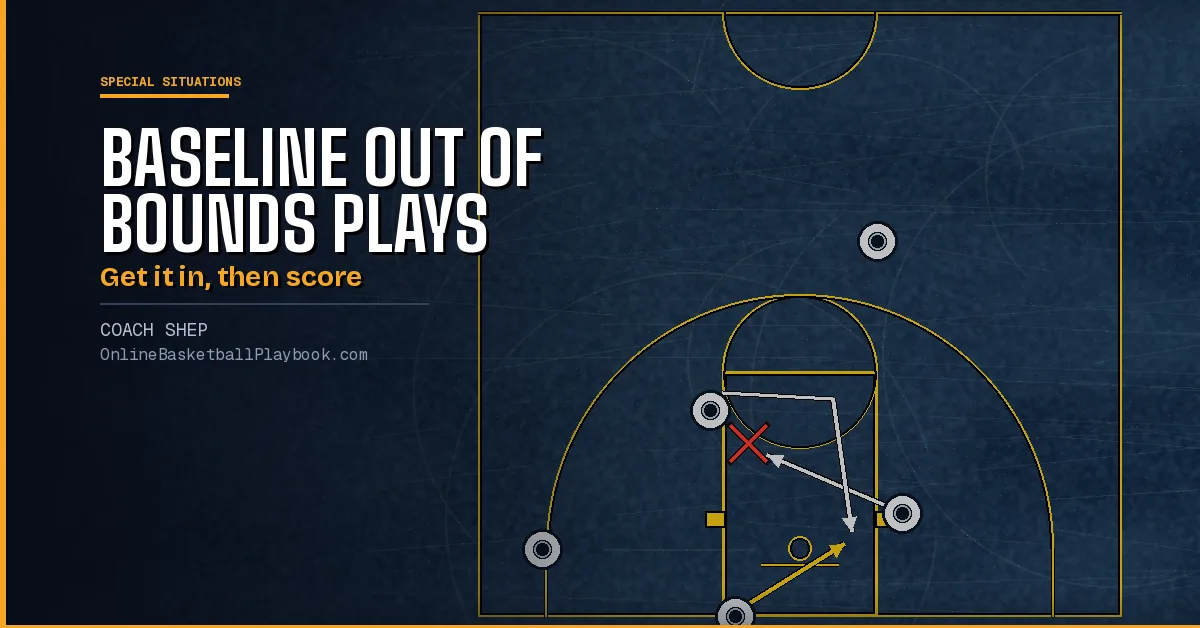
Baseline Out of Bounds Plays: Sets vs Man, Zone and for Youth
Baseline out of bounds plays drawn step by step: a box back screen and roll, Pick the Picker, the double stack, a 2-3 zone play, youth one-pass plays, the rules and the reads.
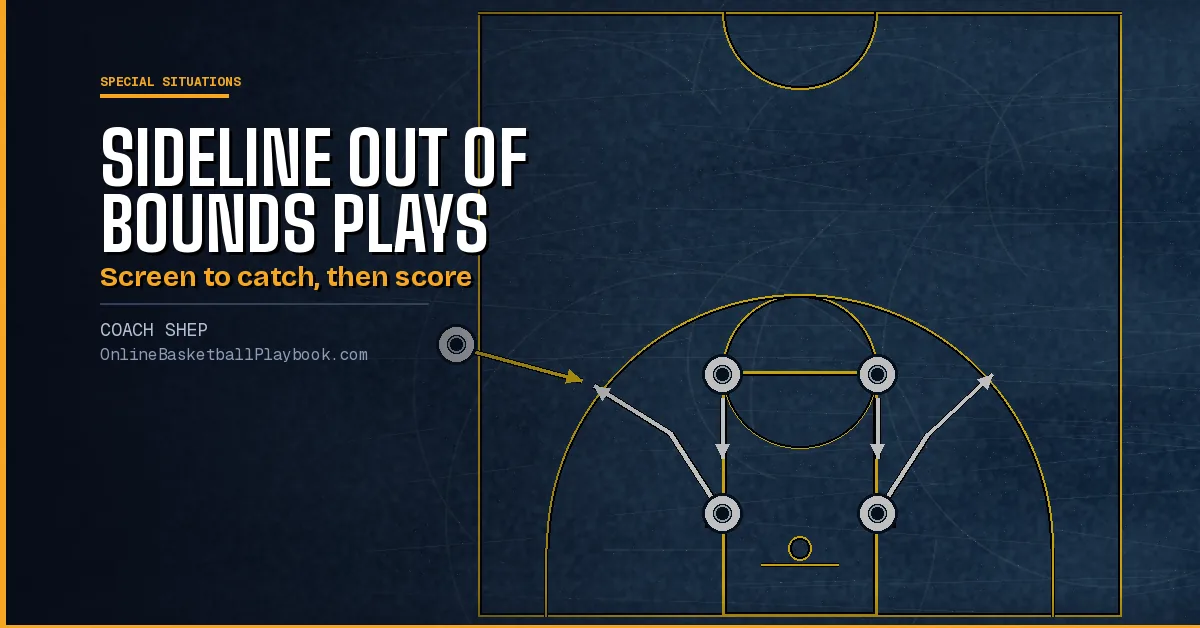
Sideline Out of Bounds Plays: SLOB Sets, Reads and Practice
Sideline out of bounds plays for coaches: SLOB sets from a box, stack and line, the inbounder's reads, plays against zone and denial, the clock and practice.