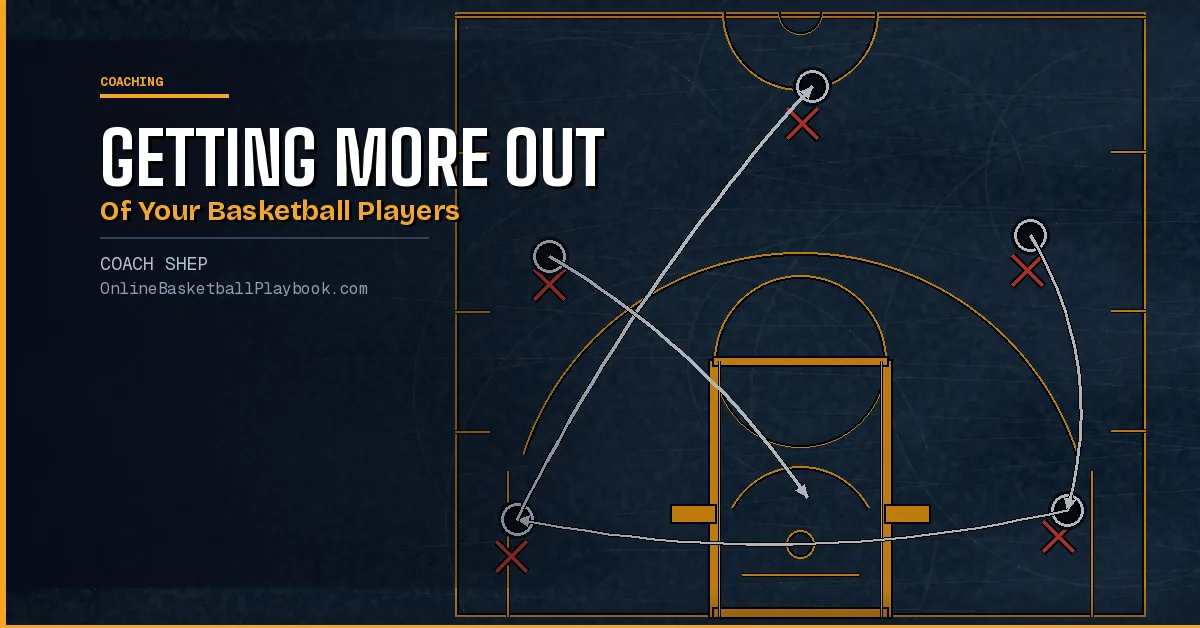
Most coaches already have the talent they need. The gap is rarely recruiting. It's teaching. These five principles show you how to raise every player's ceiling without adding a single new drill to your practice plan.
Teach Reads, Not Plays
The most common coaching mistake at every level, youth through varsity, is building an offense around plays instead of reads. A play gives a player a direction. A read gives a player a decision-making framework that works in any situation, against any defense, with any lineup combination on the floor.
When you run a play, your team is only as good as how well they execute that specific script. When the defense takes it away, and eventually every defense takes it away, your players stand flat-footed waiting to be told what to do next. Coaches describe this as their team "breaking down." The real problem is that breakdown was designed in from the start.
A read-based motion offense flips that entirely. Harry Perretta's "No Mistake" five-out motion offense, one of the most studied open-post systems in the game, is built on the principle that players "learn to play, not run plays." Every action comes from reading the defender, basket-cut a sagging defender, go backdoor against an overplaying one. The same rule applies to screeners: they slip any time the cutter goes backdoor or curls. No called play required.
The practical consequence for practice is significant. Instead of spending thirty minutes installing a new set each week, you spend that time on decision-making reps, putting players in two-on-two and three-on-three reads until the correct response to each defensive alignment becomes automatic. At the varsity level, the reads become language. Pat Summitt's 1-2-2 structured motion required screeners to call the read aloud. "Curl!" or "Slip!" , so the cutter could process the action without taking his eyes off the ball. That kind of named communication turns five individuals into one coordinated unit.
Start here: pick two reads from your offensive system and run them exclusively for two weeks. Don't add new sets. Watch your players' decision speed improve. That improvement is what getting more out of your players actually looks like.
Fix Spacing Before Fixing Shooting
Bad shooting percentages are often a spacing problem wearing a shooting costume. When players crowd the lane, driving lanes close, kick-out passes find covered shooters, and the defense can comfortably load up on the ball. Fix the spacing, and the same shooters suddenly get cleaner looks, without a single shot-form correction.
The five-out alignment is the most direct spacing tool available in modern basketball. All five players start outside the three-point arc, pulling shot-blockers and rim-protectors away from the basket. Every drive finds an open lane because there is no one standing in it. Every kick-out lands a shooter in space.
There is one critical prerequisite: the offense only works when every player on the floor can make the defense respect their catch. A single non-shooter collapses the entire structure. The defense can sag that player's defender into the lane, and now you have a fifth help-defender on every drive with no cost. Before you install a spacing-based offense, evaluate your lineup in practice. How many players can make an open three at a rate that forces the defense to close out? That number tells you which alignment to run: three-out, four-out, or five-out.
The developmental progression is explicit: teams without enough reliable perimeter threats start in three-out-two-in, which preserves an interior post presence and generates scoring through drive-and-kick to a rolling big. As perimeter confidence grows, you move to four-out. Only when the evidence in games supports it, not on a predetermined schedule, do you move to five-out.
For coaches at the youth and JV level, this framework is especially useful for parent conversations. The question isn't "why isn't my child shooting more?" It's "what does the alignment require, and what does your child need to demonstrate to earn that spot in a five-out lineup?" Spacing is the answer to both questions.
Stop Tolerating Purposeless Dribbling
Nothing kills spacing faster than a player who dribbles without a destination. The drive breaks down, the defense recovers, four teammates have to hold their spots while the ball goes nowhere, and the shot clock burns. Coaches let this happen at practice every day because there's no hard rule against it.
Hackenberg's "dribble for three reasons only" rule is one of the cleanest player-development constraints in motion offense coaching. The rule is simple: a player may dribble to attack the rim on a straight-line drive, to improve a passing angle, or to break a five-second count. Any other dribble is a team violation. When a player drives, the spacing rule activates immediately: the player at the point of attack pushes up, the corner dives, the trailer pulls to the "tail lights" position behind the drive.
Implementing this as a team rule changes player behavior within a single week. Players who previously used the dribble to think now have to make decisions before they catch the ball. Catch-ready habits develop faster. Shot selection improves because players stop dribbling into worse situations. And the players around the ball start moving with purpose because they know the drive is coming before it happens.
Run a two-possession drill: any possession where a player dribbles without one of the three purposes is a turnover, possession ends, the other team takes it out. The consequence is small enough that players aren't afraid of it but real enough that it stays in their minds. Three or four practice sessions on this rule produces a measurable change in decision speed and spacing discipline across every offensive possession.
Make Every Player Catchable, Even Non-Shooters
One of the hardest habits to develop in a spacing offense is also one of the least coached: the non-shooter who catches the ball with the same threat posture as the best shooter on the team. Feet set, eyes on the rim, triple-threat, what Rumjahn calls "fake it till you make it." The defense doesn't know who the shooters are at the moment of the catch. If a non-shooter catches and immediately looks to pass, the defense learns to ignore him within two possessions.
Every player on the floor needs to catch ready to attack. This means ball-side foot forward, knees bent, eyes up, a genuine read of whether the close-out is beatable before making any decision. Even if that player has never made a three-pointer in a game, the defender closing out doesn't know that. The moment the defender learns he can safely sag, your spacing is compromised at that spot.
The drill for this is one-on-one against a close-out. Every player runs it, not just the shooters. The non-shooter's job is to read the close-out: if the defender sprints out and loses his hips, drive it. If he slides under control, shot-fake and drive. The goal is not to make threes. The goal is to teach the player that his catch matters to the team's offensive structure, that the defense has to make a decision about how to guard him, and that the right response to any close-out is a read, not an automatic pass.
Over a full season, non-shooters who develop this habit add a dimension that no scouting report can fully account for. The defense can no longer commit a free helper to the paint off that spot. That changes the math on every drive from every other position on the floor.
Match Your Offensive System to Your Roster, Not Your Preference
Coaches fall in love with systems. That's understandable. You've invested time learning them, watching film, building practice plans around them. But the most expensive coaching decision you can make is running a system that your personnel can't execute, hoping they'll grow into it mid-season.
The three-out-two-in, four-out, five-out progression exists precisely because teams exist at different stages of development. A team with two reliable post players and three perimeter players who struggle to create off the catch should be in three-out-two-in. They generate interior scoring through drive-and-kick to a rolling big. The posts touch the ball early. The offense generates high-percentage shots through actions the players can actually execute.
Moving that same team into five-out because the coach prefers it (or because "spacing is where the game is going") guarantees a long year. The posts stand on the perimeter without the skills to operate there. The perimeter players drive into a crowded lane because the posts aren't genuine threats. The team looks lost, and the coach blames effort or attention to detail when the real issue is a mismatch between personnel and system.
Before the season, map each team onto the progression. Count how many players can reliably make the defense respect their catch, meaning the defender has to close out hard rather than sitting in the lane. That number is your alignment. If it's two, start in three-out. If it grows to four by February, move to four-out for the playoffs. The system serves the roster, not the other way around.
This is also a useful framework for mid-season adjustments. If drives are being cut off consistently, check whether a non-shooter in the lineup is being sagged. If so, either sub in a shooter or run a set that doesn't require that corner to be a threat. Personnel-first coaching isn't a retreat from a system. It's the system working as intended.
Build Habits Through Named Language
The fastest way to transfer a read from film session to game speed is to give it a name. Named language compresses a multi-step decision into a single word that players can say to each other in real time: no timeout needed, no coach intervention, no slowing down.
Pat Summitt's structured motion required screeners to call the read aloud ("Curl!" or "Bump!" or "Slip!") the moment they identified the defensive positioning. The cutter's eyes are on the ball. Without the call, the cutter guesses. With it, the action is synchronized before it starts. This is why Summitt could run a complex down-screen series at elite pace: the language did the coordination work.
Gibson Pyper's five-out specials framework builds named language in a different direction: three explicit cut reads (Curl Read, Fade Read, Reject Read) plus branches for how the offense responds to denial or sag. Every player knows the vocabulary. When the ball is caught and the defense shows denial on the wing, every player on the floor knows the offense shifts to the Continuity vs. Denial branch: no signal from the sideline required.
Coaches who haven't done this often resist it because it feels like more to teach. The opposite is true. Named language reduces what you have to re-teach after a bad possession. Instead of "let me explain what happened on that screen," you say "that was a bump situation, what was the call?" The players can self-correct because they have shared vocabulary for what went wrong. That self-correction loop is how habits form faster and hold longer.
Pick three reads from your offense before your next practice. Name them. Drill each one separately until the name alone triggers the correct movement. Then put them together in live play and require players to call the read before executing it. The first three sessions will feel slow. By the fifth, the calls will be automatic and the reads will be sharper than anything you could produce with a diagrammed play.
Before installing any new offensive concept, count your shooters (specifically, how many players force defenders to close out hard rather than sit in the lane). That number determines which alignment your team should run, and that decision alone will improve your offense more than any new set play you add this season.
- Teach two reads, not ten plays: pick basket-cut and screen-away, drill them until automatic, then add reads only when those two are owned at game speed.
- Apply the three-dribble rule immediately: drive, pass angle, five-count. Any other dribble is a team violation at practice. It fixes decision speed within a week.
- Map your lineup before choosing an alignment: count defenders who must close out hard (your genuine threats) and run three-out, four-out, or five-out to match that number, not your offensive preference.
- Require screeners to call the read aloud: one word ("Curl!" or "Slip!") before the cutter moves synchronizes the action without a coach signal and builds self-correcting habits faster than any film session.
- Designate a crash player on every possession: rotate the rebounding assignment every two or three possessions so spacing is preserved and the same player isn't sacrificing position every shot.
Want more basketball coaching strategies and drills?
Join the Online Basketball Playbook newsletter →
Draw this play free in the play drawer →
Membership: the full library, playbook packs, and Pro drawing tools →
Keep Building
Related breakdowns
Cutting Players: What to Say and How to Say It
Cutting players: what to say on day one, in the meeting and to parents, the words to use and avoid, what to hand the player, and how to keep the door open.
Coaching Communication: How to Explain Basketball to Players
Coaching communication for basketball: the teaching order, fewer and clearer words, how to correct a mistake, one team vocabulary and calls taught inside the drill.
Teaching Players to Adapt to Different Playing Styles
Teaching Players to Adapt to Different Playing Styles