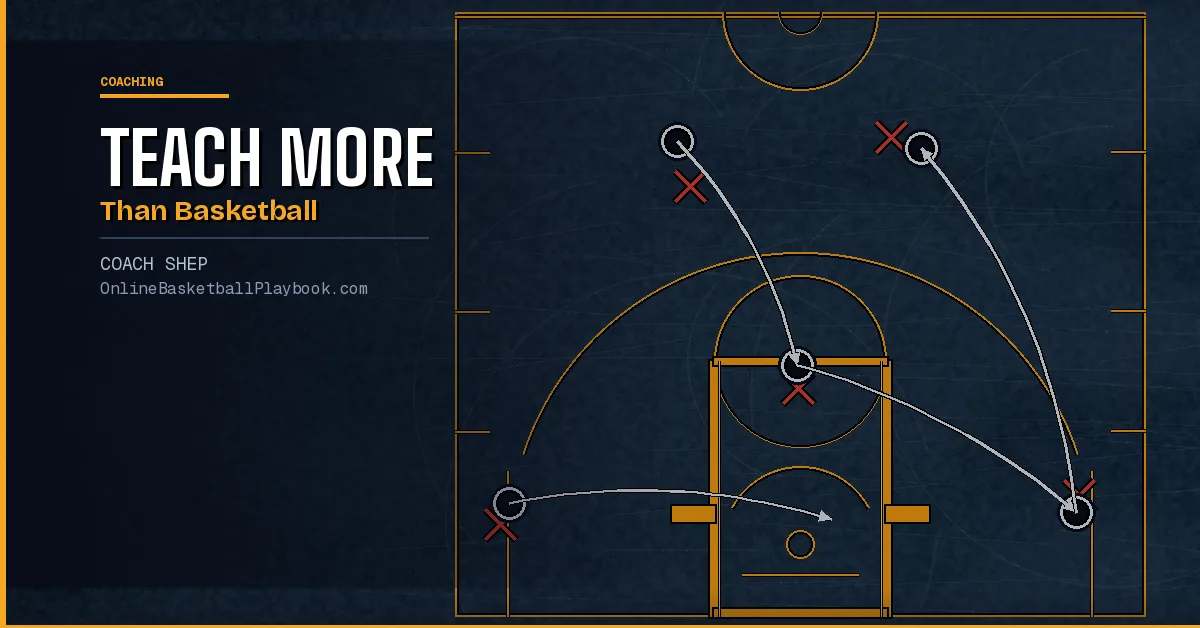
The best coaches don't hand players a script. They build players who can read, decide, and act under pressure. That shift, from running plays to making reads, is where real basketball IQ is born.
Why Plays Alone Don't Develop Players
Walk into any gym in America and you'll see coaches drilling the same four or five set plays, running them over and over until players can execute them from muscle memory. The players look sharp in walkthrough. They look comfortable in rehearsal. Then the game starts, the defense shifts, and everything falls apart.
That's not a talent problem. That's a teaching problem.
When a player only knows routes, they can only play in the situations those routes were designed for. A screen-roll action that works against drop coverage looks completely different against a blitz. A drive-and-kick looks different when the corner defender cheats toward the paint. The player who learned a path doesn't know what to do. The player who learned a read does.
The fundamental insight underlying every successful read-based offense (Princeton, dribble-drive, pace-and-space, any of them) is that basketball is a decision sport. The player who sees the picture accurately and chooses the right action wins the possession. Every drill, every coaching conversation, every practice rep should be working toward that outcome: a player who can see, decide, and act.
Teaching that kind of player takes more than running set plays. It requires a deliberate, structured approach to developing decision-making as a trainable skill. And the research and coaching practice behind it is more developed than most coaches realize.
The Decision-Making Framework Every Coach Needs
The core premise, supported by coaches from Ettore Messina to Don Meyer, is simple: decisions are a trainable skill. You don't hope players develop court vision. You engineer the reps that force them to use it.
Don Meyer described the path through four stages of learning. A player starts unconsciously incompetent. They don't know what they don't know. They can't see the help defender rotating because they've never been taught to look for it. Through deliberate teaching, they become consciously incompetent. They now know the read exists, but they have to think about it. With more reps, they reach conscious competence: they can make the read, but it's still effortful, a checklist they run in their head. The goal of every decision-making drill is to push players toward the final stage (unconscious competence) where the read happens automatically, without deliberate thought, in game time.
Meyer had a principle for this: "See the picture, sell the picture, then everybody paints the picture." Players who understand why a read exists execute it more consistently than players who are just following a command. Before the drill, explain the situation. Name the defender's mistake. Show what the offense is punishing. When a player understands the logic of a read (not just the outcome but the cause) they own it. They can apply it to situations they've never seen before.
The five laws of learning that Meyer taught (readiness, demonstration, imitation, correction, repetition) map directly onto how coaches should structure decision reps. You can never move to the next step until the current one is solid. "You can never teach too slowly," he said, meaning: don't rush past demonstration into live reps until the player has an accurate mental picture of what they're looking for.
How to Structure Advantage Drills
The most powerful tool for teaching decisions is the advantage drill, a setup where the offense starts with a built-in numbers edge, forcing a decision every single rep. The drill doesn't give the player a route. It gives them a situation and asks: what do you see, and what will you do?
The progression runs: 2v1, then 3v2, then 4v3, then 4v2-plus-2, then 5v3. Each step adds a defender, making the read harder while keeping it game-real. That's the key: the read is never scripted and never fake. A live defender is making a real choice, and the offensive player has to respond to what actually happens.
In a 2v1, the ball handler drives and the decision is binary: beat the lone defender alone, or hit the open teammate. Simple. Clean. But it trains the most fundamental read in basketball. Find the extra person. In a 3v2, there are now two defenders and three offensive players. The passer has to find the "extra" pass, often skipping over the first available option to find the true advantage. In a 4v3, the reads connect. A drive forces a rotation, which opens a cutter, which freezes a helper, which opens a shooter. The player is learning a chain of consequences, not a single move.
Quin Snyder's Systematic Situational Training method puts a name to the underlying structure. Identify the specific situation players will face. Attack it systematically, isolating it in a drill at the right numbers progression. Teach it to its finest points, not just the result but the foot angles, the timing cues, the verbal calls. Then hold players accountable, but only after giving them enough reps to build real habits. His target state: players stop waiting to be corrected and start holding each other accountable. The coach's standard becomes the team's standard.
Akser's progression follows the same logic at the individual action level: 1v0 (no defense, learn the footwork and the concept), then 1vC (a coach gives the read verbally, guiding the player in real time), then controlled advantage (the player faces more defenders than they can beat alone, forcing the pass), then full game-situation. The same progression can be used to install any action (a ball screen, a back-cut, a pindown) and the player graduates from running a pattern to reading the defense.
Teaching by Level: Youth Through High School
One of the most underappreciated points in decision-making development is that the right method changes with the player's age and experience. The same goal (build a player who reads, decides, and acts) is pursued differently at different stages.
Youth Players (Ages 8–12)
At the youngest levels, the teaching tool is conversation, not live constraints. When a young player makes a bad decision, the instinct is to stop them immediately and correct. The research-backed approach is different: let the play finish first. Then ask, "What did you see there?" before offering any correction.
That question does something powerful. It treats the player as someone who was trying to read the situation (not just a body running a wrong path) and it teaches self-evaluation. The player learns to look back at their own decisions and develop an internal coaching voice. The two-choice binary is the ceiling at this age: shoot or pass? Drive right or left? Keep the decisions small, make them real, and build the habit of looking before acting.
Developmental High School
At the high school developmental level, coaches can shift to structured advantage drills and constraint-based reps. The Akser progression fits cleanly here: install any action from 1v0, add coach guidance at 1vC, then give a controlled advantage before live game situations. The player is still being scaffolded, but the scaffolding is a situation and a constraint rather than a verbal prompt. The drill forces the read without telling them what the read is.
Advanced High School and College
At the highest levels, the target is what Ettore Messina called "decide while catching." The read happens during reception, not after, peripheral vision is scanning the help side as the ball is in the air. At this level, full read-tree menus become appropriate. A ball handler running a pick-and-roll has eight distinct options, all triggered by what the two defenders do. A screener has six. A cutter reading the same action has options of their own. The player who has moved through the earlier stages of the decision ladder can navigate all of them.
Constraints: The Underrated Coaching Tool
Constraint-based coaching is one of the most effective and underused methods for isolating and developing specific reads. The idea: limit what players are allowed to do in a drill so that the decision you're teaching becomes the only option they have to solve.
A classic example is the "catch-and-shoot or catch-and-pass only" rule, no fakes, no dribble. On the catch, the player must immediately either shoot or pass. This forces them to have a pre-read before they receive the ball, because they've taken the dribble entirely off the table. They can't take three dribbles and think. They have to see the picture before the ball arrives.
Kevin Boyle's elbow-read drill shows a complementary approach: a coach at the elbow calls a constraint each rep (hesitation, baseline-reverse, drag-crossover), and the player must execute that specific finish against a live defender at game speed. The decision itself is real: the player can't run a memorized sequence because the defense is live. But the situation is controlled: the coach has chosen which read to over-rep that day. This is the middle ground between pure live play and scripted drills, and it's enormously useful for isolating a single finishing read while keeping the rep meaningful.
Constraints also teach players what defenders are giving them by process of elimination. When a player can only catch-and-shoot or catch-and-pass, they quickly learn to read whether the defender is under the screen (shoot) or out to the ball (pass). The constraint makes the relevant information obvious. Once the constraint comes off, the player already knows what to look for.
Building a Practice Culture Around Reads
Decision-making development isn't just a drill type. It's a practice philosophy. The way a coach structures time, responds to mistakes, and talks about the game shapes whether players become readers or route-runners over an entire season.
The first shift is in how coaches respond to mistakes. When a player makes a wrong decision, the impulse is to stop play immediately and correct. That has value, but it also trains players to look to the sideline after every possession, waiting to be told what they did wrong rather than developing their own evaluation. The better practice: let the play finish, then ask "What did you see?" before offering the correction. That question activates the player's own read-back process and teaches them to self-coach.
The second shift is in how drills are scored. Jacobson's 15-second shell drill challenge turns a decision task into a scorable competition, offense gets a point for good decisions, defense gets a point for good rotations. When the standard is scored, players take the decision seriously in a way they don't when it's just a drill. The competition reveals who is and isn't reading.
The third shift is in language. Quin Snyder's principle ("the sillier the name, the more they remember it") applies directly to read coaching. Give every read a precise name, even a weird one. When a player hears "corner stunt" and knows exactly what the corner defender is doing and what that means for their decision, they can communicate faster, think faster, and hold each other accountable without waiting for a coach to intervene. The word becomes the decision.
Finally, the practice structure itself matters. One decision-making drill book builds a full ladder: 1v1 isolated reads, a gap-stunt closeout, a pindown read, a veer finish, then 2v1 ball-screen reads, then 2v2, then 3v2 and 3v3 post doubles and combination screens. The value of the ladder is the sequence. Each step isolates a new read, adds the next relevant defender, and then connects the action to the possession that flows from it. Players don't just learn the read. They learn the read in context, which is where it actually has to work.
When practice is consistently structured around advantage drills, constraint-based reps, and decision scoring, something changes in the gym. Players start talking to each other between reps about what they saw. They start calling the reads by name without being prompted. They start holding each other accountable to looking before acting. That's the target state Snyder described: the coach's accountability becomes the players' accountability. When that happens, the team is no longer being coached to make reads. They are coaching themselves.
Before your next practice, pick one specific read you want players to own by the end of the season: a corner closeout, a short-roll pitch, or a drive-and-kick. Build your advantage drill progression around that one read: 2v1, then 3v2, then 4v3. Run it every practice. Name it, score it, and let players start correcting each other when the read is wrong. One read, owned deeply, transfers better than five reads learned superficially.
- Start every practice with a decision rep. Open with a 2v1 or 3v2 advantage drill before any set plays. It primes players to look before they act for the rest of the session.
- Name every read you're coaching. Give constraint situations and defensive looks specific labels so players can communicate and self-correct without waiting for you to intervene.
- Use the 1v0 → 1vC → controlled-advantage → game progression To install any new action, don't go live until players have demonstrated the read at the previous stage.
- Ask "What did you see?" before correcting. Let plays finish, then activate the player's own evaluation before offering the answer. This builds self-coaching habits over a full season.
- Score decision drills like competition. Points for correct reads (offense) and correct rotations (defense) make the standard real and reveal which players are and aren't reading under pressure.
Want more basketball coaching strategies and drills?
Join the Online Basketball Playbook newsletter →
Draw this play free in the play drawer →
Membership: the full library, playbook packs, and Pro drawing tools →
Keep Building
Related breakdowns
Teaching Teamwork and Collaboration in Basketball
Teaching Teamwork and Collaboration in Basketball
Teaching Players to Adapt to Different Playing Styles
Teaching Players to Adapt to Different Playing Styles