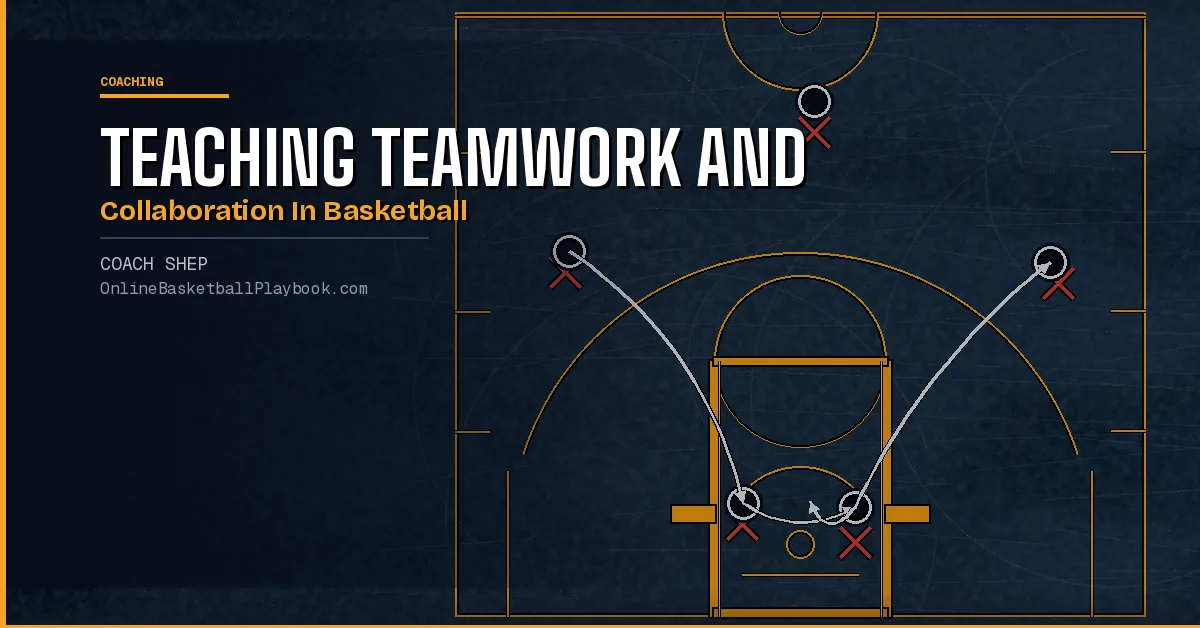
Teamwork does not happen by telling players to pass more. It happens when your practice structure forces them to read each other, communicate, and make connected decisions, every single rep.
Why Teamwork Is a Trainable Skill
Most coaches talk about teamwork in film sessions and pregame speeches. The players nod, take the floor, and revert to their default habits the moment a defender closes out. That gap, between knowing and doing, exists because teamwork was never actually trained. It was assumed.
The research-backed truth is that connected, collaborative play is a skill, and skills are acquired through deliberate, repeated practice in game-like conditions. Don Meyer framed it plainly: players move through four stages of learning, from unconscious incompetence (they do not even know the collaborative read exists) all the way to unconscious competence (they execute it without thinking). Getting players to that final stage requires specific reps, not speeches.
What that means in practice is that every drill you run either builds the habit of collaboration or the habit of isolation. An individual finishing drill where a guard catches and scores one-on-zero trains individual finishing. A 2v1 advantage drill where the ball-handler reads the helper and makes the connected pass trains teamwork. The gap between those two reps is the gap between a team that passes and a team that actually plays together.
The first job of a coach who wants collaborative players is to audit the practice plan. Count the reps where players are forced to read a teammate. If those reps are rare, teamwork will be rare on game night, regardless of what the whiteboard says.
The Read-Based Foundation of Team Play
Collaborative basketball starts with a shared read. Two players cannot play together if they are running separate scripts. They can only play together when both understand what the defense is giving and who is supposed to benefit from it.
This is why read-based offensive systems produce more genuine teamwork than rigid set-play systems. When players learn reads instead of routes, they develop a common language for what they see on the floor. The ball-handler drives because she reads help loading. The corner shooter relocates because she reads the drive and the defensive rotation. Neither is running a predetermined path. Both are responding to the same defensive picture. That shared perception is the root of team play.
Ettore Messina, one of the most decorated coaches in European basketball, teaches his players to "decide while catching." The read happens during reception (not after the catch, not in a dribble), which means the decision is already made by the time the ball arrives. For that to work, the receiver and the passer must both understand the situation before the pass is thrown. That pre-pass communication, whether verbal or through body language and spacing, is collaboration made visible.
Bob Knight framed it as "see and react", not "run your route and react." The difference is enormous. A player running a route is thinking about herself. A player reading and reacting is thinking about the defense and, by extension, about where her teammates are relative to that defense. That mental shift, from self-directed to situation-directed, is the cognitive foundation of team basketball.
Coaches who want to develop this read-sharing capacity need to teach reads explicitly, name them, and drill them in two-player and three-player groups before expanding to five-on-five. The connected read is learned in small groups. Five-on-five just reveals whether it was learned.
Advantage Drills: Where Collaboration Gets Built
The most practical tool for developing collaborative play is the advantage drill. The concept is simple: start a rep with a built-in numbers edge, and make the players solve it together. 2v1. 3v2. 4v3. The advantage creates the decision. The collaboration is required to convert it.
In a 2v1, the ball-handler must read when to attack and when to pass. The second offensive player must read where to position to receive and finish. Neither player can score alone. That is the point. The drill rewards collaboration with a basket. It punishes isolation with a turnover or a missed opportunity. The scoring system teaches the lesson faster than any speech could.
The SA-NITP framework (Systematic Advantage, Numbers in Transition Practice) builds this into a progressive ladder: 2v1 leads to 3v2, which leads to 4v3, which leads to 4v2-plus-2 situations. At each step, the read gets harder because there are more defenders to account for and more teammates whose decisions affect yours. The ladder forces players to expand their collaborative awareness rep by rep. Not all at once, but in manageable progressions that build on each other.
An important coaching note about these drills: they are simultaneously offensive collaboration drills AND defensive communication drills. The defense in a 2v1 is learning to communicate, to identify who covers the ball and who covers the roll or the corner, to talk out loud under pressure. Both ends of the floor are being trained on the same rep. That dual-purpose efficiency is one reason advantage drills belong in every practice plan, at every level.
The constraint method adds another layer of collaborative precision. By limiting what is legal in a drill (catch-and-shoot or catch-and-pass only, no fakes, no extra dribbles) you isolate the read you are coaching and remove the individual escape routes. A player who cannot put the ball on the floor and create her own shot must trust the drill structure and trust her teammates. Constraints force collaboration in a way that open-play drills cannot.
Communication as a Coaching Standard
Players who play together talk. This is not a correlation. It is causal. Verbal communication pre-empts mistakes, coordinates rotations, and signals intentions before they are acted on. Coaches who treat communication as optional, something players do when they feel like it, will watch their teams play in silence and wonder why the defense breaks down and the offense stalls.
Quin Snyder's approach to installing any system offers a useful model: identify the specific scenario, attack it systematically, teach it to its finest points, and hold players accountable. But only after they have enough reps to own the behavior. The communication standard follows the same path. You name the call ("ball," "help," "switch," "mine"), you demonstrate it, you drill it in a controlled 2v2 or 3v3 environment where the call is required to complete the rep successfully, and then you hold the standard once players have had enough practice to make it automatic.
Snyder's specific observation that "the sillier the name, the more they remember it" carries practical weight. Naming a defensive help role something memorable (a team-specific term that players coined together) does more to embed the behavior than a generic coaching cue. When players own the language, they own the behavior. The word becomes the decision.
Communication also changes how mistakes are processed. A player who is not talking on defense cannot help her teammate who got beaten. A player who is talking can redirect, rotate, and recover. The team that talks is not the team that makes fewer mistakes; it is the team that recovers from mistakes faster. That recovery speed, compounded across a game, is a measurable competitive edge.
Coaches who want a communicating team need to make communication scoreable. Track verbal calls in practice the same way you track made shots. Stop a drill when the required call is missing. Start it over when communication breaks down. Players quickly learn that the drill does not proceed without the talk, and the habit transfers.
Installing Accountability Without Crushing Initiative
One of the most common coaching mistakes in trying to build team play is enforcing accountability before players have enough reps to succeed. Snyder named this directly: accountability before reps breeds anxiety, not ownership. A player who is constantly corrected before she has internalized the read will stop reading and start waiting to be told what to do. That is the opposite of collaboration.
The sequence matters. Introduce the read clearly. "See the picture, sell the picture, then everybody paints the picture," as Don Meyer put it. Let players attempt the read with minimal initial correction. Accumulate reps. Then raise the standard and hold it. The goal is to move players from running a mental checklist (conscious competence) to reading on reflex (unconscious competence). That transition requires repetition under game-speed, live conditions. Not correction-heavy walk-throughs.
When accountability does arrive, it should come from teammates first. Snyder described the target state of a well-installed system as one where the coach's accountability becomes the players' accountability, where players hold each other to the standard without the coach as intermediary. That peer accountability is the hallmark of a genuinely collaborative team. It is not imposed from the bench; it grows from shared understanding of what the right play looks like and why it matters.
For youth players especially, the research from Ashworth is clear: after a mistake, let the play finish before correcting. Then ask "What did you see there?" rather than immediately stating the error. This conversational approach keeps the player's reading capacity engaged and teaches self-evaluation. The underlying goal at every level is identical. The player perceives the situation, the player decides, the player owns the read. The coaching method adjusts by age; the destination does not.
Scaling Teamwork Across Age Levels
The principles of collaborative play are consistent across age groups, but the methods for installing them must match the developmental stage of the players in the gym.
Youth (Ages 8–12)
At the youngest levels, teamwork starts with conversation, not constraint. Ashworth's framework applies directly: two-choice binary decisions (shoot or pass? drive right or left?) are appropriate ceiling. Let plays finish before correcting. Ask what the player saw. Do not overload young players with multi-step reads or complex communication systems. The goal is to awaken the habit of looking for a teammate before looking for a shot. Simple games that reward passing and punish hogging the ball are more effective than sophisticated drills.
Developmental High School
At the high school developmental level, structured advantage drills become the primary tool. 2v1 progressions, constraint-based reps (catch-and-shoot or pass only, no dribble), and short-roll reads in 2v2 settings build the connected decision-making that translates to collaborative team play. Players at this age can handle named reads and explicit accountability when the rep volume supports the standard.
Advanced High School and College
At advanced levels, the Messina "decide while catching" standard applies. Players should be reading the defense during reception, not after the ball arrives. Full read-tree menus (where every player on every possession has a prioritized sequence of reads) replace scripted play calls. The collaborative habit formed in youth and developmental settings becomes a sub-second reflex. Coaches at this level are not teaching players to collaborate; they are building systems that leverage the collaboration players already own.
Before your next practice, count the reps in your plan where two or more players are forced to make connected decisions. If that number is lower than your individual skill reps, your practice structure is training isolation even if your words are asking for teamwork. Flip the ratio (more advantage drills, fewer one-player finishes) and watch what changes on game night within two weeks.
- Run the 2v1 → 3v2 → 4v3 ladder weekly: start practice with advantage drills at full game pace; the built-in numbers edge forces collaboration every rep without any extra coaching cues needed.
- Name every required communication call: "help," "ball," "short-roll," "corner." Make the verbal call a condition of the drill continuing. Stop and restart until talking is automatic and habitual across the whole group.
- Use constraints to isolate the read you are coaching today: catch-and-shoot or pass only, no fakes, one dribble maximum. Pick the restriction that removes individual escape routes and forces players to trust the read and trust each other.
- Let youth players finish before correcting: After a mistake at the youngest levels, ask "What did you see?" before providing any correction. This preserves their reading instinct and builds the self-evaluation habit that sustains team play as they get older.
- Target peer accountability as the end state: when your team holds each other to the communication and read standard without your intervention, the teamwork is installed; that is the benchmark, not the coach-driven correction loop.
Want more basketball coaching strategies and drills?
Join the Online Basketball Playbook newsletter →
Draw this play free in the play drawer →
Membership: the full library, playbook packs, and Pro drawing tools →
Keep Building
Related breakdowns
Teaching Players to Adapt to Different Playing Styles
Teaching Players to Adapt to Different Playing Styles