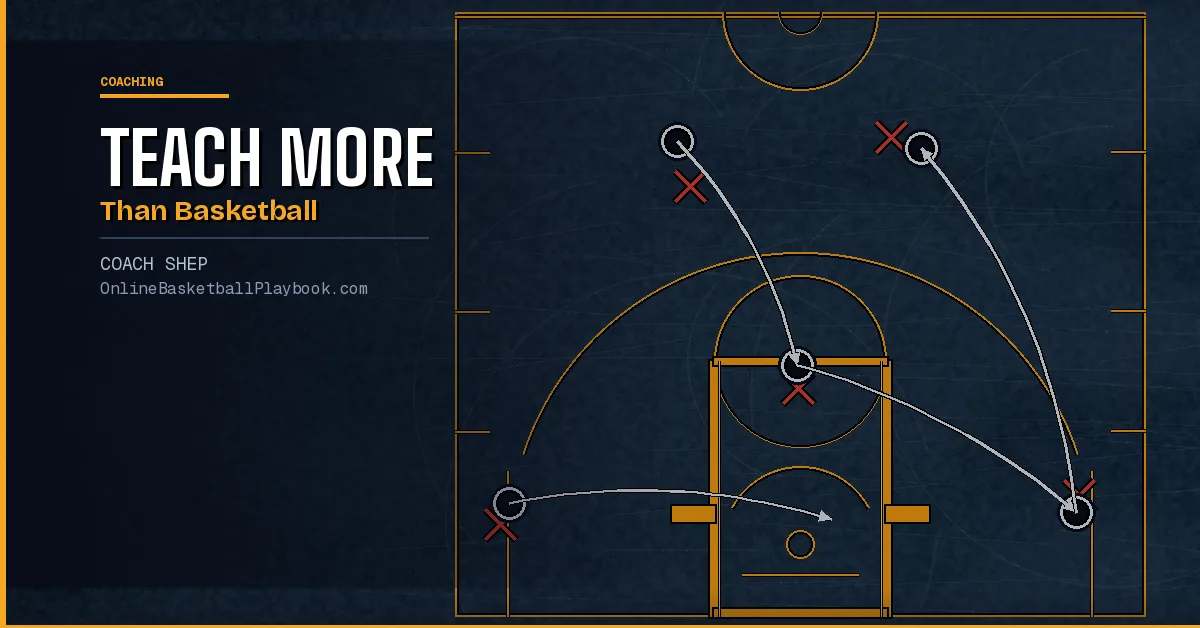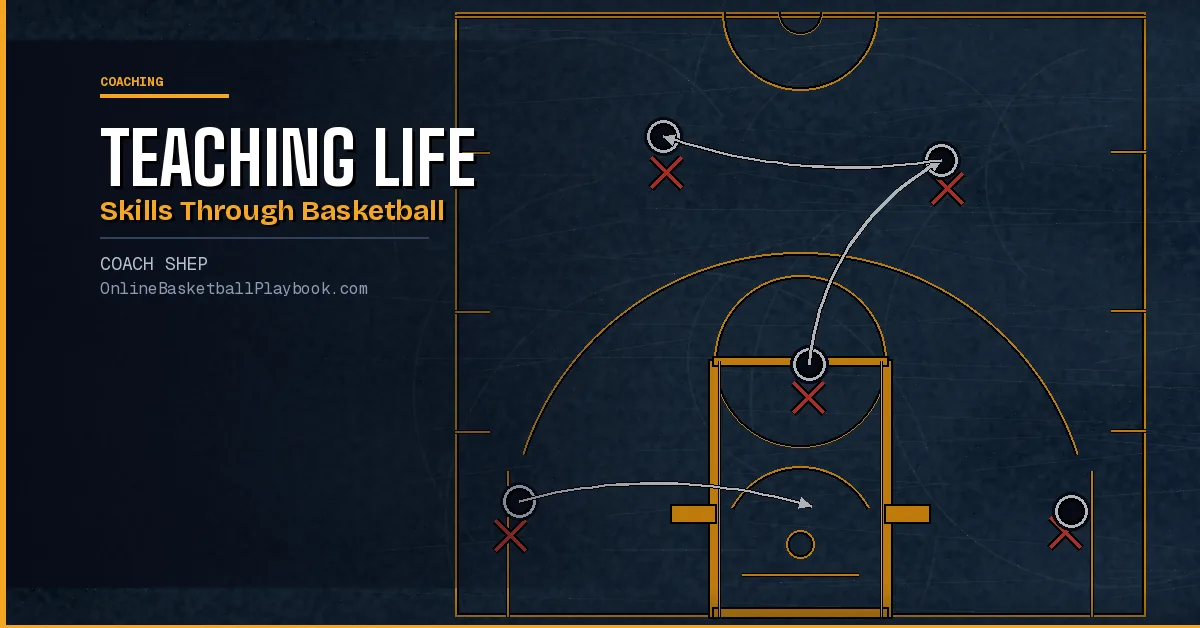
Basketball is one of the most effective classrooms a coach has, but only if the lessons are deliberate. Every drill, read, and possession is a chance to build the habits players carry off the floor for the rest of their lives.
Why Basketball Is a Life-Skills Lab
Every parent who ever signed a kid up for youth basketball had a version of the same hope: that their child would learn something beyond how to shoot. They were right to hope. The question is whether coaches make those lessons explicit or leave them to chance.
Basketball is uniquely positioned as a teaching environment because it combines individual responsibility with constant team interdependence. A player cannot hide. Unlike football, where many players are off-ball on most snaps, every basketball player is involved in every possession. You touch the ball, you make reads, you set screens, you rotate on defense, and your teammates see everything you do. That transparency is uncomfortable for kids who want to coast, and it is precisely what makes the sport such a powerful teacher.
The challenge for coaches is to name the lesson while it is happening. When a player makes a selfish play and the possession breaks down, that is a teachable moment about thinking beyond yourself. When a player fights through a screen to stay in front of their opponent even when nobody is watching, that is a teachable moment about doing the right thing when it costs you something. Neither lesson sticks without a coach who sees it and says it out loud.
Coaches who think their job is only to win games are leaving most of their leverage on the table. The most effective coaches at every level, youth recreation leagues through elite prep programs, treat each practice as a dual-purpose session: basketball skills and life skills, running in parallel, neither sacrificed for the other.
Decision-Making: The Core Transferable Skill
Of all the life skills basketball can teach, decision-making under pressure may be the most directly transferable. In the real world, the most valuable people are not the ones who know the most. They are the ones who make good decisions fast, with incomplete information, under stress. Basketball trains exactly that.
The coaching research is clear on how decision-making actually develops. You do not build it by drilling routes. You build it by putting players inside situations that force a genuine choice, every single rep, at game speed. A player who has run a play a thousand times in a walk-through knows where to go, but they do not necessarily know what to do when the defense takes that option away.
The better approach is to manufacture an advantage and make players solve it. A 2-on-1 break does not let a player hide behind a script. They have to read the defender, decide whether to finish or pass, and live with the outcome. That is the same cognitive muscle that fires when a young professional has to make a judgment call with their manager watching. The game builds the muscle. The coach names what the muscle is so the player understands what they are developing.
Don Meyer, one of the most prolific winners in college basketball history, described a four-stage learning model that applies to any skill: unconscious incompetence (you do not know what you do not know), conscious incompetence (you see the gap), conscious competence (you can do it if you think about it), and unconscious competence (the right action happens on reflex). Every coach's goal is to move players to that fourth stage. Automatic, reliable decision-making without needing to stop and think. That is exactly the kind of judgment adults need when they are leading a team, raising children, or managing a crisis at work.
The most powerful version of this teaching pairs the drill with the conversation. After a 3-on-2 drill goes wrong, a coach who asks "What did you see on that possession?" is doing something more valuable than running the play back. They are teaching the player to self-evaluate, to examine their own reads rather than waiting to be corrected. That habit, built in a gymnasium over four years of high school basketball, shows up in every professional environment that rewards self-directed learning.
Accountability Without Fear
One of the hardest things for any coach to get right is accountability, holding players to a standard without creating an environment so fear-driven that players stop taking risks. Both failure modes are real. A team with no accountability produces selfish, undisciplined habits. A team run entirely on fear produces players who are afraid to make decisions.
The research on this is unambiguous. Quin Snyder's coaching methodology, developed across a long and successful NBA career, names the sequence explicitly: identify the situation, attack it systematically, teach it to its finest points, and hold players accountable, but only after giving them enough reps to build real habits. Accountability before reps breeds anxiety, not ownership. The order matters.
This maps directly onto a life principle that most adults figure out slowly and painfully: you cannot hold someone accountable for a standard they were never taught. Coaches who yell at players for mistakes they have not been drilled to prevent are training helplessness, not ownership. Coaches who set a standard clearly, drill it until it is habit, and then hold to it firmly are training something else entirely, self-accountability, which is the version that lasts beyond the sport.
The target state is when players hold each other accountable without the coach having to intervene. That is the final measure of accountability truly installed: the team owns the standard, not just the coach. Every workplace, every family, every community organization that functions well has the same quality. Basketball is one of the few places where young people get to practice building it before the stakes of adult life arrive.
Resilience and How Failure Teaches
No sport produces more public, immediate failure than basketball. A missed free throw with two seconds left. A turnover that gives the other team the lead. A blown assignment that ends a season. The game is constructed to test how players respond when things go wrong in front of everyone who matters to them.
That is not a design flaw. That is the feature.
Resilience, the ability to absorb a setback and re-engage without collapsing, is not a personality trait some people are born with. It is a practiced response. And basketball gives players more reps at practicing it than almost any other arena available to a teenager. A player who goes 0-for-6 from the field in the first half and comes out in the second half and takes the next open shot. That player is doing something genuinely difficult that took practice to learn.
The coach's role in building resilience is specific. After a mistake, especially for younger players, the sequence matters: let the play finish first, then ask what the player saw, rather than stopping everything and correcting immediately. That approach, documented in youth coaching research, teaches self-evaluation rather than external dependency. The player learns to examine their own reads, adjust, and move forward, which is what resilience actually looks like in practice.
For older players (high school varsity, prep programs, college) the bar moves. The expectation is that a player internalizes the correction and adjusts within the same possession, not the next game. That is a high standard, and it mirrors what elite professional environments demand: you receive hard feedback and you adjust, fast, without letting the sting of it slow you down.
Coaches who protect players from the pain of failure are not doing them a kindness. They are denying them the reps they need to build the response that will matter in years when basketball is finished and the real world is doing the failing for them.
When a player makes an error, resist the reflex to stop play and correct immediately. Let the possession finish, then ask "What did you see there?" This one habit shifts players from waiting to be fixed to learning to self-evaluate, which is the skill that compounds over a lifetime, not just a season.
Communication and Team Trust
Defense in basketball is a communication exercise. It demands that five people, under physical stress, moving at speed, share real-time information and make adjustments together. You cannot execute a defensive rotation if you are not talking. You cannot switch a screen if you are not calling it. The game makes communication non-optional, which is why it is one of the best available training grounds for the skill.
What players are actually learning when they learn to talk on defense is something deeper than basketball: the value of saying the hard thing out loud when there is something at stake. Calling out a screen is easy in a gym when you know it is coming. Calling out a problem in a team meeting when your boss might push back. That requires the same instinct, and it has to be practiced somewhere before the stakes are real.
Trust in a basketball context is specific and observable. It means: I set the screen hard enough that you can use it. It means: when you drive, I move to the corner so the floor is open for you. It means: when you make a mistake, I do not point at you. I get back on defense and we figure it out later. All of these are practiced behaviors, not natural ones. Players who have spent four years being held to those standards by a good coach have a baseline of trust-building experience that most of their peers do not.
One of the most underrated coaching practices is making communication visible: naming it, praising it, and grading it. When a coach stops practice to say "That was a perfect defensive call. Let's do it again," they are teaching players that talking is not just allowed, it is expected and rewarded. That norm, repeated over a season, shapes how a player communicates everywhere else.
Putting It Together in Practice
The best coaches do not run separate "life skills sessions" and separate "basketball sessions." They design practices where the basketball and the life lessons are the same thing. The structure of the drill determines the lesson. You choose the drill to train the skill you want, and if you do it right, you get both the basketball skill and the life skill in the same rep.
A 2-on-1 advantage drill trains decision-making. A sprint to get back on defense after a turnover trains resilience. A drill where you cannot shoot unless you call the play first trains communication. None of these require extra time. They require a coach who has thought about what each drill is actually teaching and builds the debrief to name it.
The standard for a well-run practice is this: every player should leave knowing not just what they worked on, but what they are building. They should be able to articulate why they ran a constraint drill at game speed, not just that the coach told them to but that the situation on the court demanded a real decision and they had to make one. That level of self-awareness is the mark of a player being coached well, and it is the same quality that will make them a better employee, teammate, parent, and leader long after their playing days end.
This does not require a speech at the end of practice. It requires a coach who knows the answer to one question before the whistle blows: "What life skill am I training today, and will my players know it by the time we're done?" If the answer is yes, the practice was worth running.
- Name the lesson out loud. After a rep that demonstrates accountability, decision-making, or trust, stop and say it explicitly. Players will not make the connection automatically, and the transfer to life only happens when the coach bridges it.
- Use advantage drills to build decision habits. 2-on-1, 3-on-2, and 4-on-3 situations force a real read every rep. The player cannot coast, and neither can the lesson. Run them live and at game speed, not walk-through pace.
- Hold the standard after enough reps, not before. Establish the expectation, drill it to habit, and then enforce it firmly. Accountability before competence trains anxiety. Accountability after competence trains ownership, which is the version that transfers to work and life.
- Let mistakes finish before correcting. Especially with younger players, allow the possession to complete before stopping to teach. Then ask "What did you see?" You train self-evaluation, not dependence on the coach, and self-evaluation is the skill that compounds.
- Grade communication the same way you grade execution. If you only praise made shots and defensive stops, that is what players optimize for. Praise the call that led to the stop. Name it. Reward it. The habit of speaking up under pressure is built through practice, not lecture.
Want more basketball coaching strategies and drills?
Join the Online Basketball Playbook newsletter →
Draw this play free in the play drawer →
Membership: the full library, playbook packs, and Pro drawing tools →
Keep Building
Related breakdowns
Teaching Teamwork and Collaboration in Basketball
Teaching Teamwork and Collaboration in Basketball
Teaching Players to Adapt to Different Playing Styles
Teaching Players to Adapt to Different Playing Styles