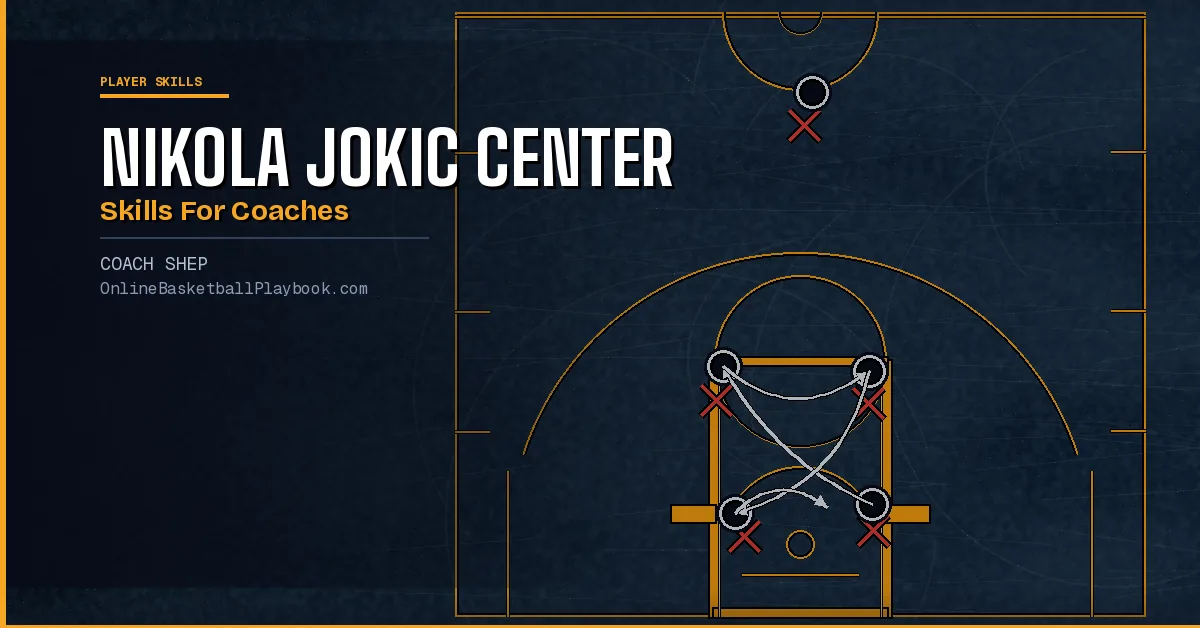
Nikola Jokic plays basketball in a way most coaches haven't taught their bigs before: passing first, reading second, scoring third. This guide breaks down how to build those same habits in your center, starting in practice tomorrow.
Why Jokic Is the Model for Modern Centers
Before you can teach Jokic's skill set, you need to understand what actually separates him from every other dominant big man in NBA history. It is not his footwork. Plenty of bigs have better footwork. It is not his athleticism. That's obviously not his edge. What separates Jokic is that he processes the game one read ahead of everyone on the floor. He receives the ball already knowing what the defense gave him. He passes off contact before he finishes. He makes the right decision so fast that defenders cannot recover in time.
That capacity to read and react at speed is trainable. It is not a gift reserved for generational talents. NBA coaches who have worked with Jokic (and college coaches who study the Nuggets' system) consistently point to one underlying truth. Jokic was coached to see the game before he developed his elite playmaking instincts. The reads came first. The execution followed.
For your center (whether you coach a 15-year-old post player or a college big) the same sequence applies. You build the reads before you demand the skill. That's the coaching challenge this article addresses directly.
The Passing-First Mindset: Teaching Your Big to Read the Floor
Most youth and high school centers are coached to catch and score. They receive a post entry, back down their defender, and look for a hook or a drop step. That's a fine starting point, but it locks your center into a single decision before they've even read the defense.
Jokic flips this sequence entirely. He catches with his eyes already scanning weak side. He reads the help before it arrives. When you watch film closely, you'll see that on a huge percentage of his assists, the pass decision is made during the catch. Not after he's established position and run out of options.
Ettore Messina, one of the most respected tactical coaches in the world, calls this "decide while catching." Read the defender during the reception itself, not after you've already squared up and the defense has already loaded. This principle (scanning and committing on the catch) is the first habit you must install in your center.
How to Teach It
Start with a constraint drill. Two perimeter players spot up, your center receives in the short corner or elbow, and you have a defender standing in the key. The rule: your big can shoot or pass immediately, but cannot dribble. This removes the safety valve of creating off the bounce and forces the player to decide on the catch. Run it for two weeks at the start of every practice. The constraint is the lesson.
Progress to a live 1-on-1 with a defensive help man positioned on the weak side. Your center must scan before they catch, call out what they see ("help is at the nail"), and make the read before the defender closes. That verbal call is the key coaching tool here. When players narrate what they see, they begin internalizing the scan as a habit rather than an afterthought.
Post Entry Reads: Drive, Kick, or Score
Jokic's post game is built on a three-option read tree, and your center can learn the same framework regardless of their offensive skill level. Every time the ball enters the post, there are exactly three questions your big should answer in order:
1. Is my defender behind me? If yes, score. A center who is physically bigger than their defender and has deep post position should not be looking to pass. Jokic scores when the math says score.
2. Where is the help? If help is crashing from the weak side, that player's man is open. The pass should be a single movement: pivot, find, deliver. Jokic's passing off the double team is the most imitated element of his game precisely because he makes this read with no hesitation and no wasted motion.
3. What does the baseline give me? Jokic's baseline drive is underrated as a teaching tool. When he is fronted or faced with a trapping double, he drives baseline, forces the defense to rotate, and reads from the drive. Your center can execute a simplified version of this: catch on the block, read the defense, and if the drive opens, take one hard dribble baseline to force a rotation, then read again.
The three-option read tree keeps your center from being a one-read player. Most youth bigs back down until they run out of space and then throw a bail-out pass. Teaching the three options in order (score, kick, drive and read) gives your big a structured decision framework rather than an improvised escape.
The Short Roll: Your Center as a Pick-and-Roll Playmaker
This is where Jokic's influence on modern basketball is most profound. His short roll passing has reshaped how NBA teams use the pick-and-roll. And it creates a skill your center can develop at any level.
In a standard ball screen action, the center sets the screen and either rolls to the basket or pops to the perimeter. Jokic does something different. He rolls to the midrange, receives the ball with space, and reads the defense from there: either finishing himself, hitting the corner shooter, or threading a skip pass to the weak side. That "short roll" position turns your center into a secondary playmaker on every ball screen action.
Teaching the Short Roll in Practice
Build a 3-on-2 drill: one ball handler, your center as the screener, and one corner shooter. Two defenders guard the ball handler and the roll man. Your center sets the screen, rolls to the midrange, and receives. The read: if the defending center drops to protect the basket, your big shoots the midrange or kicks to corner. If the defender stays high to contest the shot, your big drives past them. The corner shooter stretches the defense and creates the decision, but your center is the one making the read.
This drill is a direct application of the advantage-based teaching model: you manufacture the read by building in a numbers edge, then let the player solve it live. The defense will teach the right decision far more effectively than any coach's instruction alone.
Decision Drills That Build Jokic-Style IQ
The most direct path to a Jokic-like center is not skill work in isolation. It is decision-based drilling that forces your big to read the defense and execute the right action every single rep. Here are four drills that target the specific reads Jokic uses most.
Drill 1: Catch-and-Decide (No Dribble)
Your center receives from the elbow with two perimeter shooters spaced at 45 degrees and the corner. One help defender positions at the nail. The only rule: no dribble. Your big catches, reads the help man, and either shoots or passes immediately. This drill builds the "decide while catching" reflex. Run it for five minutes at the start of post-player skill sessions.
Drill 2: 2v1 Post Advantage
Your center receives on the block against a single defender. A second offensive player cuts from the weak side after the catch. Your big must read the help coverage: if the defender stays on them, they score; if the defender rotates to the cutter, they deliver the pass. This mirrors the exact decision Jokic makes on double teams, just at a simpler level that a developmental center can absorb and master.
Drill 3: Short Roll Read Live
As described in the previous section: ball handler, center rolling short, corner shooter, two defenders. The read tree has three branches: shoot, drive, or kick, and your center must execute the right one within two seconds of catching. Time it. Pressure creates game-realistic decision-making speed.
Drill 4: Post Drive and Kick
Your center catches on the block and drives hard baseline. Two perimeter players are spaced at 45 degrees and the corner. A third defender simulates a rotation from the weak side. Your big must read the rotation mid-drive and either finish, pull up, or kick to the open shooter. This drill develops the skill Jokic uses when he attacks the baseline and creates opportunities off his own drive.
How to Progress Your Center from Route-Runner to True Reader
Most centers who arrive in your program already have a "route", a predictable sequence of moves they run every time they catch in the post. They go right shoulder, they drop step left, they hook over their right hand. The route is comfortable and it sometimes works, but it is not the same thing as reading the defense.
The progression from route-runner to reader follows a four-stage model. Understanding where your center sits in that progression tells you exactly how to coach them this week.
Stage 1: Unconscious Incompetence
The player doesn't know what they're missing. They run their route, get blocked or forced into bad shots, and attribute the failure to the defender being good. At this stage, your job is to show the player what a read looks like. Film is powerful here. Show Jokic making the exact same catch in two possessions (one where he kicks and one where he scores) and ask your big why the decisions were different. Create the awareness before demanding the behavior change.
Stage 2: Conscious Incompetence
The player now knows the read exists and understands what they should do, but they can't execute it at game speed. They hesitate on the catch, dribble away the advantage, or make the pass a half-second too late. This is actually good news. It means the coaching is landing. Keep drilling. Use constraint drills heavily here. Remove the dribble. Limit the options. The constraint forces the read because the route is no longer available.
Stage 3: Conscious Competence
The player can execute the read reliably, but they're running a mental checklist. They catch, they think "scan left, read help, drive or kick," they execute. It looks a little mechanical and their timing is a beat slow against live defense. This is the most important stage to coach through quickly. Keep the drills live and contested. Add a shot clock or a verbal countdown. The goal is to move the read from deliberate to automatic.
Stage 4: Unconscious Competence
The read happens on the catch. Your center no longer thinks about the decision. They just make it. The scan is automatic, the read is pre-committed, and the execution follows without hesitation. This is where Jokic operates on every possession. Getting your center to stage four requires volume of reps in contested, game-paced environments. You cannot walk through this stage. It must be trained at speed.
When introducing read-based post drills, resist the urge to stop play and correct immediately after every mistake. Let the play finish, then ask your center what they saw. This conversational reflection builds self-evaluation habits that transfer to games when you cannot stop play to redirect them.
The Weekly Practice Structure That Builds It
You do not need to overhaul your entire practice plan to develop a Jokic-style center. A focused 15-minute block inserted into your existing post-player development session is enough, provided you use it consistently. Here's a simple weekly structure:
Monday: Catch-and-Decide (No Dribble): 5 minutes, both elbows and short corners. Focus on the scan during reception. Verbal call required before every pass.
Wednesday: 2v1 Post Advantage into Short Roll Live, 10 minutes. Alternate between post advantage (simple double-team read) and the 3-on-2 short roll drill. Keep it game-paced and contested throughout.
Friday: Post Drive and Kick, 5 minutes, then a 5-on-5 game where you require your center to make one pass before scoring every time they catch in the post. The rule forces the read in live play without disrupting team offense structure.
This 15-minute investment, sustained across a season, will develop a center who reads the defense rather than running a memorized sequence. That is the foundation of what Jokic does, and it is entirely teachable.
- Scan on the catch, not after: Train your center to call out the help defender's position before they make their post move. Verbal narration builds the scan habit faster than silent drilling.
- Remove the dribble in skill sessions: Catch-and-decide drills (no dribble allowed) force your big to read the floor immediately on reception, eliminating the habit of dribbling away the defense's advantage.
- Build the short roll into every ball screen rep: Every time your center sets a ball screen in practice, require them to roll to the midrange and make a read. Don't let the roll become an automatic basket-dive without a decision attached.
- Use the 2v1 post advantage drill weekly: A single extra cutter from weak side forces your big to read help coverage and choose between scoring and passing, the simplest version of Jokic's double-team read, trainable at any level.
- Film a Jokic possession each week: Show your center one possession where Jokic makes the read they struggled with in practice. Seeing the finished product at the highest level accelerates both understanding and motivation.
Want more basketball coaching strategies and drills?
Join the Online Basketball Playbook newsletter →
Draw this play free in the play drawer →
Membership: the full library, playbook packs, and Pro drawing tools →
Keep Building
Related breakdowns
Find Your Best Online Basketball Trainer for Skills Development
Find Your Best Online Basketball Trainer for Skills Development