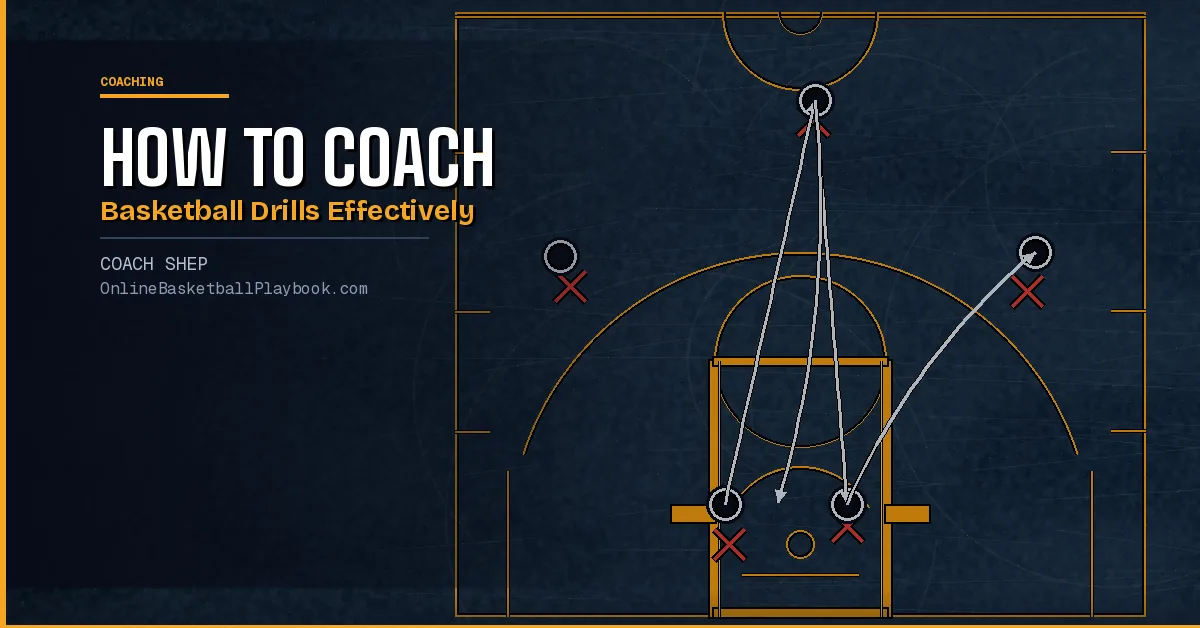
Most drills fail because they train movement instead of decisions. This guide shows you how to design and run breakdown drills that players actually carry into games.
Isolate One Read Per Drill
The most common coaching mistake in drill design is asking players to process too many things at once. When a drill contains multiple decisions (where to cut, whether to shoot, how to set the screen, and when to pass), players default to guessing or copying each other. Neither builds a real skill.
Effective breakdown drills enforce a single decision or skill. That's the core of what coaches call the part-whole method: you isolate one piece of the offense, let players repeat it until they own it, and then scale to the full system.
A 2-on-2 drive-and-kick drill teaches one thing. Read the corner when you attack. A 1-on-1 closeout drill teaches one thing. First step off the catch. A Blood 4 drill, where a made mid-range shot counts as a turnover, teaches one thing. Attack the rim or find an open three. Each constraint removes the other options and forces the player to own the one read the drill is designed around.
When you design a drill, ask yourself: what is the one decision a player must make correctly for this drill to work? If there is more than one answer, the drill is trying to teach too much. Split it into two drills, run them in sequence, and combine them only after each piece is locked in.
Use Constraints Instead of Lectures
Stopping play to explain a concept takes time, breaks rhythm, and rarely sticks. Constraints do the same coaching without the interruption, and they work because players learn by making the decision themselves, not by hearing the right answer described to them.
A constraint is a rule that makes the wrong choice expensive or impossible. Blood 4's "mid-range makes count as turnovers" is a constraint. A dribble limit in a passing drill is a constraint. "You must validate your basket with a made free throw" is a constraint. The game itself becomes the teacher.
Here are constraint types that apply across any offense:
Zone constraints
Designate areas of the court as forbidden or required. In a paint game, no one can score unless they used the paint on that possession. Spacing and attack are trained without a word. In a no-paint game, players must learn to score from the perimeter without collapsing the floor. The geography is the coaching cue.
Dribble limits
Caps on dribbles per possession (two dribbles, one dribble, or a "skip and shoot" rule) force players to read before they receive the ball and to move it before defenders recover. This is especially effective for half-court sets where ball-stopping is the primary spacing problem.
Validation rules
Require a specific action to lock in the score. "Make a free throw to count the basket" trains composure at the line under fatigue. "The basket only counts if the cutter got a good angle" trains off-ball movement. "Make it take it only if you scored on an assist" trains ball movement over isolation.
Score Every Drill to Coach Behavior
A drill that isn't scored is a drill players are coasting through. Scoring creates stakes. It tells players what the program values, and it coaches behavior without commentary from you.
The Alabama system used by Nate Oats is a clean model: a possession can earn +3 (made three-pointer), +2 (made two), +1 (offensive rebound), or lose −2 (turnover). Players tracking that math in real time learn fast that turnovers cost more than baskets earn. You don't have to say "don't turn it over." The math says it.
Karl and Stotts built an entire 101-drill encyclopedia around this principle. Their 1-on-1 post game awards +2 for a made basket, +1 for drawing a defensive foul, −1 for committing an offensive foul, +1 for a post-pass assist, −1 for a turnover, and +1 for an offensive rebound. The scoring sheet IS the coaching philosophy. Players infer from the numbers what the coaching staff values (post passing, drawing fouls, protecting the ball) without a single speech about it.
For losers to run the difference, keep a visible scoreboard. That small detail raises the intensity of every rep because players know the gap between them and the other team is what they'll run after practice. Competitive pressure in a drill is free conditioning. Players push because the score matters, not because you told them to.
Build Finishing Footwork Before Adding Reads
Here is the failure pattern: a coach installs a drive-and-kick series, players read it perfectly, but the layup percentage is low because they don't have the footwork to finish through contact. The drill looked right. The read was right. But the finish wasn't there.
Finishing footwork has to be drilled first, before any reads are attached to it. Before a player learns to read the corner defender in a drive-and-kick series, they need to have logged hundreds of game-speed layup reps: right hand, left hand, straight, reverse, crossover, hesitation, and the jump-stop power layup. Both sides. At game speed. Every day.
The layup sequence is not warm-up content. It is the foundation skill that every drive-and-kick read depends on. When the finish is automatic, the player's attention is freed for the read. When the finish isn't automatic, the player's attention splits between the footwork and the decision, and neither is executed well.
Walberg and Welling both build from this principle. The layup progression comes before team work. X-layups, Crack Back, and the full-court layup conditioning circuits (Chase, Speed Layups, the Kentucky and Celtic series) build finishing footwork under fatigue, which is when the layup actually happens in a game.
Run a timed layup sequence as your first drill of every practice: both hands, straight and reverse, from a dribble. Target a team make-count (50 in two minutes is a standard benchmark) before any breakdown drill starts. Players who can't finish at speed in isolation will not finish in a live drill or a game situation, so build the finish first and layer the reads on top of it.
Progress From Parts to Five-on-Five
The full offensive system (motion reads, cut-or-backdoor decisions, drive-and-kick chains, ball-screen actions) can't be installed all at once. Trying to go directly to five-on-five is one of the fastest ways to ingrain bad habits, because players don't yet own the individual reads and they improvise to survive.
The correct progression is: 5-on-0 to install footwork and timing, then 2-on-0 or 2-on-2 to add a live read in isolation, then 3-on-2 or 3-on-3 to add a second defender who changes the first read, then connected-action drills where two or three reads chain together, then live five-on-five once the pieces are owned.
Weber's 5-on-0 progression for five-out motion is the standard model for the early phase. Players run the motion, the cuts, and the spacing without opposition until the footwork and timing are clean. Only then does a defender enter. The 5-on-0 phase is not wasted time. It is where the muscle memory of the system gets set.
The design principle for the connected-action phase is equally important: start with one defender and one clean read, add a second defender who forces a new read, then connect two or three actions so players must keep playing through the first covered option to a second or third option. This progression is how a player moves from pattern-running to genuine reading.
A well-built drill library runs this full arc in every practice with a rotation of transition games, a shooting battery, and ball-toughness drills, ending with Perfection, a team drill that can only be completed by a made three-pointer, which forces players to earn their exit through the hardest shot on the floor.
Run Advantage Games for Live Decision-Making
Small-sided advantage games (where the offense starts with a numerical edge over the defense) are one of the most underused tools in practice planning. They are also one of the most effective for training actual game decisions, because the read is live, the pressure is real, and the advantage forces action rather than hesitation.
Alex Sarama's CLA framework builds this into the drill design itself. In a 3-on-2 or 2-on-1 advantage game, the coach controls how much of an edge the offense has by how the ball is positioned at the start. Ball on the outside hip of the ball handler means the baseline drive is open. Ball on the inside hip means the middle drive is open. The defender must hi-5 a cone to release. That gap is the size of the advantage. The coach sets the read by setting up the start.
Guided defense adds another layer. Instead of the defender playing freely, they are assigned one of three alignments (trail, cut-off, or neutral) so the offense gets the same read with varied defensive pressure across three consecutive reps. This is "repetition without repetition": the same drill, the same advantage, but three different decisions based on how the defense plays it. Players aren't memorizing a response to one look. They're building a genuine read against multiple looks.
Popovich's "3 Ways" controlled scrimmage applies the same principle at the five-on-five level. One point for a score, one point for a stop. Play to 10. After going down and back twice, throw to the coach and restart. The coach controls tempo, inserts teaching moments, and prevents players from ripping through possessions on autopilot. It is a scrimmage run like a drill, and it is the tool to reach for when live five-on-five starts to look sloppy.
Maximize Reps With Simultaneous Shooting Circuits
The most common practice efficiency problem is too many players standing in line. A shooting drill run single-file through one basket gives each player one rep every three minutes. A simultaneous shooting circuit gives every player multiple reps every minute. The math alone makes simultaneous circuits worth the organizational work to set them up.
The Livsey 13-drill battery is built entirely around this principle. Every drill in the battery runs with multiple players working at the same time. Multiple lines, multiple baskets, multiple balls. The Backpedal drill sends a player to half-court and back before each catch; Pepper sends them sprinting toward the basket on the lob; Crack Back has them sprint to a touch point and crack back to the ball. All of these can run with full-squad participation at once.
The key design rule across all of them: no player should be standing still waiting to shoot. The J-J Touch drill makes this explicit. Players must make 2 or 3 attempts before rotating, and the standard is that the shooter should be moving before every catch. If someone is standing at a spot waiting, the drill is broken. Reset the spacing and the movement pattern.
For large squads (15 or more players), run Backpedal, Pepper, and Crack Back as a five-minute rotation before any five-on-five scrimmage segment. Every player is moving, every player is catching and finishing at game speed, and the conditioning benefit is built in because the movement patterns are continuous. Five minutes of this before live play raises the readiness of the whole group without a separate conditioning block.
- Design each drill around a single read. If you can name two decisions a player must make, split the drill into two separate drills and sequence them.
- Replace verbal corrections with constraints. Mid-range is a turnover. Two dribbles max. Validate with a free throw. The rule does the coaching so you can watch instead of talk.
- Score every drill with a visible board and make losers run the difference. Competitive stakes raise intensity without extra coaching energy from you.
- Run the layup sequence first, every practice. Both hands, both sides, game speed, timed (before any read-based drill touches the floor). The finish has to be automatic before the read can be clean.
- Progress from parts to whole in order: 5-on-0 footwork → 2-on-2 live read → 3-on-3 connected action → five-on-five. Never skip to the end before the pieces are owned.
- Use advantage games with guided defense to train real decisions under varied pressure. Three consecutive reps with trail, cut-off, and neutral looks build a genuine read, not a memorized response.
- Eliminate lines with simultaneous circuits. Design drills so everyone is moving and catching at the same time. If a player is standing still waiting for a rep, reorganize the drill.
Want more basketball coaching strategies, drills, and tools?
Join the Online Basketball Playbook newsletter →
Draw this play free in the play drawer →
Membership: the full library, playbook packs, and Pro drawing tools →
Keep Building
Related breakdowns
Fun Basketball Games for Practice: Scored Games for Any Team
Fun basketball games for practice at any level: shooting games, defense-only scoring, rebounding contests and passing games, with scoring rules and records.
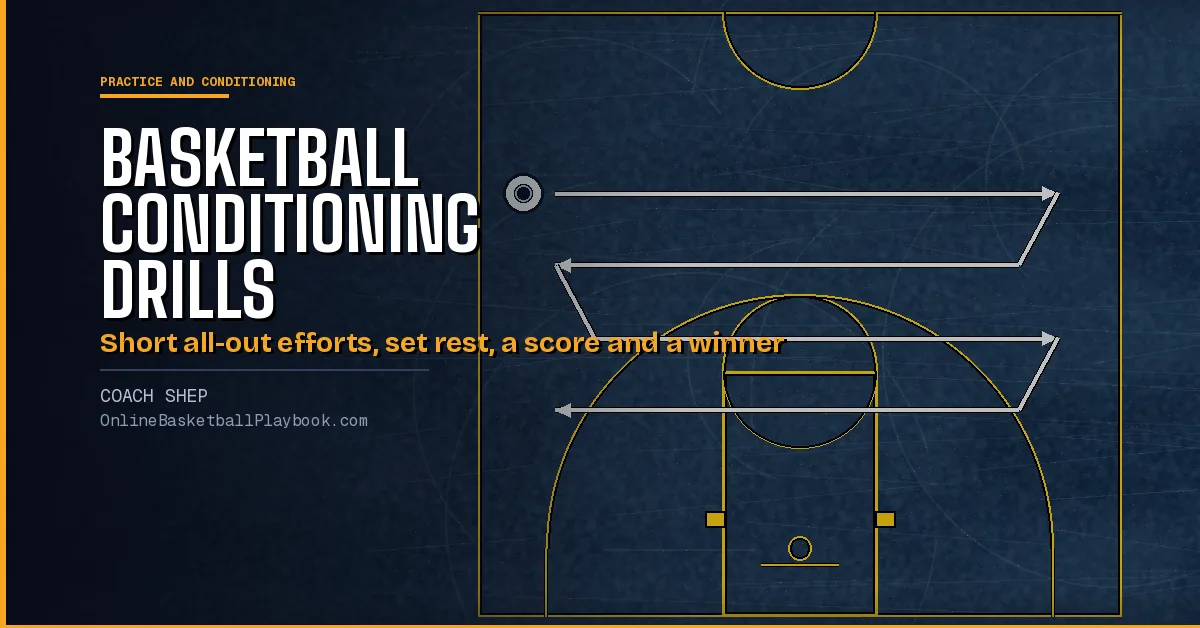
Basketball Conditioning Drills for Teams: Runs, Games and Tests
Basketball conditioning drills in three styles, timed runs, conditioning inside skill drills and scored games, with the tests and yearly plans coaches use.
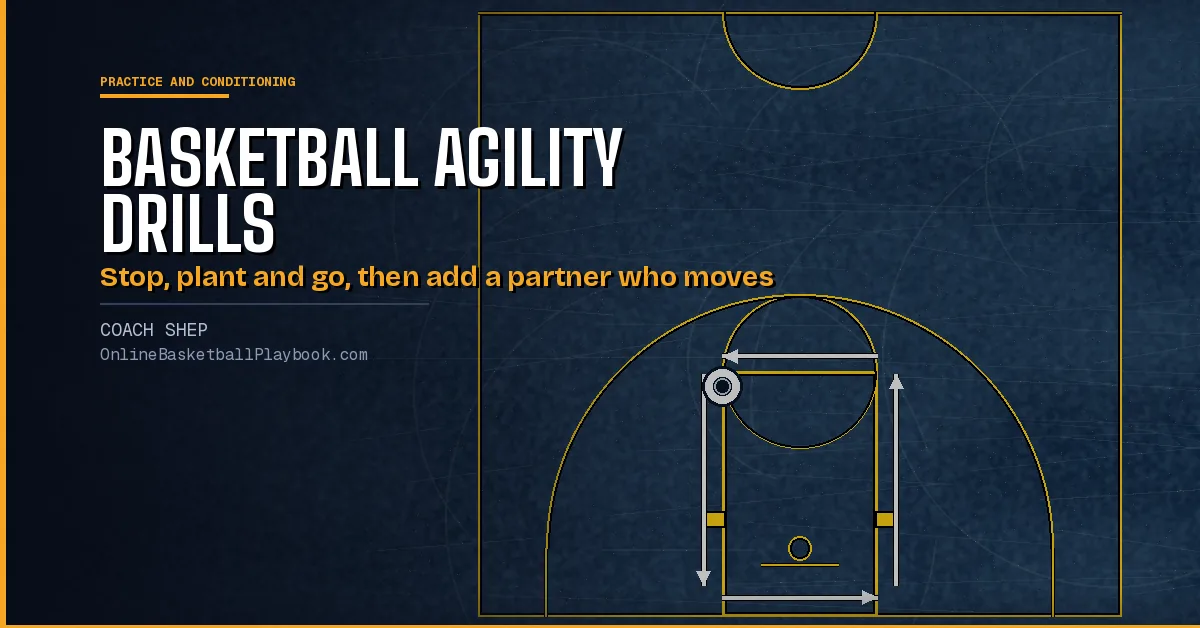
Basketball Agility Drills: Cone, Reaction and Ladder Drills
Basketball agility drills from timed cone tests to reaction, mirror and ladder drills and defensive circuits, with schedules and where coaches differ.