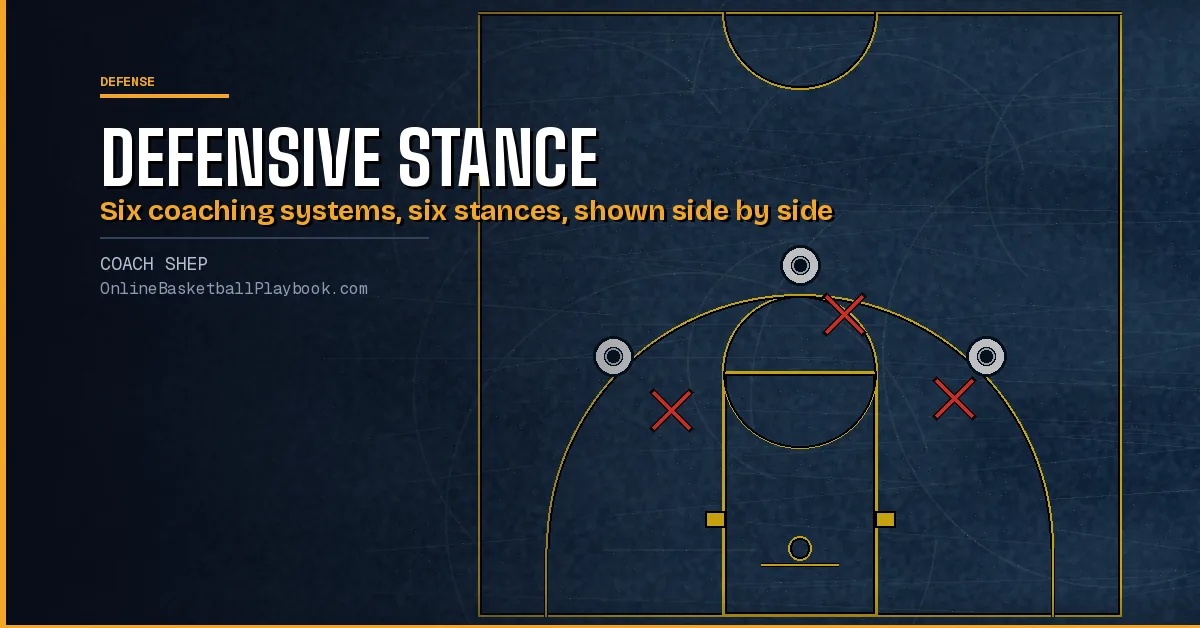
The defensive stance in basketball is the ready position every other defensive skill starts from, the closeout, the slide, the help step and the box out. Coaches agree that it is low, balanced and active, and they disagree on the details. They split on where the weight sits, how the feet are set, what each hand does and where the eyes go.
This guide teaches one stance, shows where coaches split on the details, covers the footwork that leaves the stance and lists the drills that build it. Pick one stance for your team and use it for the whole season.
Defensive Stance Basketball: One Stance to Teach
Start with one stance. Don Meyer's staggered heels-down stance is the one this page teaches, and the sections below show where a cue changes from system to system.
- Stagger the feet. Roughly shoulder width, inside foot a little forward on the ball.
- Weight on the whole foot. Heels down.
- Hands follow the ball. Overhead, at the shooting pocket or low.
- Head level with the chest. The head stays level with the offensive player's chest.
Other systems use the word stance for different cues, so write the job next to the name.
Weight: Balls of the Feet or the Whole Foot
Coaches split on where the weight sits:
- Balls of the feet. The straight-ahead, sideline-force and wide toes-out stances all put the weight there. The straight-ahead stance adds that the heels still touch the floor and that the position sets up quicker lateral movement.
- The whole foot, heels down. The staggered heels-down stance staggers the feet, sits the weight on the whole foot with the heels down, curls the toes in what is called an eagle claw, and bends every joint with the head centered and up. It also adds footfire for defense, quick alternating weight shifts without leaving the floor.
These two cues are not the same stance. A team that hears both "balls of the feet" and "heels down" will not know which one is right. Choose one, say it the same way at every practice and use the matching drills.
Feet: Width, Stagger and Angle
Coaches split on how wide the feet sit:
- A little wider than the shoulders, pointed straight ahead. Feet too close together make an upright stance and feet too wide cost explosiveness. The common error is not getting low enough, and for a player who rounds forward the fix is chest out while the hips drop.
- Wider, toes out. Knees and feet sit outside the shoulders, the toes turn out about 45 degrees, the butt is down, the back is straight and the thighs and torso form an L.
The stagger is where coaches split most:
- Inside foot forward. The staggered heels-down stance puts the inside foot a little forward against the ball, with the hips down and the back foot never dropped. The dropped back foot is called matador defense.
- Outside foot back. About shoulder width with the outside foot back, so the defender can force the ball to a sideline.
- Half a man over. Play half a man over with a heel-toe line so the angle never opens for a drive.
- Feet squared. Gene Keady keeps the feet squared so the dribbler goes outside.
Both the outside-foot-back and the squared stances send the ball outside, the first by dropping the outside foot and Keady by keeping the feet square. Pick one foot position and check it every day.

Hands: One Job or Two
Coaches split on what the hands do:
- Up and out at shoulder height. The straight-ahead stance mirrors the ball with the hands.
- Two hands, two jobs. The sideline-force stance puts the arms out, palms up, elbows a little bent. The hand on the side of the outside foot works the passing lane. The other hand digs for the ball from below with the palm up, and the warning is not to hit down on it.
- A tip hand and a steer hand. On the ball they are extended and firm. One pass away the tip arm becomes a football forearm, the steer hand becomes a deflect hand with the thumb down and the chin tucks into the deflect shoulder so the defender can see ball and player.
- A dig hand and a deflection hand. This pair is named for what each hand does.
- Lead hand on the line, trail hand flicks. Keep the lead hand on the ball's line and let only the trail hand flick at the ball, because reaching with the lead hand draws fouls and abandons the lane.
- Three hand modes. The staggered heels-down stance tracks the ball overhead, at the shooting pocket and low.
- Hands that change with the dribble. The half-man-over stance, which the next section covers, plays both hands up and offset, then a pointing hand, then a cupping hand.
Give every hand one job and say it the same way every day.
Eyes: What the Defender Watches
Coaches name different torso points:
- The belly button. The sideline-force stance.
- The waist or core. The straight-ahead stance says this for the stance itself, and the chest when it teaches man-to-man.
- Nose on chest. "Nose on Chest" is taught as a cue, and the half-man-over stance puts the nose level with the chest.
- Head level with the chest. The staggered heels-down stance keeps the head level with the chest too.
Pick one point and use the same words every day.
How the Stance Changes With the Dribble and the Ball
The half-man-over stance names three stances by what the dribble is doing:
- Ready. The player has not used his dribble, both hands are up and slightly offset to discourage the over-the-top pass.
- Point. The dribble is live and the raised hand turns palm up.
- Stick. The dribble is dead, the defender crowds the player, cups the ball and calls "stick."
The squared stance uses ready, pressure and contain, with the hands mirroring the ball, then at the waist, then palms up. The staggered heels-down stance gives a dead ball two options, swarm or sag, depending on whether the player with the ball is in range.

The stance also changes with where the ball is:
- On the ball, one pass away, help side. The wide toes-out stance teaches three. The help-side stance has the ball-side foot forward in a heel-to-toe line so the hips unlock sooner, with the arms pointing at the player and the ball.
- Open two passes away, closed one pass away. The staggered heels-down stance names an open stance two passes away, called pistols, and a closed denial stance one pass away, with the lead foot and hand in the lane, the thumb down and the ear at the chest of the player.
- Deny with the chest to the player. The straight-ahead stance's man-to-man teaching uses a denial stance with the chest to the player and the eyes over the lead shoulder, and argues against playing up the line because a backdoor cut then needs a 180-degree turn.
- Play up the line. Messina's drills teach the opposite.
See pack line vs pressure man-to-man for how that one pass of distance changes the whole defense. Whatever stance you teach, tie it to where the ball is.
Footwork Out of the Stance
Morgan Wootten's system names three steps and drills them before any team concept:
- Retreat step. Stay in front of a drive. The defender pushes off the front foot, steps back with the rear foot and slides the front foot back, and never brings the feet together.
- Advance step. Attack before the dribbler is ready.
- Swing step. Pivot on the back foot and swing the front foot and elbow the way the offensive player goes, to stop a drive toward the front foot.
Wootten's Slide drill works the steps in lines and his Hey! drill chains all three, with players calling "Hey!" on the advance step.
Other stances teach their own movement:
- Push step. In the staggered heels-down stance the lead foot moves 6 to 18 inches to the side, the power comes from the trail foot and the feet stay about shoulder width apart, low and wide. Three push steps stop a dribbler, and a beaten defender turns and runs.
- Push and reach shuffle, then run step. The wide toes-out stance teaches an explosive step and a half to two steps that squares the dribbler, then a glide-run-glide that gets the defender ahead of the ball before closing back into the stance.
- Step and slide. The sideline-force stance uses quick short steps without crossing the feet.
- Side Slide. The straight-ahead stance's warm-up keeps the feet at least six inches apart and never touching.
In a lateral stop:
- Land the outside foot wide enough. It stops the momentum but not so wide that it slips.
- Cock the ankle. The knees stay inside the width of the plant foot and the hips stay level and do not drop extremely low.
- Keep the head still. The shoulders stop swaying when the feet stop.
That lateral-stop teaching calls the common cue "knee over toe" dangerous in a lateral stop. If your strength staff teaches something different, settle it before players hear two sets of cues. The defensive footwork guide and the footwork drills page go further. Drill the footwork before the team concepts.
How to Teach It
Teach the stance in three steps:
- Check it stationary. Start players in a stationary stance and correct each one.
- Run 1-on-0 slides. Slide in a straight line or a zig-zag.
- Run a 1-on-1 zig-zag. The offense starts at about half speed and builds to full speed.
The 1-on-1 lets the offense attack anywhere from the sideline to the near lane line, so the coach sees who holds a stance under pressure.

The mass sliding drill holds the whole group in stance for two or three minutes while the coach gives visual and verbal cues for slides, drop-step slides, closeouts, a charge, a rebound and a backpedal. The points are low and wide, no leaning, arms out and a coach who brings the energy.

Get the next coaching guide in your inbox
One email when a new guide or diagram set goes up. Free.
Longer progressions build the stance in layers:
- Stance and steps progression. One-foot balance, lateral jumps, jumps with recovery, consecutive jumps, push steps, piggyback, lane slides and baseline closeouts with live options.
- Moving stance and steps. The coach signals the direction and the type of movement.
- Wall lean and mass reaction. Drills for the three stances of the half-man-over system.
- Mirror drill. Partners face each other, watching the eyes, low and wide, in 12 to 15 second reps and starting at half speed with perfect form.
- Camp-first plan. Teach on-ball stance and footwork in the first week of camp before any team concept.
Hold the stance in every drill and correct it every rep.
Practice plans for the first weeks are on the practice plans hub and more drills sit on the defensive drills page, the man-to-man drills page and the closeout technique page.
For agility work that sits next to the stance, see the agility drills guide. For where the stance fits in a full scheme, see types of defense in basketball and the pack line defense guide.
Want the printable playbook packs?
OBP Pro members get the premium playbook packs: the zone attack, out of bounds and practice plan PDFs, plus each new pack as it is finished. The membership page lists what is in each one. Or draw your own version free in PlayDraw.
See what OBP Pro includesQuestions Coaches Ask
What is the correct defensive stance in basketball?
Coaches agree on a low, balanced position with the knees bent, the back straight and the head up. They differ on weight, foot position, hands and eyes, so pick one stance and teach it the same way.
Should weight be on the balls of the feet or the whole foot?
The straight-ahead, sideline-force and wide toes-out stances say the balls of the feet. The staggered heels-down stance says the whole foot with the heels down.
Where should a defender look?
Coaches name the belly button, the waist and core, or the chest. A mirror drill says to watch the eyes.
What do the hands do in a defensive stance?
The sideline-force stance has one hand in the passing lane and one digging from below with the palm up. The wide toes-out stance has a tip hand and a steer hand. The half-man-over stance changes the hands with the dribble.
How do you teach a defensive stance?
Run a stationary check, 1-on-0 slides, then a 1-on-1 zig-zag at half speed rising to full speed.
What are the three defensive footwork steps?
Wootten's system names the retreat step, the advance step and the swing step, taught with the Slide and Hey! drills.
More Guides From This Batch
- Pack Line Defense: Rules, Post Coverage and How to Install It
- 1-3-1 Full Court Press: Roles, Traps and Rotations to Install
- Fun Basketball Drills for Kids: Team Games, Relays and Contests
- Basketball Agility Drills: Cone, Reaction and Ladder Drills
Back to Man-to-Man Defense and every Defense page.
Keep Building
Related breakdowns
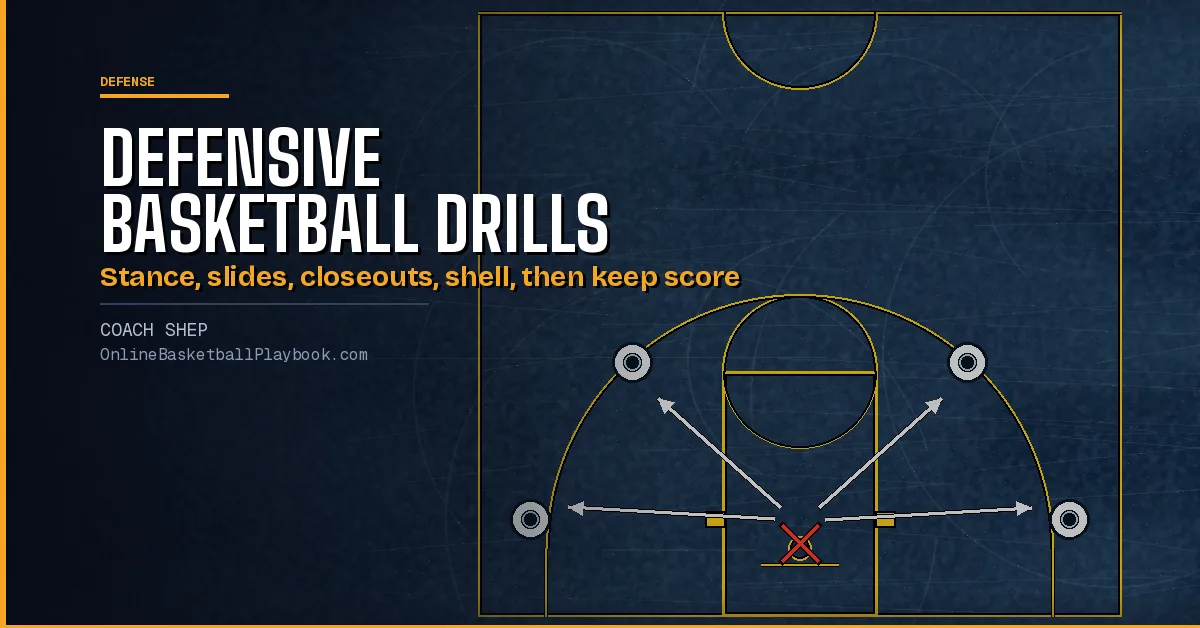
Defensive Basketball Drills: Slides, Closeouts, Shell and Games
Defensive basketball drills in teaching order, from stance and defensive slide drills to closeouts, pass denial, shell and scored games, with the versions coaches split on.
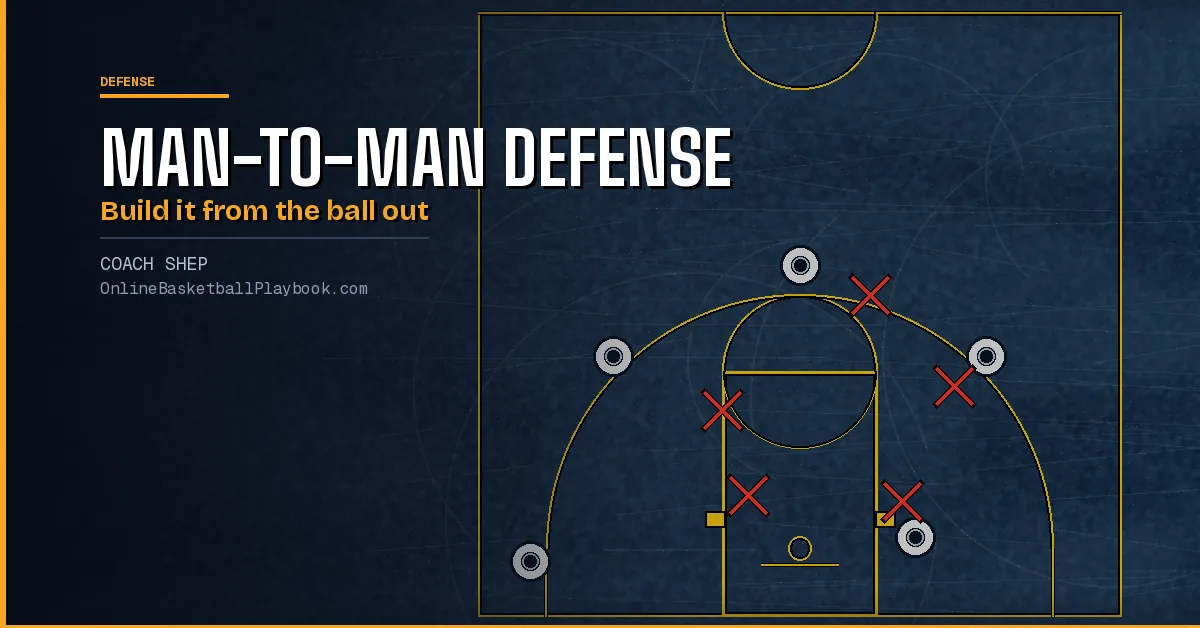
Man-to-Man Defense: Stance, Positioning, Help and Drills
Man-to-man defense starts with the ball-you-man line. Build it in order from the on-ball stance to one pass away, help and rotation, screens and the shell drill.
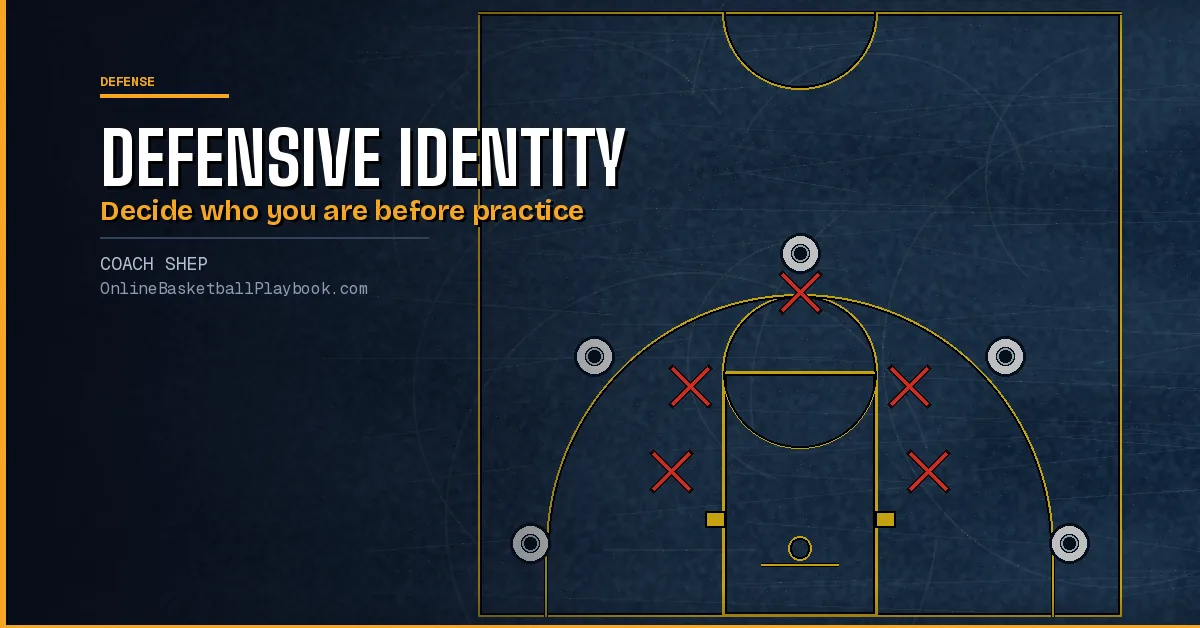
Defensive Identity Basketball: Choosing What Your Team Will Be
Defensive identity basketball coaches build on purpose: deny or pack, switch, force, press, zone, crash or get back, plus the standards that make it stick.