
Northern Colorado builds defense on five non-negotiable priorities. Master them in the right order and you get a team that creates turnovers, contests every shot, and competes on every possession — regardless of athleticism.
Priority 1: Press Footwork Before Everything
Northern Colorado does not start with plays. They start with feet. The entire defensive system — press, half-court, traps, rotations — is built on a footwork ladder that every player must master before they ever see a 5-on-5 rep.
The progression runs in a specific order: boxer stance, half-squat, step-slide with towels overhead to stay low, one-step and two-step "catch the first move" drills, and then the run-recover drill where defenders sprint to punch the cone and use a big step to cut off the offensive player. These five footwork pieces chain together in the Box Drill, which is the capstone of the press-footwork segment.
Why start here? Because the most common defensive breakdown at every level is a defender who is upright, flat-footed, or off-balance when the play begins. Northern Colorado's answer is to make correct stance and movement automatic before any concept is introduced. A player who has done the step-slide with overhead towels for two weeks does not have to think about staying low — the body already knows.
The footwork ladder also doubles as a warm-up. No setup is required. A coach can run the full boxer-through-Box sequence in eight to ten minutes at the start of any practice, and the result is a defense that arrives in every defensive possession with their feet already right. That time investment compounds across a season in a way that skill-only drills cannot match.
For programs building from scratch, this is the place to begin. Do not skip to help rotations or ball-screen coverage until the footwork is automatic. The reads come later. The feet have to come first.
Priority 2: Trap Skill and Turnover Creation
The second priority is turning the press into turnovers, and that requires specific trap mechanics — not just aggression. Northern Colorado teaches trap skill through two core drills: the circle trap and the sprint-out back-tip drill.
In the circle trap, defenders keep their feet together, walk under the ball handler's body space, and force a deflection or a hangtime pass. The rep does not end until there is a turnover. That detail matters. Ending on a turnover means the standard for the drill is the standard for the game. Players learn that a trap is not done when they close space — it is done when they create a mistake.
The sprint-out back-tip drill trains what happens when the offense escapes the trap with a pass. The rule is to run through the ball, never reach for it. Reaching is the instinct. Running through it is the skill. Teams that rely on reaching give up cheap layups off scrambled traps; teams that run through the ball convert those same possessions into turnovers at the other end.
Northern Colorado also uses back-pursuit and stunt drills, both of which train the mentality that the play is never over after a trap is broken. The stunt teaches defenders to threaten the ball handler even when out of position, buying time for teammates to recover. The shared rule across all trap work is this: steal off the ball, not on the ball. Ball-strip attempts are low-percentage and foul-prone. Forcing a hangtime pass or a misdirected throw is the real target.
Coaches who add trap-skill drills to their defensive menu quickly discover that their teams are more disruptive in passing lanes across the entire possession — not just when they are pressing. The habit of reading live ball movement, rather than tracking a single offensive player, carries over everywhere.
Priority 3: Contesting Shots Without Fouling
Northern Colorado credits their contest-without-fouling habits as the direct reason they led their league in defensive free throw rate. That result does not happen by accident. It comes from two specific drills done repeatedly until the correct movement is automatic.
The wall-up drill addresses what happens when the ball is inside. When the ball is two feet from the paint, the defender builds a chest wall — body contact without fouling — and then extends fully vertical on the shot. No arm, no shoulder, no body going sideways. Straight up. The cue is simple: the hand should be directly above the shooter's hand at the top of the contest.
The verticals drill teaches defenders to catch up and jump straight up rather than into the offensive player. In the rep, a coach holds the jersey and releases it late, so the offensive player leads. The defender has to close the gap and get vertical without making contact. The teaching phrase is high-jump, not long-jump. A long jump fouls. A high jump contests legally and forces a difficult shot.
The third piece is the contest drill itself, which puts the two movements together in a game-speed rep. The standard is simple: no baseline layup given up, no reach-in foul committed. Both outcomes are equally bad. Giving up an uncontested shot is as costly as the foul that sends the opponent to the line.
For younger teams who foul in the act of shooting too often, these three drills — wall-up, verticals, contest — are the highest-leverage defensive habit a coach can install. Fifteen minutes a day for three weeks will cut foul trouble and improve shot quality allowed at the same time. That combination is rare in coaching.
Priority 4: Closeout Discipline on the Perimeter
The fourth priority is closeout discipline. Northern Colorado's closeout framework is specific enough to name individual approaches by opponent type, and that specificity is what makes it work at the game level.
The mechanical foundation of the closeout is the same regardless of the shooter: sprint the first two-thirds of the distance, then parachute into choppy steps with hands up. The sprint closes the gap fast enough to matter. The choppy steps stop the defender from flying past the offensive player or arriving off-balance. Hands up during the chop make the defender appear closer and eliminate the quick catch-and-shoot option.
On top of that mechanical foundation, Northern Colorado uses a scouting-based label system for perimeter closeouts. The Curry closeout runs the defender off the three-point line completely — used against elite off-ball shooters who need a clear catch to operate. The Wade closeout means close and contest on the rise — used against players who pull up quickly off the dribble. The Rondo closeout means stay off and contest late — used against players who need to drive and cannot hurt you from outside.
This label system does something that generic closeout coaching cannot: it connects the drill to the actual scouting report. Players are not just executing a mechanical skill. They are executing a decision that their coach already made based on film. That connection raises buy-in and makes the defensive assignment clear even under game-speed pressure.
The standard for closeout volume is also stated plainly: the number of closeouts a team takes equals the number of ball screens they will defend. Those two things happen at the same rate across a game. A team that is lazy in closeout drills will be equally lazy rotating off screens. The habit transfers directly.
Priority 5: Will Over Skill — Compete on Every Rep
The fifth priority is not a technique. It is a standard. Northern Colorado states it directly in their practice culture: to be an elite pressing team, it has nothing to do with skill — it has everything to do with will.
This belief shapes how drills are structured. Every competitive defensive drill has a winner and a loser. The loser runs. There is no neutral outcome. A defender who half-contests, half-closes out, or half-sprints back in transition gets immediate accountability through the drill format rather than a coaching interruption. The drill itself enforces the standard.
Playing everything fast is the companion rule. Defenders who practice at three-quarter speed learn to defend at three-quarter speed. The moment the game speeds up — which it always does in a close game or in the fourth quarter — those habits fail. Northern Colorado trains at the pace at which they want to compete, and they validate every drill rep against the outcome (a stop, a deflection, a turnover) rather than against the clock.
This approach mirrors what the best coaches across all levels have documented: drill quality comes from the standards inside the drill, not from the duration. A 45-second rep that ends only on a turnover builds toughness. A two-minute rep that ends on a whistle teaches players to manage effort rather than apply it fully. The difference in a team's defensive identity over a season comes from which type of rep they took most often.
Will over skill does not mean ignoring technique. It means that technique without will does not hold under pressure. Northern Colorado installs the techniques first — footwork, trap mechanics, shot contests, closeout angles — and then requires maximum competitive effort in every drill format, because that is what it takes to apply those techniques in a game that matters.
To be an elite pressing team it has nothing to do with skill — it has everything to do with will. Validate every drill with a winner and a loser, and play everything fast.
— Northern Colorado Defensive Breakdown Principles, Basketball Vault
Installing the System in Your Program
These five priorities work as a sequence. A program that tries to install ball-screen coverage before teaching press footwork will get ball-screen coverage that breaks down when the feet are wrong. A team that skips trap mechanics but runs the press will get aggression without skill — turnovers created against bad offenses, layups given up against good ones. The order matters.
The installation model is whole-part-whole. Show the complete defensive system first so players understand where each piece lives. Break it into the smallest teachable units — one-on-one footwork, two-on-two trap mechanics, individual closeout reps. Drill those units at game intensity with clear winner-loser formats. Then reassemble at five-on-five and validate that the pieces connect under real defensive pressure.
Northern Colorado runs their daily defensive segment in two blocks: eight to fifteen minutes of breakdown work, then five-on-five. That structure keeps the technical reps frequent and short enough to stay sharp, while the five-on-five confirms that the habits transfer under full defensive pressure. The breakdown segment is not warm-up. It is installation. The five-on-five is not scrimmage. It is a daily check that what was installed actually works.
The validation standard Ettore Messina calls Defensive Validation is a clean fit here: a team's score only counts if they get a stop on the next possession. No setup required, works with any group size, and instantly raises the stakes on the defensive end without any extra coaching pressure. Run it at the end of your defensive block as a closing rep three or four days a week, and the competitive standard inside the drill will carry over to your first game of the season.
For programs at the high school level or below, start with three things: the press footwork ladder as a daily warm-up, the wall-up and verticals drills as a ten-minute no-foul block, and winner-loser scoring on every competitive defensive rep. Those three changes alone will shift the culture of a defensive practice within the first two weeks of implementation.
Start the press-footwork ladder on day one of pre-season and run it every practice as your opening defensive segment. It requires no setup, no equipment, and no additional planning — just cones or a court. By week three, your players will execute the boxer, step-slide, big-step, and run-recover sequence without any verbal cuing, which means you have already installed the foundation of every press and trap coverage you will run all season before you have run a single five-on-five rep.
- Run the press-footwork ladder — boxer stance through Box Drill — as the first ten minutes of every defensive practice day, no exceptions and no setup required.
- End every trap drill only on a turnover, not on a whistle; the standard for the drill must match the standard for the game or the habit never transfers.
- Teach wall-up and verticals before any help-rotation concept — a defender who fouls on the shot contest is a liability regardless of how good the team's rotations are.
- Label your closeouts with scouting names (Curry, Wade, Rondo) so every defensive assignment connects directly to what is on film rather than being a generic mechanical cue.
- Score every competitive defensive drill with a winner and a loser — a loser who runs — so that intensity is enforced by structure and not by constant coaching interruption.
- Close your defensive block three or four times a week with Defensive Validation: score counts only when backed up by a stop on the next possession, play to five points.
Want more basketball coaching strategies, drills, and tools?
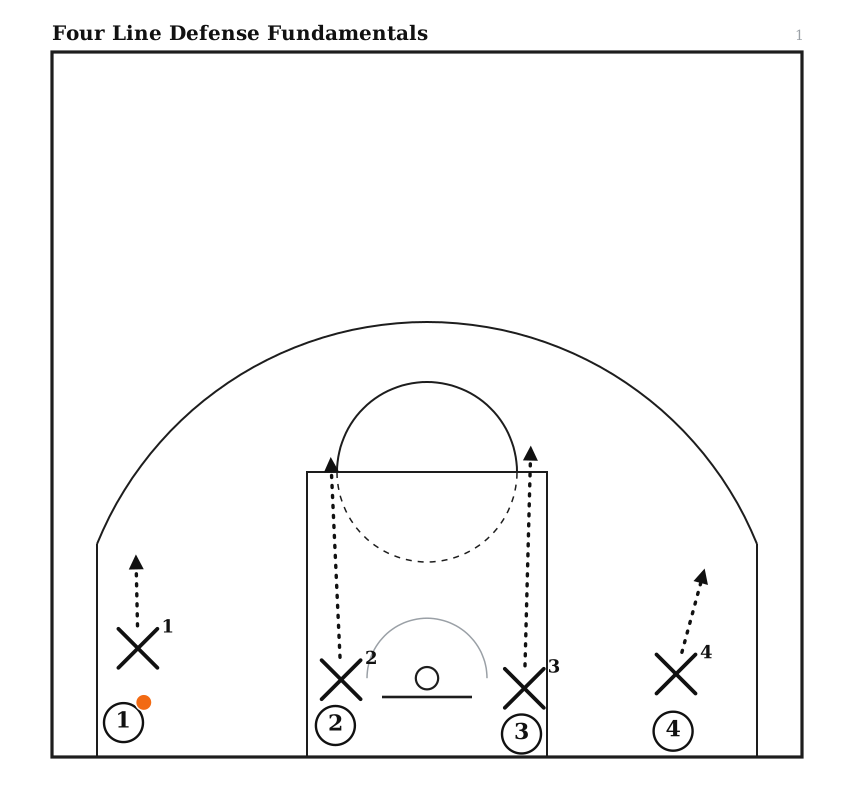
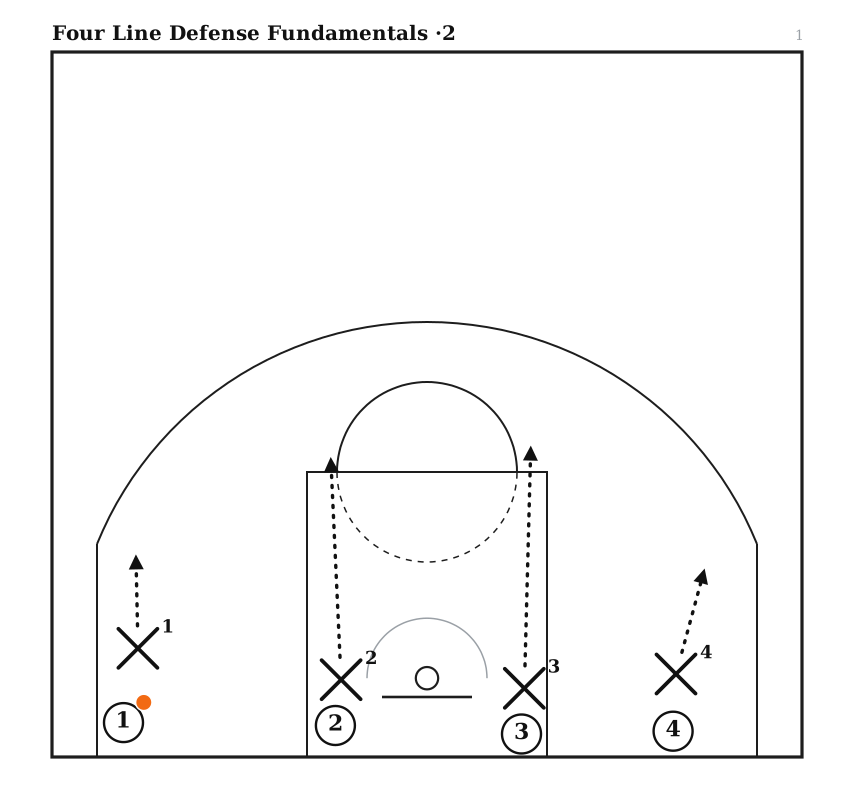
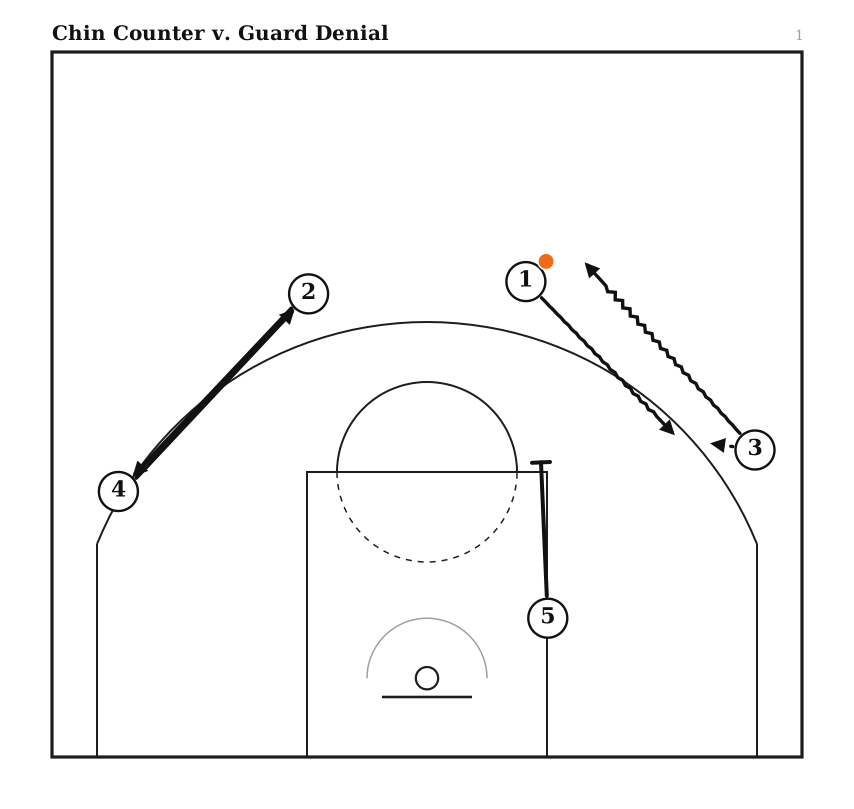
See it drawn up
Related diagrams
Keep Building
Related breakdowns
The 5 Defensive Keys of Northern Colorado Basketball
The 5 Defensive Keys of Northern Colorado Basketball
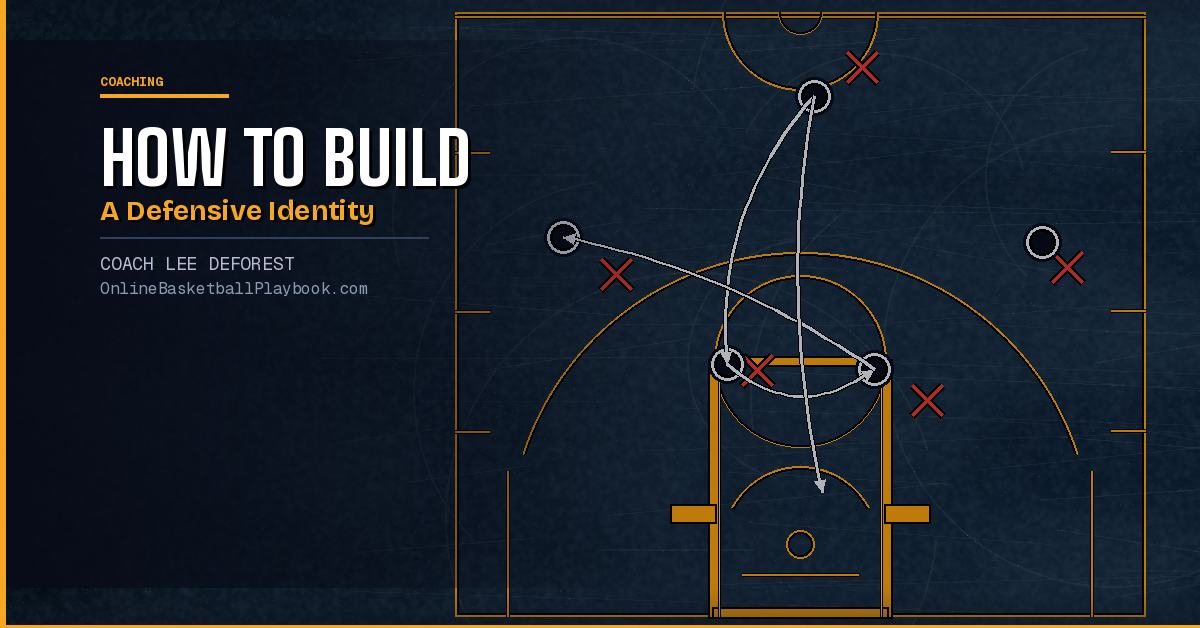
How to Build a Defensive Identity for Your Team
How to Build a Defensive Identity for Your Team