
Northern Colorado builds defense the right way — one habit at a time. Here are the five structural keys that separate their defensive system from programs that just run drills and hope effort fills the gaps.
The Footwork Ladder: Building the Foundation First
Most programs spend five minutes on stance and then go 5-on-5. Northern Colorado (NKU) does the opposite. Their press-footwork progression is built as a genuine ladder — each step depends on the one before it, and players don't advance until the previous movement pattern is clean under fatigue.
The sequence goes: boxer stance → half-squat → step-slide (towels overhead to stay low) → one-step/two-step big step to catch the first move → run-recover (sprint, big-step to cut off) → the Box drill that chains everything together. That final Box drill is where the pieces become a system. Players perform each movement transition in sequence, so the neural pattern for pressing defense gets built as a whole, not as disconnected pieces.
The towels-overhead variation during step-slide work is the key teaching detail. When players carry a towel overhead with arms extended, they physically cannot stand upright — the posture is self-correcting in a way that verbal cuing rarely achieves. Coaches don't have to yell "get low" because the drill makes cheating impossible.
Why does this matter for the press specifically? Because every breakdown in a press defense traces back to footwork that breaks down at full speed. A player who can execute clean step-slides in a controlled drill but collapses under live pressure hasn't built the habit into their body — they've just learned to perform it when they're thinking about it. The ladder approach drills the movements past the conscious level so they're available at game speed without thought.
For coaches building a defensive system at any level, the principle transfers even if you never run a press. Pick the three or four footwork patterns your scheme requires, sequence them from simple to complex, and run them every day before your first live rep. Ten minutes of purposeful footwork at the start of practice compounds across a season in ways that one-off reminders during 5-on-5 never will.
Contest Without Fouling: The Wall-Up System
Northern Colorado's defensive identity rests on a specific belief: you can protect the rim and contest every shot without collecting fouls, but only if you train the habit the right way. Their wall-up and verticals drill series is the mechanism.
The wall-up drill starts with a player positioned two feet inside the paint. When the offensive player attacks, the defender builds a wall with their chest — not reaching, not jumping to block, just vertical body position. That wall forces contact on the offensive player's terms, not the defender's. Then, when the shot goes up, the defender extends fully vertical. Chest wall first, then vertical — that sequence matters enormously. Defenders who skip the wall and jump straight to contesting often end up airborne before the shot goes up, which produces fouls.
The verticals drill solves a different problem: the late closeout into a shot. In this drill, a coach holds the jersey of the defender and releases them late — so the offensive player already has a step advantage. The defender must catch up and jump straight up rather than lunging forward to block the shot. It's a high-jump drill disguised as a contest drill. Players learn that "contest" means vertical, not horizontal. The language NKU uses — high jump, not long jump — sticks because it gives players a physical image to execute under pressure.
NKU credits this drill series for leading their conference in defensive free throw rate, meaning they contest aggressively without putting opponents on the line. That's not a coincidence. It's what happens when you drill the right habit at high volume.
The contest drill with the "high-jump-not-long-jump" cue is the third piece. Players practice the exact footwork and body angle needed to fully extend without fouling. Every rep ends on either a clean vertical contest or the coach calling out a foul — the standard is enforced in real time, which is how habits get built versus just demonstrated.
To be an elite pressing team it has nothing to do with skill — it has everything to do with will. Validate every drill with a winner and a loser, and play everything fast.
— NKU Defensive Breakdown Drills, Basketball Vault
Closeout Philosophy: Three Labels, One Standard
Northern Colorado uses a scouting-label system for closeouts that communicates a defensive assignment in a single word. The three labels — Curry, Wade, and Rondo — each describe a different coverage standard for a different type of shooter, and every player on the floor knows exactly what each one means before the ball leaves the inbounder's hands.
The Curry closeout means run him off the line. This is for your opponent's best shooter, the player who will shoot the ball the moment his foot hits the floor coming off a screen. The defensive assignment is to sprint and make him catch the ball in a difficult position — off the three-point line, on the move, with a hand in his face. You're not trying to force a drive. You're taking away the catch.
The Wade closeout is a close-and-contest on the rise. Wade-type players will shoot off the catch at a high clip, but they'll also attack a hard close-out. The defender closes hard and contests fully on the rise — the first step is the contest, not the contain. If the offensive player puts it on the floor after the contest, that's an acceptable result. You don't give up the catch-and-shoot.
The Rondo label is stay off, contest late. This assignment goes to offensive players who don't shoot well off the catch but will attack any defender who closes too aggressively. The defender maintains a cushion, takes away the drive, and contests only when the shot is coming up. Running a Rondo-type player off the line is often worse than giving him the shot.
The system works because every defensive assignment is communicated before the possession, not called out reactively when the ball swings. Players aren't guessing. The scouting label turns a complex read into a two-second pre-play assignment that sticks under pressure.
The sprint-the-first-two-thirds, then choppy-steps-and-hands-up technique applies across all three labels. The first two thirds of the closeout are a dead sprint. The final third is a controlled deceleration with short choppy steps to stop momentum and hands already above the shooter's release point. Arriving too fast and fouling is just as bad as arriving too slow and giving up an open look. The technique has to be right regardless of the assignment.
Shell and Spacing Language: Teaching the GPS
Shell defense is where most programs teach help positioning. Northern Colorado uses it to teach a full defensive language — one that gives players GPS-level precision on where to stand, when to stunt, and how to recover.
Their spacing vocabulary centers on a few terms that show up in every practice: the "50" (the midpoint position between your man and the ball), the rope (an imaginary line from the ball to your man that you're always on), and the double-contest drill that applies both concepts live. A defender who doesn't know where the "50" is will either stand too close to their man (easy skip pass) or too close to the ball (easy back-door cut). The rope concept gives players a rule that self-corrects as both the ball and their man move.
The stunt is the most important action inside the shell. NKU teaches it as a foot-and-hand move: one foot steps toward the ball handler while the near hand flashes up to disrupt the driving line. The defender does not leave their man — the stunt is a hesitation tool, not a help commitment. Players who confuse stunting with helping give up skip passes to wide-open shooters every time.
The recover cue — "two steps back" — tells players exactly how far to retreat after a stunt before reasserting their man-to-man responsibility. Two steps is specific. "Get back to your man" is not. Specific cues produce consistent execution. Vague ones produce different decisions from different players, which breaks the shell pattern entirely.
The reroute on every pass is the third piece. Every time the ball moves, every off-ball defender takes an active step to influence where their man can go next. This is not passive repositioning — it's a half-second of proactive defense that limits offensive movement before it happens. Rerouting on the pass is what separates help defenses that look active from help defenses that just react.
Run your shell drill with a scoring system from day one. Every stunt-and-recover executed correctly is a point. Every skip pass allowed is a point for the offense. Scoring makes the stakes real and forces players to communicate — no one calls out the rope or the stunt when it doesn't matter, but they do when the drill is being won and lost on correct execution of exactly those habits.
Will Over Skill: Validating Every Rep
Every drill Northern Colorado runs has a winner and a loser. That is not an accident and it is not motivational decoration — it is the mechanism by which competitive habits get built and sustained across a full season of practice.
The trap drills — circle trap and sprint-out/back-tip — are the clearest example. In the circle trap, feet stay together, players walk under, force a deflection or a hangtime pass, and the drill continues until the defense produces a turnover. Players stay in the drill. You don't rotate on a clock. You rotate on a result. That's the difference between a drill that teaches the habit and a drill that rehearses the motion.
The sprint-out/back-tip drill extends the principle to transition off the trap. When the ball comes out, players sprint through the ball — never reaching, always running through the space the ball occupies. The NKU cue is "punch the cone." The rep ends when the back-tip is executed cleanly, not when the clock runs out. Players who understand they stay in until they do it right execute with urgency that players who know they rotate in 20 seconds simply do not.
The principle of "steal off the ball, not on the ball" governs all trap work. Reaching for a live dribble produces fouls and opened-up driving lanes. The deflection comes from active hands on a pass out of the trap — playing the next pass, not the current one. That read requires training. Players don't do it naturally because the ball is the most visually compelling thing on the floor. You have to build the habit against the player's instinct.
Validation is how you make the habit stick under pressure. Messina's Defensive Validation format — where a score only counts if you get a stop on the next possession — hides the defensive emphasis inside a competitive game. Players compete to win and accountability follows automatically. NKU's approach is structurally similar: the drill has stakes, the result is public, and the pressure is real. That environment produces habits that survive a road game in February when nothing else will.
Putting It Together: The Two-Segment Practice Model
All five defensive keys — footwork, contesting, closeouts, shell, and competitive validation — get installed through a specific practice structure. NKU runs a daily two-segment defensive block: an 8-to-15 minute breakdown segment followed by 5-on-5.
The breakdown segment is where part-whole teaching happens. The system is broken into 1-on-1, 2-on-2, and 4-on-4 reps that isolate one defensive habit at game-realistic intensity. Footwork drills, trap-skill reps, closeout series, and shell variants all live here. The 5-on-5 segment is where everything reassembles. Players don't go 5-on-5 to learn — they go 5-on-5 to validate what was built in the breakdown segment. That sequence is the whole-part-whole teaching model, and it's the reason NKU's defensive habits transfer from drill to game: players have already executed each piece at full intensity before they're ever asked to put it together.
The breakdown segment must be scored and competitive. If players know a rep is just a drill, they give drill-level effort. If every rep has a consequence — stay in until you get a stop, run if you give up the basket, score for a clean execution — they give game-level effort. That's the environment where the habits that matter actually form.
The two-segment model also solves the sequencing problem that plagues most practice plans: when do you install the parts and when do you put them together? The answer is every day, in order. Breakdown first, then assembly. The parts never get disconnected from the whole, and the whole never outpaces the parts. The result is a defense that improves incrementally every practice rather than lurching between good-looking drills and chaotic 5-on-5.
For coaches building from scratch, the entry point is the footwork ladder. Run it every day before your first live rep. Layer the contest-without-fouling work into the breakdown segment within the first week. Add the shell language and the closeout labels in week two. By week three, your 5-on-5 segment will look different — not because players suddenly got more athletic, but because they have a shared vocabulary, practiced habits, and a competitive environment that demands execution. That is the Northern Colorado model, and it works at every level where players are willing to do the work.
- Run the full footwork ladder — boxer stance through the Box drill — as a daily warm-up before any live defensive rep; 8 minutes is enough and it compounds across a season.
- Teach wall-up before verticals: chest-first contact on the drive, then straight-up contest on the rise — never reverse the sequence or players will foul on the jump.
- Assign Curry, Wade, or Rondo closeout labels in your pre-game scouting and communicate them before the possession, not reactively when the ball swings to the shooter.
- Score every shell drill with a stunt-and-recover point system so players communicate the rope, the 50, and the reroute under real competitive pressure rather than just going through the motions.
- Use the two-segment model every practice: 8–15 minutes of scored breakdown reps first, then 5-on-5 for validation — parts before assembly, every single day.
- End practice with Messina's Defensive Validation format: a score only counts if you get a stop the next possession, play to five, no setup required.
Want more basketball coaching strategies, drills, and tools?
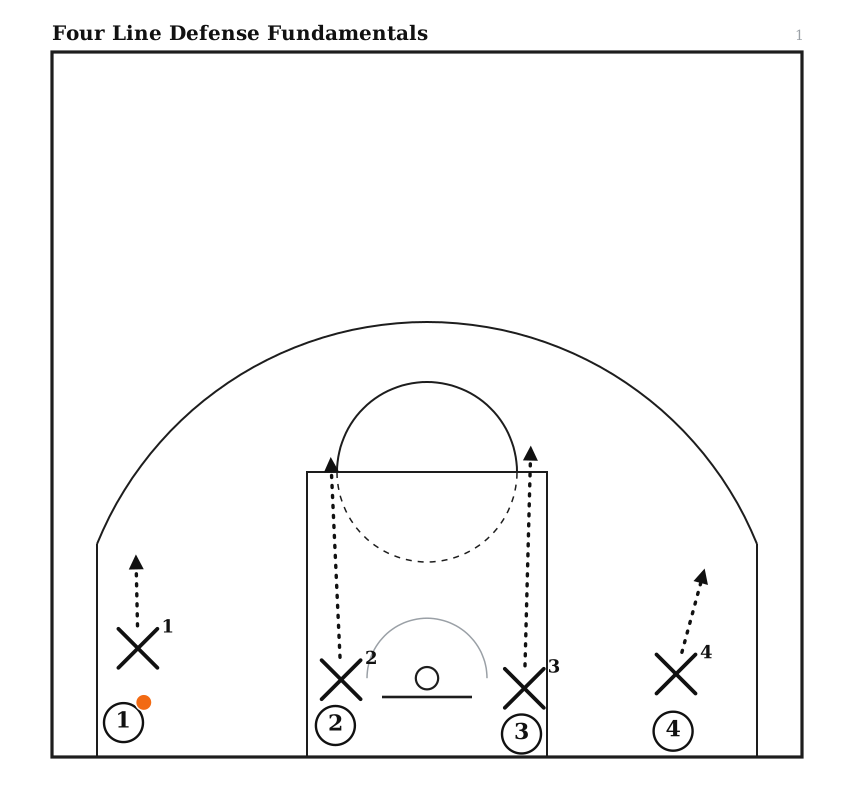
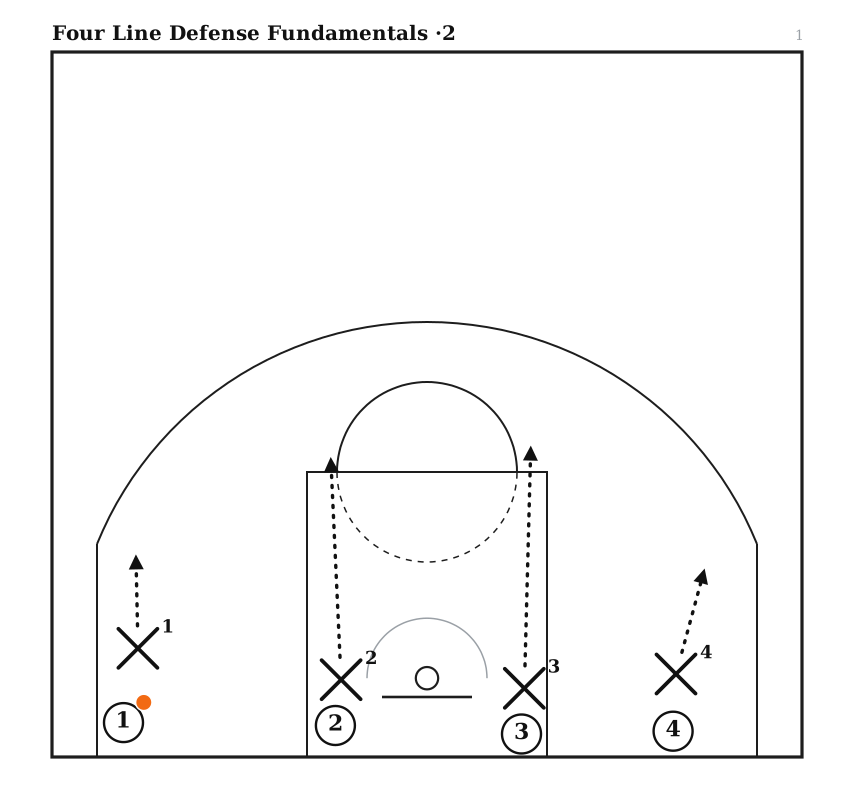
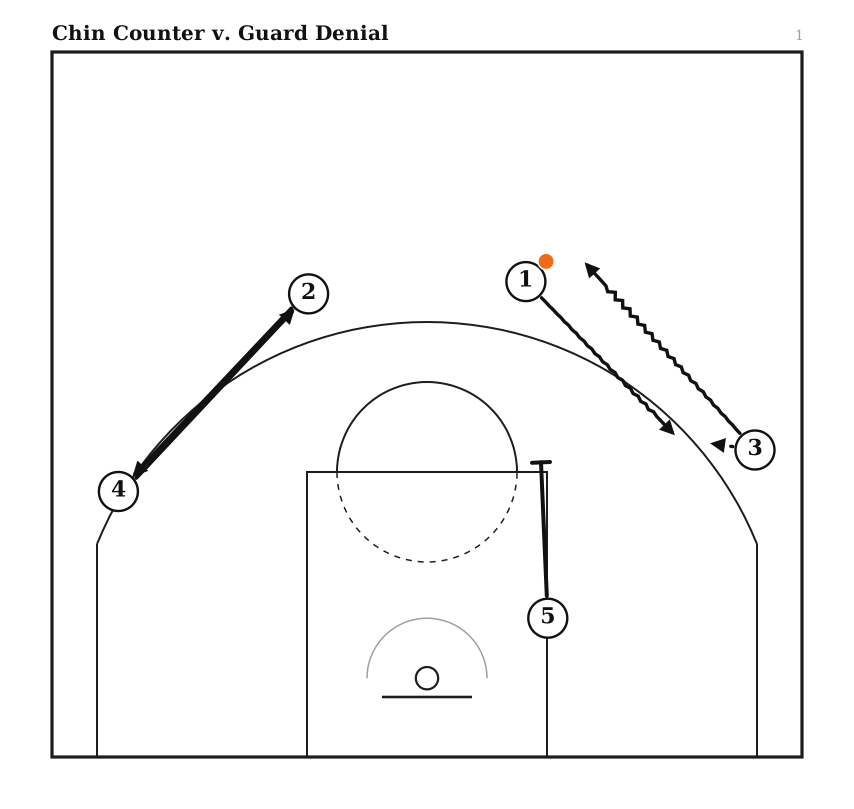
See it drawn up
Related diagrams
Keep Building
Related breakdowns
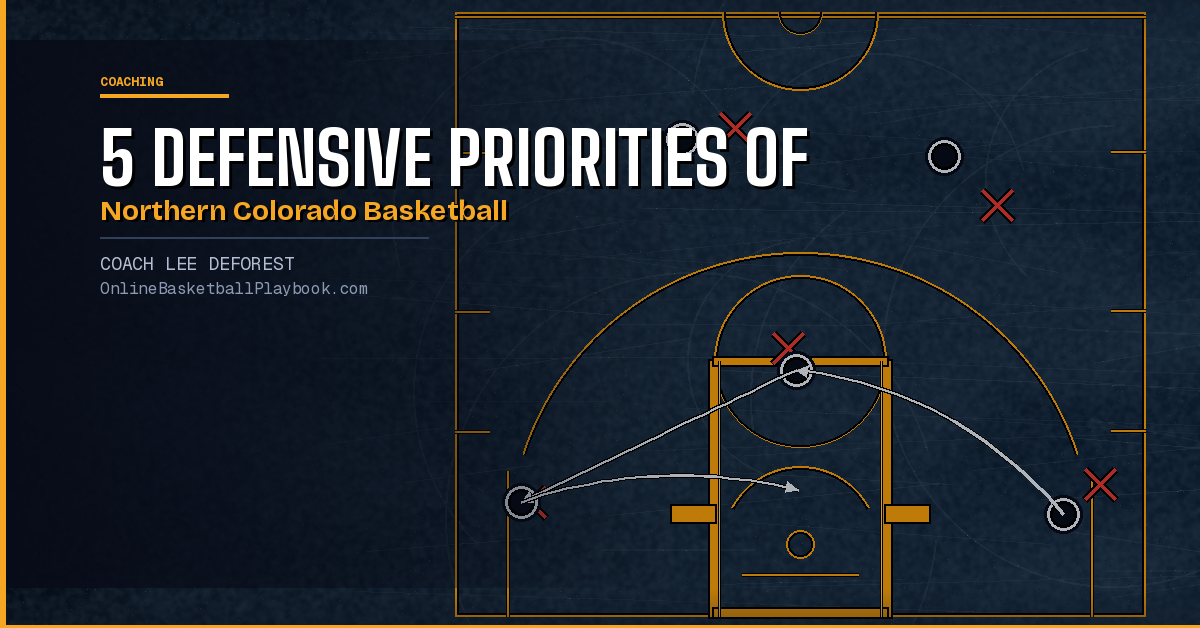
The 5 Defensive Priorities of Northern Colorado Basketball
The 5 Defensive Priorities of Northern Colorado Basketball
10 Keys to Setting and Defending Screens in Basketball
10 Keys to Setting and Defending Screens in Basketball