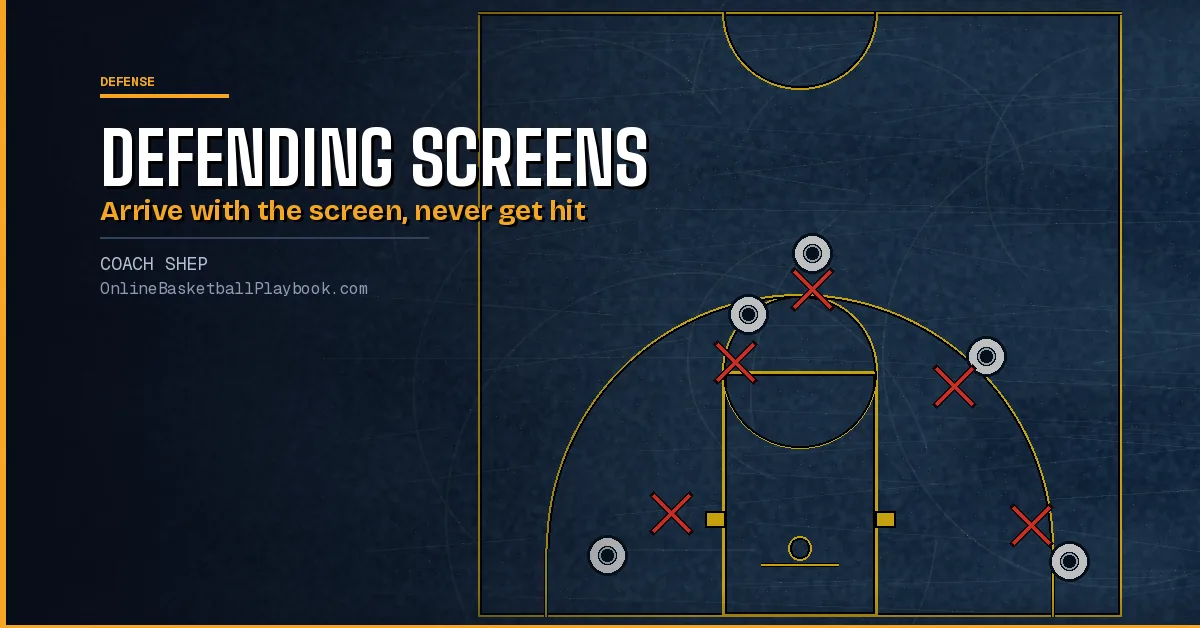
Defending screens in basketball is the hardest problem in man-to-man defense, and it is the area where coaches disagree the most. There is no single right coverage, only the right coverage for the personnel and the situation. What does hold across coverages is a short list of execution keys.
This guide covers the five keys, the on-ball and off-ball coverages they sit on top of, what each mistake costs, where coaches split and how to teach it. For the coverage-by-coverage breakdown of the ball screen itself, see How to Defend the Pick and Roll.
Screen Defense at a Glance
| Key | The rule | The failure |
|---|---|---|
| 1. Coverage | Choose by personnel and scouting before the game | One coverage against every handler |
| 2. Timing | The screener's defender arrives with the screen | He shows up after it, and no coverage works |
| 3. On-ball defender | Never gets hit. Bully through or recover in front | He is picked clean and help cannot save it |
| 4. The roll | A low man owns the roller on every coverage | A layup to the roller off a late rotation |
| 5. Talk | Call the screen and the coverage early and loud | A late call and two defenders on one player |
Key 1: Choose the Coverage Before the Screen
Coverage is a decision, not a default. Make it before the game from personnel and scouting.
- Who has the ball. A shooter, a driver or a passer.
- What the screener does. Roll, pop or pass.
- Where the other four stand. The other four offensive players.
Plan to use only one or two coverages in a game. The call can still change as you see how screens are being set, and once an opponent gets comfortable, mix up how a screen is guarded.
| Coverage | What it does | Use it against |
|---|---|---|
| Hard show or hedge | The screener's defender steps into the handler's path with shoulders to the ball and forces him wide | A great shooter who scores behind the screen |
| Soft show | The screener's defender sits two steps off and tilts toward half court, which gives the on-ball defender time to recover | A creative handler with a screener who is a pop threat |
| Drop | The screener's defender drops two steps under and two steps away so the on-ball defender can slide under | A handler who is not a shooter, or a screen outside the scoring area |
| Blitz | Two defenders trap the handler. Many coaches auto-trap any ball screen below the free-throw line | A star handler, with a corner-filled read to gate it |
| Ice | The on-ball defender pushes the handler toward the sideline and takes away the screen's angle | Best for a defense that already forces baseline and has quick-footed bigs |
| Switch | The two defenders trade men | Equal-size players, and short-clock situations |

The floor location matters as much as the player. Teach the coverage by where the screen happens.
- Far from the scoring area. A drop or under from the big.
- Inside the scoring area. A blitz.
- As options. A high flat or switch.
- Where the scoring area is. Roughly three feet beyond the three-point line and in.
Choose the coverage before the screen, and stay with it until the film says change.
Key 2: The Screener's Defender Arrives With the Screen
Whatever the coverage, the screener's defender has to arrive with the screen and not after it. Timing is the difference between a stop and a breakdown.
- Show early and get split. A post defender who shows early gets split.
- Show late and let him turn. A post defender who shows late lets the handler turn the corner.
- Jump early and get it refused. A guard who jumps to the screen early gets it refused.
Arriving on time means anticipating the screen before contact, getting to the handler's driving path first and staying connected to the screener so the handler cannot split the two defenders.
The other half is timing inside a blitz. The two defenders have to meet at the same moment. Get up to touch, which means pressuring the handler so he passes over or around you, and never let him snap a direct pass out of the trap. If the screener's defender is late, the handler gets a clean pass.
Arrive together, and arrive on time.

Key 3: The On-Ball Defender Never Gets Hit
Getting screened cleanly is a defensive mistake, and it belongs to the on-ball defender. His job is to bully through the screen or recover in front of the handler before he turns the corner. A rejected screen, where the handler turns the other way, is a read the defender allowed. The habits that follow:
- Get into the handler's body. Giving the handler room makes it easier for him to build speed and fake the defender. Push up into him the moment the screen is called.
- Go over unless the scouting report says otherwise. Crowd the man with the ball and throw the leg and arm over the top in one motion.
- Keep the hands high and active. That guards against the snap-back pass.
- Sprint back in front. The screener's defender can only recover if the on-ball defender gets in front of the handler.
- Treat going under as a decision. It fits a handler who is not a strong outside shooter, and the defender still needs a quick recovery on the far side. Going under early can also get the screen rejected. Under is the easiest choice and the one that teaches the least.
Stay in front of the ball every time.
Key 4: Someone Owns the Roll
Every coverage needs a player responsible for the roller, and that player is the low man. If nobody owns the roll, the roller catches in the paint.
- Split the roller. The top big takes the short roll and the low tag man takes the long roll.
- Gap defender stops him. The adjacent gap defender stops the roller until the on-ball defender recovers.
Name the role and rep it three on three, with a weak-side helper, before any five on five.

A slip is not a screen. When the screener peels off before contact and cuts to the basket, the defense should stunt and stay in its two-on-two assignment. Do not show or drop as if a full ball screen happened.
Know who owns the roll before the screen comes.

Key 5: Talk Early and Connect the System
Communication is part of the coverage. The big calls the screen and its direction first, so the on-ball defender's position shifts before the screen is set. Drill six calls daily. The staff needs one shared vocabulary for ball screens. Call the program's terms at least three times, early and loud.
Then connect the screen defense to the rest of the system, because how you defend the post dictates what you can do against screens. See Man-to-Man Defense for the base principles.
Talk early, and talk loud.
Get the next coaching guide in your inbox
One email when a new guide or diagram set goes up. Free.
Defending Off-Ball Screens
The same keys apply off the ball on down screens, cross screens, flares and staggers. You cannot fight through a screen and worry about your man, so pick one.
- Fight over the top. It frees a curl.
- Go under. Against a non-shooter.
- Lock and trail. Ride as a caboose on the cutter's hip.
- Switch.
Two points follow:
- The side of the floor changes the coverage. On a ball-side screen, the shooter's defender chases along the same path and forces a curl, which arrives with the defender attached and no shooting window. On a weak-side screen, he fakes the chase and goes over the screen, which pushes the shooter out to a flare. The pass that has to arrive there is a skip, the hardest pass to complete.
- The screener's defender has two jobs. He extends the shooter's route with a body check or a fake switch, and he stays between the screener and the ball so the roll or slip is covered.
On flares and wide pins, get into the body of the cutter and never go under, then loosen to the ball to kill the slip.
Switching off the ball is also a tool. The screener's defender calls it and then jumps the passing lane, and it works best between similar sizes. Set the switch pairings before the game. For the offensive side see Basketball Screens and Drills to Teach Off-Ball Screens.
Pick one answer to each screen before the game.
What Each Mistake Costs
Offenses read your coverage and go to the answer. Use this as a film checklist.
- Hedging too far. A screener's defender who commits fully to the ball gets split. One who stays attached gets attacked on the outside hip.
- Cheating early. An on-ball defender who jumps under or over early gets the screen turned down.
- A hard hedge. It invites a back-out and an isolation against the switch.
- Going under with no help. That is a pull-up jumper.
- A trap. The handler takes two retreat dribbles and the screener short-rolls one step to make it four on three.
- Switching a big onto a small on a high screen. The screener slides down and posts the smaller defender, which is why show and recover is preferred. Steer switching, where the big pushes the screener toward the ball defender to force the switch, and a pre-switch off the ball can soften the cost.
- A late switch call. Switches need clear verbal signals, eye contact and practiced timing.
Watch the film for these and fix one at a time.
Where Coaches Split on Screen Defense
Hedge or no hedge. Personnel decides.
- Hedge with commitment. Hedge or show and commit to it.
- Go under, no hedge. Refuse to hedge because it pulls the big too far from the basket.
- Contain at the level of the screen. No hedge and no switch.
When the trap fires. Check each trigger before you mix systems.
- Before the dribble dies. Blitz the star.
- After he picks up the dribble. Trap only then.
- On named openings. Such as the ball being dribbled toward you.
- By location. Double below the free-throw line and switch above it.
Switching.
- Never switch ball screens.
- Switch as much as you can. A switching, hands-off team is hard to attack.
- Switch equal sizes and short clocks. Switch equal-size players and always switch in short-clock situations.
- Do not switch a slip.
Going under.
- Only against a non-shooter.
- By screen height. Go under on a high pick and roll and over on a mid one.
Hard hedge or flat hedge.
- Hard hedge. It faces the sideline to force extra steps toward half court.
- Flat hedge. It faces half court, level with the screen, which forces lateral steps and keeps the big attached against a roll or pop.
Choose your side of each fork and teach it with one set of words.
How to Teach Screen Defense
Master the two-player coverage first, then add helpers one at a time.
- Two on two with no help. Hedge, over and under all have to work alone. Ban switching at first.
- Three on three with a weak-side helper. The helper is the low man. He leaves his man to attack the roll and spots on the line between the roller and the basket.
- Four on four. Add the fourth defender in two ways, depending on where he stands.
- Five on five. Run the live coverage. You can also show it at five on five first and break it down afterward.
- Daily calls. Drill the program's screen calls every practice.
More drill detail is on Drills to Teach Ball Screen Defense and Ettore Messina Pick and Roll Defense Drills.
Two players first, then add one helper at a time.
Coach Cheatsheet
- Decide the coverage the day before. Do not decide it at the screen.
- The screener's defender arrives with the screen.
- The on-ball defender never gets hit.
- Name the low man and rep the roll three on three.
- A slip is not a screen. Stunt and stay two on two.
- Call the screen early and loud, and know how your post defense shapes your rotations.
Questions Coaches Ask About Defending Screens
What is the best way to defend a ball screen?
There is no single best coverage. Choose it by the handler, the screener and where the screen happens, decide it before the game and protect it with a low man on the roll.
Should you go over or under a screen?
Over is the default unless the scouting report says to go under a driver. Under fits a handler who is not a strong outside shooter and needs a fast recovery on the far side.
How do you defend a slip?
Do not treat it as a screen. Stunt toward the ball and stay in your two-on-two assignment.
Should you switch screens?
Coaches differ. Switch equal-size players and in short-clock situations, avoid putting a big on a small on a high screen and always call the switch early.
How do you defend off-ball screens?
Fight over, go under against a non-shooter, lock and trail or switch. On ball-side screens force the curl, and on weak-side screens push the shooter out to the flare.
All defense pages sit under the Defense hub. Related guides include Types of Defense in Basketball, How to Defend Ball Screen Continuity, Drills to Teach Defending Cutters and How to Attack Every Ball Screen Coverage.
Want the printable playbook packs?
OBP Pro members get the premium playbook packs: the zone attack, out of bounds and practice plan PDFs, plus each new pack as it is finished. The membership page lists what is in each one. Or draw your own version free in PlayDraw.
See what OBP Pro includesMore Coaching Guides
- Building Team Chemistry in Basketball: Roles, Rules and Habits
- Blocker-Mover Offense: Roles, Alignments, Reads and Install
- 1-3-1 Baseline Out of Bounds Defense: Shape, Jobs, Traps
Back to Types of Defense and every Defense page.
Keep Building
Related breakdowns
10 Keys to Setting and Defending Screens in Basketball
10 Keys to Setting and Defending Screens in Basketball
Pick and Roll Defense: Every Ball Screen Coverage Compared
Pick and roll defense compared: drop, show, blitz, switch, ice and under, what each takes away and gives up, the help behind it and how to choose.
Pack Line Defense: Rules, Post Coverage and How to Install It
Pack line defense as coaches run it: where the line sits, on-ball and gap rules, post doubles, screens, dead balls, the costs and an install order.