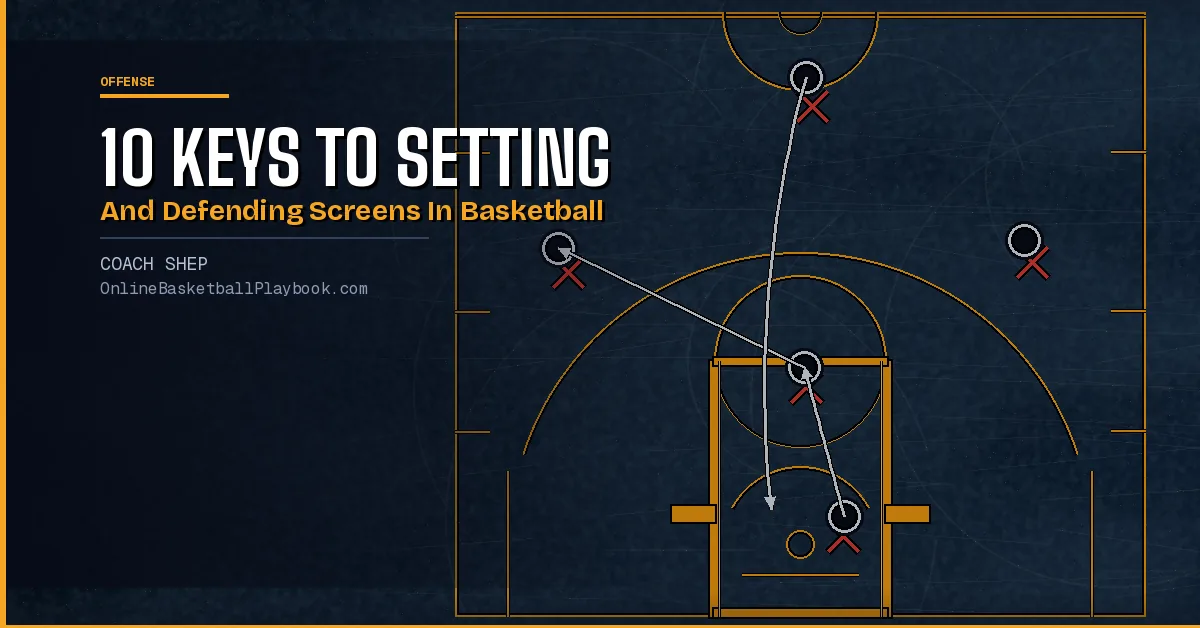
Screens decide games. Whether you're setting a back-screen in a Princeton action or defending a pick-and-roll against a great shooter, the team that executes screening fundamentals on both ends controls tempo, creates advantages, and wins possession battles night after night.
Key 1–2: How to Set a Legal, Effective Screen
A screen that gets called for an illegal foul is worth exactly nothing. Before any offensive system can function, every player on your roster needs to understand the physical and timing requirements of a legal screen. These two keys are the foundation everything else is built on.
Key 1: Establish a Wide, Stationary Base Before Contact
The most common screening foul comes from a screener who is still moving when contact happens. The rule is simple: you must be completely set (feet outside shoulder width, body upright and stationary) before the defender makes contact with you. Coaches often cue this as "plant and brace." Wide feet lower your center of gravity and make you harder to push through. Narrow feet get you off-balance the moment a physical defender hits you, and the official reads that movement as a moving screen every time.
The secondary piece is angle. Your screen angle determines what action you're freeing up for the ball handler. Screening at a 45-degree angle to the sideline opens the middle. Screening parallel to the lane opens the corner. Teach your players that the angle of the screen is not random. It is a decision that communicates exactly where the ball handler is supposed to attack.
Key 2: Give the Defender One Step of Distance
You cannot set up inside a defender's normal path without giving that defender a chance to stop or change direction. In practice, that means your body should arrive at the screen location slightly before the ball handler uses it, not simultaneously. If you're running at a defender to cut off their path, you're setting an illegal screen regardless of whether you're stationary at the moment of contact. The court standard is roughly one step (enough that a defender moving at normal speed could theoretically avoid the screen if they saw it in time). This rule protects your team from ticky-tack foul calls and protects defenders from injury.
Key 3–4: Reading the Defense as the Ball Handler
Using a screen well is a two-person skill. The ball handler who dribbles blindly into every screen without reading how the defense is playing it will produce turnovers and broken possessions. Great point guards and wings learn to read the defense before the screen is even set.
Key 3: Catch the Defender on the Hip, the "Shoulder Blade" Rule
The ball handler's timing determines whether the screen works. Come off a screen too early and the defender has room to recover around it. Come off too late and you're already past the advantage point. The standard coaching cue is to aim your outside shoulder at the screener's inside shoulder blade. When you execute this path correctly, the defender's natural recovery routes (over the top or under) are both contested, and you emerge with a genuine advantage off the catch or off the dribble.
Many young players set up the screen from too far away. The correct footwork is to take your defender in the opposite direction first (away from where the screen is set), then cut back sharply so the defender's momentum is moving the wrong way when the screen arrives. This is called "setting up the screen," and it's what separates a functional off-ball player from one who just stands around waiting to catch the ball.
Key 4: Reject the Screen When the Defender Shows Early
Reading the screen coverage is the highest-level ball-handling skill in this article. When a defensive big "shows" or "hedges" hard into the ball handler's path, many players try to fight through the show and use the screen anyway. The smarter read is a reject. Attack opposite the screen, away from the hedge, into the open space the hedging defender just vacated. A properly executed reject turns the defense's best coverage against itself. The same read applies to an ICE coverage: if the defender is steering you toward the sideline, reject the screen toward the middle before the ice coverage can fully establish.
Key 5–7: The Five On-Ball Defensive Coverages
There is no single best way to defend a ball screen. The top coaches in the world disagree on this, and that disagreement itself is instructive. The right coverage depends on who is setting the screen, who is handling the ball, and what your personnel can execute. What every elite program agrees on is that you must have a coverage, you must drill it until it is automatic, and every player on the floor must know their assignment the instant a ball screen is called.
Key 5: Hard Show / Hedge, Your Best Tool Against Elite Shooters
In a hard show, the screener's defender steps aggressively into the ball handler's path (shoulders square to the ball, taking away the direct downhill lane). The ball defender recovers around the screener and re-engages the handler before they can shoot. This is the correct coverage when you're guarding a shooter who scores behind the screen rather than off the dribble. The risk is the screener's roll: a slow recovery by the hedging big leaves the roller open at the rim. This is why the back-side rotation (the help-side defender rotating to cut off the roll) must be drilled as a package with the hedge itself, not as an afterthought.
Key 6: Drop / Sag, Protecting the Rim Against Non-Shooters
In a drop coverage, the screener's defender drops two steps below the screen, allowing the ball defender to slide underneath the screen and re-engage in front of the handler. This takes away the downhill drive and protects the rim, but it concedes a clean mid-range pull-up to any handler who can shoot off the dribble. The drop is the correct base coverage when the ball handler is not a perimeter shooting threat, or when the screen is set above the three-point line with separation from the screener. Use it wrong (against a great shooter), and you are handing them open mid-range looks all night.
Key 7: Blitz / Trap, Pressure Below the Free-Throw Line
A blitz sends two defenders at the ball handler the moment they use the screen, forcing them to pass under pressure. Many programs run this as an automatic call any time a ball screen occurs below the free-throw line, where the handler is already in a scoring area and the roll to the basket is short. The critical execution rule: get "up to touch" (make the handler dribble over or around you, never let them snap a direct pass). When a handler can zip a direct pass to the roller without any deflection, the blitz has failed. The blitz also requires the corner to be tracked: if the corner is filled with a shooter, running the blitz without coverage on that shooter is inviting a kick-out three.
Key 8: Defending Off-Ball Screens
Most defensive breakdowns in games are not on the ball handler. They happen two passes away, on a cutter coming off a down screen or a curl off a stagger. Off-ball screen defense is where attention to detail separates good defenses from great ones.
The fundamental choice is whether to fight over the top of the screen or go under it. Fighting over the top keeps you in a position to contest catch-and-shoot opportunities but exposes you to being pinned on a curl. Going under is appropriate against non-shooters but hands open three-point looks to anyone who can shoot off the catch.
A third option (less commonly taught but extremely effective) is the lock-and-trail technique, where the defender follows the cutter as a "caboose" on their hip through the screen, maintaining inside position rather than fighting through the screener's body. This technique requires good anticipation but denies both the curl and the pop because the defender is already in position when the cutter reaches their spot.
Regardless of technique, the screener's defender has a responsibility too. Blow up the screen angle. Step into the path of the cutter so they cannot run a clean curl, forcing a pop or a fade instead. The idea that off-ball screen defense is only the cutter's defender's problem is wrong. It takes two defenders to execute it correctly.
Key 9: Match Your Coverage to Your Personnel, The Switching Question
Switching all ball screens has become increasingly popular at every level of the game. A switching team eliminates the two-on-one timing advantage the offense creates and removes the decision-making burden from defenders in transition. At the high school level, many experienced coaches recommend switching as the default coverage precisely because it is the simplest to execute and the hardest for offenses to attack without sophisticated post-up counters.
But switching has real costs. If your roster has significant size or skill mismatches (a small guard who can be posted by a four-man, or a big who cannot guard a ball handler in open space), switching exposes those mismatches on every action. Jim Calhoun and Tony Bennett have both noted publicly that switching should be reserved for exceptional circumstances or very mature teams, because over-reliance on switching as a crutch prevents defenders from developing the individual skills to fight through or over screens.
The practical framework: run switching as your base at the youth and early high school level where the decision-making burden must be low. As players mature, introduce the hedge and drop packages as your scouting-specific tools, so you can choose your coverage based on who you're guarding rather than always defaulting to the same answer.
When you introduce a new on-ball screen coverage to your team, spend the first two practices running the coverage against no defense at all (walk through the screener's defender's footwork, the on-ball recovery path, and the back-side rotation assignment separately) before you ever put a live defender in the drill. Players who don't know their specific job in a coverage will improvise in games, and improvisation against a good ball screen offense produces layups.
Key 10: Drilling Screens So Coverages Become Automatic
The final key is the most practical one. Everything in this article becomes useless without repetitions. Ball screen defense (both the on-ball coverage and the back-side rotation) must be drilled in 2-on-2 and 3-on-3 segments until the assignments are automatic. The goal is that no defender has to think about their job when a screen is called in a game; the decision was made in practice and the muscle memory takes over.
On the offensive side, run your screening actions against live defense from the first week of practice. Teach the shoulder-blade cue. Teach the reject. Teach your screeners how to roll versus pop based on what the coverage gives them. Players who understand the full picture (both how to use the screen and how the defense is trying to take it away) make better decisions under pressure than players who have only been taught one side of the action.
The best drill framework for screens is simple: 2-on-2 live from the arc, with the coaching staff calling a coverage before each rep. The offense knows what coverage is coming. The defense knows what coverage to run. Both sides work on execution, not discovery. Add the third player and back-side rotation when the base two-man execution is clean. Add scout-specific actions (stagger, flare, pin-down) in the second half of the week when you're preparing for a specific opponent.
- Set a legal screen: feet wide, body stationary, arrive one step before contact. Give the defender a chance to stop or you're getting called every time.
- Set up the screen: take your defender the opposite direction first, then cut back sharply. The angle reversal is what creates separation, not the screen alone.
- Ball handler timing: aim your outside shoulder at the screener's inside shoulder blade. Too early and you waste the screen, too late and the advantage is already gone.
- Read and reject: when the defense hedges hard or ICEs the screen, attack opposite. The reject turns their best coverage into open space for you.
- Screener's defender: arrive with the screen: if you arrive late, the ball handler is already through. Your arrival timing is the whole coverage, not your footwork after the fact.
- Own the back-side rotation: every coverage (hedge, drop, or blitz) requires a help-side defender to own the roll. Name that defender before tip-off and hold them accountable in film.
- Know the offensive counter-map: if the opponent keeps throwing back to the corner every time you blitz, the blitz is failing. Rotate differently before you abandon the coverage entirely.
Want more basketball coaching strategies and drills?
Join the Online Basketball Playbook newsletter →
Draw this play free in the play drawer →
Membership: the full library, playbook packs, and Pro drawing tools →
Keep Building
Related breakdowns
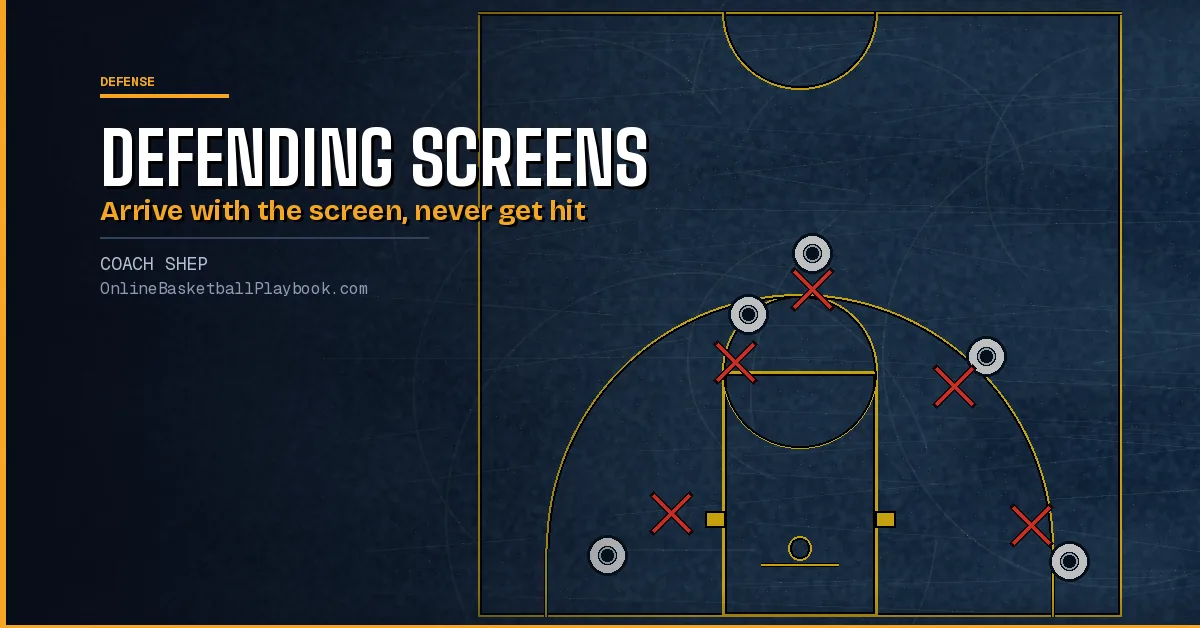
Defending Screens in Basketball: 5 Keys for Every Coverage
Defending screens in basketball comes down to five keys that hold under any coverage, for ball and off-ball screens, with the mistakes that cost baskets and drills.
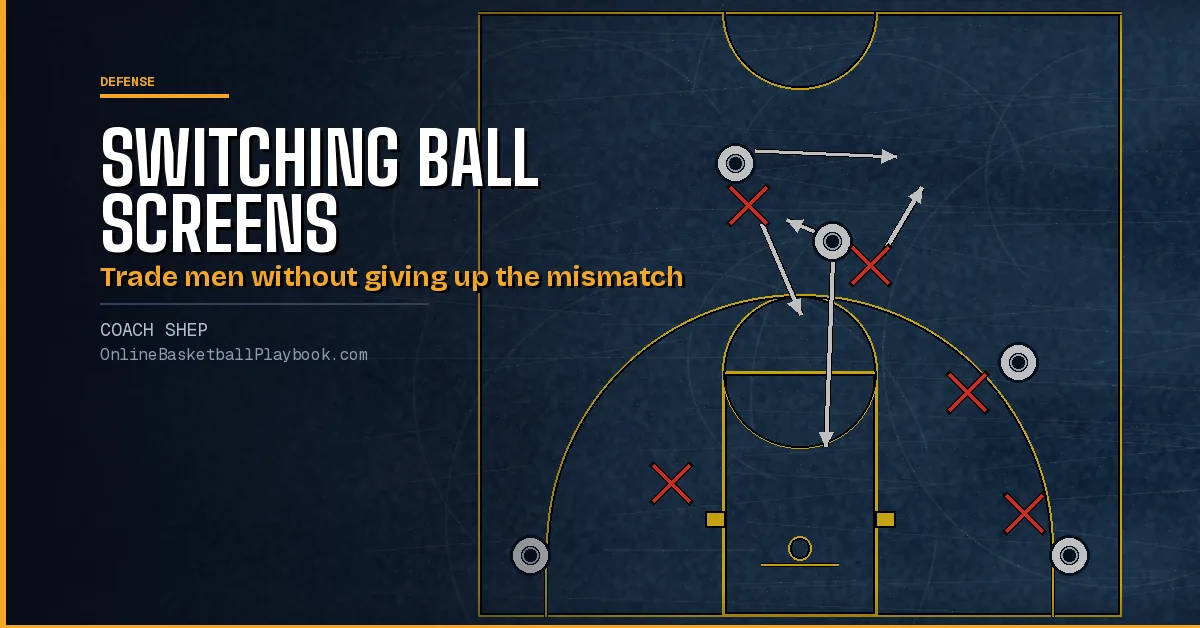
Switching Defense Basketball: How to Switch Ball Screens
Switching defense in basketball: when to switch ball screens, who calls it, the jump switch, the late switch, the scram after a mismatch and drills to install it.
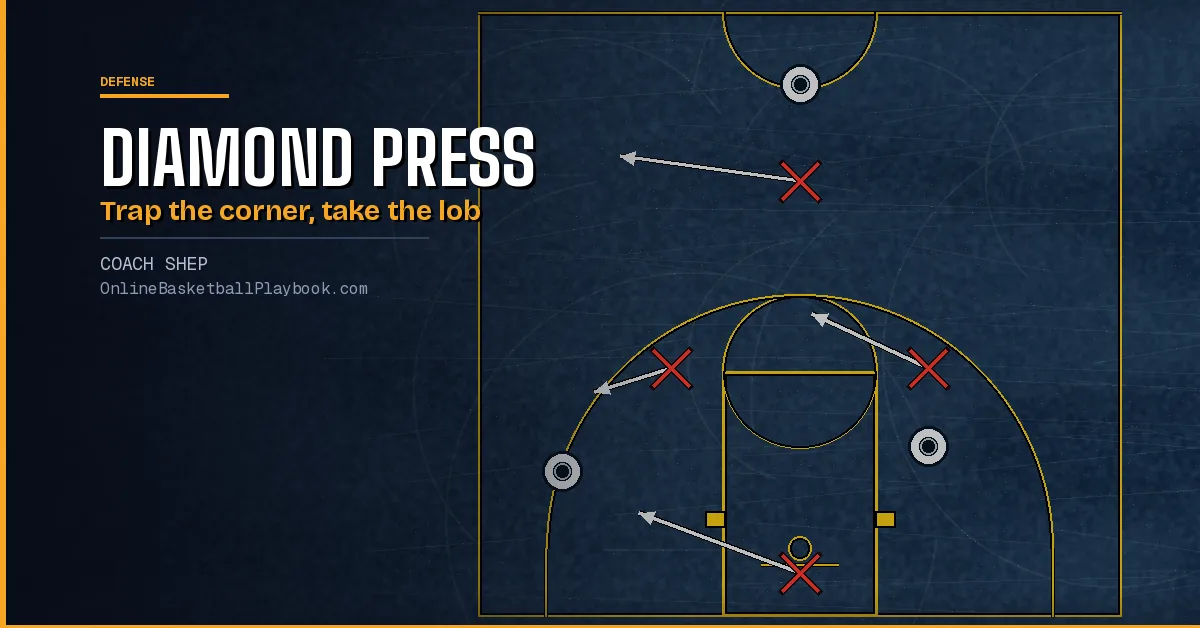
1-2-1-1 Diamond Press Basketball: Roles, Traps and Install
How to run the diamond press in basketball: who plays each role, how to trap the corner, what to do on the reversal and the lob, and how to install it step by step.