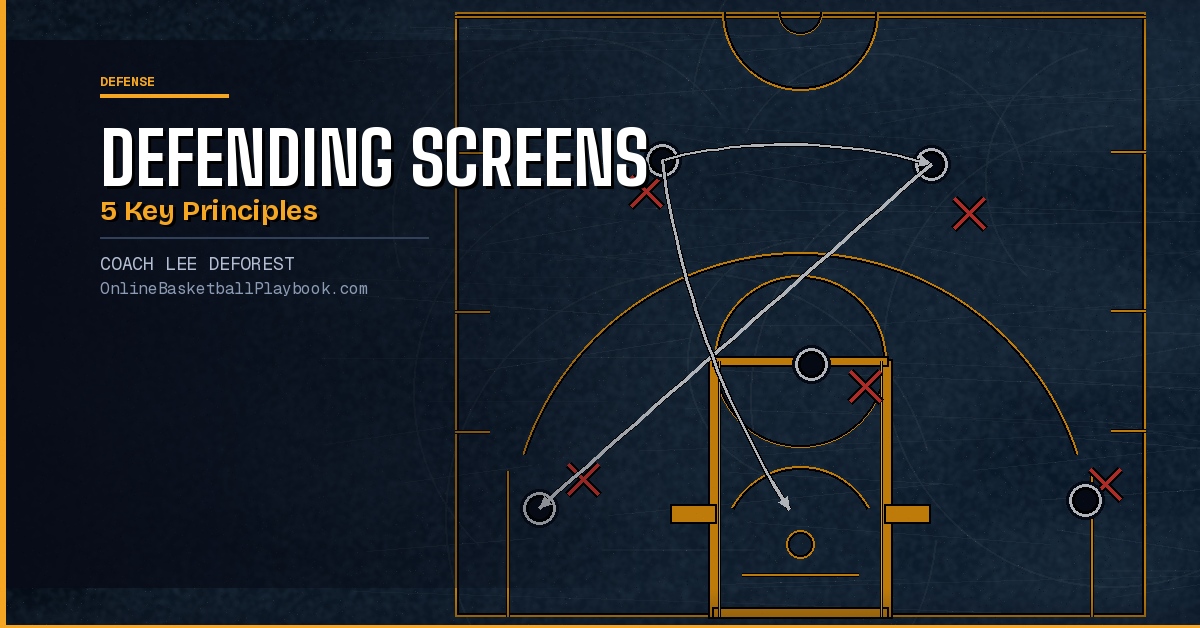

Defending screens is the hardest problem in man-to-man defense. No single coverage fits every situation. These five keys give your team a framework to handle ball screens and off-ball screens at any level.
Key 1: Choose the Right Coverage for Your Personnel
There is no universally correct pick-and-roll coverage. The coverage that wins you games depends entirely on who you have on the floor and who you are defending. This is the first principle coaches at every level need to accept before installing any system.
The most common on-ball coverages are the hard show (or hedge), the soft show, the drop, the blitz, and the ICE. Each solves a different problem. The hard show — where the screener's defender steps aggressively into the ball-handler's path with shoulders square to the ball — is built for stopping elite shooters who thrive scoring behind screens. When your opponent's pick-and-roll ball handler can pull up and drain mid-range jumpers before the defense recovers, the hard show is your answer. It forces the handler to pick up his dribble or go wider than comfortable.
The drop coverage, sometimes called the slide or the "2-under-2-away," works in the opposite situation. The screener's defender retreats two steps below the level of the screen and two steps off the lane, giving the on-ball defender a lane to slide underneath the screen. Use this against a ball-handler who does not threaten from three and primarily wants to turn the corner. The drop surrenders the mid-range but cuts off the drive and makes the action less threatening overall.
The blitz — sending two defenders to trap the ball-handler immediately off the screen — is an aggressive wrinkle often deployed below the free-throw line. Coaches like Rick Pitino and Ron Walberg have built defenses around auto-blitzing any ball screen below the arc, forcing the offense into rushed reads with two defenders in their face.
The ICE or "down" coverage directs the ball toward the sideline before the screen even sets, killing the angle of the action entirely. Rather than reacting to where the offense wants to go, ICE tells the ball-handler where he is going. It is especially effective when your opponent's screener is a strong roll threat but a weak perimeter shooter.
The right call each possession depends on your personnel matchup that night. Build a primary coverage, then identify one or two counters to mix in based on scouting. Teams that use the same coverage against every action become predictable and beatable by the third quarter.
"There is no one right coverage, only the right coverage for the personnel and the situation."
— Basketball Vault, Defending Ball Screens
Key 2: The Screener's Defender Must Arrive With the Screen
Timing is the most undercoached element of screen defense. Most teams focus on the on-ball defender's technique and ignore the screener's defender entirely. That is a mistake. The screener's defender's job is to arrive at the point of the screen at the exact moment contact is made — not a step early, not a step late.
If the screener's defender gets there late, the ball-handler turns the corner before the coverage can take effect. There is no hedge, no drop, no blitz that works if the screener's man is one step behind. You might as well not have a coverage at all. When coaches say their scheme is getting "torched," the first thing to look at on film is the screener's defender's timing — not the on-ball defender's footwork.
Arriving with the screen also means knowing the screen is coming. This is a communication problem before it is a footwork problem (see Key 4), but the screener's defender must be tracking the screener's movement from the moment the offense initiates action. Eyes on the screener's chest at all times. Reading the hip angle. Anticipating the direction the screener will set.
In a blitz coverage, timing becomes even more critical because both defenders are converging on a small area of the floor. The on-ball defender must contain the handler long enough for the screener's defender to arrive and form the trap. If the screener's man sprints and gets there half a second early, he telegraphs the trap and the handler goes away from it before it forms. Get there with the screen, not before it.
Drill this in practice by running live coverage work against a two-man game without allowing the screener's defender to pre-rotate. Force them to read and arrive on time, every rep. The timing muscle must be built through repetition — it does not show up automatically because a coach draws it on a whiteboard.
Key 3: The Ball Handler's Defender Cannot Get Hit
The on-ball defender getting screened is not bad luck. It is a mistake. The on-ball defender's primary job in any screen coverage is to avoid getting caught on the body of the screener. If he gets bodied up and stuck, no amount of help from teammates rescues the possession. The coverage fails at step one.
There are two acceptable outcomes for the on-ball defender: he fights over the top of the screen, staying glued to the handler's hip; or he forces the handler to reject the screen entirely, going the other direction. What is never acceptable is getting picked clean — stopping dead, losing the handler's path, and forcing the screener's defender to make an impossible recovery.
The technique for fighting over the top starts before the screen arrives. The on-ball defender must read the screener coming, take a lead step toward the ball-handler, and get his shoulder in front of the screener's hip before contact is made. This is the "bully" technique — getting through the screen by meeting it aggressively rather than trying to go around it after the fact.
Going under a screen — used in drop coverage against non-shooters — is a deliberate tactical choice, not a failure. The on-ball defender ducks his head, goes below the screener's body, and recovers in front of the handler on the other side. It only works if the screener's defender gives him the space to do it and the handler is not a threat to shoot off the catch.
Rejecting the screen, also called "going away," forces the action in the opposite direction of the screen. The on-ball defender influences the handler back to his dominant hand or into ICE coverage before the screen even arrives. This kills the play before it starts and often creates the easiest defensive possession of the four options — but it requires early recognition and aggressive footwork to execute.
In practice, run your on-ball defenders through screen recognition drills where they must identify and respond to live screeners without the luxury of help. The goal is building instinctive response — when a screener's hip appears, the on-ball defender is already moving.
Key 4: Communicate Early and Loudly
Defense breaks down in silence. Screen defense in particular is impossible without constant, early, specific communication between all five players on the floor. Most defensive breakdowns — especially in youth and high school basketball — trace back to a defender who didn't call out the screen until the ball-handler was already past it.
The communication sequence for a ball screen looks like this. The weak-side or help-side defender sees the screener moving and calls "screen!" before the screener arrives. The on-ball defender hears it and decides on his response. The screener's defender hears it and begins his move to arrive with the screen. All of this happens in less than two seconds — which means it has to be automatic and loud.
The same principle applies to off-ball screens. When a defender sees a down screen, cross screen, flare screen, or stagger coming for a teammate, they call it immediately. "Down! Down!" or "Cross! Cross!" — short, sharp, directional. The defender coming off the screen needs to know what is coming and where to go. The defender guarding the screener needs to know whether to hedge, switch, or trail.
Switching off screens is one place where communication decides everything. A late switch call means two defenders cover the same player while the screener rolls free. An early, clear call gives both defenders time to find their new assignment cleanly. This is why coaches who favor switching coverage emphasize communication training above all else — the scheme is only as good as the speed of the calls.
Build communication habits in every defensive drill, not just breakdown work. If players are silent running a shell drill, stop the drill. If they're quiet during transition defense, stop the drill. The habit of talking is practiced into existence. It does not switch on automatically in game situations unless it has been demanded every single day in practice.
Key 5: Link Your Screen Defense to Your Post Defense
Coaches often build their pick-and-roll defense in isolation from the rest of their defensive system. That is a structural error. How you defend the post dictates everything else you do on defense, and screen defense is no exception.
If your post defense requires your help-side defender to front the block or half-front from the high side, that defender is not available to provide weak-side help when a ball screen is set on the opposite side of the floor. If you blitz the pick-and-roll and send two defenders to trap, the roll man and the corner shooter become immediate threats — and the coverage of those players has to come from somewhere. That somewhere is determined by your post and help principles.
Teams that defend the post with heavy fronting create holes in their pick-and-roll rotations because the help chain is anchored on the low block. Teams that play behind the post with one body can rotate more freely to cover pick-and-roll actions and kick-out passes. Neither is right or wrong — but they must be consistent and connected.
The same logic applies to off-ball screens. If your help-side principles tell defenders to stay on the weak side and not hedge flare screens, your team will give up corner threes off flares all night against an offense that spaces the floor. If your principles tell them to chase flares over the top, a smart cutter can exploit the dead space left behind. The answer has to be built into the system, not improvised possession by possession.
Walk through your full defensive system on a whiteboard and trace every help rotation from your post defense to your pick-and-roll coverage to your off-ball screen responses. Find the holes. The good news is that a well-connected system is more predictable for your players, which makes it faster to execute under pressure. Consistency of principles — applied from the post out to the perimeter — is what turns scheme into real team defense.
Coach Cheat Sheet: Screen Defense at a Glance
Use this as a quick reference during film review or practice planning. Each situation maps to the coverage most likely to stop it.
- Elite shooter as ball handler: Hard show / hedge — step into the path, shoulders to ball, force wide
- Creative handler, screener pops: Soft show — sit two steps off, tilt to halfcourt, let on-ball recover
- Non-shooter handling, outside scoring area: Drop / slide — screener's man two-under-two-away, on-ball goes under
- Ball screen below the free-throw line: Blitz / trap — both defenders on the handler, get "up to touch"
- Strong screener, weak perimeter shooter: ICE / down — influence toward sideline, kill the screen angle
- Screener slips to the basket: Stunt and stay 2-on-2 — do not send help, screener's defender owns it
- Off-ball curl or flare screen: Lock-and-trail on the cutter's hip ("caboose") or go under vs. non-shooters
Want more defensive breakdowns, drill progressions, and play diagrams delivered to your inbox?
Keep Building
Related breakdowns
10 Keys to Setting and Defending Screens in Basketball
10 Keys to Setting and Defending Screens in Basketball