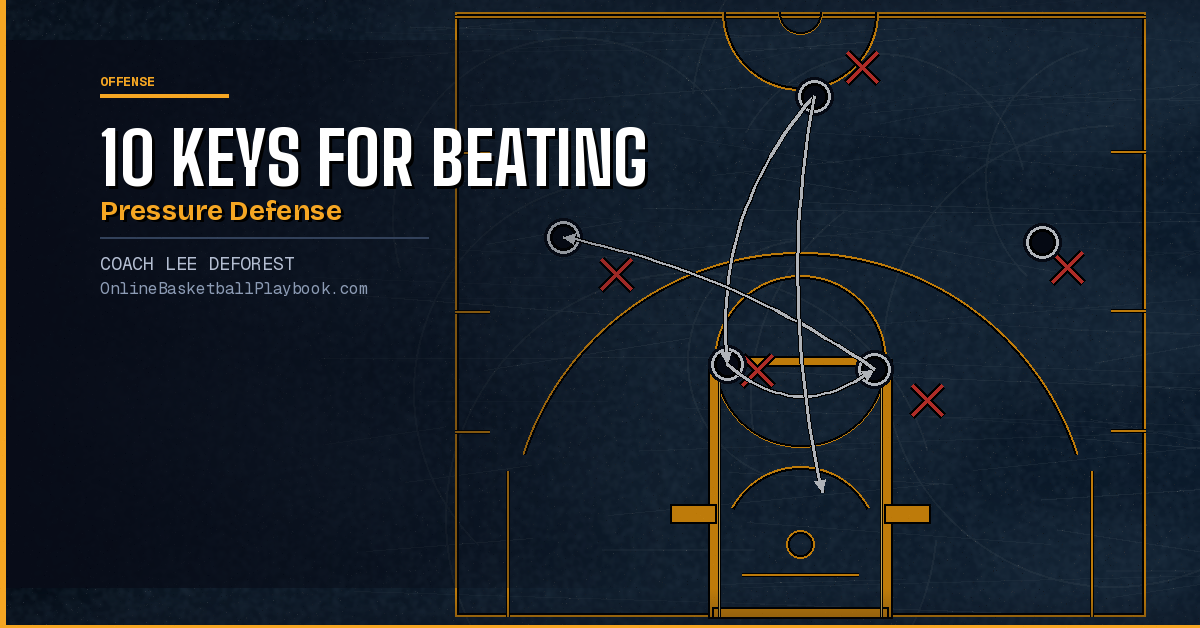

Pressure defense rattles unprepared teams. But with the right spacing, poise, and mindset, you can turn every trap into a scoring chance. These 10 keys give your players a clear roadmap.
Key 1–2: Mindset and Attacking Intent
The first two keys aren't X's and O's — they're mental. Teams that consistently beat pressure defense think about it differently than teams that merely survive it.
Key 1: Attack to Score, Not Just to Advance
Most coaches tell their players to "get past halfcourt" against a press. That's a mistake. The moment your team's goal is just to cross the timeline, the defense wins. Pressing teams want you to panic, take quick threes, or slow your offense. The answer is the opposite: hunt the layup first.
When you attack with scoring intent, the defense can't just sit back and wait for you to make an error. They have to make decisions — and decisions create mistakes. A ball handler who pushes the pace and looks to score puts immediate stress on the deep safety, who is almost always one player defending a 2-on-1. That's a winnable situation if your players read it right.
Build this mindset in every press break drill your team runs. The practice rep should always end with a shot or a layup — not just a chest pass at halfcourt. What players practice, they do under pressure.
Key 2: Treat the Trap as an Opportunity
Traps scare inexperienced players. Two defenders converging on the ball looks like a disaster. But any two defenders trapping the ball means the remaining three defenders are covering four offensive players. The math is always in your favor — and the numbers are always behind the trap.
When a player gets trapped, the correct emotional response is calm, not panic. The outlets exist. The defense cannot cover all of them. Your job as a coach is to make that reality so clear in practice that players feel confident in trap situations rather than frantic. Panic — not the trap itself — is what causes turnovers.
"Attack to SCORE, not just to cross half court."
— Basketball Vault
Key 3–4: Spacing and Outlet Options
Mindset without structure doesn't work. Your spacing against pressure must give the ball handler three options at all times — sideline, middle, and reverse. This is the anti-trap law that every press-break system is built on.
Key 3: Three Outlets — Always
Two defenders can trap the ball. Two defenders cannot cover three separate passing lanes simultaneously. When the offensive spacing creates a sideline outlet, a middle outlet, and a reverse (back) outlet, the trapped player simply has to stay calm and find the open window. The defense reveals which option is available by what they choose to take away.
This is where alignment discipline matters. If your players cluster, two defenders can effectively guard all of them. Space them wide and long, and the trap becomes a 3-on-2 at worst. Teach your players: when your teammate gets trapped, your job is to put yourself into the outlet position immediately — before the trap fully forms.
Players who understand basketball IQ development make this automatic. They read the defense before the trap materializes and pre-position into open lanes rather than reacting after the trap is set.
Key 4: The Reverse Outlet Beats Zone Presses
Most teams prepare for the sideline and middle outlets. Few practice the reverse — the back pass to a trailing teammate or the inbounder. Against zone press defenses, the reverse is often the cleanest look of all because press defenses typically push players toward the ball. Going backward resets the entire defense and creates new gaps on a fresh attack.
The reverse pass requires trust. Ball handlers don't instinctively want to go backward. Train it explicitly. Use live passing drills where the reverse is rewarded with an open cutter on the next pass. Once players see the layup that comes from a clean reverse pass, they stop being reluctant to use it.
Key 5–6: Ball Handling Under Pressure
The best spacing in the world doesn't help if your ball handler can't control the ball against an aggressive defender. Keys 5 and 6 address the physical and technical side of handling pressure.
Key 5: The Pull-Back Dribble
When a trap forms, the pull-back dribble is the ball handler's most important skill. It's not a retreat — it's a reset that creates the passing angle. The technique: turn your shoulders, get your chin up toward the top shoulder to see the full floor, and push back with big steps using the dribble to create space.
The pull-back accomplishes two things. First, it stops the trap from sealing you against the sideline, where the baseline is your third defender. Second, it shortens the distance your teammates need to close to become viable outlets. Players "come back to the ball" to reduce the pass distance — but that only works if the handler pulls back to give them space to fill.
Skilled handlers can pull back and reattack with the dribble after the defense resets. Average handlers should use the pull-back to set up the pass. Either way, the movement is the answer to being trapped — not picking up the ball and looking for a miracle.
Key 6: Eyes Up, Chin Up, Know the Floor
The second most common cause of press turnovers after panic is tunnel vision. The ball handler sees the defender, ducks their head, and dribbles into trouble. Keeping the eyes up — scanning the floor at all times — lets players see the open outlet before the trap fully closes.
This is a ball handling drill emphasis, not just a game instruction. Drill it with distraction: noise, defensive hands, multiple defenders calling out different options. The rep teaches the eyes to scan even when the body is under stress. Players who can handle the ball with their head up under fatigue and noise are the ones who don't turn it over in crunch-time press situations.
In every ball handling drill against press defense, require players to call out the open outlet before they pass. This trains eyes-up habits and forces them to read the floor rather than dribble by instinct under pressure.
Key 7–8: Reading Traps and Finding Numbers
Once the ball handler has poise and the team has proper spacing, the next level is reading *which* trap the defense is running and identifying the numbers advantage before it closes.
Key 7: Identify What the Defense Is Giving You
Not all pressure defenses trap the same way. A full-court press that traps on the sideline creates different outlet reads than a run-and-jump defense that traps in the middle of the floor. Your players need to understand what the defense takes away — because what it takes away tells you what it leaves open.
If both defenders sprint hard to trap the sideline outlet, the middle and reverse are open. If one defender runs ball and the other hedges middle, the sideline outlet stays available and the reverse becomes the skip. Players who can read this in the moment don't need a called play — they just make the correct read. That's the long-term goal: turning press reads into instinct.
Key 8: Find the 3-on-2 Behind the Trap
Every two-man trap leaves three offensive players covering four. Find those four. Read which of the remaining defenders commits to an outlet pass — and then attack the defender who didn't commit. That's where the open cutter to the rim lives, and it almost always creates a 2-on-1 against the deep safety.
The deep safety (typically the last defender back) is almost always slower than the players racing toward the basket. Getting the ball past the trap and into the hands of a player attacking the deep safety in a 2-on-1 is one of the highest-percentage plays in basketball. Practice finishing this situation. The press break isn't done when you cross halfcourt — it's done when you score.
Key 9–10: Alignment, Practice, and Putting It Together
The final two keys connect structure to execution. Even teams that understand all the principles above can struggle if their press-break alignment is wrong or if they haven't practiced these situations enough to perform them under real game pressure.
Key 9: Use a Versatile Alignment
Named press-break plays have limitations: defenses adapt, players forget assignments under pressure, and a single look becomes predictable. A versatile alignment — one that lets players read and react rather than run a scripted play — is more durable.
The 1-4 alignment (one player handling the ball, four spread across the floor) is the most common starting point for press breaks because it naturally creates the sideline, middle, and reverse outlets without requiring players to be in precise positions. It also gives you a lead outlet on each side and keeps spacing intact whether the defense presses man or zone.
What matters most isn't the name of the alignment but the principle it serves: create three outlets from every ball position. Whatever you call it, if those three outlets exist, your team can handle any pressure defense they face. Compare this to 5-out motion offense principles — spacing-first thinking applies equally to halfcourt and press situations.
Key 10: Practice Pressure Every Day
The most important thing a coaching staff can do for press-break execution is create pressure in practice — daily, competitive, and live. Teams that practice against a shell or a half-speed press look good in walk-throughs and fall apart in games. Teams that go live against a hard press in practice every day develop the poise, reads, and habits that hold up when it counts.
Build it into your basketball practice plan as a non-negotiable segment. Run 5-on-5 press situations with consequences — losers run, winners repeat with a harder press. Make the environment uncomfortable enough that a real game press feels easier than practice. That's how you develop teams that welcome pressure rather than fear it.
Film the drill. Watch it with players. Show them exactly where the spacing breaks down, where the eyes drop, and where the read is missed. Repetition plus feedback builds the press-break instincts that can't be coached in the moment from the bench.
- Three outlets always: sideline, middle, and reverse — teammates pre-position before the trap closes, not after.
- Attack to score: the goal is a layup, not just crossing halfcourt — train press breaks to end with a shot.
- Pull-back dribble: create space from the trap with big push-steps back, chin up, eyes scanning the full floor.
- Find the 3-on-2: every two-man trap leaves numbers behind it — read which defender commits and attack the open lane.
- Reverse pass resets: going backward beats zone press defenses and creates fresh gaps for the next attack.
- Live pressure daily: walk-through reps don't build press-break poise — only live, competitive reps under fatigue do.
- Versatile alignment over scripted plays: spacing-first formations let players read and react rather than remember assignments under stress.
Get free play diagrams, drills, and coaching guides delivered weekly.
Keep Building
Related breakdowns
10 Keys to Setting and Defending Screens in Basketball
10 Keys to Setting and Defending Screens in Basketball