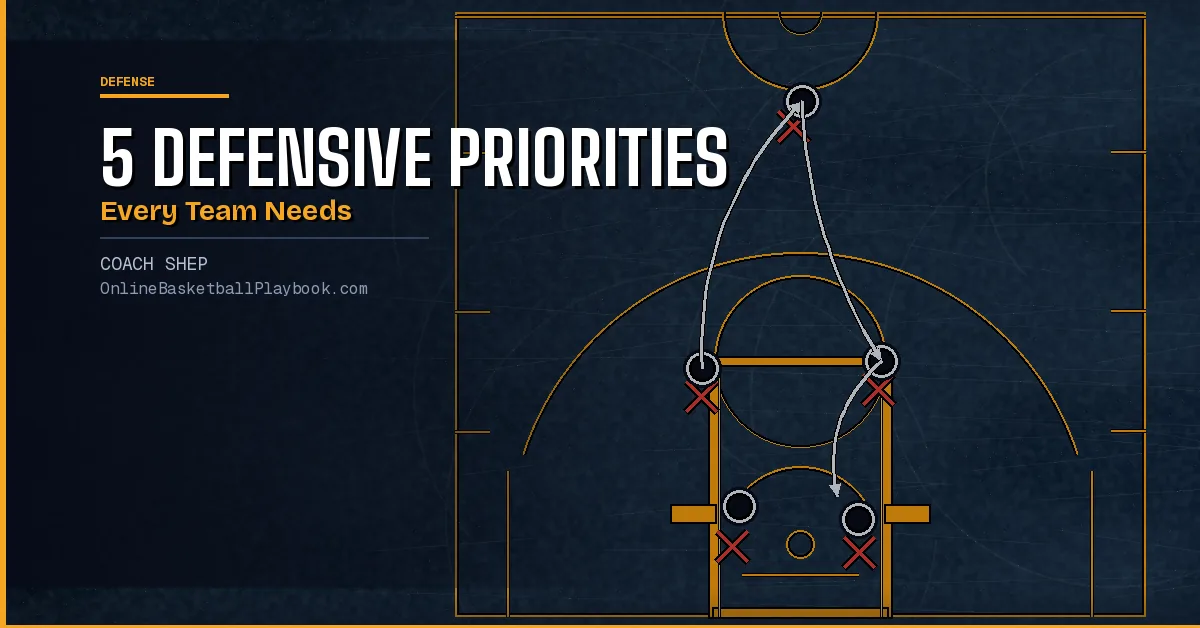
Offense sells tickets, but defense wins championships. These five defensive priorities give any team (youth, high school, or college) a clear framework to stop opponents, protect the paint, and compete every possession.
Priority 1: Protect the Paint
Every successful defensive system starts with one rule: make the opponent take difficult, contested shots far from the basket. The paint is the most valuable real estate on the floor. When you surrender easy layups and uncontested post catches, you are surrendering the game. Protecting the paint is not just about your center. It is a five-man responsibility that starts the moment the ball leaves the offense's fingertips.
The foundational skill here is positioning. Defenders must understand where the ball is and where their man is, then find a spot between those two points that threatens both the pass and the drive. This concept, called help-side positioning, keeps the entire defense connected. One defender out of position creates a domino effect that collapses the whole structure.
Teaching paint protection begins with the shell drill. The shell drill is the single best tool coaches have for building this habit. Run it every practice. Four defenders, four offensive players, ball moves, and every defensive player must react correctly before you add a new wrinkle. The shell drill makes paint protection automatic instead of reactive.
Beyond positioning, you need your bigs to be active and physical without fouling. A defender who jumps at every shot fake gives up two free throws instead of a difficult mid-range attempt. Teach your bigs to stand tall, read the shooter's hips, and time their contest to the actual release, not the pump fake. This single adjustment can cut opponent free throw attempts significantly across a season.
Finally, paint protection requires rebounding. A contested shot that results in an offensive rebound is not a defensive stop. Stress "block out first, then go get the ball" and your paint protection numbers will rise every week.
Priority 2: Contest Without Fouling
One of the most overlooked defensive skills at every level is learning to contest shots without fouling. This is not a passive concept. It is an aggressive, disciplined skill that must be drilled repeatedly. Teams that master it hold opponents to lower effective field goal percentages and keep their best defenders on the floor instead of sitting with foul trouble.
The physical mechanics are specific. On a closeout, the defender sprints the first two-thirds of the distance, then chops his feet into short, quick steps to brake. Hands go straight up, not forward, not sideways, but straight up. This creates an imposing vertical barrier without making contact. Players who understand this technique are almost impossible to call for a foul on a jump shot because they are jumping straight, not into the shooter.
The wall-up technique is equally important in the paint. When a ball handler drives to within two feet of the paint, the defender plants, squares his chest to the attacker, and presents a vertical wall. The arms extend upward. If the offensive player initiates contact into a stationary defender, that is a charge, not a blocking foul. Drilling this daily changes the dynamic in the lane.
Closeouts are a separate skill that demands its own practice time. Study how elite defenders close out: sprint, parachute, choppy steps, hands high to appear closer to the shooter than they actually are. Good closeout technique disrupts the shooter's rhythm without the risk of a foul. A poorly executed closeout either leads to a foul or a wide-open three. Neither is acceptable.
Teach your players the difference between fouling on the ball and reaching off the ball. Steals won off the ball (on a swing pass, a careless dribble, a skip pass) come with almost zero foul risk. Reaching in directly on the ball handler leads to cheap fouls and free points. The phrase "steal off the ball, not on the ball" should become a team-wide mantra.
Priority 3: Help and Recover
No defense is a one-man show. The moment a ball handler beats his defender off the dribble, the entire team's ability to help and recover determines whether that drive produces two points or a scramble that ends in a turnover. Help defense is the connective tissue that holds everything together, and it requires more coordination than almost any other defensive concept.
The first principle of help defense is positioning. Defenders away from the ball must be in a stance that lets them see both their man and the ball simultaneously. This is called ball-you-man alignment, and it means the defender is never fully turned away from the action. If the ball handler attacks, the helper can step in. If a pass is thrown, the helper can contest or intercept.
Understanding help defense principles deeply changes how players think about their role. A defender on the weak side is not "resting" while the ball is on the strong side. He is the last line of protection. His job is to read the drive, decide whether to help, and simultaneously anticipate where the skip pass will go if he does help. This is high-level defensive IQ, and it takes time to develop.
Recovery after helping is equally critical. When a defender steps in to stop a drive, he must then sprint back to his man before the ball moves. The rotation has to be a chain reaction. Every defender takes one step closer to the ball when a helper commits, and every defender recovers when the ball reverses. Teams that execute this rotation cleanly give up very few open looks even when their on-ball defender gets beaten.
Practice help and recover with live 3-on-3 and 4-on-4 situations where the offense is instructed to drive on every catch. Force your defenders to make real-time rotation decisions at practice speed, then at game speed. The drill is only useful if the pace is high enough to create actual urgency.
Priority 4: Stop Transition Offense
Transition defense is where games are lost in the first thirty seconds of a possession. A missed shot or a turnover triggers the opponent's fastest players into a full sprint, and if your team is not organized and running back immediately, you will surrender layups at an alarming rate. Over a forty-game season, transition defense is one of the biggest differentiators between winning and losing programs.
The habit starts with the mindset. Every player on your team must know that the moment possession changes, the priority is getting back. That means no freelancing in hopes of a long outlet pass, no standing and watching a missed shot, and no walking back after a made basket against you. Transition defense begins before the opponent even catches the ball.
Structurally, most teams assign a "safety" (usually a guard or wing who does not crash the offensive glass) whose primary job is to sprint back and stop the ball if there is a leak-out. The safety does not worry about stats. He worries about taking away easy buckets. This role is non-negotiable in any well-run defensive system.
For more detail on organizing your transition defense from a schematic standpoint, the key is stopping the ball first and finding your assignments second. A defender who sprints back but chases the wrong man is almost as dangerous as one who doesn't sprint at all. Teach your players to find the ball, stop penetration, and then locate the next-most-dangerous offensive player.
Communication is everything in transition. Call out "ball," "I got help," and "back, back, back" constantly. A loud, communicating defense that sprints back will survive most transition situations even when they are temporarily outnumbered. A quiet, confused defense gets burned regardless of talent level.
End every half-court offensive possession in practice with a defensive sprint-back drill. The moment a shot is taken or a turnover occurs, all five defenders immediately sprint to half court and back into position. This builds the reflex of converting to defense before the offensive play is even over, which is where most transition breakdowns originate in games.
Priority 5: Defend the Pick and Roll
The pick and roll is the most common action in basketball at every level. If your team cannot defend it, opponents will run it forty times a game until you break. Mastering pick-and-roll defense is not optional. It is a survival skill. The good news is that once your players understand coverage principles and have repped them at practice speed, the pick and roll becomes manageable even against elite ball handlers.
There are three primary coverage options: going under the screen, going over the screen, or switching. Each has appropriate situations. Going under is used against poor three-point shooters where you want to take away the drive. Going over requires the on-ball defender to fight through the screen aggressively and stay attached to the ball handler. Switching is used when defenders are similar in size and skill, eliminating the advantage the screen creates.
For a complete breakdown, the guide to defending the pick and roll covers the footwork and positioning for each coverage in detail. What matters most in practice is that your players understand WHY you are choosing a particular coverage against a particular opponent, not just what it is. Understanding the logic makes adjustments mid-game far easier.
The biggest mistake young defenders make on ball screens is stopping when the screen is set. An effective on-ball defender never stops moving. He anticipates the screen, communicates with his teammate, and either fights over it or uses his body to navigate under it depending on the coverage called. The screener's defender must also be active (hedging, dropping, or switching based on the scheme), never flat-footed.
Repetition is the only path to mastery here. Run pick-and-roll coverage as a 2-on-2 drill at three-quarter speed before adding live game pressure. Iisalo, Donovan, and other elite coaches install ball-screen coverage at reduced speed specifically so players can internalize every detail of the footwork and communication before the pace makes it impossible to think. Quality of the rep beats quantity every time.
Putting It All Together
These five priorities do not exist in isolation. They are interconnected. A team that protects the paint well contests more shots in the lane. A team that contests without fouling stays out of bonus situations and keeps their rotation intact. Help-and-recover principles reinforce paint protection. Transition defense prevents the offense from ever gaining momentum. Pick-and-roll coverage ties ball pressure, help, and rotation together into one repeatable system.
The best way to install all five priorities is through the whole-part-whole method. Show your players the complete defense (how it looks in a live 5-on-5 game situation), then break it into parts, drill the parts at game-realistic intensity, and reassemble. The shell drill handles help defense and positioning. Closeout circuits handle contesting. 2-on-2 covers pick and roll. Transition drills build the sprint-back reflex. Each drill is a piece of the same puzzle.
Building a complete defensive culture also requires accountability. Players must know that defensive mistakes (a missed rotation, a lazy closeout, a failure to sprint back) will be addressed on film and in practice. Building accountability into your defensive system is what separates teams that understand the priorities from teams that actually execute them under pressure.
Track defensive metrics every week: points in the paint, transition points allowed, opponent three-point percentage. Numbers give you an objective look at which priority needs the most work. If transition points are rising, double down on sprint-back drills. If opponents are shooting 40% from three, your closeout technique needs work. The five priorities give you a diagnostic framework, not just a philosophy.
Defense is a choice. Offense requires talent, spacing, timing, and skill development. Defense requires effort, communication, and willingness to compete. Every player on your roster can defend at a high level if you teach the priorities clearly, drill them daily, and hold the standard every single possession.
- Protect the paint first: run shell drill every practice; five-man responsibility, not just the center's job
- Contest straight up: Sprint, chop, hands vertical. Never reach, never jump into the shooter
- Help and recover: ball-you-man alignment at all times; rotation is a chain reaction, not one player's decision
- Sprint back immediately: assign a safety to stop the leak-out; find the ball before you find your man in transition
- Know your pick-and-roll coverage: drill it 2-on-2 at three-quarter speed; the on-ball defender never stops moving through the screen
- Steal off the ball, not on the ball: contest passes and swing passes with zero foul risk instead of reaching on the live dribble
- Track and adjust weekly: measure transition points, paint points, and opponent three-point percentage to diagnose which priority needs the most work
Get free play diagrams, drills, and coaching guides delivered weekly.
Draw this play free in the play drawer →
Membership: the full library, playbook packs, and Pro drawing tools →
Keep Building
Related breakdowns
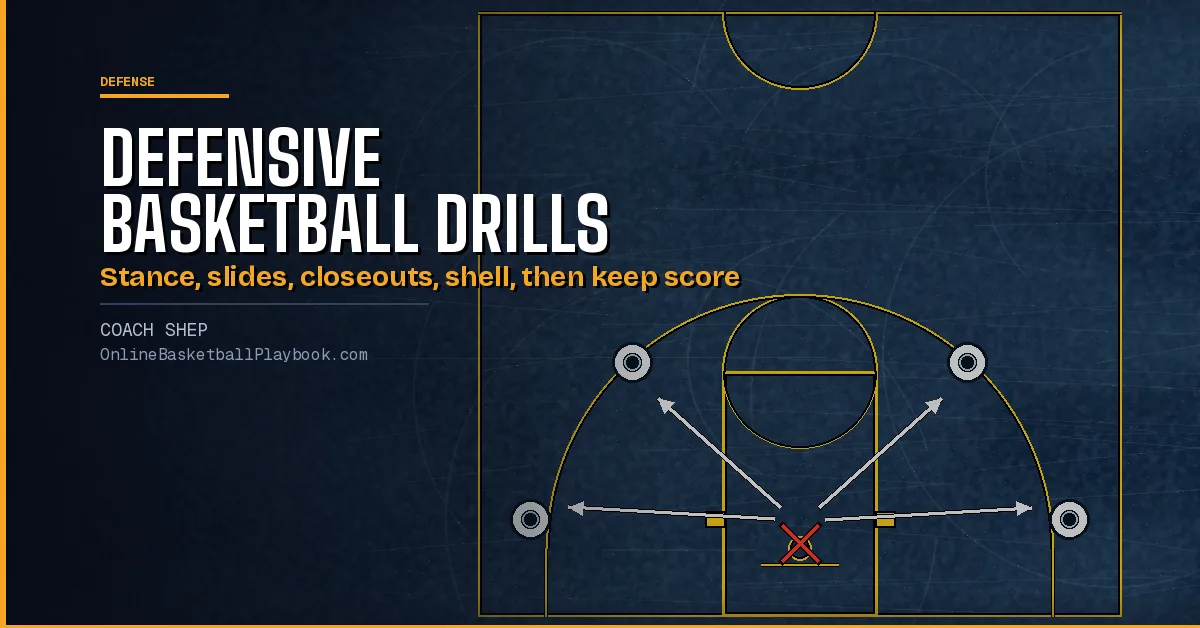
Defensive Basketball Drills: Slides, Closeouts, Shell and Games
Defensive basketball drills in teaching order, from stance and defensive slide drills to closeouts, pass denial, shell and scored games, with the versions coaches split on.
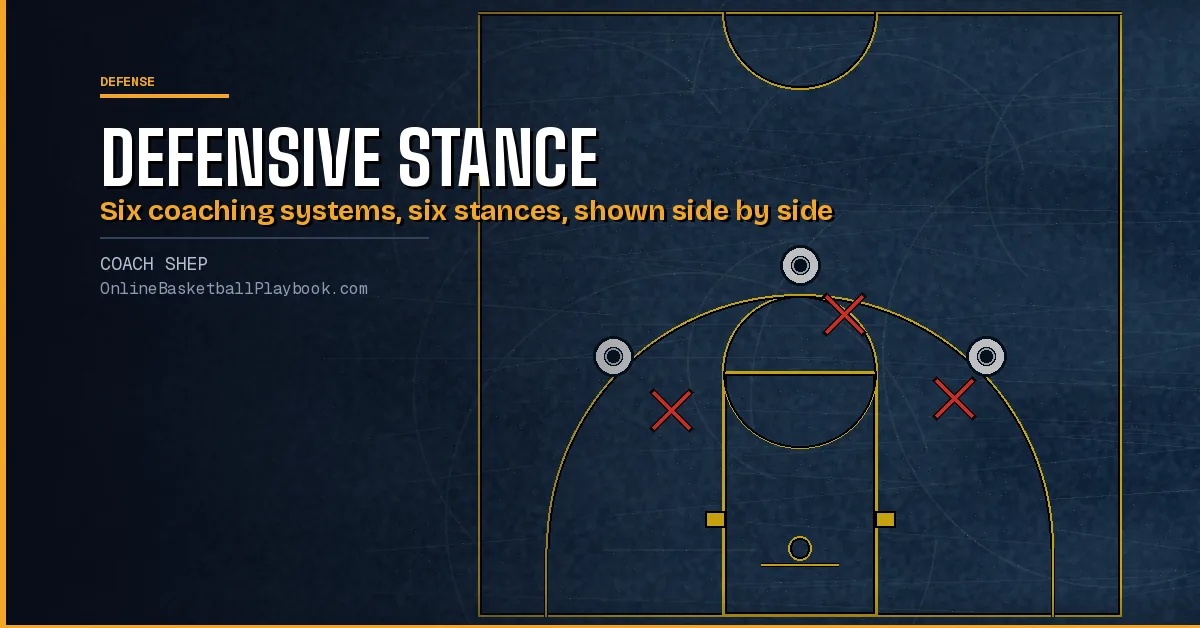
Defensive Stance in Basketball: Weight, Feet, Hands and Drills
Defensive stance in basketball: weight, feet, hands and eyes, the footwork out of the stance and the drills that build it.
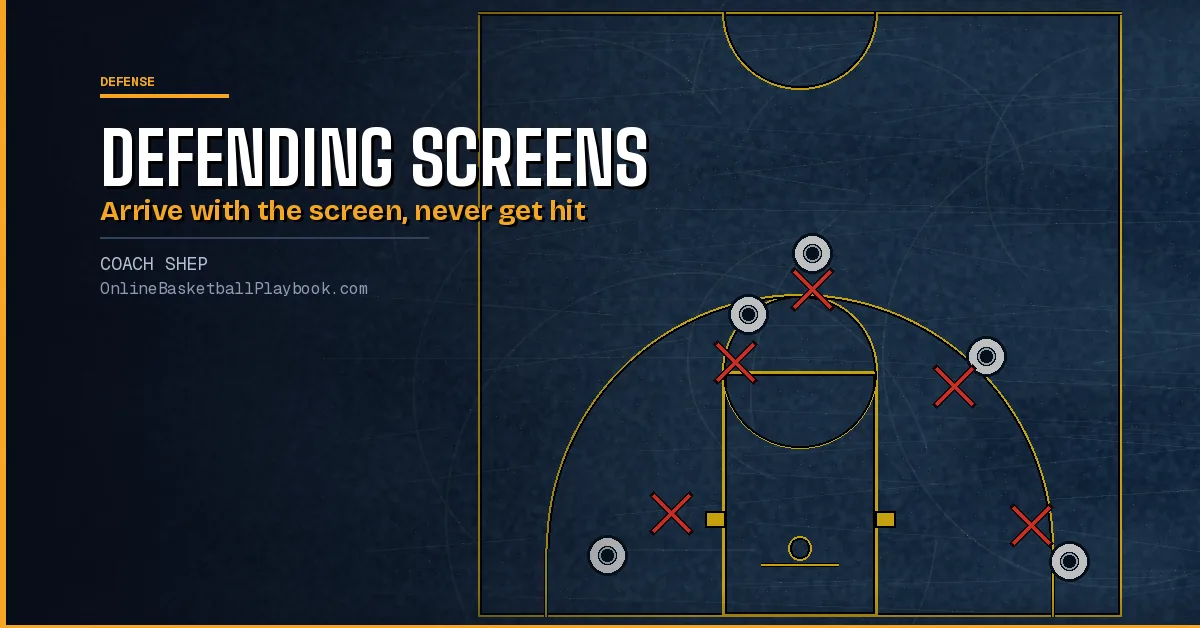
Defending Screens in Basketball: 5 Keys for Every Coverage
Defending screens in basketball comes down to five keys that hold under any coverage, for ball and off-ball screens, with the mistakes that cost baskets and drills.