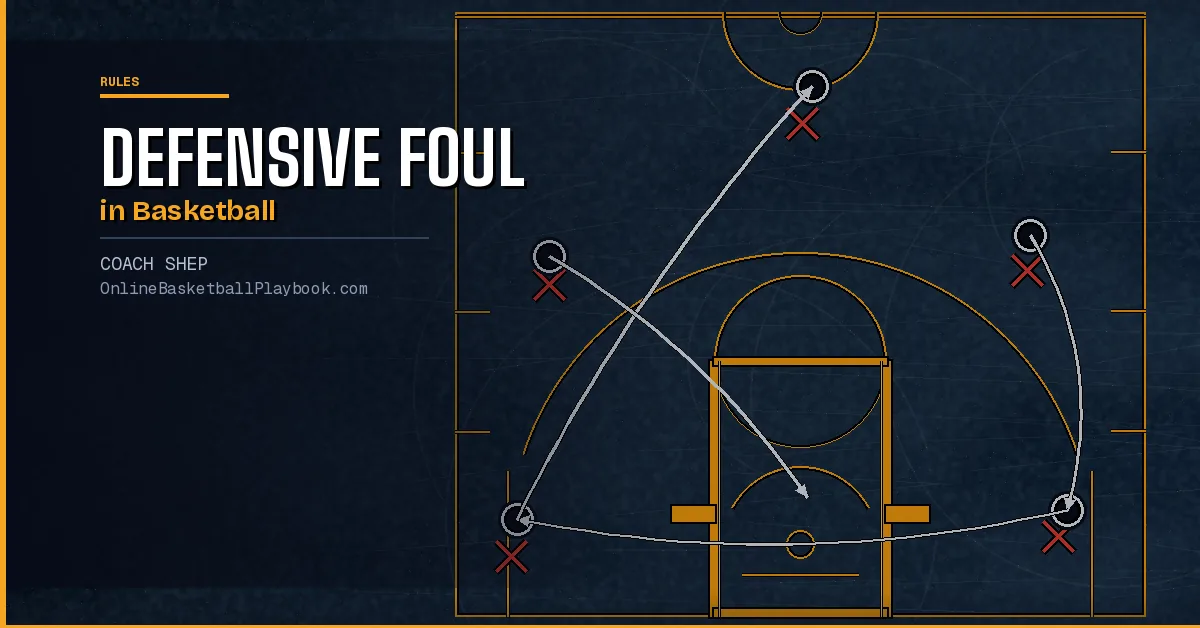
A defensive foul occurs when a defender makes illegal contact with an offensive player. Understanding the rules, recognizing foul situations before they happen, and training legal footwork separates smart defenders from foul-prone ones.
What Is a Defensive Foul?
A defensive foul is any illegal personal contact initiated by a defender that impedes an offensive player's movement or play. Under both NBA and FIBA rules, the offense has the right of way when a player is in their established path or in the act of shooting. The defender is obligated to yield, not the ball-handler.
Contact alone does not equal a foul. Officials look for who initiated the contact and whether the defensive player had established legal guarding position first. Legal guarding position requires two feet on the floor, facing the opponent, before contact occurs. A defender who is still moving their feet or who reaches into the offensive player's cylinder forfeits that protection.
Defensive fouls result in one of three outcomes depending on the situation: the offensive team retains possession with an inbound pass, the fouled player shoots free throws, or in the case of intentional or flagrant contact, the team receives additional possession. Teams that commit more than a set number of fouls per half enter the penalty, meaning every foul becomes automatic free throws for the offense (a significant tactical disadvantage that coaches work hard to avoid).
Understanding this foundational rule is the starting point for building sound team defense. Great defensive systems like the man-to-man defense depend on players who can apply pressure without giving away free points at the line.
Types of Defensive Fouls
Not every defensive foul looks the same. Referees classify contact differently based on where it happens, how it happens, and the degree of intent behind it. Knowing the categories helps defenders recognize their own bad habits and helps coaches design better practice drills.
Reaching Foul
The reaching foul is the most common defensive mistake at every level. It happens when a defender extends an arm and makes contact with the ball-handler's arm, wrist, or body while attempting to steal the ball. The fundamental problem is that reaching removes the defender's body from a good defensive stance because the moment the arm flies out, the feet stop moving and the hips rise. A good ball-handler will absorb the contact, draw the call, and put the defender in foul trouble. The fix is simple in theory: keep your hands up and your feet active.
Hand-Check Foul
Hand-checking is placing a hand or forearm on an offensive player and using that contact to slow, redirect, or monitor the player's movement. It was legal in earlier eras of the sport but was largely outlawed in the NBA in 2004 and is called consistently in college and international play. Defenders who grew up using their hands to "feel" where a ball-handler is going must retrain this habit. Legal body position, staying between the ball-handler and the basket with active feet, replaces the shortcut the hand-check provided.
Blocking Foul
A blocking foul is called when a defender moves into the path of a driving offensive player without first establishing legal guarding position. The key phrase is "first establishing." The defender must be stationary, facing the opponent, with both feet down before the offensive player reaches that spot. If the defender slides in late or is still moving, the contact is a block, not a charge, even if the contact looks identical from the stands.
Shooting Foul
A shooting foul occurs when a defender makes illegal contact with a shooter during the act of shooting. The act of shooting begins when the player starts their upward motion and continues until the ball is released and the player returns to the floor. Contact during this window on the arm, hand, or body results in free throws regardless of whether the shot goes in. Defenders must time their contests to the ball, not the body.
Flagrant Foul
Flagrant fouls involve excessive or unnecessary contact beyond what is needed to play defense. A Flagrant 1 is unnecessary contact; a Flagrant 2 involves severe or intentional contact and results in ejection. These calls have increased in frequency as officiating has tightened around player safety. Smart defenders understand that effort and aggression are valued, and recklessness is not.
Blocking Foul vs. Charge: The Most Debated Call in Basketball
Few officiating calls generate more debate than the block/charge decision. The correct call often depends on fractions of a second and inches of position, which is why coaches and players must understand the rule precisely rather than relying on intuition or arguing with officials.
The legal guarding position rule is the anchor. When a driving player initiates contact with a defender who has established legal position, it is a charge on the offense. When the defender is still moving, arriving late, or reaches into the offensive player's cylinder, it is a blocking foul on the defense. The offensive player's speed and angle of attack do not change the rule.
The restricted area arc, the painted semicircle under the basket in the NBA, college, and many high school leagues, adds another layer. A defender standing inside that arc almost always receives a blocking call, regardless of foot position, because the rule presumes the defender arrived too late to establish position on a drive to the basket. This prevents defenders from simply camping under the rim to draw charges.
Training players to take charges outside the restricted area is a legitimate defensive tactic. A well-trained help defender who slides into position early, sets their feet, and absorbs contact can draw an offensive foul that swings momentum, stops an easy bucket, and puts the ball-handler in foul trouble simultaneously. Programs that emphasize help defense principles often build charge-taking into their defensive system as a deliberate weapon.
The coaching point for defenders: move early, get there first, and stop moving. The moment you stop moving is the moment you have a legal right to that spot.
Managing Foul Trouble
Foul trouble is a strategic problem as much as a rules problem. A starter who picks up two fouls in the first quarter forces a coach to choose between playing them conservatively, limiting their defensive impact, or benching them and disrupting rotation. Neither option is good. Teams that consistently stay out of foul trouble maintain their best defenders on the floor, force opponents into tougher shots, and control game tempo on their own terms.
The Two-Foul Protocol
Most coaches operate under some version of a two-foul protocol for key players: if a starter picks up two fouls before halftime, they sit until halftime or until the foul situation is manageable. The logic is sound, and a player guarding with two fouls is defensive liability because any aggressive play risks a third foul. That tentativeness often leads to giving up easier shots or driving lanes than just sitting the player would have.
Positioning Over Aggression
Players in foul trouble must shift their defensive mindset from aggressive to positional. They give ground to take away direct drives, funnel ball-handlers toward help, and prioritize staying in front over gambling for steals. This is a skill unto itself. Many players, particularly younger ones, do not know how to defend at this level because they rely on athleticism and gambling rather than positioning and anticipation.
Recognizing Foul-Drawing Tendencies
Certain offensive players are skilled at drawing fouls. They pump-fake defenders off their feet, lean into defenders on three-point attempts, or use their off-arm to create the appearance of contact. Defenders facing these players need game-specific preparation. Study their tendencies in film, understand their go-to foul-drawing moves, and guard them with technique rather than emotion. Getting baited into a foul on a pump fake is entirely preventable with proper preparation. A strong basketball IQ is what separates a defender who gets disciplined from one who gets played.
How to Defend Without Fouling
The goal of defense is to make the offense work harder for lower-quality shots, not to make contact. Defenders who internalize this shift their entire approach from trying to stop the ball with their hands to stopping it with their feet, positioning, and communication.
Stance and Footwork
A wide, low defensive stance with active feet is the foundation of legal defense. The defender should be able to slide laterally without crossing their feet, maintaining a cushion that lets them react without reaching. When the cushion collapses and the defender has to reach to recover, fouls happen. Good footwork is rehearsed. The basketball footwork drills players do in practice directly reduce foul rates in games.
Hands Up, Not Out
Hands up (in the shooter's line of vision) is legal and effective. Hands out (reaching into the offensive player's space) draws fouls. This is a habit players can train in isolation, but it requires consistent coaching reinforcement because reaching feels instinctive in the moment. Coaches must call out reaching in every practice rep, not just in games, to hardwire the correct response.
Contesting Without Contact
Shot contests do not require touching the shooter. A hand in the shooter's face without making contact on the body or arm is a clean, legal closeout. Defenders who practice controlled closeouts, sprinting to a spot, breaking down their momentum, and extending a hand without flying into the shooter, can contest a high percentage of shots without fouling. A proper basketball closeout technique is one of the highest-value defensive skills to develop.
Communication and Switching
Many defensive fouls occur because a defender is caught by surprise: a screen they didn't see, a cut they didn't anticipate, a drive through a gap they didn't recognize. Defensive communication prevents these situations. Calling out screens, calling for switches early, and talking through coverage keeps every defender informed and positioned before contact becomes a risk. Teams that talk on defense commit fewer fouls than silent teams, all else being equal.
Coaching Defensive Fouls Out of Your Team
Defensive fouling is a coachable problem. Players foul excessively for identifiable reasons (bad habits, poor footwork, gambling for steals, losing positioning on drives) and those reasons can be addressed in practice with the right drills and feedback loops.
Diagnose Before You Prescribe
Before designing a solution, identify where your team's fouls are coming from. Shooting fouls on drives suggest your closeouts are late or your help defenders are arriving without their feet set. Reaching fouls suggest ball pressure habits that rely on hands rather than feet. Blocking fouls on drives suggest your defenders are arriving late to help or are not reading the ball-handler's early cues. Film review with players is the fastest diagnostic tool.
Shell Drill as a Foul-Reduction Tool
The shell drill is the single best practice tool for reducing defensive fouls because it trains positioning, rotation, communication, and footwork simultaneously in a controlled environment. Run it with a rule that any reach or reach-in during the drill costs the defense extra reps. Players quickly internalize the behavior change when the feedback is immediate and consistent.
Competitive Foul-Tracking
Post-practice and post-game foul data, broken down by player, situation, and type, creates accountability. When players see their own foul patterns on paper, they own the problem differently than when a coach tells them verbally. Competitive tracking between players (who can go the most possessions without a foul in 5-on-5 situations) gamifies the habit building in a productive way.
Officials are taught to call the defender's feet first. If the feet are moving at the moment of contact, the call almost always goes against the defense, regardless of how the contact looked from the bench. Train your players to be stationary before contact happens, not after.
- Establish legal guarding position before the offensive player arrives: two feet down, facing the opponent, stationary.
- Keep hands up in the shooter's vision, never reaching into the offensive player's body or arm.
- Stay out of the restricted area arc when attempting to take a charge on drives to the basket.
- Call out screens early so the defender being screened can fight over or under cleanly without grabbing.
- In foul trouble, play positional defense: give cushion, funnel to help, avoid gambling for steals.
- Use film to categorize foul types by player so practice solutions target actual problems, not guesses.
- Contest shots with a hand in the shooter's face, not by flying into their body on the landing.
Get free play diagrams, drills, and coaching guides delivered weekly.
Draw this play free in the play drawer →
Membership: the full library, playbook packs, and Pro drawing tools →
Keep Building
Related breakdowns
Intentional Foul in Basketball: Complete Guide
Intentional Foul in Basketball: Complete Guide
Basketball Fouls List: Every Foul, Penalty and Limit by Level
Basketball fouls list for coaches, with every personal, offensive, flagrant and technical foul, the free throws, the bonus and the foul-out limit at each level.