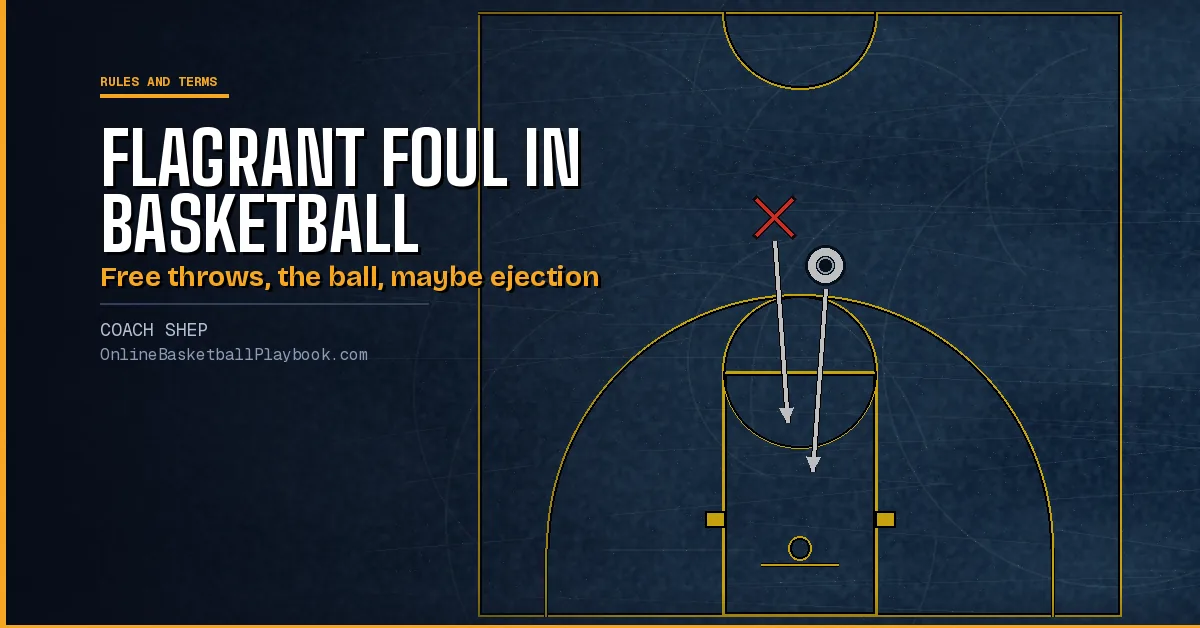
A flagrant foul in basketball is contact that goes past a normal foul, either unnecessary, excessive or, at the higher grade, severe enough to eject the player. Every level uses the idea, but the names, the penalties and the number of flagrant fouls before an ejection all differ. This flagrant foul basketball guide labels every rule with its level: NFHS (high school), NCAA men, NCAA women, the NBA and FIBA. Rule numbers are given where the official book was read. The NFHS rulebook is not free to read, so NFHS lines come only from the NCAA-published rules differences chart, and anything that chart does not cover says to check your state association rulebook. The whole list of fouls is on the basketball fouls list, and behavior fouls are on technical foul in basketball.
Flagrant Foul Rules at a Glance
| Level | Names | Penalty | Ejection |
|---|---|---|---|
| NFHS | Flagrant personal, flagrant technical | Not in the differences chart. Check your state association rulebook | A single flagrant foul |
| NCAA men | Flagrant 1, flagrant 2 (personal or technical) | Two free throws and the ball (three on a missed three-point try) | One flagrant 2. A third flagrant 1 disqualifies |
| NCAA women | Flagrant 1, flagrant 2 | Two free throws (three on a missed three), then a throw-in at the division line | One flagrant 2, two flagrant 1, or one technical and one flagrant 1 |
| NBA | Flagrant foul penalty (1) and penalty (2) | Two free throws and the ball at the free-throw line extended | One penalty (2), or two flagrant fouls in a game |
| FIBA (2026) | Disruptive foul, flagrant foul, disqualifying foul | Free throws by the shot rule, then a frontcourt throw-in | Two flagrant fouls, or one flagrant and one category 1 technical. A disqualifying foul removes the player at once |
Sources for the table: the NCAA rules differences chart rows "Types of Fouls" and "Disqualification/Ejection" (NFHS). NCAA men Rule 4 Sec. 15 Art. 2.c, Rule 4 Sec. 12 Art. 1, Rule 10 Sec. 1 PENALTY. NCAA women Rule 10 Secs. 13 and 14. NBA Rule 12B Sec. IV. FIBA 2026 Arts. 37 to 39.
What Makes a Foul Flagrant
Each book defines it in its own words.
- NCAA men (Rule 4 Sec. 15 Art. 2.c.1). A flagrant 1 is contact that is excessive (unwarranted or too much) and/or unnecessary (avoidable), and the book says it is not based only on how severe the act is. Its examples: excessive or unnecessary contact, contact that is not a legitimate attempt to play the ball or player, pushing or holding a player from behind to prevent a score, fouling a player clearly away from the ball to stop the clock or keep it from starting, contact with a player making a throw-in, an excessive elbow swing, hooking an opponent over or under the arm, and contact that is not the result of a normal basketball play.
- NCAA women (Rule 10 Sec. 13 Art. 1). A flagrant 1 is contact that is not a legitimate attempt to play the ball, is designed to take away an opponent's obvious advantage, comes away from the ball to stop the clock or keep it from starting, contacts a thrower-in, is excessive, hard or unnecessary, or is an excessive elbow swing. Contact with a thrower-in also counts as the team's warning for reaching through the boundary.
- NBA (Rule 4 Sec. IV(f), Rule 12B Sec. IV). A flagrant foul is unnecessary and/or excessive contact, called whether the ball is live or dead.
- FIBA 2026 (Art. 38.1.1). A flagrant foul violates the spirit of sportsmanship and fair play and goes past a personal or disruptive foul. The criteria are a play that is not legitimate basketball, a reckless, violent or dangerous act, or excessive, hard contact while playing the ball or the opponent.
- NFHS. The differences chart lists flagrant personal and flagrant technical fouls but gives no definition. Check your state association rulebook. High school also has an intentional foul, which is a separate call covered on intentional foul in basketball.

Flagrant 1 vs Flagrant 2
The NCAA and the NBA both split flagrant fouls into two grades.
| Level | Lower grade | Higher grade |
|---|---|---|
| NCAA men | Flagrant 1: excessive and/or unnecessary | Flagrant 2: not only excessive but also severe (brutal, harsh, cruel) or extreme (dangerous, punishing), ball live (Rule 4 Sec. 15 Art. 2.c.2) |
| NCAA women | Flagrant 1: the six kinds of contact listed above | Flagrant 2: any flagrant misconduct, contact judged violent or severe, or noncontact conduct judged persistent, extreme, vulgar or abusive (Rule 10 Sec. 14) |
| NBA | Penalty (1): unnecessary contact | Penalty (2): unnecessary and excessive contact (Rule 12B Sec. IV) |
The NCAA men's book tells officials what to weigh for a flagrant 2: how severe the contact was, whether it was a real attempt to block a shot, the chance of injury, such as a blow to the head or a foul on a player in a vulnerable position, and any contact to the groin. A block attempt can still be a flagrant 2 if there is hard contact to the head, a wind-up or an emphatic follow-through. The NBA's flagrant criteria (Comments on the Rules II.Q) are close: the severity of the contact, whether it was a legitimate basketball play, a wind-up or follow-through with the arm or hand, the potential for injury, the severity of any injury and the outcome, such as an altercation.
The Penalty: Free Throws, the Ball and Who Shoots
- NCAA men (Rule 10 Sec. 1 PENALTY). A flagrant 1 or 2 is two free throws and the ball at the designated spot nearest the foul, and three free throws and the ball on a missed three-point try. The usual one free throw after a made basket does not apply to a flagrant foul. If the fouled player cannot shoot because of a flagrant foul, the differences chart says a substitute or any player may shoot.
- NCAA women (Rule 10 Secs. 13 and 14). Two free throws to any member of the offended team, three on a missed three-point try, and then a throw-in at the division line opposite the scorers' table.
- NBA (Rule 12B Sec. IV). Two free throws and the ball on either side of the court at the free-throw line extended, with a personal and a team foul charged. If the fouled player is hurt on a penalty (1), his coach picks one of the four other players on the floor to shoot. On a penalty (2) the coach picks a substitute and any player on the team may shoot.
- FIBA 2026 (Art. 38.2). Two free throws on a player not shooting. On a shooter, a made goal counts plus one free throw, and a miss is two or three. Then a throw-in from the frontcourt throw-in line opposite the scorer's table. The foul counts as a team foul.
- NFHS. Not in the differences chart. Check your state association rulebook.
Free-throw lane and line rules are on basketball free throw rules.

Ejection and Disqualification
| Level | Rule |
|---|---|
| NFHS | Ejection on a single flagrant foul. Flagrant fouls count toward the team-foul total and ejection (NCAA rules differences chart, "Disqualification/Ejection" and "Count Towards") |
| NCAA men | Automatic ejection for a flagrant 2 personal or technical foul or for fighting (Rule 4 Sec. 14 Art. 2). Disqualification at a third flagrant 1 (Rule 4 Sec. 12 Art. 1) |
| NCAA women | Ejection for a flagrant 2, two flagrant 1 fouls, or one technical and one flagrant 1. A flagrant 1 also counts toward five fouls and the team-foul total (Rule 10 Sec. 13 PENALTY) |
| NBA | Ejection on a penalty (2) or on two flagrant fouls in the same game (Rule 12B Sec. IV). A penalty (2) can also bring a fine of up to $100,000 and/or a suspension by the Commissioner (Comments on the Rules II.B) |
| FIBA 2026 | Game disqualification on two flagrant fouls, two category 1 technicals or one of each, and only that last foul is penalized (Arts. 38.2.3 and 38.2.4) |
The NCAA women's 2025-26 changes add a one-game suspension for a player who fails to serve a mandatory rule-based suspension, and for that player's head coach (Rule 10-14).
Dead-Ball Contact and Fighting
Contact after the whistle is handled differently by level.
- NCAA men (Rule 4 Sec. 15 Arts. 3.d and 3.e). A flagrant 2 technical can be contact during a dead ball that is excessive and severe or extreme, or noncontact conduct, ball live or dead, that is extreme, sometimes persistent, vulgar or abusive. Lesser dead-ball contact that is unnecessary, unacceptable or excessive is a contact dead ball technical.
- NCAA women (Rule 10 Sec. 14). Flagrant 2 covers noncontact conduct too, and its examples include fighting, contacting or threatening an official, and leaving the bench when a fight may break out.
- NBA. A flagrant can be called with the ball dead or alive (Rule 12B Sec. IV(c)). Dead-ball contact is a technical if it is unsportsmanlike and a flagrant foul if it is unnecessary or excessive (Rule 12A Sec. V(i)).
- Fighting. NFHS ejects (NCAA rules differences chart, "Fighting"). NCAA men and women eject with a one-game suspension, and a second offense brings a season suspension. FIBA treats flagrant acts of aggression on opponents or referees as a disqualifying foul (Art. 39.2.3).
Replay Review
- NCAA men (Rule 11). Replay is not used to decide whether a foul happened, except for a flagrant foul (Sec. 1 Art. 4.a). After a foul call, officials may review whether it was flagrant and may downgrade it to a contact dead ball technical or a common foul (Sec. 2 Art. 1.d.1). A coach may ask for a monitor review of a possible flagrant 2 contact foul (Art. 1.d.4), and the team is charged a timeout if no flagrant or contact dead ball technical results (Sec. 5 Art. 1.c).
- NCAA women. A head coach may go to the table to request a replay review of a flagrant 1 or contact flagrant 2 foul (Rule 2 Sec. 10 Art. 13.c).
- NBA. A flagrant must be confirmed by instant replay (Rule 12B Sec. IV(d)). Replay is triggered when officials are not reasonably certain a foul met the flagrant criteria, and the review decides whether it stands, becomes flagrant 1 or 2, or becomes a technical (Rule 13 Sec. I(a)(3) and (c)(1)).
- FIBA 2026 (Appendix F.3.3). Where the replay system is used, referees may review whether a personal, disruptive, flagrant or disqualifying foul met its criteria and upgrade or downgrade it.
- NFHS. Not in the differences chart. Check your state association rulebook.
Get the next coaching guide in your inbox
One email when a new guide or diagram set goes up. Free.
FIBA 2026: Disruptive and Flagrant Fouls
FIBA's rules in force from 1 October 2026 rename this area. The 2024 book used one name, the unsportsmanlike foul (Art. 37), for both a hard, excessive foul and a foul that stops a fast break, and its Art. 38 was the disqualifying foul. The 2026 book splits that into two fouls.
| FIBA 2026 foul | What it covers |
|---|---|
| Disruptive (Art. 37) | Unnecessary contact, not playing the ball, to stop a transition or the clock at the end of a quarter, or contact from behind or the side on a player with no opponent between him and the basket |
| Flagrant (Art. 38) | Not a legitimate basketball play, reckless, violent or dangerous, or excessive and hard contact |
| Disqualifying (Art. 39) | Any flagrant unsportsmanlike action by players, substitutes, coaches or team members, including acts of violence |
The disruptive and flagrant fouls carry the same free throws and frontcourt throw-in. The difference is the count. Two flagrant fouls disqualify a player, while Art. 37 sets no disqualification count for the disruptive foul.
Plays That Draw Flagrant Calls
The rulebooks' own examples point to a few plays a coach can prepare a team for.
- The chase-down. A defender pushing or holding a player from behind to stop a score is a listed NCAA men's flagrant 1 that can rise to flagrant 2. In FIBA 2026 the same play is a disruptive foul unless it reaches the flagrant criteria.
- Late-game fouling. When a team fouls to stop the clock, grabbing a player clearly away from the ball is a listed flagrant 1 in both NCAA books. The other late-game rules are on basketball late game situations.
- The throw-in. Contact with a thrower-in is a listed flagrant 1 in both NCAA books, and the inbounds plays themselves are on basketball inbound plays.
- Elbows on the rebound. In NCAA men's play, elbow contact from total body movement is a common or flagrant 1 foul, and contact from elbows swung with the shoulders as pivots, faster than the body turns, is a flagrant 2 (Rule 4 Sec. 18 Art. 7, Rule 10 Sec. 1 Art. 15).


Related calls: offensive fouls, blocking fouls and loose ball fouls.
Want the printable playbook packs?
OBP Pro members get the premium playbook packs: the zone attack, out of bounds and practice plan PDFs, plus each new pack as it is finished. The membership page lists what is in each one. Or draw your own version free in PlayDraw.
See what OBP Pro includesQuestions Coaches Ask
What is a flagrant foul in basketball?
Contact that goes past a normal foul. NCAA men call a flagrant 1 excessive or unnecessary contact, and the NBA calls a flagrant foul unnecessary and/or excessive contact.
What is the difference between a flagrant 1 and a flagrant 2?
In NCAA men's play a flagrant 1 is excessive or unnecessary and a flagrant 2 is also severe or extreme. In the NBA penalty (1) is unnecessary contact and penalty (2) is unnecessary and excessive. A flagrant 2 ejects at both levels.
What is the penalty for a flagrant foul?
Free throws and the ball. NCAA and NBA award two free throws (NCAA three on a missed three-point try), and FIBA uses its shot rule. Check your state association rulebook for high school.
How many flagrant fouls before an ejection?
One flagrant 2 at NCAA and NBA level. Two flagrant fouls in the NBA, two flagrant 1 fouls in NCAA women's play and two flagrant fouls in FIBA. NCAA men disqualify at a third flagrant 1. In high school, a single flagrant foul ejects.
Does a flagrant foul count as a team foul?
Yes. The NCAA rules differences chart says so for NFHS and both NCAA levels, and the NBA and FIBA 2026 books charge a team foul too.
Can a flagrant foul be called on a dead ball?
Yes. The NBA calls flagrant fouls with the ball dead or alive, and NCAA men have a flagrant 2 technical for severe dead-ball contact.
Can officials review a flagrant foul on video?
Yes in the NCAA, the NBA and FIBA where replay is used. The NBA requires replay to confirm every flagrant.
More Guides From This Batch
- Basketball Speed and Agility Drills: Sprints, Starts and Stops
- Fast Break Basketball Drills for Youth and Varsity Teams
- Pick and Roll Basketball Drills: From 2 on 0 to Live Reads
- Jab Step Basketball: How to Do It and How to Teach It
Back to Basketball Rules and Regulations and every Rules and Terms page.
Keep Building
Related breakdowns
Technical Foul in Basketball: Rule, Penalties and Calls by Level
What a technical foul is in basketball, what draws one, what it costs in free throws and when it ejects a player or coach, labeled by NFHS, NCAA, NBA and FIBA rules.
Basketball Referee Signals: Foul Signals and Calls by Level
Basketball referee signals from the official NBA, NCAA and FIBA charts: how a foul is reported, foul signals by level, and violation, scoring and timeout signals.
Double Dribble in Basketball: Rule, Examples and Calls
A double dribble is a second dribble after the first has ended. Rules by level (NFHS, NCAA, NBA, FIBA), what restarts a dribble, examples and how to coach it.