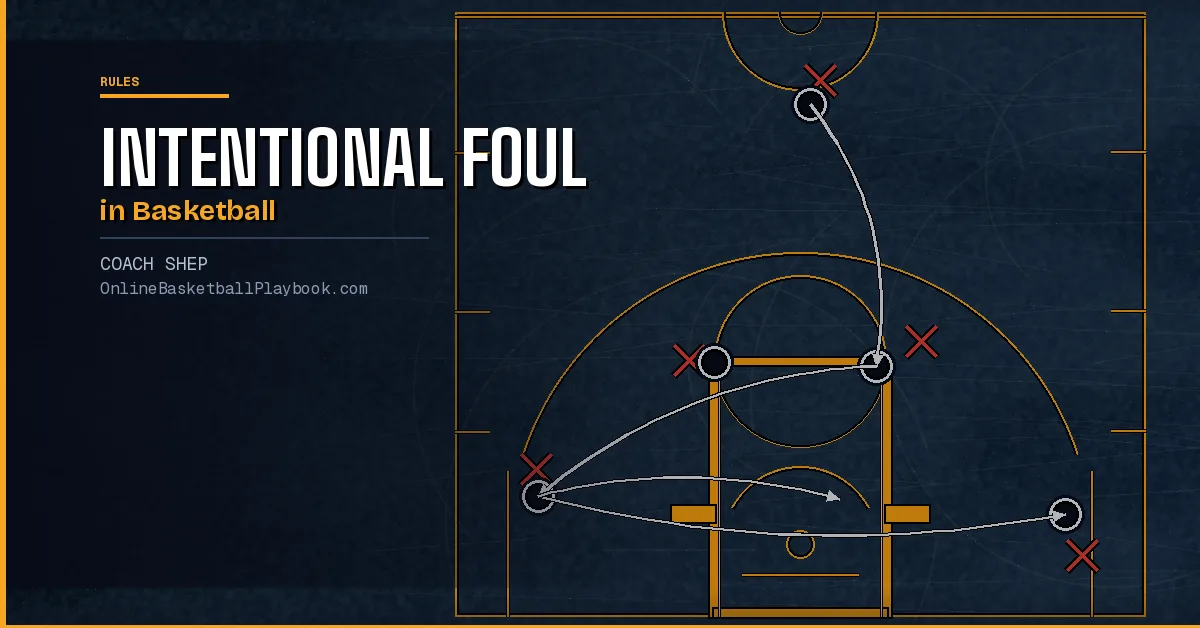
The intentional foul is one of basketball's most deliberate strategic tools. Knowing when to use it (and how to execute it correctly) can swing a close game, stop the clock, and put poor free-throw shooters on the line.
What Is an Intentional Foul?
An intentional foul in basketball is a foul committed on purpose, a calculated decision by the defensive team, not a mistake or a reaction play. At every level of the game, from youth leagues to the NBA, coaches use intentional fouls to control tempo, stop the clock, and exploit mismatches at the free-throw line.
The terminology varies by level. In the NBA, the rulebook uses the phrase "flagrant foul" for particularly hard contact, while a foul committed deliberately but without excessive force is simply called a "personal foul." In NCAA and high school basketball under NFHS rules, referees can classify certain deliberate fouls as "intentional fouls," which carry a specific penalty structure that differs from a standard personal foul.
The most common scenario most fans and coaches recognize is the end-of-game intentional foul. A team trailing by a few points needs possessions, so they deliberately foul the opposing team to stop the clock, send them to the line, and get the ball back. It is a calculated gamble. You are giving the other team free points in exchange for time and the chance to score yourself.
Understanding the intentional foul requires more than knowing what it is. You need to know the rules, the situations where it makes sense, and how to communicate it to your players so they execute it cleanly and do not accidentally commit a flagrant foul or a technical. For coaches building basketball IQ in their players, the intentional foul is a concept that separates players who understand the game from those who just play it.
Rules and Penalties by Level
The rules governing intentional fouls are not uniform across levels of play, so coaches need to know which rulebook governs their league.
NBA Rules
In the NBA, referees classify fouls into personal fouls, flagrant fouls (Flagrant 1 and Flagrant 2), and technical fouls. A deliberate foul in the bonus sends the fouled player to the line for two free throws, and the offensive team retains possession. The key word is "retains". This is unique to certain situations and makes intentional fouling extremely costly if you commit it at the wrong time.
The NBA also enforces an "away from the play" foul rule in the final two minutes of regulation and overtime. If a team fouls a player away from the ball during those final minutes, the fouled team gets two free throws plus the ball. This rule was designed specifically to counter hack-a-player tactics and end-of-game fouling that dragged games out.
NCAA and High School Rules
Under NCAA and NFHS rules, an intentional foul results in two free throws plus possession of the ball for the team that was fouled. This is the standard interpretation most youth and high school coaches need to understand. Because the penalty is free throws plus the ball, using intentional fouls in these levels is riskier than in the NBA. You are giving up two free throw attempts AND surrendering the ball.
The one exception is in late-game situations when a team is not yet in the bonus. Before the bonus, a deliberate foul results in possession change without free throws (in most youth and high school settings). Coaches must track foul counts meticulously to know when intentional fouling becomes strategically viable.
Youth Basketball
Most youth leagues follow modified NFHS rules. Many leagues reduce foul counts or use running clocks that limit the effectiveness of intentional fouling. Always check your specific league's rules before building a late-game strategy around deliberate fouls. Poor free throw shooting is common at youth levels, but so is inconsistent officiating. Factor both into your calculus.
When to Foul on Purpose
The decision to intentionally foul is a situational one. There is no universal answer. The right move depends on the score, the clock, the foul count, the opponent's free throw percentage, and your own team's ability to score in transition after the made or missed free throw.
The Classic Late-Game Scenario
The most common situation: you are trailing by five or fewer points with under two minutes left. The opposing team has the ball and is trying to run clock. Every second they hold the ball is a second your team cannot score. Fouling stops the clock and forces them to earn their points at the line instead of dribbling out the game.
The math is straightforward. If you are down four and the other team's ball-handler shoots 50% from the free throw line, every intentional foul is statistically valuable. They are expected to score one point, you get the ball back, and you have a chance to cut it to three or even tie. If you are fouling a 90% free throw shooter, the math flips. You are almost certainly giving up two points in exchange for a possession, and the clock still runs out.
Stopping a Fast Break
Intentional fouls are also used to stop fast breaks before they become easy baskets. A defender who gets beaten and has no chance to stop a layup may intentionally foul the ball-handler to prevent a high-percentage shot. At the NBA level, this is rarely used because the penalty is severe. At the high school and youth level, trading two free throws (especially for an average shooter) for an open layup often makes sense.
This connects directly to your transition defense principles. Knowing when to foul to prevent a layup is part of every system-level conversation about how you defend the open court.
Disrupting Opponent Momentum
A deliberate foul can also break up a run. If the other team has scored six or eight straight points and your players are rattled, stopping play with a foul (even if it costs two free throws) gives you a timeout-equivalent moment to regroup without burning a timeout. This is more art than science, but experienced coaches recognize when their team needs a pause.
Hack-a-Player Strategy
Hack-a-player, sometimes called "Hack-a-Shaq" after the tactic used against Shaquille O'Neal in the early 2000s, is the practice of intentionally fouling a specific poor free-throw shooter (often before the ball is even inbounded) to exploit their weakness at the line.
The logic is simple: if a player shoots 40% from the free throw line, he is expected to score 0.8 points on two attempts. That is below the league average for any possession. By repeatedly fouling that player, you suppress the opponent's offensive efficiency. At the NBA level, players like DeAndre Jordan, Ben Simmons, and Andre Drummond have been targeted this way for entire seasons.
Does It Actually Work?
The data suggests hack-a-player works in pure efficiency terms, but it is slow, aesthetically ugly, and has prompted rule changes at multiple levels. The NBA's "away from the play" rule and the Clippers-Jordan rule were both designed to limit its use. Many youth leagues have followed with similar restrictions.
At the high school level, hack-a-player is less common but not unheard of. If your opponent has a player who shoots 30% from the line, fouling him in a close fourth quarter is defensible coaching. The tactical risk is that it can look poor to officials and spectators, and an overly aggressive foul on a non-ball-handler can get called as intentional under NFHS rules, which means free throws AND possession.
Coaching Against the Hack
If your team has a poor free throw shooter who gets targeted, you have two options: hide him or fix him. Hiding means running plays that keep him away from the ball in late-game situations or substituting him out when the other team is likely to foul. Fixing means committing to the work in practice. Free throw improvement is one of the most direct results of focused basketball player development: It requires repetition, routine, and mental discipline.
Defending the Intentional Foul as an Offense
When the opponent starts fouling you intentionally, the pressure shifts to your free throw shooters and your in-bounds execution. Many teams fall apart in these moments not because of the free throws themselves but because of the chaos. The tempo changes, the crowd gets loud, and players who never practice under pressure suddenly have to deliver.
Free Throw Routine and Mental Composure
Every player on your team needs a consistent free throw routine. This is non-negotiable in the fourth quarter. A routine (same stance, same ball bounces, same breath) gives the brain something familiar to fall back on when the body is under stress. Teams that lack a routine become inconsistent under pressure. This is why effective basketball practice must include free throw shooting at the end of conditioning, not at the beginning when players are fresh.
Inbounds Execution After Made Free Throws
When you make both free throws, the other team will immediately foul again. Your inbound passer must be calm, your target players must get open, and no one on the floor should be surprised by what is happening. Walk through it in practice. Know which player the defense is likely to foul, and have a plan to get the ball to a different player if your primary target is being denied.
Teaching Intentional Fouls to Your Team
One of the most overlooked aspects of coaching late-game situations is that players do not naturally know how to foul on purpose cleanly. Young players either foul too hard (risking a flagrant) or not hard enough (the play continues and the clock keeps running). Teaching the skill of a clean intentional foul is a real coaching responsibility.
What a Clean Intentional Foul Looks Like
A clean intentional foul is body contact (typically a wrap-around on the arm or a deliberate hold) that is firm enough for the referee to call immediately, but controlled enough that there is no injury risk and no chance of escalation. The defender's hands must be visible and the contact must be unambiguous. A foul that is too subtle will not get called; a foul that is too hard can be upgraded to a flagrant.
Teach your players to foul on the arm, not the head or body. The arm is the safest and most visible target for officials. Practice the motion so players are not improvising when the game is on the line.
Communication on the Floor
In the final minute of a close game, the coach cannot sub in a new set of instructions every possession. Players need pre-agreed signals for when to foul. Some coaches use a specific hand gesture from the bench; others assign one player (usually the point guard) to relay the call to teammates. Whatever your system, rehearse it. Players who are looking at the bench for permission while the opponent dribbles toward half-court will foul too late or miss the window entirely.
This kind of high-IQ late-game execution is part of what separates teams with real basketball team culture from groups of talented individuals who fall apart when the stakes rise.
Drilling Late-Game Scenarios
The most effective way to prepare for intentional foul situations is to simulate them in practice. Set up the game state (down three, 45 seconds left, opponent in bonus) and run through it live. The offense tries to protect the ball and make free throws; the defense practices timing the foul and converting on offense after the stop. Drilling these scenarios removes the mental load during the game itself. Players who have been in the situation before do not panic.
As a general rule, intentional fouling makes mathematical sense when the targeted shooter shoots below 65% from the free throw line. Above that percentage, the expected points surrendered often outweigh the value of the possession you receive in return. Always know your opponent's free throw splits before tip-off.
- Know the foul bonus status at all times. Fouling before the bonus gives the ball away without sending anyone to the line
- Target the weakest free throw shooter on the floor, not the ball-handler by default
- Foul on the arm, not the body. Clean, visible contact that officials will call immediately
- Practice free throws at the end of conditioning so players simulate real-game fatigue on the line
- Pre-designate one player (usually the point guard) to relay the foul signal from the bench to teammates
- Know your league's specific intentional foul rules. NCAA and NFHS penalize intentional fouls with free throws plus possession
- After your team is fouled intentionally, get into your inbounds sets immediately. Do not let the opponent disrupt your tempo
Get free play diagrams, drills, and coaching guides delivered weekly.
Draw this play free in the play drawer →
Membership: the full library, playbook packs, and Pro drawing tools →
Keep Building
Related breakdowns
Basketball Fouls List: Every Foul, Penalty and Limit by Level
Basketball fouls list for coaches, with every personal, offensive, flagrant and technical foul, the free throws, the bonus and the foul-out limit at each level.