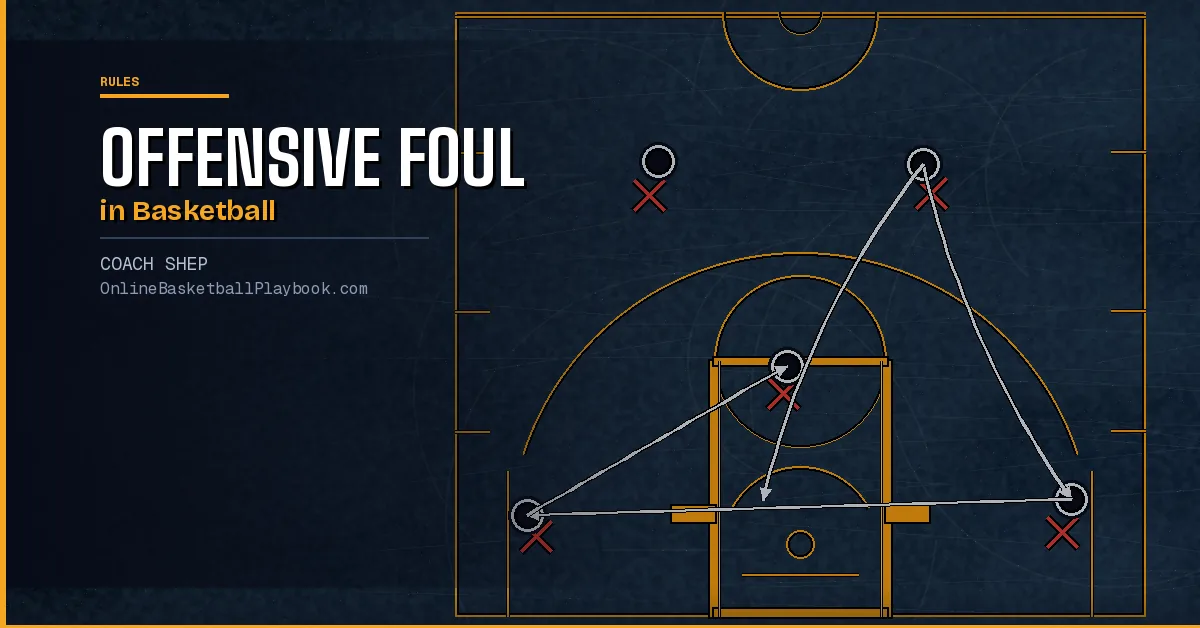
An offensive foul is one of the most misunderstood calls in basketball. This guide breaks down every type, the rules behind each, and exactly how to coach players on both sides of the play.
What Is an Offensive Foul?
An offensive foul occurs when a player with the ball, or a teammate setting a screen, makes illegal contact with a defender. Unlike a defensive foul, the penalty flips: the offensive team loses possession, and the basket (if made) does not count. No free throws are awarded to the defense unless the team has reached the bonus limit.
The most common offensive foul is the charge, where a ball-handler drives into a stationary defender who has established legal guarding position. But offensive fouls extend well beyond the charge call. Illegal screens, pushing off during a drive, using an elbow to clear space, and moving into a defender mid-shot can all draw the whistle against the offense.
Understanding offensive fouls is essential for Basketball IQ development. Players who know where the line is, both as ball-handlers and as screeners, make smarter decisions, draw fewer turnovers, and keep their team in offensive rhythm. Coaches who teach this clearly turn a rulebook item into a competitive weapon.
At every level of basketball, offensive fouls carry a heavier cost than most players realize. A charge call in the fourth quarter stops a scoring possession cold, restarts the defense, and can shift momentum entirely. Teams that minimize offensive fouls through awareness and footwork consistently outscore teams that don't.
Charge vs. Blocking Foul
No call in basketball generates more sideline debate than the charge/block distinction. The rule itself is straightforward on paper: if a defender has established legal guarding position before the offensive player's lower body begins its upward shooting motion or contact path, it is a charge. If the defender is still moving or has not yet established position, it is a block.
Legal guarding position requires two things: both feet on the floor and the defender's torso facing the opponent. The defender does not have to be completely stationary before the offensive player gathers. They just have to have established position before significant contact occurs. Once that position is set, the offensive player is responsible for avoiding contact.
The difficulty is timing. Defenders often slide into position a fraction of a second before contact, which makes the call a judgment call for officials. This is why basketball footwork drills matter so much on the defensive side, a defender who beats the ball-handler to the spot and plants cleanly gives the official no reason to doubt.
For offensive players, the key is reading the defense early. A ball-handler who sees a defender already in the paint with feet set should change direction or pull up rather than drive through. Players who drive with their head down and contact a stationary defender almost always get called for the charge, regardless of their intent.
The "Gather Step" Timing Rule
In the NBA and increasingly at the college level, officials apply a refinement: if a defender slides into position after the offensive player has already gathered (the moment the dribble ends and the player collects the ball for a shot or pass), the call leans toward a blocking foul. The offense cannot be penalized for contact that happens after they've already committed to a move they cannot reverse. This nuance rarely applies at the youth or high school level, where officials use simpler positioning criteria.
The Restricted Area Rule
The restricted area arc, a four-foot semicircle under the basket at the NBA and college levels, exists specifically to reduce charge calls in a zone where defensive players commonly position themselves directly under the rim to draw contact from driving players.
Inside the restricted area, a defender cannot draw a charge. Even with legal guarding position established, a foul inside the arc is ruled a blocking foul on the defense. The rule protects offensive players who are finishing at the rim from defenders who drop into the lane and absorb contact without making a legitimate defensive play.
This rule does not exist at most youth or high school levels. Coaches working at those levels should still teach players about the arc concept, because understanding it early prepares them for the rule when they advance. Defensively, teach your players to take charges from the elbow or mid-range area rather than directly under the basket where their positioning may not hold up.
For offensive players, knowing the restricted area matters because it affects finishing strategy. If a defender beats you into the paint but is standing under the rim, you may still be protected by the arc, which is another argument for attacking with pace and getting inside that line before contact occurs.
Types of Offensive Fouls
The charge is the headline, but coaches need to teach every category of offensive foul if they want players who compete clean and smart.
Illegal Screen
A screener must be stationary at the moment of contact. If a player is still moving when the defender runs into them, it is an illegal screen, an offensive foul. Common violations include the screener stepping into the defender's path at the last second, the screener widening their stance to absorb contact, or the screener extending elbows to impede movement.
Illegal screens are among the most commonly missed calls at every level of basketball, but they create real problems for the offense even when uncalled: defenders who see an illegal screen pattern alert officials quickly, and a flagrant pattern will eventually draw whistles. Teaching legal screening technique inside your motion offense protects the entire system.
Push-Off
A ball-handler who extends an arm, forearm, or elbow to create separation from a defender commits an offensive foul. This happens most often on drives to the basket where the offensive player uses the off-arm to push the defender away while finishing. It also appears on post moves when a post player leans or shoves with the off-hand to back a defender down.
Moving Screen / Re-Screening
When a screener rolls or cuts while the defender is still in contact with them, effectively continuing to block the defender's path after the initial screen, that is a moving screen. It is different from a screener who sets, then releases to roll after the defender has cleared. Teaching the difference requires repetition and video review at the varsity level.
Elbow Foul
Swinging elbows to create space around the ball is an offensive foul regardless of intent. This applies to post players spinning out of the post, ball-handlers pivoting in traffic, and players fighting through double-teams. The player does not have to make contact on a swing. In some rules sets, a dangerous swing that forces a defender to retreat is still a foul even without contact.
Foul on a Screen Away From the Ball
Off-ball offensive fouls are frequently missed but still count. A player setting a back-screen who steps into a defender, or a cutter who uses a forearm to push off a help-side defender, can be whistled even when nowhere near the ball. These fouls often negate well-designed plays right at the moment they're breaking open.
How to Coach the Offensive Foul
The first coaching task is making the distinction between a physical, aggressive offense and a foul-prone offense. Players can be taught to play hard and still stay legal. The key is body position and contact awareness rather than timidity.
For ball-handlers, teach the concept of finishing through contact that comes from behind or the side versus running into contact that is stationary and in front. Finishing through a defender who is reaching or bumping from behind is legal. Running into a wall, a defender with both feet set, is a charge. That distinction, repeated in practice, builds the read.
For screeners, teach the five-step legal screen: approach from the correct angle, plant both feet, square your shoulders, keep your hands in, and hold the position until the ball-handler clears. If a screener is getting called for illegal screens repeatedly, go back to stance. Most illegal screen calls trace to a screener who is still moving or who widened their feet at contact.
At the youth and middle school level, offensive foul education is largely about awareness. Most young players don't know what an illegal screen looks or feels like. Walk through it without a ball first. Have players set screens on a coach who demonstrates what moving into them looks like versus setting a clean pick. Make it visual and tactile before you make it competitive.
At the high school and college level, video is your best tool. Pull clips of illegal screens and push-offs from practice or game film, freeze them, and show the moment of infraction. Players learn faster when they see themselves versus when they're told.
Connecting offensive foul awareness to your basketball player development program pays dividends long-term. Players who understand the rule at 14 arrive at the varsity level with a clean habit already built. Players who learn it at 17 spend their early varsity career fighting tendencies that are hard to break.
Drills and Practice Reps
Offensive foul concepts require live, contested reps to stick. Static walkthroughs explain the rule; competitive situations teach players to apply it under pressure.
Charge/Block Shell Drill
Run your standard shell drill but add a rule: any time a defender establishes a set position in the lane before the ball-handler's path is committed, the ball-handler must pull up or redirect. If they drive into the set defender, it counts as a turnover. This builds the visual habit without needing an official to make calls. The players self-regulate based on a clear rule they all understand.
Live Screen Setting
Pair a ball-handler and a screener against one defender. The screener must set three legal screens in a row before the drill ends. Any movement at contact resets the count. This drill exaggerates the standard so that a legal screen becomes automatic. Add a second defender so the screener has to hold position even when being bodied.
Post Contact Reads
In post play, the push-off is one of the most common and most-missed offensive fouls. Run a two-on-one post drill where the post player has a defender behind them and a helper on the weak side. The post player must score or kick without using the off-arm to push. Count points only when the score comes without a push-off. This drill makes the clean move the rewarded move.
Transition Charge Drill
In transition, defenders often sprint to the paint and set up to take a charge from a driving ball-handler. Run a three-on-two transition drill where one of the defenders is designated to drop into charge position while the other defends the pull-up. The ball-handler must decide at the three-point line whether to kick or pull up. This mirrors the real read players must make in games when defenses scramble back.
Teach players to accept the call and move on immediately. Arguing an offensive foul call never reverses it, and officials remember players who complain, which can cost a team a 50/50 call later in a close game when it matters most.
- A defender must have both feet planted and torso facing the offensive player to draw a charge. One foot down is not enough.
- Inside the restricted area arc (NBA/college), a blocking foul is called on the defense even if position was established. No charges allowed under the rim.
- A screener must be completely stationary at the moment of contact. Any movement into the defender is an illegal screen.
- Push-offs with the off-arm during drives and post moves are offensive fouls even when incidental-looking. Officials are trained to watch the off-hand.
- Elbow swings that force defenders to retreat are flagged even without direct contact in many rules sets. Teach players to keep elbows tight while pivoting in traffic.
- Off-ball offensive fouls on back-screens and cuts count the same as charge calls. Build awareness of contact away from the ball in every screening drill.
Get free play diagrams, drills, and coaching guides delivered weekly.
Draw this play free in the play drawer →
Membership: the full library, playbook packs, and Pro drawing tools →
Keep Building
Related breakdowns
Intentional Foul in Basketball: Complete Guide
Intentional Foul in Basketball: Complete Guide
Basketball Fouls List: Every Foul, Penalty and Limit by Level
Basketball fouls list for coaches, with every personal, offensive, flagrant and technical foul, the free throws, the bonus and the foul-out limit at each level.