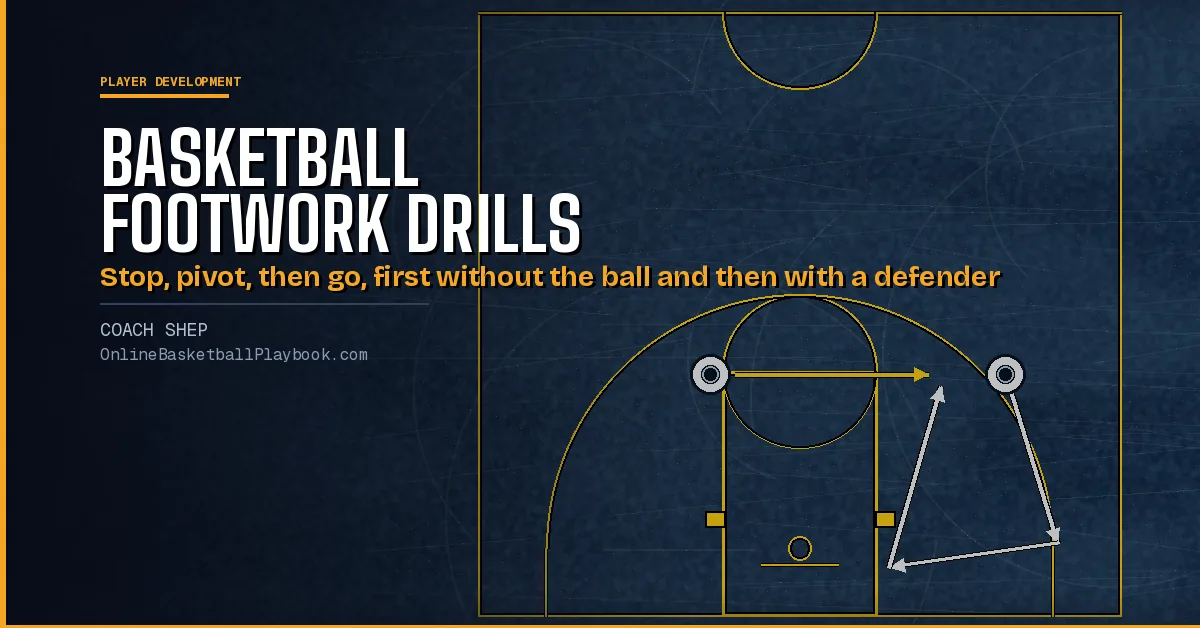
Basketball footwork drills teach the movements under every skill, how a player stops, turns, cuts, jabs and slides. Footwork is one of the most important and least emphasized fundamentals in the game. This guide sorts them by skill and draws five.
It covers the box drills, cut-and-catch drills, jab series, defensive slides and the 30-minute workouts programs use, and it lists where coaches disagree on the stop and the pivot foot. More practice material is on the Drills hub and in Basketball Player Development.
Basketball Footwork Drills at a Glance
| Skill | Drills |
|---|---|
| Stops and pivots | Pivoting drill, 4-Pivot drill, Four Corners, Circle Footwork Drill for shooters |
| Post and box footwork | box drills, post drop-step and reverse-pivot stations |
| Cuts and catches | Cut and pivot, baseline starts stops and turns, front cut, back door cut, getting open |
| Live-ball moves | Jab series, elbow drill, swing series, wide-base pivot drill, wing cut drills |
| Defense | Cone drill, lane slides, wave drill, Eagle footwork, a warm-up in two packages |
| Finishing | Step-slide-shot progression, two-step finishes |
Stance, Stops and Pivots
Footwork starts with balance. Don Meyer's quick stance has the feet staggered and the weight on the whole foot, and every skill builds on it in an order: stance, starts, steps, turns, stops and jumps. Foot speed matters less than starting, stopping and changing direction.
A shoulder-width stance puts the weight on the balls of the feet, feet about shoulder width apart, knees flexed, head centered over the lower body and hands about chest high. With the ball on the perimeter it becomes triple threat. Other systems use the word stance for different cues, so write the job next to the name.
Stops
Three stops go with it:
- One-two stop. The back foot lands first and becomes the pivot foot, and the second foot lands wide for balance.
- Stride stop. The back foot acts as brakes, the feet land wider than the hips and the inside shoulder faces the rim.
- Jump stop. Both feet land together after a hop with the weight leaning back a little, so either foot can become the pivot.
A player can catch a pass with a jump stop and then pivot on either foot, which helps post players most.
Pivots
A pivot happens on the ball of the pivot foot, with the head up and the knees a little bent. The pivot point must not change, and the foot does not slide.
- Forward pivot. Swing the free foot ahead.
- Reverse pivot. Swing it behind, which is also called a drop step.
The pivoting drill is plain. Start with the left foot as the pivot and pivot forward 15 times, then backward 15 times, then switch feet and repeat.
- 4-Pivot drill. After an explosive start the player jump-stops and cycles the front pivot and the reverse pivot off each foot.
- Offensive Pivoting and Passing Breakdown Drill. Groups of three, a dribbler, a defender and a receiver who catches and shoots, in 55-second rotations, usable with both feet.
- Circle Footwork Drill for shooters. Three or four players in each free-throw circle jog, toss the ball to themselves on a whistle, pivot off the inside heel and square up, stop without shooting and switch direction for the other foot, while a coach in the center sees every foot.
Teach the stop and the pivot before anything else.
Four Corners
The four-corner drill teaches the jump stop and the reverse pivot together. Four lines stand about 25 feet apart at the corners of a square with a ball at the front of each.
- Dribble to the middle. On the whistle all four dribble toward a target near the top of the key.
- Jump-stop and reverse-pivot. Jump-stop about three feet before they meet, reverse-pivot toward the line on their right or left, decided before the whistle, and chest-pass to the front of that line.
- Switch. After about 20 passes the coach calls switch and they pivot and pass the other way.
It looks like a dance when the timing is right and like chaos when it is not.

The Box Drills
There are six box drills, and players can do them every workout, individually before a workout or as a team before practice. Each starts the same way. The player stands on the low block with his back to the baseline, spins the ball back to himself and catches it with a two-foot jump stop at the elbow. Then he runs one of six finishes.
- Drop step, layup. Jump stop, drop step with the outside leg, one dribble, layup.
- Inside pivot, jump shot. Jump stop, fake a drop step, forward pivot on the inside foot, jump shot.
- Inside pivot, shot fake, crossover step, layup. Jump stop, fake a drop step, forward pivot on the inside foot, shot fake, crossover step, one dribble, layup.
- Reverse pivot, jump shot. Jump stop, reverse pivot on the outside foot, jump shot.
- Reverse pivot, rip, layup. Jump stop, reverse pivot on the outside foot, rip to the outside, one dribble, layup.
- Reverse pivot, fake rip, crossover step, layup. Jump stop, reverse pivot on the outside foot, fake the rip, crossover step, one dribble, layup.

Footwork is mostly a secondary skill in other drills, so these give it all the attention, and they are best run before practice while legs are fresh.
Cuts, Catches and Turns
Cut and Pivot
This footwork drill puts a jump stop, a reverse pivot, a V-cut and a forward pivot in one sequence. Players form two lines, one passing and one moving.
- Cut to the corner. The mover on the left wing cuts to the corner, jump-stops, reverse-pivots, runs the baseline to the block and V-cuts back out toward the elbow or the wing area.
- Catch and shoot. He forward-pivots there, catches the pass in triple threat and shoots, rebounds his own shot and gives the ball to the next passer.
Coaches walk through it in slow motion first and then speed it up, and five to ten minutes a practice improves the basics quickly. The cues:
- Hop. Land on both feet at once.
- Reverse pivot. On the inside foot toward the open floor.
- V-cut. Plant the inside foot and push off it hard.
- Forward pivot. On the baseline foot to face the passer.

Starts, Stops and Turns
This drill sets four lines 12 to 15 feet apart, at the left corner, each edge of the lane and the right corner, with a ball at the front of each.
- Drive, stop and turn. On the whistle each player makes a direct drive or a crossover drive to free-throw line extended, makes a quick stop and a quick rear turn, passes back and goes to the end of the line with a change of pace.
- Harass the handler. Coaches can stand at the line and harass the ball handlers to force the turn.
- Cue LBBOS. Low, body balanced, base of support, with the heel of the pivot foot lifted on the turn.
- Add cut drills. A front cut drill, where players fake a pass, take two or three steps away and cut hard to the basket, and a back door cut drill with an out, in, out pattern.

- Getting Open and Moves. A player runs proper Y-cut or L-cut footwork, catches a pass from the coach, squares to the basket and practices jabs, fakes and shots, with a defender added later.
- Wing cut drills. Mike Brey runs them. A player passes to a coach at the top of the key, runs to the low block, cuts to the wing, catches, faces and pivots with the feet wide and the knees bent. Add a shot fake and one dribble to a power layup or a jump shot, and the pull-through drill goes off the hip of a coach acting as the defender.
Add the defender only after the footwork is clean.
Jab and Live-Ball Footwork
Jay Wright's perimeter series starts every drill from the same catch.
- Wide-base pivot drill. A player catches, pivots and takes several steps with the non-pivot foot while staying strong and balanced on a wide base, pivoting on the right foot every rep and then the left.
- Elbow drill. Jump-stop at the elbow, pivot on the inside foot and go into the jab series.
- Jab series. Three options: jab and go (a short jab and then a long stride past the defender), jab and rip to change direction, and jab then bring the foot back for a jumper. The most important point is to catch on balance, turn and jab so the defender is off you.
- Pound pivot. It has its own page, How to Do a Kobe Bryant Pound Pivot.
- Mark Few's jab series. Five moves: jab and go, jab and step by, jab and shoot, hitch and shoot and hitch and go.
Wright's swing series covers a catch with no screen. The player walks into his defender, takes the inside hand and inside foot through, gives a target with the outside hand and uses the outside foot as the pivot. The moves are swing and go, swing and cross and swing and jumper.
Add footwork with the ball:
- Skip and rip, inside-out skips. They simulate the stance and the low rip of a live-ball move with no defender.
- Hurdler drill. It alternates a low rip and a high rip.
- Overhead toss drill. A player lobs the ball up, lets it bounce once and takes one explosive step to catch it with no double step.
Catch on balance, then attack.
Defensive Footwork Drills
Defensive footwork is simple. Keep the weight on the balls of the feet, the feet about shoulder width apart, the knees bent, the head up and the arms out with the palms up. Slide with quick short steps and do not cross the feet or hop. The cue is step and slide, in that order. The foot on the side of travel steps first and the other foot follows.
Cone Drill
The cone drill has six moves around five cones, with players lined up on the baseline.
- Run the route. The first player closes out on the first cone, back-pedals to the second, slides sideways to the third, closes out on the fourth, slides to the fifth and back-pedals to the baseline.
- Stagger the starts. The second player starts once the first slides past.
- Go game speed. Stay low even when back-pedaling and sliding, and run two or three laps each.
- Warm up with it. A single lap with no cones works as a pregame warm-up.
- Retreat right. On a retreat the outside foot drops back and the front foot pushes.

Eagle Footwork, a Two-Package Warm-Up and Other Slide Drills
Eagle Footwork teaches three stances, on the ball, one pass away and help side, and drills them daily.
- On-ball stance. Low and wide, with the toes out about 45 degrees.
- Shuffle. Push with one leg and reach with the other while the head, shoulders and hips stay on one plane.
- Closeout. It starts from the help-side stance, explodes up the floor, chops into the knees and throws the hands up with the palms to the ceiling.
A separate warm-up rotates two packages by day:
- Forward and backward. Ankle bounces and stride-outs.
- Lateral. Lateral ankle bounces, stride-outs and a jump stop with a diagonal push back.
The three keys are a still head, arm movement and a push off the balls of the feet.
In lane slides a player slides across the lane, touches the far side with the near foot and slides back for 30 to 60 seconds, with a ball held high or bean bags as variations. A wave drill has players face the coach, who motions slides, retreat steps, advance steps and drop steps. Slide first and never cross the feet.
For agility work beyond slides, see Basketball Agility Drills, and for the full guide to this skill, see Basketball Defensive Footwork, Basketball Closeout Technique and Closeout and Recover.
Footwork for Finishing
A step-slide-shot progression for players of all ages runs on the saying no foot, no player.
- Stage A. The player stands under the net looking at his feet with the ball at the chin and the elbows out. Without a dribble he takes one giant step to the right and slides the left foot over for a two-hand power layup, landing on both feet together, then repeats left.
- Stage B. Add a dribble.
- Stage C. A hard pound dribble with the hands on the ball until he shoots.
- Stage D. Keep the eyes on the goal.
- Stages E to H. Replace the slide with a hop.
Ask for clean makes and sets of 10 to 25 reps, by age and skill. Clean feet first, then the finish. For more, see Basketball Finishing and Footwork Drills, Layup Drills and Basketball Pivot Footwork.
Get the next coaching guide in your inbox
One email when a new guide or diagram set goes up. Free.
30-Minute Footwork Workouts
Two 30-minute plans follow. For high school and college, run two to four sessions a week from preseason into the first weeks of the season and three or four sessions a week in the offseason. For youth, twice a week is good, even for 20 minutes.
| Block | High school and college | Youth, ages 8 to 12 |
|---|---|---|
| Warm-up | 4 minutes of mobility, then high knees, carioca and lateral quick steps | 5 minutes of a circle run, mobility and relay games |
| Stations | 8 minutes, four 2-minute stations: slide and closeout, triple-threat pivot and jab, post drop and reverse pivot, two-step finishes and jump stop | 12 minutes, three 4-minute stations: jump stop and pivot, jab and drive step, slides and closeouts |
| Breakouts | 8 minutes, 4 for guards and 4 for posts | None |
| Partner work | 6 minutes of 30-second rounds, footwork-only ball handler against a defender practicing contain steps, slide and closeout | 8 minutes of 30-second offense and defense rounds with no contact |
| Finish | 4 minutes of 3-on-3 or 4-on-4, 12 to 15 second possessions, each score needs a required footwork move | 5 minutes of 3-on-3 where each score includes a taught move |
The cues on the high school plan are low base with a short choppy first step, plant foot with the eyes up and finish balanced. Winners rest, and losers do 10 controlled reverse pivots and 10 bodyweight squats. The plan says to back down to twice a week or shorter sessions later in the season, especially the day before a game.
Where Coaches Disagree
Coaches split on three questions.
Which stop?
- A two-foot jump stop. Either foot can pivot.
- A stride stop. The second foot lands inside the charge circle. After two years of jump stops, only the best athletes could score off them.
- A jump stop or a one-two step. A jump stop for a quick release and a one-two step when closely guarded.
- A quick stop with a rear turn. The jump into a jump stop slows the stop.
Which pivot foot?
- One permanent foot. The weak foot for a perimeter player, as Sean Miller and others teach.
- The inside foot. Billy Donovan and others teach it.
- Read the shot. The inside foot when the shot is there and one fixed foot when attacking.
- Either foot. Jay Wright and others drill both ways.
Hold the triple threat?
- Catch in triple threat. So you can pass, shoot or dribble.
- Split-step on the catch. Dribble-drive coaches start the drive on the catch with a split-step in place of triple threat.
- Decide within one second. Shoot, drive or pass within one second and no holding.
Pick one answer to each question and teach it the same way every day.
There is a perimeter rule too. A right-handed player pivots on the left foot and jabs with the right, and the opposite for a lefty. Coaches vary. Post players need both feet, and a low-post player who catches after a jump stop can choose either one depending on the defender.
An older National Federation statement on the stop exists, so check the current rule:
- NCAA men. The current book (2026-27, Rule 9-5-4) says a player who lands on both feet at once may use either foot as the pivot, one foot followed by the other makes the first the pivot, and a player who jumps off one foot and lands on both has no pivot.
- NCAA women. The book (2025-26) allows a landing on both feet at approximately the same time.
- High school. Check your state association rulebook.
See Traveling in Basketball and Pivot Foot in Basketball.
Want the printable playbook packs?
OBP Pro members get the premium playbook packs: the zone attack, out of bounds and practice plan PDFs, plus each new pack as it is finished. The membership page lists what is in each one. Or draw your own version free in PlayDraw.
See what OBP Pro includesQuestions Coaches Ask
What are good basketball footwork drills?
Common choices are a pivoting drill with 15 pivots each way off each foot, the box drills, the four-corner jump stop drill and a cone drill for slides and closeouts.
What are good footwork drills for youth?
The youth workout uses three four-minute stations, jump stop and pivot, jab and drive step, and slides and closeouts, with partner rounds and a 3-on-3 game where each score includes a taught move.
How do you improve footwork in basketball?
Work in a sequence. Teach the stance, stop and pivot with no defender, add a cut and a catch, then add a defender. The step-slide-shot progression starts under the net and adds a dribble, then a pound dribble, then eyes on the goal.
What is the difference between a jump stop and a stride stop?
In a jump stop both feet land together and either can become the pivot. In a stride stop the feet land one after the other and the first is the pivot. Coaches split on which to teach.
How long should a footwork workout be?
The plans run 30 minutes, two to four times a week for older teams in the preseason and twice a week even for 20 minutes for youth.
What are good defensive footwork drills?
A cone drill, lane slides, a wave drill and the three-stance Eagle Footwork. The cue is step and slide, and do not cross the feet.
More Guides From This Batch
- 2-3 Zone Offense: Sets, Plays and Continuities to Run
- Basketball Inbound Plays: Baseline and Sideline Sets to Run
- Basketball Scouting Report Template and How to Fill It Out
Back to Basketball Player Development and every Player Development page.
Keep Building
Related breakdowns
Individual Basketball Workouts Mid Season
Individual Basketball Workouts Mid Season
How to Build a Shooter: Individual Shooting Workouts That Actually Work
Game shots, game speed, a score on every rep, here's how to structure individual shooting workouts that turn gym time into real shooting ability.
Basketball Player Development: Workouts and Skill Progressions
Basketball player development runs on a plan, game speed and a make count. Learn the skill progression, scoring, error fixes, drills and how to program a season.