
Mental toughness is the skill that keeps a player competing when they're tired, frustrated, or behind. It can be trained deliberately — and the coaches who build it into practice see it pay off when games get tight.
What Mental Toughness Actually Means
Ask ten coaches what mental toughness means and you'll get ten different answers. Some say it's about competing hard when fatigued. Others define it as the ability to make good decisions under pressure. Both are right — but neither is complete.
Mental toughness in basketball is the capacity to maintain high-level performance — physically, technically, and emotionally — when conditions are adverse. Adverse conditions are everywhere in a game: a referee call that goes against you, a turnover at a critical moment, a crowd that's hostile, a player who has beaten you twice in a row. The mentally tough player doesn't pretend those things don't sting. They absorb the hit and return their focus to the next play.
The key distinction most coaches miss is that mental toughness is not a personality trait. It is a skill set — one that responds to deliberate training the same way shooting or footwork does. Players who appear naturally tough have usually developed those habits through competitive environments, adversity, or self-directed repetition. Coaches who understand this stop waiting to recruit mental toughness and start building it.
Research from sport psychology consistently shows that mental toughness breaks into several trainable components: attentional control (the ability to focus on what matters and ignore what doesn't), emotional regulation (managing frustration, anxiety, and overconfidence), resilience (bouncing back after a mistake or setback), and confidence (belief in one's ability that is earned through preparation, not just declared). A solid basketball player development plan addresses each of these systematically, not as an afterthought.
One more point worth stating plainly: mental toughness is not the same as being emotionally flat. Some players express themselves physically and vocally when they compete — that's fine. Mental toughness is about direction and recovery, not suppression. A player can show frustration and still make the next play correctly. The dangerous pattern is when emotion occupies a player's attention so fully that it pulls them out of the present moment and costs the team.
Building Pressure Habits in Practice
The principle here is simple but demanding: if you want players to perform under pressure in games, they must practice under pressure regularly. Comfort is the enemy of competitive development. A drill run at 70% intensity with no consequences attached produces players who perform at 70% intensity with no consequences attached — which is not what games reward.
Pressure in practice comes from several sources. Time pressure is the most basic — give players a task with a countdown. Scoring pressure means every drill has a win condition and a lose condition, and players know the stakes before they start. Fatigue pressure means running a key decision-making drill at the end of practice rather than always at the start when players are fresh. Social pressure means performing in front of the group with eyes on you. Coaches should rotate deliberately among all four.
The shell drill is a classic example that translates well here. When you run shell drill basketball as a competitive segment — offense scores, defense scores, teams rotate, pressure accumulates — you're training communication, focus, and quick recovery simultaneously. A player who gets beaten in shell drill and immediately calls a proper help call is demonstrating real mental toughness. That's the moment to acknowledge it out loud.
Consequence-based competitions within practice also teach players how to respond to adversity rather than just avoid it. If a team loses a defensive possession drill, they run. If they win three possessions in a row, they earn something. Players learn to regulate their emotion and re-engage quickly because the stakes demand it. Over time, the habit of resetting after a negative play becomes automatic — and that's exactly the response you need in the final two minutes of a close game.
One powerful coaching tool is intentional adversity: deliberately create situations in practice where the odds are against the group, then watch how they respond. Three offensive players against five defenders. Forty-five seconds on the clock, down two possessions. The challenge isn't whether they win the drill — it's whether they compete clearly through the discomfort. Debrief after. Ask players to name what they were thinking. Make the mental process visible.
Focus, Process, and the Present Moment
Most mental errors in basketball trace back to a single problem: the player's attention went somewhere it shouldn't have. They were thinking about the missed free throw instead of the next defensive assignment. They were calculating the score instead of executing the next action. They were thinking about what the coach would say instead of what the play called for. Every one of those is a focus failure — and focus is trainable.
The most effective framework most coaches use is process focus: teach players to direct their attention to controllable actions rather than outcomes. The outcome of a shot is partially outside a player's control — defense, contact, and luck all play a role. The process (footwork, release point, follow-through) is entirely within the player's control. Training basketball shooting form with this lens — where the coach grades execution, not makes — builds the habit of attending to process regardless of result.
Breathing is underutilized in basketball mental training. Controlled breathing activates the parasympathetic nervous system, reducing the physiological stress response that narrows a player's attention and speeds up their decision-making in the wrong direction. Teaching players a simple pre-free-throw routine that includes a deliberate breath — two counts in, three counts out — gives them an anchor to return to the present. It also slows them down at a moment when players are most likely to rush.
Cue words are another practical tool. A player who has a simple mental cue — "next play," "feet first," "see the floor" — has something to grab onto after a mistake instead of spinning into negative self-talk. Coaches should help players develop their own cues rather than assigning generic ones, because ownership increases the likelihood the player actually uses them under stress.
Team Culture as a Mental Toughness System
Individual mental toughness training matters, but the team environment either reinforces it or erodes it. A player who has worked on their focus and resilience will lose those gains quickly if they practice inside a culture that tolerates blaming, complaining, and excuse-making. Culture is the container that either holds mental toughness or leaks it.
The most effective programs make mental standards explicit — not as motivational posters, but as daily operational rules. Building basketball team culture at this level means defining what behaviors are non-negotiable and enforcing them consistently from the first day of preseason. Not just physical effort standards — but mental ones. What happens when a player blames a teammate for a turnover? What happens when someone makes an excuse after a defensive breakdown? If the answer is "nothing," that's the team's real standard.
"A preseason code of ethics (rest, punctuality, respect) enforced immediately; 'discipline is the KEY word.' Standards are clearer when they're non-negotiable and set before problems arise."
— Basketball Vault
The culture of mental toughness starts with the coaching staff's own behavior. Players watch closely how coaches respond to adversity — a bad possession, a run by the opponent, a dispute with an official. A coach who loses composure in those moments, regardless of what they say before the game about mental toughness, is modeling the opposite of what they want. Coaches who maintain visible calm and clarity during storms give players a template to copy.
Teams that thrive under pressure also tend to have a strong collective identity — a shared understanding of who they are when things get hard. That identity needs to be built deliberately through consistent language, consistent standards, and shared experiences of adversity navigated together. The identity becomes the player's answer to the question: "What do I do right now?" The answer isn't personal — it's "we compete, we reset, we make the next play."
Drills and Routines That Build Mental Strength
The best mental toughness drills are physical drills with mental demands built in. They don't require extra time — they require intentional design. Here are the structures that work.
Pressure Free Throw Routines
End practice with a free throw competition that has real stakes. Teams split up, players shoot in pairs, and the team score determines a consequence for the losers — conditioning, extra defensive reps, or similar. This replicates the heart-rate and attention demands of late-game free throws better than any pre-practice drill can. Give players time between shots to practice their reset routine, and debrief on what they noticed in their own heads.
Fatigue Decision-Making
Run a hard conditioning segment — sprints, full-court defensive slides — and then immediately run a 4-on-3 or 3-on-2 transition read. Players must make quick decisions while physically taxed. This is exactly what happens at the end of close games, and it's rarely practiced. Connecting basketball conditioning drills to skill execution bridges the gap between what players can do fresh and what they can do when it matters.
Mistake Recovery Drill
Deliberately build turnovers into a drill — give the ball to the defense every third possession regardless of what the offense does — and train the mental response, not just the physical one. Coaches watch for how quickly players redirect their attention and communication after a negative play. Slow recovery or prolonged emotion gets corrected immediately, not as a character flaw but as a teachable skill.
Competitive Shooting Under Pressure
Players shoot a series of contested shots after a physical task (box-out, sprint, defensive closeout). The score matters. Players track their own makes and compete against a personal standard. This builds the habit of executing a shot routine even when fatigued and when the result is being measured publicly — which is a closer simulation of game conditions than most shooting practice achieves.
Mental toughness training is most effective when players understand the purpose of what they're doing. Before a pressure drill, tell your team exactly what mental skill you're targeting and why it matters in games. Players who understand the why engage more authentically than players following instructions they don't understand.
The Coach's Role in Developing Mental Toughness
Coaches shape mental toughness more through their daily interactions than through any specific drill or speech. The way a coach responds to a missed assignment, a turnover, or a player's bad game determines whether that player learns to compete through adversity or learns to fear failure.
There is a practical tension here that every coach navigates: you need to hold high standards without creating an environment where players are so afraid of mistakes that they stop competing aggressively. Fear of the coach's reaction is not mental toughness — it's anxiety management. The goal is players who compete freely within a framework of clear expectations, and who self-correct quickly because they understand the standard, not because they're afraid of the bench.
The most effective coaching approach is to be intense in practice and supportive in games. Correct hard in controlled environments where there's time to re-teach. On game night, when the result matters, trust the work done in practice and keep communication clear and direct rather than emotional. This is a discipline. It requires the same mental skills from coaches that they're asking of players.
Feedback language matters significantly. "You weren't ready" is different from "Next time, be in position before the catch." The first is a judgment about a person's character. The second is an instruction about a fixable behavior. Players who receive specific, behavior-focused correction after mistakes stay engaged with the process. Players who receive character judgments tend to either shut down or shift their energy to protecting their ego rather than improving their play.
Developing basketball IQ and mental toughness often go together. A player who understands the game — who knows what's supposed to happen and why — has a roadmap to return to after a mistake. Confusion and mental toughness are incompatible. The player who doesn't know where to be has nothing solid to focus on. The player who knows exactly what the next play demands has a clear target. Raising basketball IQ is one of the highest-leverage investments a coach can make in the mental side of the game.
Finally, recognize mental toughness out loud when you see it. Not with generic praise — but specifically. "I saw you get beat on that cut, and on the very next play you were the first one back in transition. That's the standard." That kind of precise acknowledgment teaches the entire team what mental toughness looks like in action, names it, and reinforces it as the team's expectation. Players repeat what gets recognized.
- Run every practice with at least one drill that has a competitive win/lose outcome and a real consequence — this is how pressure habits form.
- Teach a pre-shot and post-mistake reset routine to every player and hold them accountable to using it in games.
- Set your mental standards — no blaming, no complaining, reset on the next play — in preseason and enforce them from day one, not when problems arise.
- Connect conditioning to decision-making at least twice per week so players learn to execute under physical fatigue.
- Give specific, behavior-focused feedback after mistakes — not character judgments — so players stay engaged with improvement rather than protecting their ego.
- Model the composure you want on game night; players take their emotional cues from the bench, especially in pressure moments.
- Acknowledge mental toughness by name when you see it — specific recognition teaches the whole team what the standard looks like in real time.
Get free play diagrams, drills, and coaching guides delivered weekly.
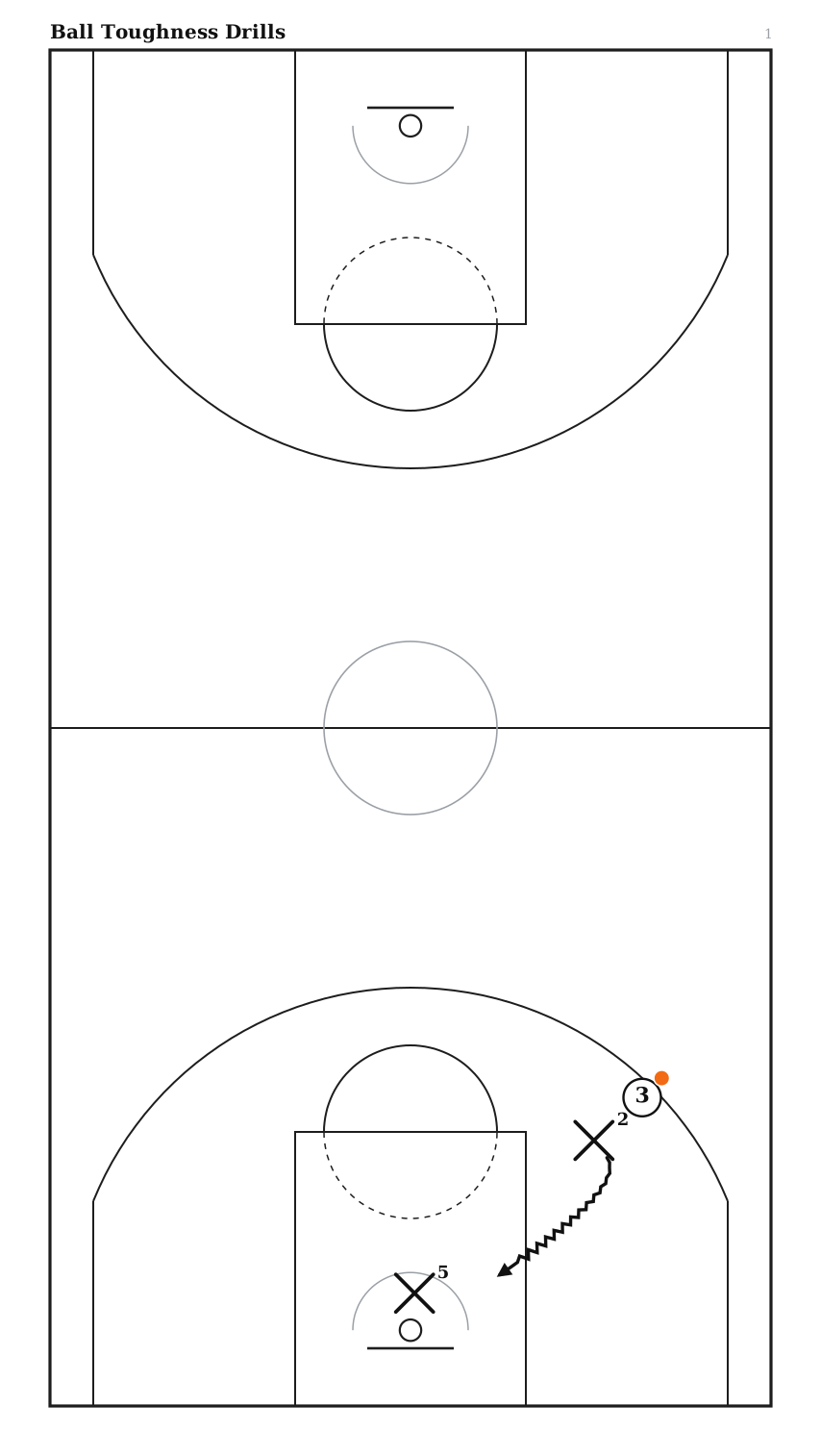
See it drawn up
Related diagrams
Keep Building
Related breakdowns
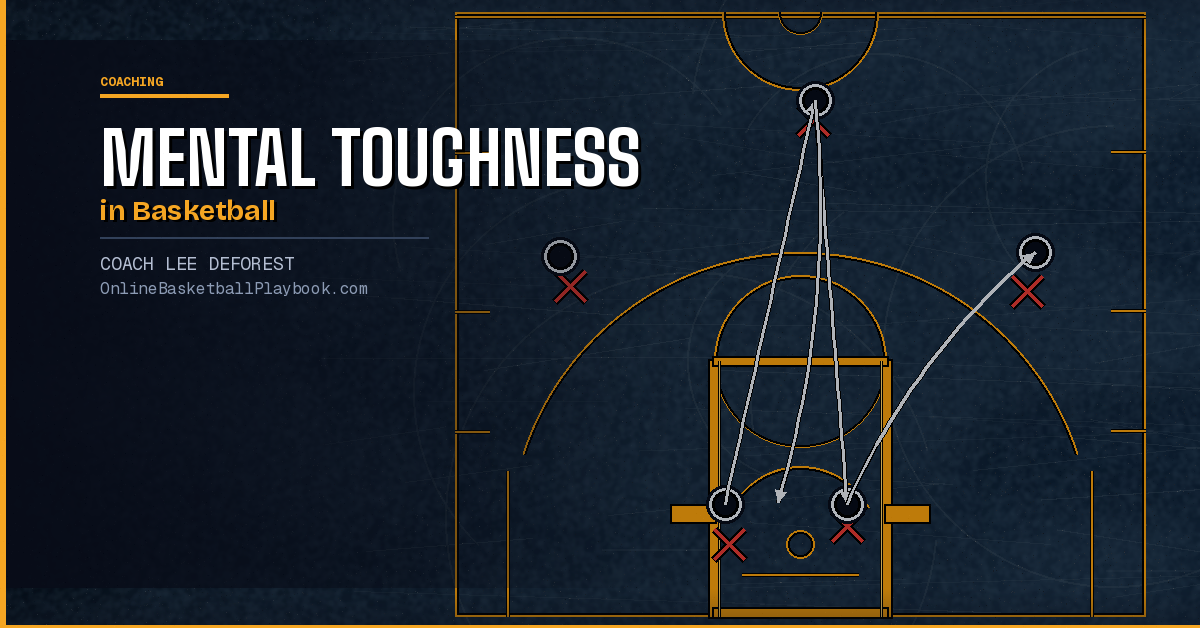
Mental Toughness in Basketball: How to Be Mentally Tough as a Player
Mental Toughness in Basketball: How to Be Mentally Tough as a Player
Strength Training for Youth Basketball Players
Strength Training for Youth Basketball Players