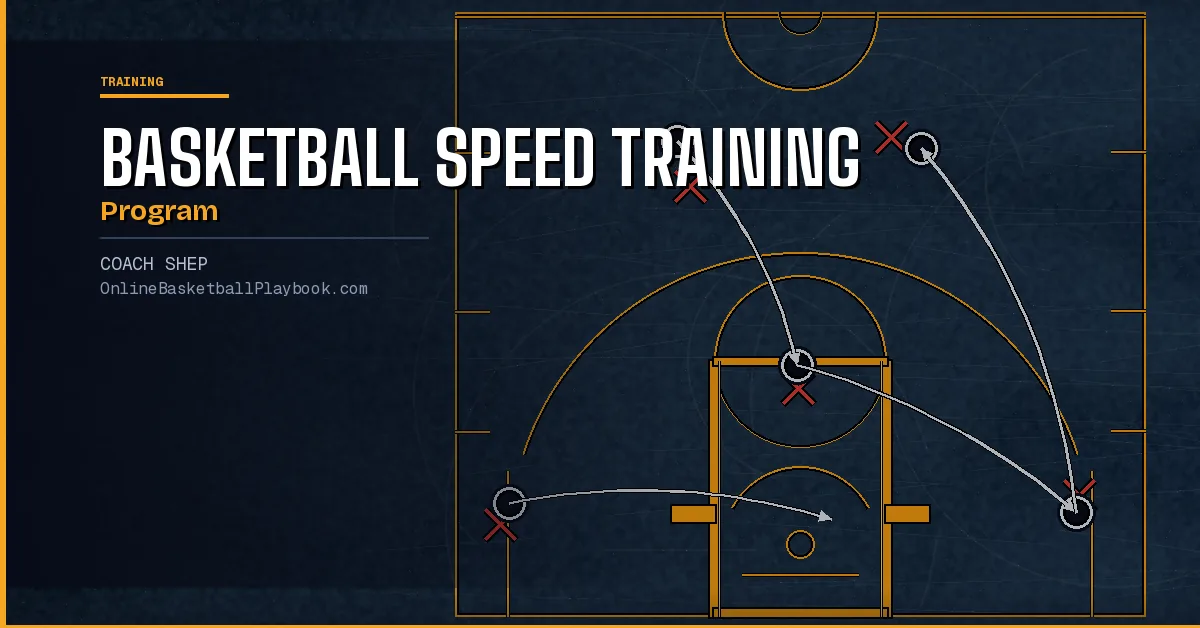
Speed wins basketball games. This program uses court-based sprints, quickness work, and anaerobic conditioning designed specifically for basketball, not track athletes. Every drill maps to real game movements.
Why Basketball Speed Is Different
Most speed training programs are built for linear athletes: sprinters, wide receivers, soccer forwards. Basketball speed is a different animal entirely. Players rarely run in a straight line for more than 15 feet. They accelerate, stop, change direction, plant, and explode again, often 50 or more times per half. The physical demand is not sustained speed; it is repeated bursts of explosive effort with incomplete recovery.
This distinction matters enormously when designing a training program. Long-distance running builds an aerobic base but does little for the anaerobic bursts that actually define basketball performance. A player who can run a 6-minute mile but hasn't trained short explosive efforts will tire and lose quickness in the fourth quarter just as often as a player with no running background at all.
The movements basketball requires (defensive slides, drop steps, hard closeouts, fast break sprints, and back-cuts) all use the same anaerobic energy system. That system fuels efforts lasting roughly 6 to 60 seconds. Train it specifically, and players get faster where it counts: on the court, in competition. Pair your speed work with basketball footwork drills and the gains stack. Footwork patterns get sharper when the athlete has the quickness base to execute them at game speed.
The good news is that the court itself is the training tool. You don't need a weight room or fancy equipment to run a rigorous basketball speed program. Lines, cones, and a ball are enough. What you need is structure, intent, and honest effort on every rep.
Building the Anaerobic Foundation
The anaerobic energy system is what powers basketball. Understanding how it works and how to build it is the starting point for any serious speed program. When a player sprints hard, cuts sharply, or battles for a rebound, they are drawing on short-burst energy pathways that don't require oxygen. The byproduct is lactate, which accumulates and causes the familiar burning sensation and slowdown in muscles. A higher lactate threshold means a player can sustain hard efforts longer before that breakdown kicks in.
Building the anaerobic foundation requires all-out efforts of 60 seconds or less with adequate rest between reps. This is the work-to-rest ratio principle: early in training, rest two to three times as long as the work interval. As fitness improves, you compress that ratio toward 1:2 or even 1:1.5. The rest periods are not optional. They're what allows each sprint to be a true all-out effort rather than a jog in disguise.
A common mistake is cutting rest short to "toughen players up." What that actually produces is moderate-paced running rather than genuine speed development. You get better at jogging, not sprinting. The adaptation you want (improved lactate threshold, faster recovery, maintained quickness under fatigue) comes from the quality of each sprint, not from grinding through exhaustion with no rest.
This is also why a structured basketball conditioning drills program matters so much. Random running doesn't build the specific anaerobic engine basketball demands. Planned intervals, progressive overload, and periodic testing do. Coaches who track these metrics across a season see real, measurable improvement rather than guessing at fitness levels.
Court Speed Drills That Transfer
The best speed drills for basketball happen on the court, using basketball movements. Here are the core runs that belong in any serious program, organized by what they develop.
Suicides
Suicides remain one of the most effective conditioning and speed drills in basketball because they combine acceleration, deceleration, change of direction, and repeated effort. A standard suicide covers the baseline to the near free-throw line, back, to half court, back, to the far free-throw line, back, and then full court and back. Target completion time is 28 to 32 seconds for high school and college players. Track times and expect players to be consistent. A suicide that takes 30 seconds on the first rep shouldn't take 38 on the fifth.
17s
Seventeen sideline-to-sideline sprints in 60 seconds or less. Players start at one sideline, sprint to the other, and return. Count each sideline touch as one rep. This drill builds lateral speed, change of direction, and the ability to maintain pace under accumulating fatigue. It's simple to measure and easy to compare across time points. The benchmark doesn't lie.
Lane Slides
Defensive slide sprints across the lane for 15-second intervals. Hips stay low, feet stay wide, no crossing. This drill directly builds the lateral quickness that translates to help defense principles and on-ball pressure. It's often overlooked in favor of straight-line sprints, but basketball defense is lateral. Train it that way.
Half-Court Sprints
Simple, measurable, and demanding. Player starts at baseline, sprints to half court on the whistle, touches, and returns. Rest, then go again. Ten to fifteen reps with 20-25 seconds of rest between is a solid starting volume. The key is that each rep must be a genuine sprint, not a three-quarter-effort jog.
Volleyball Runs (Change-of-Direction Sprints)
Named for their origins in volleyball practice, these runs involve sprinting to a cone, touching it, and changing direction to sprint to the next. Set up a zigzag pattern across the court. These develop the sharp deceleration-to-acceleration transition that shows up in back-cuts, closeouts, and fast break pursuit.
Quickness and First-Step Explosiveness
Top-end speed matters less in basketball than first-step quickness. A player who can accelerate from a standstill to full speed in two steps will beat a faster player every time on a curl, a drive, or a back-cut. First-step training is its own discipline and deserves dedicated attention in any speed program.
Tennis Ball Reaction Drills
A coach or partner holds a tennis ball at shoulder height and drops it without warning. The player must react and catch it before the second bounce. This trains the neural response time that precedes any athletic movement. Start from a ready stance, then progress to starting from a back-turned position or a defensive slide. Reaction quickness is trainable. This drill proves it.
Fast Feet Around a Cone
Place a cone on the floor. Player circles it with quick, tight steps: rapid ground contact, low center of gravity, staying on the balls of the feet. Set a 10-second interval and count reps, then challenge players to beat their count. This drill directly improves foot turnover speed and ankle strength, which are the foundation of quickness on the court.
One-Foot Balance Work
Stand on one foot for 30 seconds, progress to eyes closed. This builds ankle stability and proprioception (the body's ability to sense its own position). Players who have done consistent one-foot balance work absorb contact better, land more safely after jumps, and change direction with less wasted motion. It's unsexy, but the injury prevention value alone makes it worth including every practice.
Explosive Starts
From a stationary position (standing, crouched, or seated) explode to sprint on a signal. Cover 15 feet maximum. The goal is maximum acceleration in the first three steps. Do 8 to 12 reps with full recovery between. This is pure first-step training and has direct application to every offensive movement in the game, including off the dribble drives and catch-and-go situations off screens.
Ankle strength and single-leg stability are the foundation of court quickness. Most youth athletes break down athletically before they break down tactically. Don't skip the balance and foot-speed work in favor of only straight-line sprints.
Programming Speed Into Practice
The most efficient basketball speed programs don't separate conditioning from skill work. They bake speed into practice design. When your basketball practice plan runs at game pace and losers run in competitive drills, you're developing speed and skill simultaneously rather than trying to jam both into a finite schedule.
The approach works like this: competitive drills (4-on-4, 5-on-5, shell drill segments) run at game pace with scored outcomes. Losing teams run. Winning teams rest. The competitive pressure drives genuine effort, and the stakes make players push through the fatigue rather than saving themselves. Over a season of this kind of practice design, the team's fitness rises without a single formal conditioning session.
That said, dedicated speed sessions still have a place, especially pre-season and early in a build. A weekly physical toughness day (structured sprints, timed runs, quickness circuits) establishes the anaerobic base before the season's competitive pressure takes over as the conditioning mechanism. Think of it as periodized training: heavier explicit conditioning early, more conditioning-through-play as the season progresses.
Pair speed sessions with technical work when possible. Finishing speed drills that combine a sprint to a catch with a contested layup marry physical development with skill. Players aren't just getting faster. They're learning to execute skills at high speed under fatigue, which is exactly what games demand. This mirrors what the best transition offense coaches do: run the fast break so frequently in practice that the team's conditioning comes from mastering the skill rather than running extra sprints.
Testing and Tracking Progress
Conditioning is measured, not assumed. Without benchmarks, you can't know if your speed program is working. The following tests give you repeatable, objective data points that show improvement across a season.
The 300-Yard Shuttle
Run 12 trips between the baseline and the near free-throw line (roughly 25 yards each way). Time two full runs with several minutes of rest between them. Average the two times. This is the gold standard anaerobic conditioning test for basketball. Re-run it at the start of the season, at mid-season, and at the end of the year. A faster average time with less gap between the two runs indicates improved conditioning and recovery.
The 30-Second Suicide Mark
Players run suicides for 30 seconds from the whistle. Mark the spot they reach when time expires. Record it. Run it again the next week and the week after that. Players should be reaching farther with each test. The visual progress of the mark creeping toward or past the far free-throw line is motivating. Players can see their own improvement in a single sprint.
17s Benchmark
Count completed sideline-to-sideline trips in 60 seconds. Track this number for each player at regular intervals. The combination of improving count AND tighter times reveals both speed development and recovery improvement.
Chart these results. Share them with players. Fitness data held in private does half the motivational work it could do in the open. When a player sees their 300-yard shuttle average drop from 62 seconds to 54 seconds over eight weeks, they feel what the training is producing. That buy-in sustains effort through the parts of a program that are hard.
- Work-to-rest ratio: Start at 1:3 (one second of work, three seconds rest) and compress toward 1:2 as fitness builds. Never cut rest to toughen players up early in training.
- All-out on every rep: A 75% effort sprint builds 75% speed; protect rest intervals so each sprint is genuinely explosive from start to finish.
- Lateral over linear: Include lane slides and change-of-direction drills every week. Basketball is lateral and your speed work should reflect that.
- Test it regularly: Run the 300-yard shuttle and the 30-second suicide mark at the start, middle, and end of the season; track and chart results so progress is visible.
- Bake speed into practice: Game-pace competitive drills with losers running build conditioning and skill simultaneously. Don't always separate fitness work from technical work.
- Build ankle strength: One-foot balance and fast feet drills belong in every week. Most youth speed breakdowns are athletic, not tactical. Address the base.
Get free play diagrams, drills, and coaching guides delivered weekly.
Draw this play free in the play drawer →
Membership: the full library, playbook packs, and Pro drawing tools →
Keep Building
Related breakdowns
Strength Training for Basketball: Lifts, Loads and Seasons
Strength training for basketball: the lifts that carry to the court, the conjugate method, loads and reps, jump training, in-season lifting, youth rules and tests.
Basketball Conditioning: How to Build a Program That Lasts
Basketball conditioning built as a program. The energy system, work and rest, the runs and tests, cardio, a preseason ramp and how programs split the year.