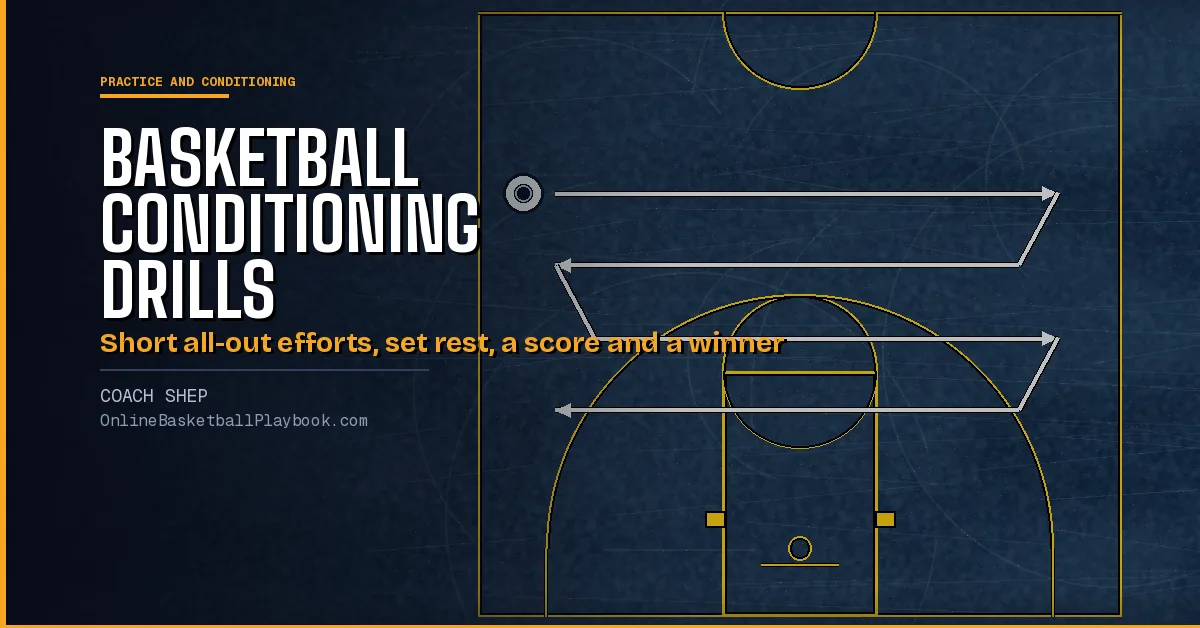
Basketball conditioning drills build the fitness to repeat all-out sprints, slides and jumps for a whole game and still hold technique and judgment when tired. Coaches build it three ways: timed runs set apart from skill work, conditioning layered inside skill drills, and scored games that make players run without calling it running. This guide lists the drills in each style, then covers tests, season plans, young players and the mistakes to avoid. Coaches disagree on several points, so each version below is named for what it does.
Basketball Conditioning Drills at a Glance
| Style | What it looks like | Example |
|---|---|---|
| Timed runs | Suicides, 17s, ladder sprints and lane slides with a set time and rest | Timed-run version, 20s version, Tennessee |
| Conditioning inside the drill | Shooting, dribbling and transition drills built so the movement is the conditioning | Touch-spot, partner-chase and lane-slide versions |
| Scored games | Full-court small-sided games with a clock, a score and a winner | No-dribble game version, Bruce Weber |
What the Game Demands
The timed-run version sets one rule. The game is anaerobic, so use all-out efforts of 60 seconds or less with a work-to-rest ratio of 1:3 early in the year, tightened to 1:2 as fitness builds. Its aim is a higher lactate threshold, so technique holds longer under fatigue. Research cited at the high school level puts game work-to-rest near 1 to 3.6 and a change of activity about every 3.8 seconds. The anaerobic view holds that two miles on a track trains the wrong energy system.
Not every program agrees. Tennessee calls the game anaerobic but still opens preseason with an aerobic base of 12, 15 and 18 minute timed runs and stairclimber work at 70 to 85 percent of maximum heart rate. The aerobic-base version starts the year with a phase of aerobic running, and a distance version keeps 3 to 5 mile runs on its menu. Both ideas are on the table, so decide which one your preseason uses and say why.
Timed Runs
The timed-run version has 12 on-court drills. These are the ones with set times.
| Drill | What the player does | Time and rest |
|---|---|---|
| Suicides | Baseline to near free-throw line and back, half court and back, far free-throw line and back, far baseline and back | 28 to 32 seconds, rest 60 to 90 |
| 17s | 17 sideline-to-sideline widths | 60 seconds, rest 2 to 3 minutes |
| 9s | Same as 17s in half the time | 30 seconds, rest 60 to 90 |
| Ladder Sprint | 1 length, then 3, 5 and 7 lengths | 5, 16, 31 to 32 and 46 to 48 seconds, with rests growing from 10 to 15 seconds up to 60 to 90 |
| 4-8-16 | 4 sideline sprints, then 8, then 16 | 4 sprints in 15 seconds or less with 30 to 45 seconds of rest, then 8 sprints in 30 seconds or less with 60 to 90 seconds of rest, then 16 |
The Ladder Sprint carries a gate. Nobody runs the 7-length set until every earlier group hits its target time. Its note is written for a regulation court and does not give younger-player numbers, so shorten the court or cut the counts for young teams.

Other programs time their own versions. The 20s version runs 20 timed runs that start at 45 seconds for the first three and drop two seconds every three runs, then every two runs, down to 31 seconds on runs 19 and 20, and bigs add two seconds. Tennessee moves to intervals in season, including 800s, 400s, 200s, 30-second suicides and 17 widths in 60 seconds. Duke dropped organized fall conditioning for seven years because heavy preseason loads left its teams tired by March.
Slide and Movement Conditioning
Defensive footwork can be the conditioning. The timed-run version's Lane Slides are a defensive slide across the lane and back for as many trips as possible in 15 seconds, with 30 to 45 seconds of rest. The lane-slide version has players slide the lane with a goal of getting both feet outside it in three steps, and in a call version a coach's call of "Ball" forces the player to turn fully and drop step.

Coach K's Duke defensive circuit is a ball-free version aimed at the stance. It includes a mirror drill where one partner slides and the other stays in front for 12 to 15 second reps, lateral bounds down the court and cone drills that mix running and sliding. The movement-based version builds conditioning from the game's movements to prepare hips, groin and ankles. Its six are the sprint, backpedal, slide, pivot, jump and land, and lunge. For the mechanics of the stance, see Defensive Stance in Basketball, Basketball Defensive Footwork and Basketball Agility Drills.
Conditioning Inside Skill Drills
The touch-spot version says players should never have to run suicides. It sets the dose of a shooting drill with the distance to a touch spot, the action after the shot and the rep count, and uses free throws between sets as the rest. Vance Walberg conditions through shooting drills and has no separate conditioning beyond a yearly test. The weave version replaces suicides with a five-man weave. These are a few more drills in this style.
- Full-court chase. A continuous full-court partner drill from the partner-chase version. One partner speed dribbles for a layup while the other, who made the inbound pass, sprints to catch up and get in front. Roles swap on every trip.
- Pyramid finisher. From the lane-slide version. Shoot five, sprint the baseline and back, shoot four and sprint, and keep counting down to one, then back up to five.
- 3-on-0 transition. Geno Auriemma's drill needs 13 clean trips in a row and any error resets the count to zero. The only adjustment given is to lower the target for younger teams.
- Make targets under a clock. A two-minute full-court left-hand layup drill sets goals of 75 makes for boys varsity and 65 for girls varsity. George Karl's four-minute drill aims for 100 baskets.
- Fast-break drills. The fast-break version uses six fast-break drills as its conditioning, including the Wolf drill and continuous 3-on-2 and 2-on-1.
- Tired shooting. The partner-chase version's sprint-to-the-line free throws put every shooter at the line off a sprint. A cool-down version closes with rotations of 2, 4, 6 and 10 free throws in a row. See Free Throw Drills.

See Fast Break Basketball Drills and 3 Man Weave for more of the transition side.
Get the next coaching guide in your inbox
One email when a new guide or diagram set goes up. Free.
Scored Games as Conditioning
The no-dribble game version runs a full-court 3 on 3 with no dribble, played to 2 points on a winner's court and a loser's court. It builds fitness faster than track work in this version because players treat it as a game, heart rates usually go above 190 and the staff charts wins and losses. The rules are specific. The defense must pick up by three-quarter court or lose a point, the second time loses the game, and a defensive charge wins the game. The winning team may outlet only to half court, and all three offensive players must cross half court once the ball does. Games run 20 minutes in week one and add about five minutes a week.

- Stop-count game. Bruce Weber's version uses three teams of three or four on a 12-minute clock. A stop is worth one point, possessions are limited to 20 seconds and the scoring team sprints to the far foul line and back after every score. Weber calls it a great conditioner.
- Full Court Cut Throat. The defense must get three stops in a row, and after each play the losing team sprints to the far end outside the court while the ball stays in play.
- The press as conditioning. Walberg presses for 28 minutes so his team finishes the last four with fresh legs.
- WAR. The touch-spot version's rebounding drill, run daily, starts with five defenders inside the lane while the coach misses a shot on purpose. The defense must cut out and find the ball.
Running as a Consequence
Coaches split on whether running belongs after a mistake or a loss.
| Approach | Example |
|---|---|
| Sprints only for mistakes: down and back in 10 seconds, then two trips in 21, then a 10-liner day with suicides in 30 | Vance Walberg |
| The losing team of a game to 18 runs a suicide in 17 seconds | Rick Pitino's 1997 Celtics practice |
| One suicide, about a minute, for losing a drill but not as a fitness tool | One-suicide rule |
| The everyone-on-the-line block kept as a mental toughness test | Toughness block |
| No predictable end-of-practice sprint block, because players learn to save energy for it | No-pattern rule |
| Punishment practices only selectively, especially in mid-season | Selective punishment |
Tests and Standards
A test tells a coach whether the drills work. These are the ones in use.
| Test | Standard | Example |
|---|---|---|
| 300-Yard Shuttle | 12 trips from the baseline to the far free-throw line, run twice with 5 minutes between, average the two | Timed-run version |
| 30-Second Suicides | 30 seconds on, 90 seconds rest. Mark where you finish and beat it next session | Timed-run version |
| 12 by 6 | 12 repetitions of 6 crossings in 33 to 35 seconds, run in three groups | UNC |
| Qualifying run | 17 sidelines in 1 minute before a player earns practice reps | John Beilein |
| 10 Liners | Down and back under 10 seconds, 10 trips, once a year, and everyone must make it | Vance Walberg |
| Mile and long runs | Duke times the mile twice in October. UNC runs it on day one. The long-run version calls a 1.75-mile run under 12 minutes basketball shape | Krzyzewski, UNC, long-run version |
The Conditioning Year
| Plan | Off-season | Preseason and season |
|---|---|---|
| UNC | Strength base only, lifting three times a week, no extra running, and pick-up games four to five times a week so the legs recover | Six-week ramp with conditioning twice a week for 20 to 30 minutes, court workouts two to three times and weights twice, building toward the test |
| Duke (Krzyzewski) | Not stated | No organized fall conditioning for seven years. Weights three days, pickup three days, the mile twice and 25 minutes of ball-free work from October 21 to 30. In season, 10 percent of practice goes to conditioning and special situations |
| Tennessee | Year-round periodized plan | Aerobic base of timed runs, stairclimber and bike, then intervals in season |
| Two-week ramp | Not stated | Two weeks of 35 to 40 minutes a day of isometric and partner drills, closing on a timed 1.75-mile run |
| Summer speed plan | Eight weeks, three days a week, speed and agility only with no lifting and 2 to 3 minute rests so quality beats fatigue | Not stated |
The late-peak version warns that over-conditioning early produces soreness that hurts learning, and it saves the peak for league play and the playoffs. For full plans, read Basketball Preseason Conditioning Program, Basketball Conditioning Programs for Teams and Developing a Strong Basketball Conditioning Program.
Conditioning Young Players
The games-first view gets children running through games. The 5-to-8 version keeps drills for 5 to 8 year olds to 5 to 10 minutes with everyone moving. The 8-to-12 version keeps ages 8 to 12 on bodyweight work and schedules strength after skill work or on non-practice days. No version gives test numbers for young players, so shrink the court and the counts of any adult standard. See Basketball Drills and Games for Kids.
Safety and Mistakes
- Warm up first. Plan 5 to 8 minutes of low-intensity work through the main movement patterns at about half intensity, ending in a light sweat.
- Stop on warning signs. Chest pain, severe breathlessness, dizziness and nausea are signs of overexertion. A player with heat-exhaustion symptoms does not return that day, which matters in a hot gym.
- Do not open with a boot camp. Pushing players too hard in the first days produces soreness that hurts learning for weeks. Krzyzewski's heavy preseason loads left Duke tired by March.
- Do not build the off-season around vertical-jump testing. The strength view holds that it crowds out speed, deceleration, agility and balance.
For the weekly view, see Basketball Conditioning Workout for Coaches, Running for Basketball Fitness and Basketball Fitness. To fit conditioning into a practice, see Basketball Practice Plan, and for tryout days see Basketball Tryouts.
Questions Coaches Ask About Conditioning Drills
What are good basketball conditioning drills?
That depends on the model. For timed runs, the timed-run version's suicides, 17s and lane slides. Inside skill drills, the full-court chase and the pyramid finisher. As games, the no-dribble game version's full-court 3 on 3 with no dribble and Weber's stop-count game.
How do you condition a basketball team without running?
Put the conditioning in the drill. The touch-spot version's shooting drill, the partner-chase version's full-court chase and scored full-court games all make players run while they work on a skill.
How long should basketball conditioning drills be?
The timed-run version keeps efforts at 60 seconds or less with rest of two to three times the work. UNC conditions twice a week for 20 to 30 minutes in preseason, and the two-week ramp uses 35 to 40 minutes a day for two weeks.
Should a team run suicides?
Coaches split. The timed-run version builds a whole program on them, and the touch-spot version says players should never have to run them. The one-suicide rule allows one suicide as a consequence for losing a drill but not as a fitness tool.
How do you test basketball conditioning?
The timed-run version's 300-yard shuttle and 30-second suicides, UNC's 12 by 6 in 33 to 35 seconds and Beilein's 17 sidelines in a minute are all in use. Pick one and retest on a schedule.
Conditioning belongs to practice planning, and the same hub lists every practice and conditioning page on the site.
Want the printable playbook packs?
OBP Pro members get the premium playbook packs: the zone attack, out of bounds and practice plan PDFs, plus each new pack as it is finished. The membership page lists what is in each one. Or draw your own version free in PlayDraw.
See what OBP Pro includesMore Guides From This Batch
- Press Break Basketball: Alignments, Reads and Drills
- Basketball Tryouts: Sessions, Drills, Scoring and Cuts
- Shell Drill Basketball: Stages, Rules and Live Versions
- Defensive Basketball Drills: Slides, Closeouts, Shell and Games
Back to Practice Plans and every Practice and Conditioning page.
Keep Building
Related breakdowns
Fun Basketball Games for Practice: Scored Games for Any Team
Fun basketball games for practice at any level: shooting games, defense-only scoring, rebounding contests and passing games, with scoring rules and records.
Basketball Agility Drills: Cone, Reaction and Ladder Drills
Basketball agility drills from timed cone tests to reaction, mirror and ladder drills and defensive circuits, with schedules and where coaches differ.
Fun Basketball Drills for Kids: Team Games, Relays and Contests
Fun basketball drills for kids built as contests, relays and elimination games, with the rules, the changes that keep every child playing and where coaches differ.