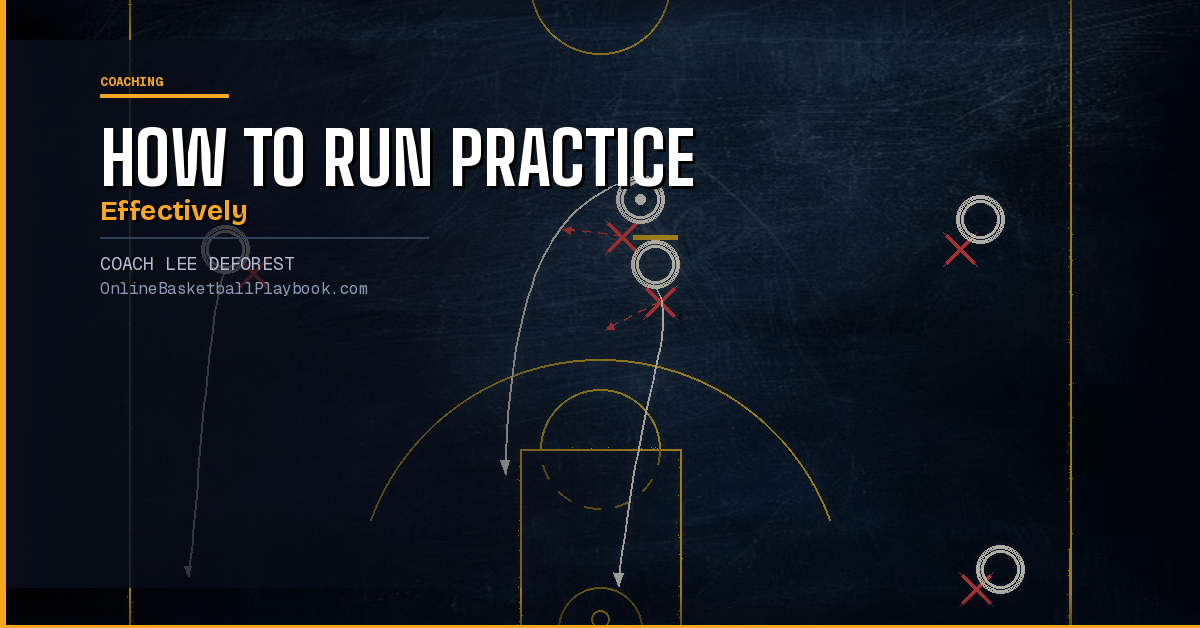

Effective basketball practice is not about time on the floor — it is about the quality of every rep. Coaches who structure practice with clear segments, scored drills, and game-pace intensity develop players faster than those who simply fill two hours.
Why Practice Structure Matters
Most coaches understand that repetition builds skill. Fewer understand that how those reps are delivered determines whether players actually improve or simply go through the motions. A two-hour practice with no clear structure, no competition, and no consequences is two hours of managed boredom. Players learn to endure it rather than attack it.
The foundation of an effective practice is this: every minute must develop the team. That means every segment has a purpose, every drill has a winner and a loser, and the energy you demand from your players in half-court teaching looks exactly the same as the energy you expect in transition. If your players are coasting in walk-through segments and picking it up only when the pace gets fast, you have a practice culture problem — not an X's and O's problem.
A well-structured basketball practice plan forces coaches to be deliberate before practice ever starts. What are you teaching today? How long does each segment run? What does success look like in each drill? Coaches who answer these questions before tip-off run better practices than coaches who decide on the fly.
The research on skill acquisition is clear: high-repetition, high-stakes environments accelerate learning. When players know there is a scoreboard, a winner, and a consequence for losing, their focus sharpens. They stop saving themselves. They compete. That competitive tension in practice is what prepares them to perform when the game is on the line.
Segment Practice with Intent
The best coaches treat practice like a script. Every segment has an entry point, a teaching objective, a time block, and an exit check. You do not wander from one activity to the next. You make a decision in advance and you run it with conviction.
A typical high-level practice flows from individual skill work into small-group breakdown drills, then into competitive team segments. The logic is developmental: players first isolate a skill in a controlled environment, then apply it in a more chaotic, game-like context. Start with half-court teaching where you can stop play, make corrections, and reinforce the concept. Then transition to up-and-down segments where pace increases and decisions must be made quickly.
When your roster is short — injury, illness, or academic issues pulling players from the floor — resist the temptation to run your normal competitive games with reduced numbers. Instead, go "half full": sprint both ways, reset, and keep intensity high to the end. Cutting the number of players should never mean cutting the intensity of practice. Adjust the format, not the standard.
Time management is a skill that separates elite coaches from average ones. If you budget twelve minutes for a ball-handling segment, you take twelve minutes — not fifteen, not seventeen. Every extra minute you spend on one segment costs you a minute somewhere else. Players who see a coach run over time learn that the plan does not matter. Players who see a coach manage time precisely learn that what is on the board means something. For foundational work, ball handling drills and basketball footwork drills should each have a capped time block with a clear competitive finish.
Score Everything — Compete Every Drill
One of the most underused tools in coaching is the scoreboard. Not just the game scoreboard — the practice scoreboard. When drills are scored, when turnovers are charted, when the losing group runs at the end of the segment, the competitive pressure in your practice shifts entirely. Players stop going half-speed. They stop laughing off mistakes. They start playing like something is on the line, because something is.
A scoring system does not need to be complicated. A simple structure — positive points for made plays, negative points for turnovers — creates enough tension to change behavior. You can score offensive breakdown drills on a plus/minus system: a made basket earns points, a turnover costs points, and a putback after an offensive rebound earns a bonus. Assign a consequence for the loser — conditioning, a round of push-ups, extra defensive slides — and you will see your players compete harder in drill work than some teams compete in games.
Turnovers should be charted, not just noticed. When a player knows the coach is recording each live-ball turnover, their decision-making sharpens. They do not gamble on low-percentage passes. They do not dribble into traps carelessly. The charting creates accountability that the moment alone cannot provide. Over time, your turnover numbers in practice will predict your turnover numbers in games with striking accuracy.
"Score everything. Drills and 5-on-5 are scored (e.g. +3 / +2 / +1 putback / −2 turnover), turnovers charted, and the losers run — competition and consequences in every segment."
— Basketball Vault
Run Practice at Game Pace
The single biggest gap between what coaches demand in practice and what games actually require is pace. Games are fast. Decisions happen in fractions of a second. Help rotations close out in two steps or they are too late. Passes that are a half-second slow get tipped. If your practice does not simulate that pace, your players will not be ready to play at it.
Running at game pace is not just about speed — it is a conditioning product of how you practice. When you demand game speed in every segment, your players develop the physical and mental conditioning to sustain that pace for forty minutes. You do not need separate conditioning runs tacked onto the end of practice if practice itself is physically demanding. The conditioning comes from the pace you enforce every day.
This has a direct implication for your teaching approach. When you stop practice to make a correction — which you should — keep the stoppage brief and sharp. Make your point in thirty seconds or less, reset quickly, and go again at full speed. Long, meandering stoppages drain the energy from practice and let players' heart rates drop to a level where nothing they do resembles game conditions. Say what needs to be said and get back to work.
Defense is where pace matters most. Defensive breakdowns that are taught at half speed produce defenders who are always a step late in games. When you work help defense principles in practice, the rotations must happen at game speed or the teaching is incomplete. Players need to feel what it is like to close the gap on a live driver, to get their feet set under pressure, to contest a shot while moving at full speed. That only happens if you demand game pace from the first drill of the day.
Validate Every Drill
Every drill in your practice should have a name, a reason, and a way to determine a winner and a loser. If a drill does not have all three, it does not belong in your practice plan. This is the validation test: can you explain in one sentence why this drill makes your team better? Can you describe the competition element that gives it teeth? If the answer to either question is no, cut the drill or rebuild it.
Named drills create a shared vocabulary between coaches and players. When you call a drill by name, everyone knows immediately what is about to happen, who is going where, and what success looks like. That saves transition time and keeps the pace of practice high. Drills without names are drills without ownership — players do not internalize them, coaches do not refine them, and they fade from the practice rotation without ever being evaluated.
Multi-purpose drills are especially valuable. A drill that simultaneously reinforces ball pressure, deny positioning, and transition to offense after a steal teaches three things in one rep. When you can stack teaching points into a single drill, you get more learning per minute — which is the whole goal. Before you add a new drill to your rotation, ask what it develops and whether an existing drill already covers that ground. Fewer, better drills beat a long menu of disconnected activities.
Before your next practice, write down the name, purpose, scoring method, and consequence for every drill on your plan. If you cannot fill in all four columns for a drill, replace it with one you can fully validate — your practice will immediately become more competitive and more focused.
Managing Your Roster During Practice
Every player on your roster needs to be engaged for the full duration of practice — including injured players, players in foul trouble, and players who are sitting out a segment as a consequence. A player standing on the sideline watching practice contributes nothing to your team and develops nothing for themselves. Every minute a player is not engaged is a wasted minute.
Injured or non-participating players should run with their team's losses and should be actively coaching their teammates from the sideline. This does two things: it keeps them connected to the competitive stakes of the drill, and it develops the basketball IQ and leadership skills they will need when they return to the floor. Sitting on a chair watching your phone is not an option. Coaching your team up — calling out coverages, encouraging effort, identifying breakdowns — is exactly what basketball IQ development looks like in a practice setting.
This principle extends to your entire culture around practice participation. The message to your team should be consistent: the only way you get better is reps. Sitting out does not improve anyone. Every time a player is away from the floor — for any reason — they are losing ground. That urgency should inform how players approach every practice, every day, at every level of your program.
Managing substitutions and rotations during practice also requires planning. Know in advance how you will rotate players through competitive segments. Random substitutions create confusion and interrupt flow. Planned rotations keep pace high and ensure every player gets meaningful reps in the segments that matter most for their development. For a deeper look at the culture side of this, building basketball team culture starts with what you allow and what you demand in practice every single day.
Film Review and Follow-Up
Practice does not end when the players leave the floor. What you do with the information from practice — the film, the stats, the turnover chart — determines whether tomorrow's practice is better than today's. Coaches who film practice and review it systematically are operating at a different level than coaches who rely entirely on memory.
A targeted film review does not require watching every minute of practice footage. Pull the clips that show the specific breakdowns you want to address. If you have forty defensive clips that show the same coverage mistake, you need to address that mistake directly in tomorrow's practice plan. The film tells you what to teach. The practice plan is how you teach it. When those two are aligned, players see clear cause and effect between what they did wrong and what you are asking them to fix.
Follow-up also means holding the same standard every single day. The danger in coaching is that you set a high standard on Monday, let something slide on Wednesday when you are tired or pressed for time, and inadvertently communicate to your team that the standard is negotiable. It is not. What you tolerate defines your standard more powerfully than what you emphasize. If ball pressure is a point of emphasis but you allow lazy positioning to go uncorrected on film review day, your players learn that ball pressure is optional. Standards are enforced by what you tolerate, not what you talk about.
Tie your practice to the schedule. Know how many practices you have before your next game. Prioritize accordingly. If you have eight practices before your conference opener and your shell drill work is showing live coverage breakdowns, that drill needs more time now — not the week before the tournament. The best coaches plan backward from the game, allocating practice time to the things that will matter most when the lights come on.
- Write your full practice plan the night before — every drill named, timed, and scored with a consequence for the loser.
- Open each practice with a clear statement of the day's teaching priority so players know what success looks like before the first drill starts.
- Chart turnovers on a physical clipboard every practice and post the weekly total where the team can see it.
- Keep coaching stoppages under thirty seconds — make your correction, reset, and return to game pace immediately.
- Assign injured or non-participating players a specific coaching role during competitive segments so no one is disengaged from the stakes.
- End every practice with a competitive segment — never let the final memory of practice be a low-stakes walkthrough.
- Review film within twenty-four hours of practice and build the next day's plan around the specific breakdowns you found on tape.
Get free play diagrams, drills, and coaching guides delivered weekly.
Keep Building
Related breakdowns
Where to Practice Basketball: Complete Guide to Finding Courts and Training Spaces
Where to Practice Basketball: Complete Guide to Finding Courts and Training Spaces