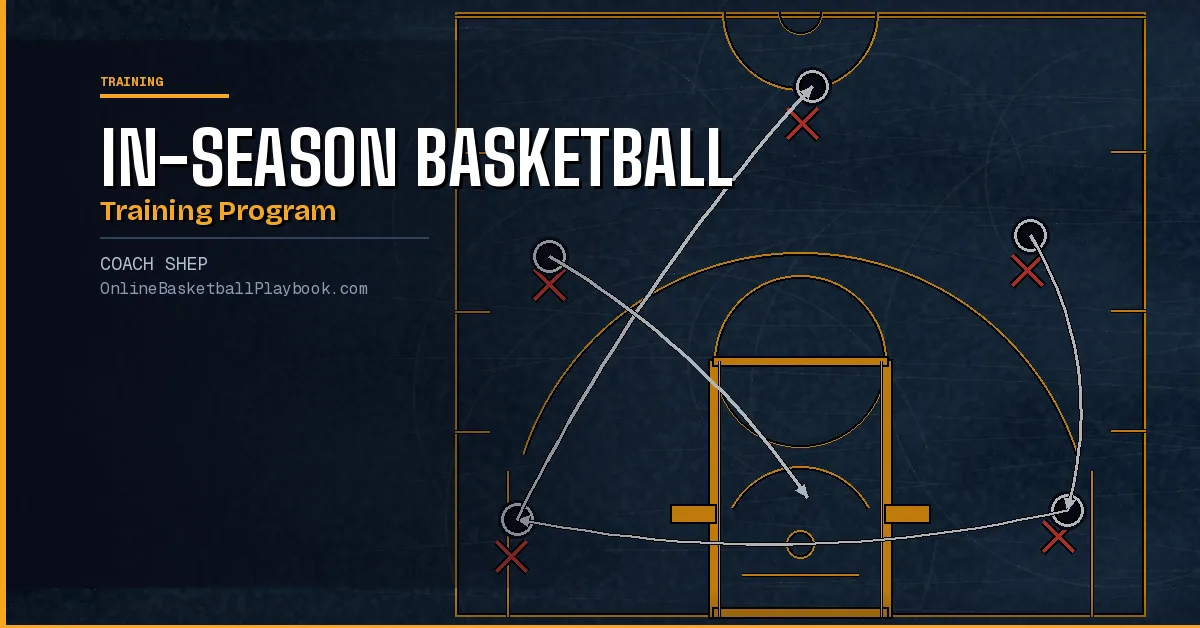
In-season training is not about getting bigger or faster. It is about staying sharp. The goal is maintaining conditioning, protecting skill development, and managing fatigue so players peak when playoff games arrive.
Why In-Season Training Matters
Most coaches treat the season as the time to play and stop developing players. That is a mistake. Teams that commit to a structured in-season training program arrive at the end of the year with more depth, better conditioning, and sharper skills than teams who simply survive game-to-game.
The challenge is real: schedules are packed, bodies are tired, and practice time is compressed. But that constraint is the very reason you need a plan. Without one, conditioning decays after the first month, and the players who started the season in peak shape are running on fumes by February.
In-season training has three objectives. First, maintain the anaerobic fitness players built in the preseason. Second, continue developing skills, especially for younger players who need repetition to grow. Third, protect players from overuse by building intentional recovery into the weekly schedule. A good basketball practice plan addresses all three without adding unnecessary volume.
The teams that win championships are not always the most talented teams. They are often the teams who stayed healthiest and freshest at the right time. In-season training is how you engineer that outcome.
Conditioning During the Season
Basketball is an anaerobic sport. That fact does not change once the season starts. Players need short, explosive efforts with adequate rest, not long slow runs that train the wrong energy system. Any conditioning you do during the season should mirror what the game demands: bursts of maximum effort lasting under sixty seconds, followed by recovery.
The best conditioning during the season is baked into practice itself. When you run game-pace 4-on-4 or 5-on-5 segments with competitive stakes, you are conditioning players and building basketball skill simultaneously. Losers run. Winners earn rest. The competitive pressure pushes players past the comfort threshold that traditional conditioning drills rarely reach.
That said, some structured conditioning maintains fitness benchmarks that scrimmage alone cannot guarantee. Short sprint series (suicides, sideline widths, half-court runs) done at the end of practice two or three times per week keep the anaerobic engine sharp without stacking excessive load on top of games. Keep work intervals under sixty seconds and give players a 2:1 rest-to-work ratio minimum. Basketball conditioning drills run this way do not beat players down; they sharpen them.
One practical standard: run a timed benchmark, a thirty-second suicide or a set of sideline widths, at the beginning and midpoint of the season. If times slip significantly, your conditioning plan needs adjustment. If times hold or improve, you are managing load correctly. Conditioning is measured, not assumed.
Skill Work That Fits the Schedule
The biggest mistake coaches make during the season is abandoning individual skill development entirely. Every minute goes to team preparation: scouting the opponent, installing plays, rehearsing sets. Players never touch the ball in an individual context. By late January, ball handling breaks down under pressure, shooting mechanics erode, and the skill base you built in October has deteriorated.
The solution is not to carve out enormous amounts of time. It is to protect small, consistent windows. Fifteen minutes before practice of individual work ball handling drills, form shooting, footwork compounds over a full season. Players who get that repetition in November and December emerge from the midseason stretch sharper than players who did not.
Structure the skill work by position groups and individual need. Guards who struggle attacking off the dribble need specific repetitions there. Bigs who are developing a mid-range game need touches in that zone. The work should be targeted, not generic. A player who does ten minutes of exactly the right skill work beats the player who does thirty minutes of comfortable but low-intensity drill time.
For shooting specifically, the in-season goal is maintenance plus one area of growth. Maintain the shots players already make reliably. Add volume on one shot category: whether that is catch-and-shoot corner threes, pull-up mid-range, or free throw consistency. Spreading attention across too many shooting categories during the season produces improvement in none of them. Pick the needle that moves the most and focus there.
Recovery and Load Management
Recovery is training. Coaches who understand this build it into the weekly schedule explicitly. Coaches who ignore it wonder why their team looks flat in February and March.
The human body adapts to stress during rest, not during the stress itself. When players train hard and compete frequently without adequate recovery, the adaptation never happens. They absorb load without the physiological return. Performance plateaus and then drops. Injury risk climbs. Teams coached this way often look worse at the end of the season than they did at the start.
Practical recovery management during the season starts with monitoring load. How many games did the team play this week? How intense were practices? What does the travel schedule look like? After a two-game weekend, Monday practice should be low intensity: walkthrough tempo, film, skill work without conditioning. After a light week with only one game, Tuesday can carry a harder training load.
Sleep is the most underused recovery tool in youth basketball. Encourage players to prioritize it. Body composition, hydration, and nutrition all matter, but sleep quality and duration are the single biggest lever coaches cannot control directly, only educate toward. A team that consistently sleeps eight-plus hours performs better at the end of close games than a team that does not.
After consecutive game days, limit practice to forty minutes maximum. Use the time for walkthrough, film review, and light shooting, no sprinting, no intense competitive drills. Players will perform better in the next game if they rest more and drill less the day after a back-to-back.
Weekly Practice Structure
An in-season week follows a rhythm, and the best coaches map it out before the week starts. The structure shifts based on game count, but the principles hold constant: build early in the week, sharpen midweek, and taper into game day.
In a typical week with two games, Wednesday and Saturday, the structure looks like this. Monday: lighter load, individual skill work, film and team concepts at walkthrough pace. Tuesday: the hardest practice of the week, full competitive 5-on-5, conditioning built in through game-pace drills, team preparation for the Wednesday opponent. Wednesday: game. Thursday: recovery day, light skill work only. Friday: sharpen execution for Saturday, no new information, focus on what the team does best. Saturday: game.
The weekly structure should include at least one block dedicated to what your team needs most. If your defense is breaking down in transition, that gets time. If your basketball player development priorities include finishing at the rim, work that into individual periods. The structure creates the container; the content fills based on team need.
One principle that separates organized programs from disorganized ones: players should never be surprised by what practice looks like. Post the plan. Communicate the objective for each session. When players understand the purpose behind the structure, they buy in more completely and get more out of each minute on the floor.
- Monday after a game: Low intensity: individual skill work, walkthrough pace, no conditioning sprints.
- Tuesday (primary practice): Full competitive 5-on-5, game-pace segments, conditioning built in through play.
- After back-to-back games: Cap the next practice at forty minutes, no sprinting, prioritize sleep and nutrition reminders.
- Individual skill windows: Protect fifteen minutes before or after practice three times per week: ball handling, shooting, footwork by position.
- Conditioning benchmarks: Run a timed sprint test at the season's midpoint to confirm fitness is holding; adjust practice load if times slip.
- Game-day prep: No new plays, no heavy conditioning, rehearse familiar actions at game speed, review opponent tendencies briefly.
Peaking for the Playoffs
Every decision you make in October, November, and December is either building toward or borrowing against your playoff run. Teams that push maximum intensity every single week have nothing left when the bracket starts. Teams that managed load intelligently all season arrive fresh.
Two to three weeks before playoffs, begin a deliberate taper. Reduce overall practice volume: fewer minutes, fewer conditioning runs, lighter physical demands. Maintain intensity on the skills and concepts that matter most for your team's identity. If you run motion offense, sharpen the reads. If your defense is built around shell principles, review and perfect the concepts using the shell drill. Do not introduce new material. This is the time to execute what players already know, faster and cleaner.
During the playoff taper, mental freshness matters as much as physical freshness. Keep practices engaging. Use competition (small-sided games, shooting contests with stakes) to keep intensity high without stacking physical load. Players who are mentally sharp compete harder than players who are physically fresh but mentally flat from grinding repetition.
Track your best lineups and rotation patterns heading into the postseason. Who performs best in high-leverage minutes? Which defensive matchups favor your personnel? In-season data (who defended well, who shot efficiently in late-game situations, who stayed composed) should drive playoff rotation decisions. Coaches who manage their team this way with discipline through the regular season arrive at the bracket with answers, not guesses.
The entire in-season training program exists to make this moment possible: a healthy, sharp, confident team playing its best basketball at the right time. That outcome does not happen by accident. It is built, week by week, through smart load management, consistent skill development, and recovery discipline.
Get free play diagrams, drills, and coaching guides delivered weekly.
Draw this play free in the play drawer →
Membership: the full library, playbook packs, and Pro drawing tools →
Keep Building
Related breakdowns
Strength Training for Basketball: Lifts, Loads and Seasons
Strength training for basketball: the lifts that carry to the court, the conjugate method, loads and reps, jump training, in-season lifting, youth rules and tests.
Basketball Conditioning: How to Build a Program That Lasts
Basketball conditioning built as a program. The energy system, work and rest, the runs and tests, cardio, a preseason ramp and how programs split the year.