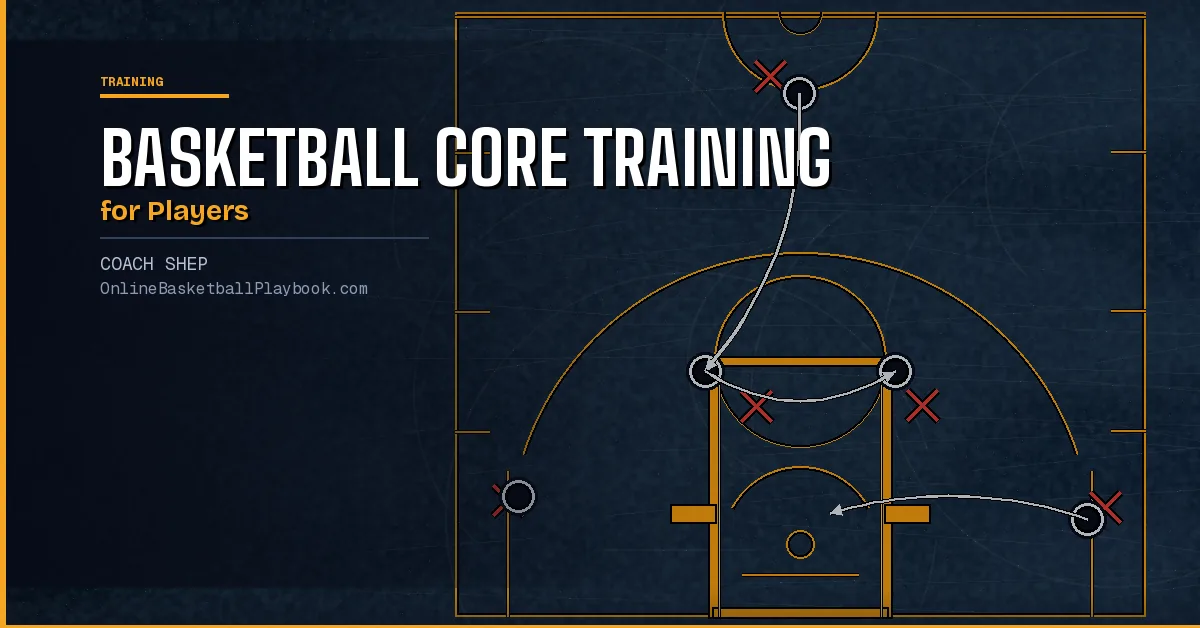
Core strength is the foundation every basketball skill is built on: your shot, your first step, your defensive stance. Without it, technique breaks down under fatigue. This guide shows exactly how to build it.
Why Core Strength Matters in Basketball
Most players think of core training as sit-ups. Coaches know better. The core is everything between your shoulders and your hips, the muscles that stabilize your spine, transfer force from your lower body to your upper body, and keep your posture sound when you're exhausted in the fourth quarter. When your core is weak, every other skill suffers.
Think about the demands of a single possession. You sprint from the paint to the three-point line on a transition stop. You drop into a defensive stance, shuffle laterally, then close out with a hand high. You contest a shot, box out, and leap for the rebound. Every one of those movements originates from the core. Without a stable foundation, you compensate. Your hips tilt, your back rounds, your knees cave, and that's how injuries start.
For players who want to improve their basketball player development, core training is often the fastest lever available. It doesn't require elite athleticism to start. A consistent 15-minute core routine, done three times a week, creates measurable differences in lateral quickness, box-out leverage, and the ability to hold technique when the game gets physical.
Youth players especially need this foundation before they can absorb advanced skill instruction. A player who can't maintain a stable athletic position through a full defensive possession isn't ready to run complex schemes. Building the core first makes every other coaching point stick faster.
The Anaerobic Demands of the Game
Basketball is an anaerobic sport. Points are scored in short, violent bursts: a two-second fast break, a five-second half-court set, a quick defensive rotation. These efforts are fueled by the anaerobic energy system, not the aerobic one. That means training long-distance running, while useful for a base, is not sufficient conditioning for the court.
The practical implication: your core training needs to match the game's energy demands. That means short, maximal efforts with adequate rest. Research and coaching practice both point to work-to-rest ratios of 1:2 to 1:3 as the sweet spot for basketball conditioning, especially early in a training block before fitness develops. As the season nears, you compress that rest and push the lactate threshold higher.
The lactate threshold is the point where fatigue and tightness overwhelm technique. You've seen it: a player who looks sharp for two minutes of a drill and then starts slipping out of their stance, rounding their back on contested shots, or half-heartedly boxing out. That's lactate buildup breaking down their movement quality. Core strength delays that breakdown by reducing the energy cost of maintaining good posture under load.
For coaches building a conditioning program, the key insight is that core work and anaerobic conditioning are not separate tracks. A plank hold performed explosively at the end of a sprint set, when the player is already fatigued, trains the body to maintain stability under game-realistic stress. That transfer is what separates functional core training from gym-only fitness.
Essential Core Drills for Basketball Players
The best core drills for basketball players share one trait: they require the body to resist movement, not just produce it. A crunch produces spinal flexion. A plank resists it. A lateral lunge with a medicine ball resists rotation while producing lower-body force. The game demands resistance more than production. Your core is constantly fighting to keep your posture stable while your limbs are moving at high speed.
Plank Progressions
Start with a standard front plank: elbows under shoulders, body in a straight line from heels to crown, no sagging hips. Hold for 30 seconds, rest 30 seconds, repeat three times. Once a player can maintain perfect form for 60 seconds, progress to a plank with alternating arm reaches, then plank to push-up transitions, then plank with leg lifts. Each progression increases the anti-extension and anti-rotation demand without losing the fundamental movement pattern.
Pallof Press
This is the single best anti-rotation core exercise for basketball players. Anchor a resistance band at chest height, stand perpendicular to the anchor point, and press the band straight out from your chest while resisting the rotational pull. Hold for two seconds, return. The Pallof press teaches the core to lock down rotation, which is exactly what you need when a guard drives baseline and you have to hold your defensive position without spinning out of your stance.
Dead Bug
Lie on your back, arms straight above your shoulders, legs in a tabletop position. Lower one arm and the opposite leg toward the floor simultaneously while pressing your lower back into the ground. Return and switch sides. This trains contralateral coordination, the same pattern your body uses when sprinting, while reinforcing lumbar stability. It's a drill that looks simple and exposes weakness immediately.
Medicine Ball Rotational Throws
Stand sideways to a wall, hold a medicine ball at hip height, rotate away from the wall, then explosively rotate back and throw the ball against the wall. Catch and repeat. This trains rotational power production, which transfers directly to post moves, boxing out, and passing through traffic. Use a light ball (4–6 pounds) and emphasize speed of rotation over load.
Lateral Band Walks
Place a resistance band around your ankles, get into an athletic stance, and walk laterally, keeping tension in the band throughout. This targets the hip abductors and external rotators, the muscles that stabilize your defensive stance and prevent knee cave on landing. It looks like a warm-up drill, but done at the end of a conditioning block when players are fatigued, it's a direct simulation of holding a stance in the fourth quarter.
Integrating Core Work Into Practice
The best conditioning is the game played hard. That principle, well-established in elite coaching, applies directly to core training: whenever possible, integrate core work into game-realistic practice rather than isolating it entirely in the weight room. The adaptation is more specific, the time investment is shared, and players understand the purpose because they feel the transfer immediately.
One practical approach: build core stations into your basketball practice plan during water breaks or transitions between competitive segments. After a four-minute 5-on-5 segment at game pace, players rotate to a 90-second core station (30 seconds of Pallof press each side, 30 seconds of dead bug) before the next competitive rep. The core stimulus arrives when the player is already in an elevated heart rate state, which more closely matches game conditions.
Another approach is to use core-focused active recovery. After a sprint set (say, three full-court suicides) instead of standing and resting, players drop into a plank hold for 20 seconds. The rest period still happens, but the body is working to maintain spinal stability under fatigue. Over a season of this, players develop the ability to hold their athletic positions in the final minutes of close games.
For coaches who run a shell drill or defensive positioning segments, consider adding a core component to the entry requirement. Before a player can enter the drill, they complete 10 lateral band walk steps each direction. It takes 15 seconds, activates the hip stabilizers before defensive movement patterns begin, and builds a habit of physical preparation that carries into games. See how these concepts connect to basketball footwork drills: Footwork quality is directly tied to the stability core training provides.
The biggest mistake in youth core training is skipping the regression. If a player can't hold a dead bug with a flat lower back, they're not ready for rotational throws. Start with what the player can do well, build quality reps, then add complexity. A sloppy plank trains the wrong pattern and creates the injury risk you're trying to prevent.
A Weekly Core Training Plan
The following plan is designed for in-season use: three focused sessions per week, each 15–20 minutes, structured to complement practice without creating excessive fatigue. It can be done in a gym, at home, or on the court before or after practice.
Day 1: Anti-Extension Focus
Front plank 3×30s, dead bug 3×8 each side, push-up with a 2-second pause at the bottom 3×8. Rest 30 seconds between sets. The pause push-up teaches the player to maintain core tension at the bottom of the movement, which directly transfers to absorbing contact in post play and on contested layups.
Day 2: Anti-Rotation Focus
Pallof press 3×8 each side, side plank 3×20s each side, lateral band walk 3×10 steps each direction. Rest 30 seconds between sets. This session targets the obliques and hip stabilizers, the muscles most responsible for defensive stance integrity and resistance to being bodied off position on the block or in the paint.
Day 3: Power and Integration
Medicine ball rotational throw 3×6 each side, dead bug 2×8 each side, plank with alternating arm reach 3×6 each side. Rest 45 seconds between sets. The medicine ball work adds a velocity component that the stability drills don't provide. Power production from the core is what separates players who look strong in a gym from players who generate real force in competition.
Progression model: add one rep or five seconds to each set every two weeks. When players can complete Day 1 with 3×60s planks and 3×12 dead bugs, introduce harder variations: stability ball rollouts instead of planks, single-leg dead bugs, loaded Pallof press with a heavier band.
Testing and Measuring Your Progress
What gets measured gets improved. Core training is easy to skip because the benefits are invisible, right up until the moment a player holds their defensive stance through a 40-second possession in the fourth quarter and you realize they couldn't have done that six weeks ago. Build in regular testing to make the progress visible.
The plank hold test is the simplest benchmark. Time how long a player can maintain a perfect front plank (hips level, no compensations) at the start of a training block. Retest every three weeks. Most players improve significantly in the first six weeks of consistent training. When a player goes from 35 seconds to 90 seconds, you can show them that number and connect it to what they're feeling on the court.
The lateral shuffle test connects core training directly to basketball movement. Set up cones 15 feet apart and count how many shuffles a player can complete in 30 seconds while maintaining an athletic stance (no crossing feet, no hip rise on direction changes). Players with stronger cores maintain their stance longer into the test without compensating. Retest monthly.
For coaches running a full program, pair core testing with a conditioning benchmark. The 300-yard shuttle (12 trips between the baseline and the near foul line, average of two runs) establishes an anaerobic baseline. Track it alongside core testing and you'll see the correlation: players whose core scores improve also tend to improve their conditioning times, because less energy is spent fighting poor posture and more is available for locomotion.
Finally, track practice quality, not just test scores. Ask assistants to note which players are maintaining athletic positions in the final 10 minutes of practice versus which are breaking down. Over a training block, that observation becomes the most meaningful measure of whether your core program is working. The goal was never a better plank number. It was better basketball at the end of a hard game.
- Plank progressions: Build from 30s holds to alternating arm reaches to push-up combos before adding load or complexity.
- Pallof press: the best anti-rotation drill available; use it 2–3 times per week for defensive stance carry-over.
- Embed core in practice transitions: 90-second core stations during water breaks deliver specific adaptation at game-realistic fatigue levels.
- Match work-to-rest ratios: Core conditioning sets should use 1:2 to 1:3 ratios early in the season, compressing rest as fitness builds.
- Test every 3 weeks: Plank hold time and lateral shuffle count give objective numbers that connect the training to game performance.
- Regress before you progress: A player who can't hold a dead bug flat doesn't advance to rotational throws. Quality reps before complexity.
Get free play diagrams, drills, and coaching guides delivered weekly.
Draw this play free in the play drawer →
Membership: the full library, playbook packs, and Pro drawing tools →
Keep Building
Related breakdowns
Basketball Stamina Training for Players
Basketball Stamina Training for Players
Movement Screening for Basketball Players: What to Watch
Movement screening for basketball players: how to run a screen, the squat, lunge, balance and step-over screens, reading results, landing checks and the pain rule.
Strength Training for Basketball: Lifts, Loads and Seasons
Strength training for basketball: the lifts that carry to the court, the conjugate method, loads and reps, jump training, in-season lifting, youth rules and tests.