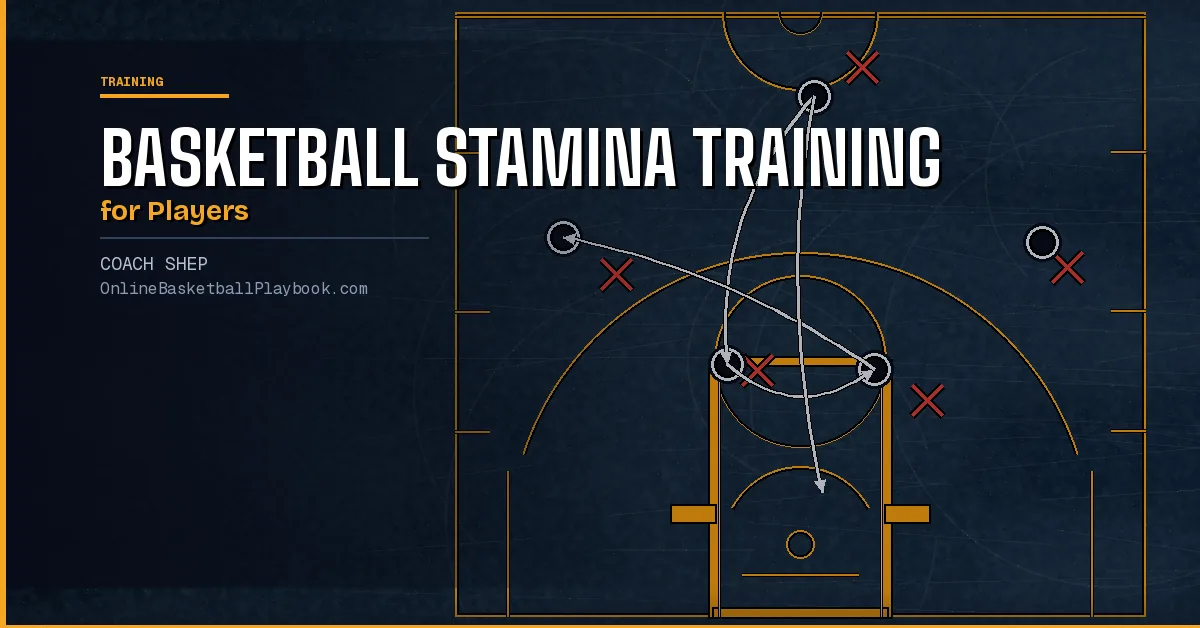
Basketball stamina is an anaerobic skill, not a cardio one. Players who train it right hold their technique in the fourth quarter. This guide covers the conditioning methods, drills, and practice habits that build real basketball fitness.
Why Basketball Stamina Is Anaerobic
Most coaches think about stamina as "being in shape" in a general sense. Can a player run for two hours without stopping? That's the wrong model for basketball. A real game is made up of dozens of explosive efforts (a sprint in transition, a closeout, a cut, a defensive rotation), each lasting five to fifteen seconds, followed by a few seconds of lower activity before the next burst. The energy system driving those efforts is anaerobic, not aerobic.
The aerobic system matters for recovery between plays and for general health, but the limiting factor for most players is the anaerobic threshold (the point at which lactic acid accumulates faster than the body can clear it, causing tightness, mental fog, and broken technique). When a player's shot form collapses in the fourth quarter, that's usually a lactate problem, not a cardio problem.
This distinction changes how you train. Long slow runs build a broad aerobic base, but they don't prepare the neuromuscular system for the kind of explosive-recovery cycles basketball demands. Effective basketball stamina training uses short, all-out efforts with measured rest periods, structured to push the lactate threshold higher over time. Work-to-rest ratios of 1:2 to 1:3 (meaning a 20-second sprint followed by 40 to 60 seconds of rest) are the target window. Start with more rest early in pre-season and tighten the ratio as fitness builds.
Every conditioning run in a well-designed basketball program stays on the floor and uses basketball movements. Suicides, lane slides, cross-court runs, and change-of-direction patterns all train the anaerobic system while reinforcing the movement patterns players use in games. That's a better investment than the track. Players who understand the why behind anaerobic training also compete harder in conditioning. They know the score, literally and physiologically.
On-Court Conditioning Drills
The library of on-court conditioning runs is wide, and variety matters (both for physical adaptation and for keeping players mentally engaged). The following are the most reliable drills, how to run them, and what they train.
Suicides
The classic. Players start on the baseline, sprint to the near foul line and back, to half court and back, to the far foul line and back, and to the far baseline and back. A well-conditioned player completes a suicide in 28 to 32 seconds. Time every run. Post the numbers. When players can see their times on a whiteboard, competition takes over and effort improves without a word from the coach.
17s and 9s
Sideline-to-sideline runs for time. A 17 means 17 sideline-to-sideline trips in under a set time (typically 60 to 65 seconds for varsity). A 9 is a half-rep version. These target lateral conditioning and are useful because they isolate the full-court width rather than length, testing a different movement pattern than suicides. Players who play primarily basketball conditioning drills that emphasize forward sprints often struggle on 17s because their lateral fitness hasn't been trained separately.
Lane Slides
Defensive slides across the lane for 15-second intervals. This is the drill that most directly ties conditioning to defensive skill. A player who can slide hard for 15 seconds and recover in 30 (and repeat that eight times) is ready to guard without fouling in the fourth quarter. Pair lane slides with any shell drill basketball progression and you get conditioning and defensive skill in the same rep.
30-Second Suicides
Players mark where they reach at the 30-second buzzer on the first run. Every future run is measured against that mark. The goal is to beat your own line, not someone else's. This builds individual accountability and gives the drill built-in periodization. As fitness improves, the mark moves.
4-8-16 Drill
Players sprint four baseline lengths, rest, eight, rest, sixteen. The cumulative load at the back half of the set is significant and mirrors the fatigue players experience in a close fourth quarter. Use this drill late in pre-season when a base level of conditioning already exists.
Game-Pace Training as Conditioning
The most underused conditioning tool in basketball is the practice itself. When coaches run 5v5 segments at game speed with short rest, competitive scoring, and consequences for the losing team, they are running an anaerobic conditioning session, one that also develops decision-making under fatigue, which no sprint drill can replicate.
The principle comes from coaches who have studied elite program practices: pace is a product of how you practice. If your practice tempo is slow and deliberate, your team will be slow and deliberate in games. If practice is run at game speed (every transition, every sprint back on defense, every outlet pass), players adapt both physically and cognitively to that tempo.
Losers run is a practical tool within this framework. When the losing team in a scrimmage segment runs, conditioning becomes competitive and stakes-driven. Players push harder because the consequence is real. This is preferable to running sprints as a group after practice where effort varies wildly and the connection to competition is abstract.
Structured 4v4 and 5v5 segments with 90-second rest windows between sets give coaches control over the work-to-rest ratio while still using game-realistic movements. A solid basketball practice plan integrates these segments deliberately (not as filler between drills, but as the primary conditioning mechanism). When a team plays a motion offense, the cutting and spacing within a motion offense in basketball system naturally generates stamina demands that pure sprint drills can't fully replicate.
The key is intentionality. Practice has to be designed to generate conditioning, not assumed to. Coaches who let water breaks run long, who stop play to lecture frequently, and who walk through half the practice at half speed are not getting conditioning from their practice time regardless of how hard the end-of-practice sprint looks.
Testing and Tracking Fitness Progress
Conditioning that isn't measured is assumed. Teams that test fitness consistently have a data point to train against, and players respond to numbers in ways they don't respond to vague encouragement. Two benchmarks form the core of a measurable basketball fitness program.
The 300-Yard Shuttle
Players run 12 trips between the baseline and foul line (25 yards each) as fast as possible. They rest, then run again. The average of both runs is the score. The 300-yard shuttle is a well-validated anaerobic test that correlates with basketball performance. Establish a baseline in the first week of pre-season and retest every three to four weeks. Post results. Make the improvement visible.
The 30-Second Suicide Mark
As described above (mark the spot, beat it next time). Simple, self-referential, and immune to excuses about height or natural speed. Every player can improve their own mark. This is the kind of progress metric that builds a culture of individual accountability alongside team conditioning.
Why Testing Matters Culturally
Conditioning becomes motivating when it has an objective standard. Players who know they will be tested run harder in practice. Coaches who publish fitness test results alongside skill evaluations signal that physical preparation matters as much as technique. Teams that treat the 300-yard shuttle as seriously as a shooting workout are building a culture of compete (not just tracking numbers for the sake of it).
Test conditioning at the start of pre-season, mid-pre-season, and at the first week of the regular season. After that, use the 30-second suicide mark weekly as a maintenance check. Full shuttle retests mid-season are useful when a team is in a slump. The numbers often reveal whether fatigue is a factor in performance drops, which changes the practice prescription entirely.
Building the Athletic Base
Stamina training at the highest level of conditioning cannot compensate for a weak athletic foundation. Most youth-level breakdowns (blown assignments, missed rotations, poor technique in the fourth quarter) trace back to athletic deficiencies rather than tactical confusion. Players who lack ankle stability, balance, or quickness degrade faster under fatigue than players who have built those qualities deliberately.
Ankle Strength and Balance
One-foot balance work, eyes-closed balance drills, and single-leg landing mechanics are low-cost investments with high returns. A player who rolls an ankle four times a season is losing conditioning weeks every time. Ankle strength prevents that. Include single-leg work in every warm-up rather than reserving it for injured players in rehab.
Fast Feet and Quickness
Tennis-ball reaction drills, fast-feet patterns around a cone, and ladder work train the neuromuscular system to fire faster between movements. Quickness is not purely genetic. It responds to training, especially in younger players. A player who takes 0.2 seconds less to react to a ball-handler's first step doesn't need to be faster; they just need to start sooner.
Functional Movement Screening
Before a player runs conditioning, they should be able to move correctly. Deep squat mechanics, single-leg stability, hip hinge patterns. These functional movement standards prevent injury and ensure that conditioning runs reinforce good mechanics rather than entrench bad ones. Running suicides with poor hip mechanics just trains poor hip mechanics at high heart rate.
The athletic base work also pays dividends in skill development. A player with strong ankle and balance control handles the ball better under pressure. A player with genuine quickness creates more space in basketball footwork drills and translates that quickness to live play faster than a player with the same technical skill but a weaker athletic base.
Periodizing Toward the Season
Stamina training works best when it builds deliberately across a pre-season calendar rather than being applied uniformly. Periodization means structuring training so that fitness peaks when it matters (at the start of the regular season and through postseason), not in week one of August when no games are played.
Phase 1: General Conditioning (Weeks 1-4)
Higher volume, longer rest periods (1:3 work-to-rest ratio), emphasis on building the aerobic base alongside anaerobic work. Test the 300-yard shuttle in week one and set individual benchmarks. This is also the phase for functional movement work and ankle conditioning, building the foundation before the intensity loads go up.
Phase 2: Basketball-Specific Conditioning (Weeks 5-8)
Shift toward on-court drills at tighter work-to-rest ratios (moving toward 1:2). Increase game-pace scrimmage segments. Introduce 30-second suicide marks and begin tracking individual improvement. Retesting the 300-yard shuttle in week six reveals whether the training is working.
Phase 3: Competition Prep (Weeks 9-12)
Tighten the ratio to 1:2 and move the bulk of conditioning into game-pace practice. Reduce standalone conditioning runs as skill integration becomes the priority. The goal in this phase is to arrive at game one with a team that is functionally conditioned (able to execute at full effort in the fourth quarter of a tight game), not one that is exhausted from peak conditioning loads.
In-Season Maintenance
Once the season starts, the goal shifts to maintenance rather than improvement. Game preparation occupies most of practice time, and the fitness built in pre-season sustains itself if practice tempo remains high. Weekly 30-second suicide marks track maintenance without adding excessive conditioning load to a team that is also playing two to three games per week.
A well-periodized conditioning program also prevents the mid-season fatigue crash that many teams experience in January. When fitness is built systematically and tapered intelligently, players arrive at late-season play in better physical condition than they were at mid-season (a genuine competitive advantage in tournament play).
- Work-to-rest ratio: Start at 1:3 early in pre-season, tighten to 1:2 as fitness builds. Don't run hard with insufficient rest because it trains bad habits, not fitness.
- Test it: 300-yard shuttle (baseline to foul line x12, average two runs) is your measurable anaerobic benchmark. Run it week 1, week 6, and week 10.
- Mark your spot: 30-second suicide marks give every player an individual standard to beat. Post them, track them, use them as weekly accountability.
- Condition in practice: Losers-run scrimmage segments and game-pace 4v4 sets are conditioning. Design practice to generate fitness, not just assume it happens.
- Build the base first: Ankle strength, single-leg balance, and quickness work belong in every pre-season before high-volume sprinting starts. Skipping it leads to injuries that erase conditioning weeks.
- Never run as punishment: Keep conditioning competitive (team relays, beat your time, losers run). Conditioning should have a winner and a number, not a punitive association.
Get free play diagrams, drills, and coaching guides delivered weekly.
Draw this play free in the play drawer →
Membership: the full library, playbook packs, and Pro drawing tools →
Keep Building
Related breakdowns
Movement Screening for Basketball Players: What to Watch
Movement screening for basketball players: how to run a screen, the squat, lunge, balance and step-over screens, reading results, landing checks and the pain rule.
Strength Training for Basketball: Lifts, Loads and Seasons
Strength training for basketball: the lifts that carry to the court, the conjugate method, loads and reps, jump training, in-season lifting, youth rules and tests.