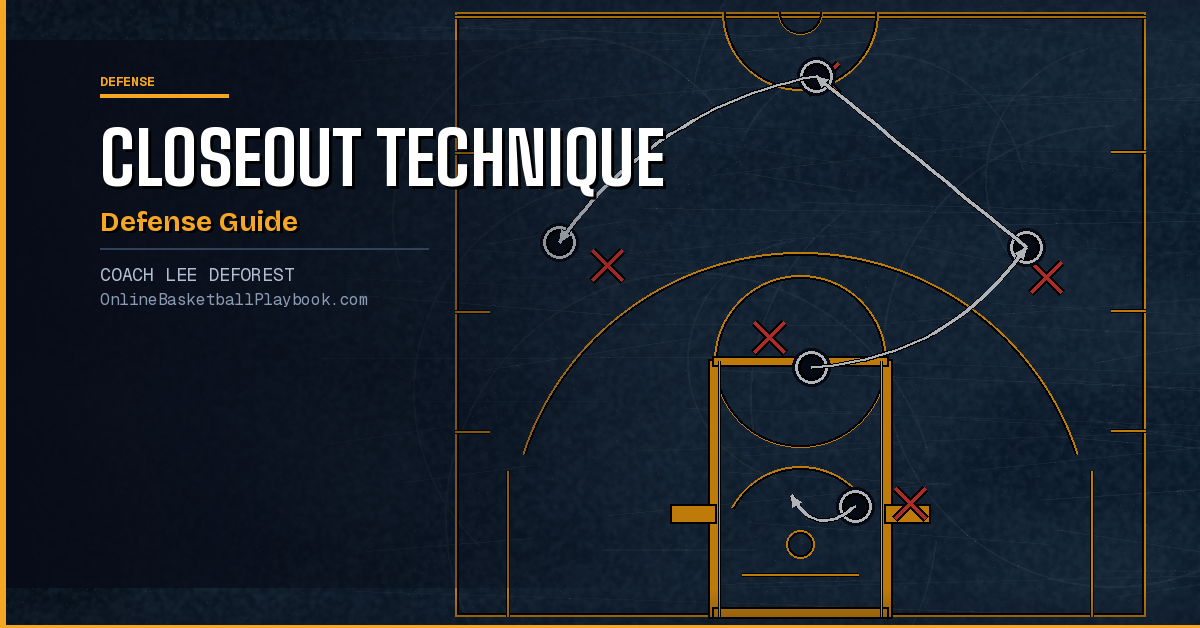

A bad closeout gives up an open three or a straight-line drive. A good one does neither. This guide breaks down every part of the closeout — footwork, hands, reading the offensive player, and contesting without fouling.
The Sprint-and-Chop Footwork Model
The closeout is a two-phase movement, and coaches who teach it as one continuous action produce defenders who either arrive out of control or slow-jog from help position and never get there in time. Understanding the phases separately — and then connecting them — is what separates solid closeout teams from leaky ones.
Phase one is a full sprint. When the ball is swung to your man, your first step is explosive. You are covering ground as fast as possible. There is no shuffling, no crossover step — you run. At this stage you are not worried about your man's shot. Your only job is to close the distance between where you are and where he is. Staying in a defensive stance during this phase is a mistake; it is too slow and it often means the shooter has already started his shooting motion by the time you arrive.
Phase two begins when you are roughly one-third of the distance away from the shooter. Here you transition from a sprint to short, choppy steps. Your feet get quick and close to the floor, your hips drop, and your weight shifts back so it sits behind your knees rather than forward over your toes. These choppy steps bleed off the momentum you built in the sprint so you don't fly past the shooter or barrel into him for a foul. They also put you in a balanced athletic stance so that whatever happens next — a shot, a jab, a drive — you can react.
"Sprint the first two-thirds of the distance, then short choppy steps the last third to arrive balanced."
— Closeout Technique, Online Basketball Playbook Vault
The transition point between sprint and chop is something players have to feel through repetition. Early in training, err on the side of chopping earlier — it is better to arrive a step short but under control than to blow past the shooter with your weight on your front foot. As players get comfortable, they can push the sprint phase longer and tighten the chop window.
One common coaching cue that captures this well is "hard and short." Hard refers to the sprint — you are going hard to cover ground. Short refers to the choppy steps — you arrive with short, controlled strides. Players who hear this cue in practice tend to remember it in games because it encodes both phases in two words.
Footwork drills for the closeout should simulate the help-and-recover movement, not just the final few steps. Players start in help position on the weak side, read a dummy pass, then close out to a wing or corner. Do it both directions. Do it against live shooters who can actually shoot so the defender feels the urgency. Drill it in every pre-practice warm-up until the sprint-and-chop becomes automatic.
High Hands and Body Position on Arrival
Footwork gets you there. What you do with your hands and your body when you arrive determines whether the closeout actually accomplishes anything. Two defenders can execute identical sprint-and-chop footwork and produce completely different outcomes depending on how they arrive.
The hands go up. Both of them, with elbows bent rather than locked straight. The goal is to take away the rhythm jump shot — the quick catch-and-shoot that three-point shooters thrive on. When a defender arrives with hands at his sides or reaching forward, a good shooter can catch, set, and release before the hands get anywhere near the ball. When hands go up on arrival, the shooter has to either elevate above the contest (difficult) or hesitate and reset (which is time you can use to get more balanced).
Keeping elbows bent matters because it lets you quickly drop the arms into a defensive position if the offensive player drives. Straight-arm high hands are harder to recover from. Bent elbows are both a shot-contest tool and a drive-recovery tool simultaneously.
Body position on arrival ties directly back to the chop phase. Your weight should be back — hips low, head behind your knees, not your weight pitched forward on your toes. A defender who arrives with weight forward is easy to blow by. The offensive player pump-fakes, the defender's momentum carries him into the air, and a clear driving lane opens. Weight-back arrival means you can absorb a pump fake without jumping, hold your ground, and still contest a real shot.
The closeout position you arrive in also encodes information about your coverage intent. If you are shading the shooter to push him baseline, your closeout should arrive slightly higher and angled to cut off the middle. If your scheme funnels drivers to the middle for a weak-side help defender, your closeout angle shifts accordingly. The position of your body on arrival is not just balance — it is the first move of whatever comes next.
Reading Shooter vs. Driver
Not every offensive player requires the same closeout. One of the clearest distinctions in closeout theory is between closing out on a shooter and closing out on a driver — and the adjustments you make when a player can do both.
Against a good shooter, you close out hard. You are willing to fly by if needed to take away the rhythm catch-and-shoot. The risk of letting a shooter get a clean look is greater than the risk of getting driven — a great shooter will convert that open three at a high percentage. So you sprint, you arrive with high hands, you get up into his space. If he catches and shoots over you, that is a lower-percentage shot than the open look you would have given by hanging back. After contesting, your job becomes boxing out and not fouling, which means you do not chase the ball — you find the offensive player and seal him off the glass.
Against a poor shooter, the math flips. If the player holding the ball is a non-threat from range, sitting back a half-step invites the shot — and you want him to take it. You close out shorter, lower, with high hands, but you do not crowd him on the catch. The priority shifts to eliminating the inside pass and the drive. You are comfortable letting him shoot threes at low efficiency; you are not comfortable letting him skip a pass to a corner shooter or attack a driving lane you left open by over-closing.
The hard case is a two-way threat — a player who can shoot and drive at high levels. Against this type of player, you concede nothing. You close out hard enough to bother the shot but you arrive with your weight back and your hips low so you can contain a drive. Your closeout angle may shift based on your team's scheme — if you want to funnel the driver toward your weak-side help, you shaded slightly. If you want to keep him in front and make him beat your individual coverage, you close out more directly. There is no clean answer; the key is that you arrive in a position that makes both options difficult rather than one that eliminates one threat and gifts the other.
The Vertical Contest and Foul Avoidance
The most costly mistakes in closeout defense are not missed sprints or slow reactions — they are fouls. A contested three-point attempt that draws a foul is catastrophic: three free throws at high percentage, plus momentum. A charge drawn by a defender in the paint who planted their feet cleanly is a turnover. The difference between these two outcomes often comes down to one concept: vertical versus horizontal movement.
A vertical contest means you jump straight up — a high-jump, not a long-jump. Your arms go overhead, your body stays within its established vertical space, and you do not reach toward the ball or lean into the offensive player's shooting space. A defender who jumps straight up and establishes a vertical plane is protected. A defender who jumps forward, reaches across, or lunges toward the shooter is in foul territory regardless of whether they touched the ball.
The "wall up" concept applies on drive coverage as much as on shot contests. When a driver attacks and you have run out of lateral room, the instinct is to reach or grab. Instead, plant your feet, straighten your body, keep your arms overhead, and let the driver run into your position. The technical term is "taking a charge," but the principle is that your body is the wall — chest first, arms up, stationary. If you reach or lean, you foul. If you are vertical and stationary, the contact often draws an offensive foul.
Teams that lead their league in opponent free throw rate are often teams that drill vertical contests relentlessly. The "foul with your chest" coaching cue is a counterintuitive but effective way to teach this — it focuses defenders on body position rather than hand movement. Getting your chest into the shooter's space in a vertical stance is different from reaching with your arms. The hands follow the body when the body is trained correctly.
Practice vertical contests separately from closeout footwork drills. Have a coach or dummy throw up a shot after a drive and require the defender to jump straight up with both arms extended. Then add the full sequence: closeout, contain a jab, defend a drive, vertical contest. The contest is the end of a sequence, not an isolated move, and defenders need to train it in context.
Scouting Labels and Closeout Decisions
One of the most practical advances in closeout coaching is the use of player-specific scouting labels that tell a defender exactly how to close out before the ball is even swung. Rather than processing the read on the fly, the defender already knows — because practice has attached a behavior to a name.
The classic example is the three-tier label system. A shooter gets labeled with a name that cues a hard closeout and contest — think of it as a "run him off the line" closeout. A driver gets a label that cues a softer, lower closeout focused on containment rather than shot contest. A non-threat gets a label that tells the defender to sit, stay home, and eliminate the interior pass without sprinting to the ball-handler at all.
These labels work because they transfer the cognitive load from the game to practice. When a player hears the label in a game situation, his body already knows what to do — he drilled it by that name dozens of times. The decision is made before the catch. This is especially valuable late in games or in high-pressure moments when thinking slows reaction.
The "bluff" closeout — sometimes called a "fake-and-absorb" — is another label-driven technique. Here the defender sprints toward the ball-handler, makes aggressive body language suggesting a hard closeout, then absorbs rather than contests as the offensive player attacks. The defender is baiting the drive rather than eliminating it, because the help defense behind him is set up to take the drive away. The word "bluff" drives the behavior — defenders know not to contest, to absorb, and to trust the help. Without the label, that read is almost impossible to make consistently in a game.
Building a scouting label system requires pre-practice preparation: someone on staff identifies each opponent's shooting threat level, attaches a label, and communicates it in the pre-game defensive walkthrough. Defenders practice the label-to-behavior connection in controlled drills so the linkage is automatic by tip-off.
The Driving Line and Chest-First Approach
The driving line is a concept that ties together closeout angle, body position, and scheme. Rather than simply contesting the shot or containing the drive, a well-designed closeout puts the ball-handler on a specific path that your defense is built to handle.
In many defensive schemes, the goal is to force the ball handler to the corner — away from the middle of the floor and away from the paint. To do this, the defender closes out to the top side of the offensive player, cutting off the middle with their body. The position of the closeout forces the driver in one direction before he has even made a move.
The "chest-first" closeout is the technique that makes this work. Instead of arriving with hands extended or reaching toward the ball, the defender closes out with both hands wide and their chest leading toward the offensive player's near shoulder. The goal is to physically beat the offensive player to the spot — arrive at the top-side shoulder before the drive develops. When the chest is on the shoulder and the feet are set, the driver cannot go middle without going through the defender's body. He is put on a driving line to the corner, where the scheme has help waiting or where he is least dangerous.
The no-foul standard on this technique is strict: the hand cannot ride the offensive player's body or hook his arm. The chest creates the contact; the hands stay wide. Any grab or hook with the hand is a foul regardless of how good the positioning was. Drilling this distinction — chest contact is good, hand contact is bad — is critical because defenders under pressure naturally reach, and in this technique reaching defeats the purpose and puts you in foul trouble.
Combining the driving line concept with the scouting label system gives your closeout defense a complete structure. The label tells you how hard to close out and whether to contest or contain. The closeout angle and chest-first arrival tell you which direction to funnel. The vertical contest protects you from fouls when the drive comes. Together these three pieces — label, angle, contest — form a system that accounts for every offensive option on the catch.
- Sprint first, chop second: full speed for two-thirds of the distance, short choppy steps for the final third
- Hands up on arrival: both hands high, elbows bent, ready to contest the shot or recover on the drive
- Weight back: hips low, head behind the knees — never pitched forward over your toes
- Jump vertical, not horizontal: contest with a high-jump not a long-jump; arms up, body inside its vertical plane
- Read the label: know before the catch whether you are contesting, containing, or sitting on a non-shooter
- Chest-first, not hands-first: on a driving-line closeout, your chest beats the offensive player to the spot — hands stay wide, never hooking
- Angle encodes the scheme: close out top-side to cut off middle, or shade baseline based on your team's help structure
Want more defensive breakdowns like this — plus drills, film notes, and play diagrams — delivered to your inbox?
Keep Building
Related breakdowns
Creating Better Basketball Free Throw Shooters
Creating Better Basketball Free Throw Shooters
Basketball Free Throw Shooting: Technique and Mental Game
Basketball Free Throw Shooting: Technique and Mental Game