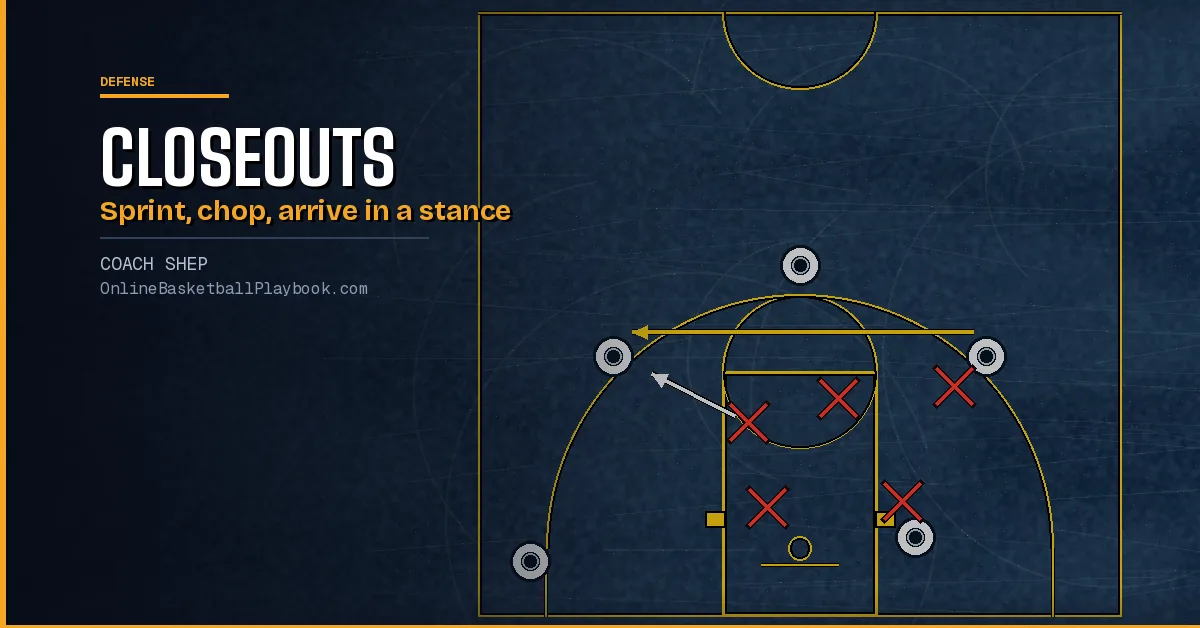
A closeout is the run a defender makes from a help or gap spot to a player who has just caught the ball, or is about to.
He covers the ground fast, then breaks down so he arrives balanced, able to contest the shot and still stop the first drive. Every defense that helps and lets the ball move uses it, and teams that give up perimeter catches on purpose, such as the pack line and zones, close out on almost every pass. Closeout basketball is where help defense pays its bill.
This page covers when to leave, the sprint and the chop, the hands and feet on arrival, which way to send the drive, how coaches label shooters, the contest without fouling, the recovery after it, the drills, and the common mistakes, with the options side by side. It sits under types of defense in basketball in the defense section.
Closeout Basketball Starts on the Pass
Choose the trigger for the run:
- Go on the release. Move the instant the ball leaves the passer's hand and sprint while it is in the air.
- Not before the release. Leaving early invites a pass fake.
- Read the passer's eyes. Most passers telegraph the pass.
- Start on the catch. The run starts when the receiver catches.

Where the defender helps from sets how far he runs:
- Astride the lane line. A gap stance puts the defender astride the lane line with the ball below the wing, which shortens the closeout.
- Drop diagonally. Messina drops diagonally along the passing line, never straight back, because a straight drop makes the skip recovery too slow.
A slow closeout usually starts with the former ball-side defender who did not sprint to help, not the man closing out. Pick one trigger and rep it every day.
Sprint, Then Chop
Every closeout splits the run into a fast phase and a braking phase. The chop is a run of short, quick steps that kills momentum so the ball handler cannot dribble around the defender. Pack line teams call it "hard and short", sprinting two or three steps, then short choppy steps. Coaches put the split in different places.
| Split | Sprint | Chop |
|---|---|---|
| Two thirds | The first two thirds of the distance | The last third |
| Halfway | Half the distance | Close out short |
| Three quarters | Three quarters of the distance | The last quarter |
| A step count | Two running steps, or two or three, or three | Patter or chop steps |
| From the shooter | Until two steps from the ball | The last two steps |
The stop steps go by several names: stutter steps, pitter-patter steps, patter steps, chatter steps and happy feet. Brake with the upper body:
- Snap the shoulders and head back.
- Pull the shoulders back. Like a parachute opening behind him.
- Get the weight back. Rick Majerus wants weight back to absorb the dribble.
The defender arrives within reach, not past the shooter. Finish about an arm's length away. Hubie Brown has players touch the shooter in practice so they learn what arm's reach feels like. High hands make the defender look closer, so he does not have to get as close.
Sprint first, then chop, and arrive in a stance.
Hands and Feet on Arrival
Coaches teach five hand setups:
- Two high hands, bent elbows. Most pack line teams and Rick Majerus (thumbs to the ears).
- Inside hand high, outside hand low. Two hands overhead raise the center of mass and slow the slide after a shot fake.
- One hand up. It discourages the shot or push the drive, used by Nate Oats and Mike Krzyzewski's drills among others.
- Hands set by the read. Two hands up for a shooter with his eyes up, and a trace hand plus a spear hand for a driver with his eyes down.
- No hands-up look. A horizontal swipe at the ball on the catch instead.
Once the defender is square, switch from high hands to active hands, tracing the ball once it goes to the floor. The feet split too:
- Inside foot forward.
- Outside or baseline-side foot back.
- Outside leg up. Hubie Brown closes from the outside with the outside leg up.
- Cheat step to the outside. Rick Majerus takes it on his count, "1, 2, fire feet."
Contest with the correct hand. Chart every contest as correct hand or wrong hand, the left hand on a right-handed shooter and the reverse. Correct-hand contests made the bigger difference. Pick one hand and foot setup and teach it the same way every day.
The Angle: Where the Drive Goes
The arrival angle sets the drive direction, and the direction depends on the team defense. This is the widest split in closeouts.

Nate Oats closes out from the elbow to the wing, puts the center of his chest on the shooter's top shoulder, beats him to the spot and sends him on a driving line to the corner, with no middle.
- Chin to the top shoulder. Close with the chin to the top shoulder.
- Body on the outside knee. Set the body on the shooter's outside knee to take the middle away.

| Closeout | Where the closeout sends the drive |
|---|---|
| Force baseline | Outside foot back, toward the baseline. Hubie Brown sends it there because the traps are coming. |
| Force sideline | Toward the sideline |
| No baseline | The pack line: toes to the pack, the drive goes middle into the help |
| No middle | No middle (Messina and others). Oats puts the driver on a driving line to the corner. |
| Funnel outside | Funnel the drive outside, away from the middle |
| Force middle into help | Recover with the shoulder closer to the baseline so drives go back to the middle |
| Weak hand | On a long closeout, push the shooter to his weak hand |
The path matters as much as the angle. Rick Majerus arcs the closeout and never runs straight at a corner shooter, so the dribbler cannot drive straight to the rim. Bruce Weber uses loop closeouts. A banana cut closes out skips. Which way a team forces is its own decision, laid out on lock left defense and pack line defense.
Read the Shooter Before You Run
Not every catch gets the same closeout. The rule fits in four lines:
- Good shooter. Close out hard to take away the shot and force a dribble, and fly by if necessary.
- Poor shooter. Close out short and low with both hands up, take away the pass inside, expect the dribble and let him shoot.
- A man who can do both. You will probably lose anyway.
- Great shooter or great driver. Brad Stevens gives a great shooter less room and closes to his shooting hand, but breaks down less against a great driver.
Turn the read into a word on the scouting report, so the decision is made before the catch. Staffs use the same labels for different jobs, so write the job next to the name:
- Run him off the line. A shooter closed out hard, called "Curry" in player-type labels and Shooter in pack line labels.
- Close out and contest on the rise. "Wade."
- Stay off, let him shoot, contest late. "Rondo."
- Go up under the catch to force a dribble. "Dead 3."
- Close within a finger's touch. "Straight."
- Hard and short. "TSPD" (think shot, play drive).
- Toes to the pack. "Driver" in the Dead 3, Straight and TSPD labels.
- Short. Driver in pack line labels. Both: hard then back off, or a regular closeout.
- Set the distance by the label. Sniper, Player and Driver set the closeout distance, with no three-point attempts for Snipers.
- Read the eyes. Eyes up gets a long closeout with two hands up, eyes down a short one with trace and spear hands.
The scouting card these labels go on is covered in basketball scouting. Decide the closeout before the catch.
Short and Long Closeouts
Short and long closeouts are different jobs. The short closeout is a shell-spot stunt and recover, played as 1 on 1. The long closeout comes off an X-out or a skip: no one can guard a good player 1 on 1 from that distance, so the defender runs the shooter off the line into the rotation, pushes him to his weak hand, and never gives up a basket off the first pass.

He renamed that closeout from "cold" to "bluff," because players heard "cold" as dare him to shoot. The new word turned it into fake and absorb. Words drive the behavior in other drills too: "Ball! Ball! Ball!" on the run in one set of drills, and "shot" called early in Chris Mack's closeout drill.
Fly by or stay down is a three-way split:
- Never fly. Technique teaching and the 2-3 zone.
- Fly by a great shooter. The four-line rule above, the "Curry" label, and the bluff closeout's run off the line.
- Always fly. Full-court pressure never closes out short. A dribble drive press uses fly-outs in place of closeout drills.
Decide when your team flies by and when it stays down.
Contest Without Fouling, Then Recover
The contest goes straight up.
- Wall up. The wall-up drill, run against a drive two feet into the paint, takes the contact with the chest and then contests at full extension straight up, high jump not long jump. The team that ran it led its league in defensive free-throw rate the year before.
- Stay vertical. A help defender with planted feet in the charge circle is called for the foul and a vertical one is not.
- Never foul a jump shooter. Hubie Brown never does.
Three cautions: never foul a three-point shooter, never run past him, never leave the ground to block. Stay down on fakes and do not lunge.
Hands stay off the driver. Nate Oats said 28 percent of an opponent's second-half possessions in one game went to the free-throw line, so his team had to quit fouling: chest on him, hands off. In practice he says the closeout hand cannot ride the driver or it is a foul. A tennis ball in each hand stops reach-ins while the arms still move.
The closeout ends in the first drive and the box out:
- Stop the drive first. Then pressure.
- Absorb the jab. Absorb it with the back foot.
- Answer with "Back," then "Attack." Answer a jab or fake with "Back," a two-footed drop step, then "Attack," closing back out with both hands up.
- Box out. A flying closer is out of position to box out. A 1 on 1 drill runs sprint, contest, contain, box out, rebound.
Rebounding after the contest is on box out basketball, and the help rules that send the closer out are on help defense basketball. Finish every closeout with a box out.
Get the next coaching guide in your inbox
One email when a new guide or diagram set goes up. Free.
Closeout Drills
Tex Winter called the closeout "the most important aspect of individual defensive play." Drill closeouts every day, as Chris Mack does, who runs his closeout drill even in pre-game warm-ups. Because the pack does not deny ball reversals, closeouts happen constantly, so pack teams drill them every day.
- After zig-zag work. Messina's ladder puts closeouts right after zig-zag work.
- After on-ball defense. Put them right after on-ball defense.
- Build each rep in three steps. The three-step shell goes close out only, then the offense may take two dribbles, then live.

- 1 on 1 closeouts. In the pack line the defender starts in the lane, tosses to the offense at the top of the key, and it is live with a two-dribble limit. The defense stays on with a stop and the offense stays on with a score.
- Chair closeouts. The defender closes out to a chair on the air time of the pass. Keep a hand on the chair and sprint without sliding.
- Vegas closeouts. Four stages: close out with pressure and trace, guard one or two bounces, contest and rebound, then live with restrictions.
- Majerus's 5-spot closeouts. Hands up and weight back, arc the closeout, two running steps then patter steps, gap the ball at the top of the key so nothing goes down the lane, arc the corner closeout, and an early-success rule where the offense takes a dribble and fakes a shot or pass so defenders are not surprised.
- Make the offense attack the closer. A shooting drill allows one shot fake and one sideways dribble, so shooters practice the counter while closers practice the stop.
More drill setups are on man-to-man defense practice drills and the shell on shell drill basketball. Rep the closeout until it is automatic.
Common Closeout Mistakes
- Flying out of control. It has three costs: a shot fake and drive beats it, it risks fouling a three-point shooter, and it leaves the closer out of position to box out.
- Running a straight line. Rick Majerus says a straight-line closeout, above all to the corner, lets the dribbler drive straight to the rim.
- Leaving before the release. It invites the pass fake.
- Reaching or riding the driver. The free-throw problem above.
- Crossing the feet after the chop. One cue is step and slide, not slide and step.
- Blaming the wrong player. The slow closeout may start with the teammate who did not sprint to help.
Fix one mistake at a time.
Questions Coaches Ask
What is a closeout in basketball?
The run a defender makes from a help spot to the player catching the ball: a sprint, then short chop steps, arriving in a stance with a hand up to contest the shot and the feet ready for the drive.
How far should you sprint before you chop?
The most common split is two thirds sprint and one third chop. The split can also be halfway, three quarters or a set number of steps.
What makes a closeout reckless?
Flying at the shooter out of control. It loses to a shot fake and drive, risks fouling a three-point shooter, and leaves the closer unable to box out.
Should a closeout force baseline or middle?
It depends on the team defense. Pack line teams close out to take away the baseline. Close to the top side to send the drive to the corner, or force baseline into a trap.
What is a good basketball closeout drill?
1 on 1 closeouts with a two-dribble limit, chair closeouts and Vegas closeouts are common. The three-step shell builds every rep from closeout only, to two dribbles, to live.
Want the printable playbook packs?
OBP Pro members get the premium playbook packs: the zone attack, out of bounds and practice plan PDFs, plus each new pack as it is finished. The membership page lists what is in each one. Or draw your own version free in PlayDraw.
See what OBP Pro includesMore Core Coaching Guides
- Advantage Basketball: Reading the Help and Keeping It Alive
- Backdoor Cut Basketball: How to Read the Denial
- Ball You Man Defense: Off-Ball Positions by Passes Away
- Help Defense Basketball: Help Side, Stunts, Rotations and 911
Back to Types of Defense and every Defense page.
Keep Building
Related breakdowns
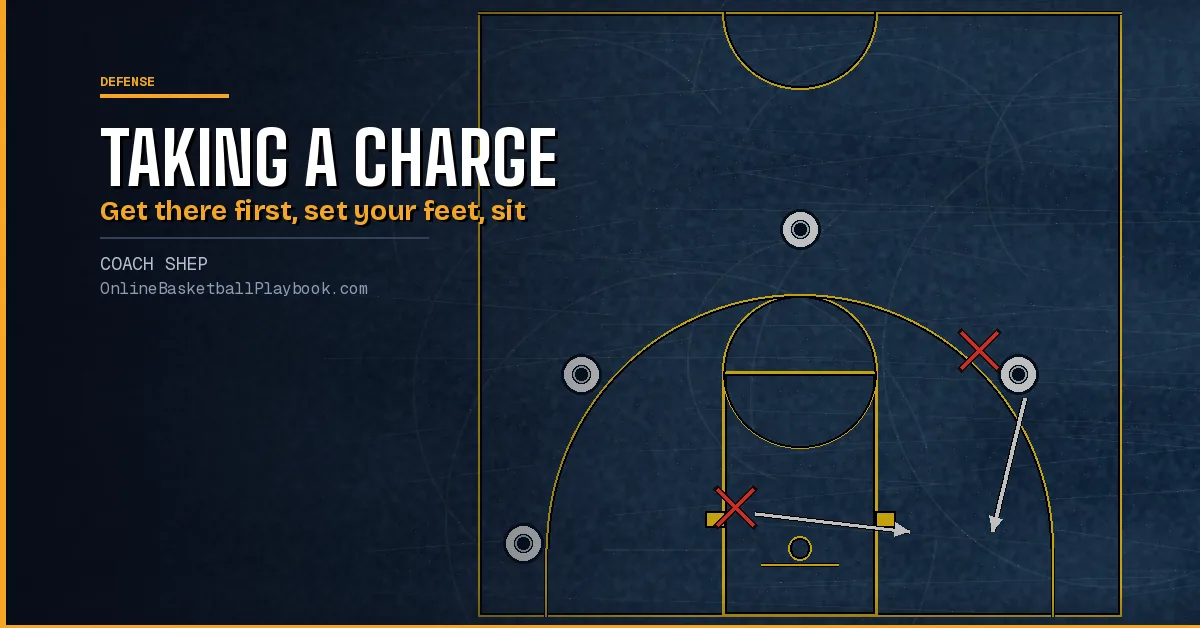
Taking a Charge in Basketball: Technique, Falls and Drills
Taking a charge in basketball: where charges come from, setting the feet, the legal spot by level, three ways to fall, the drills and when to wall up instead.
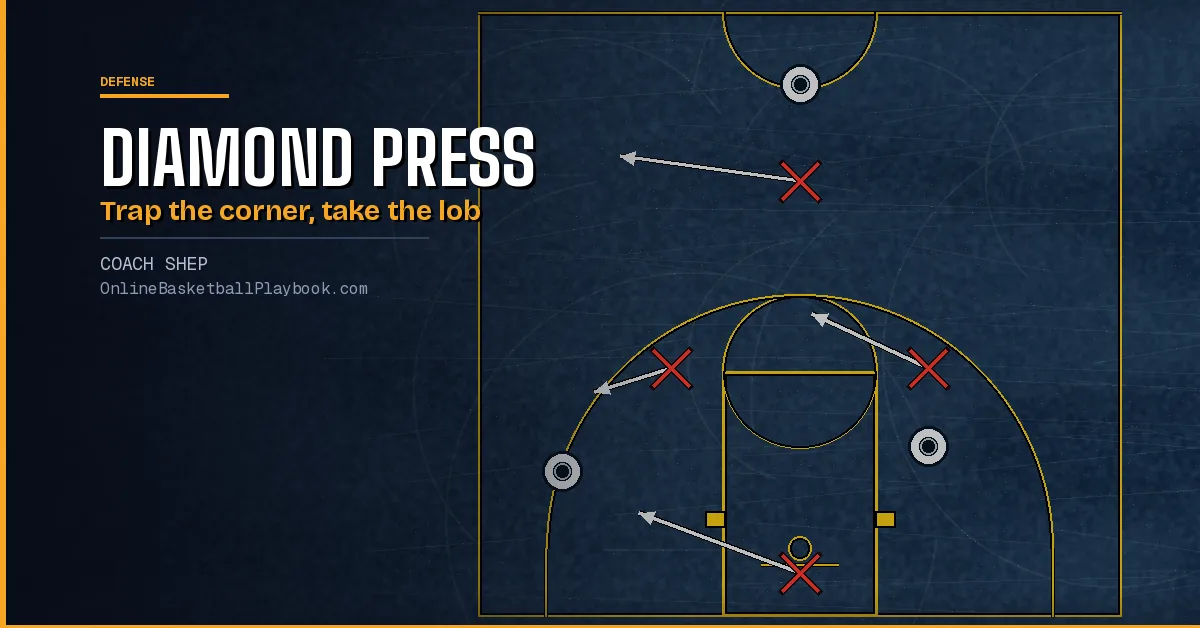
1-2-1-1 Diamond Press Basketball: Roles, Traps and Install
How to run the diamond press in basketball: who plays each role, how to trap the corner, what to do on the reversal and the lob, and how to install it step by step.
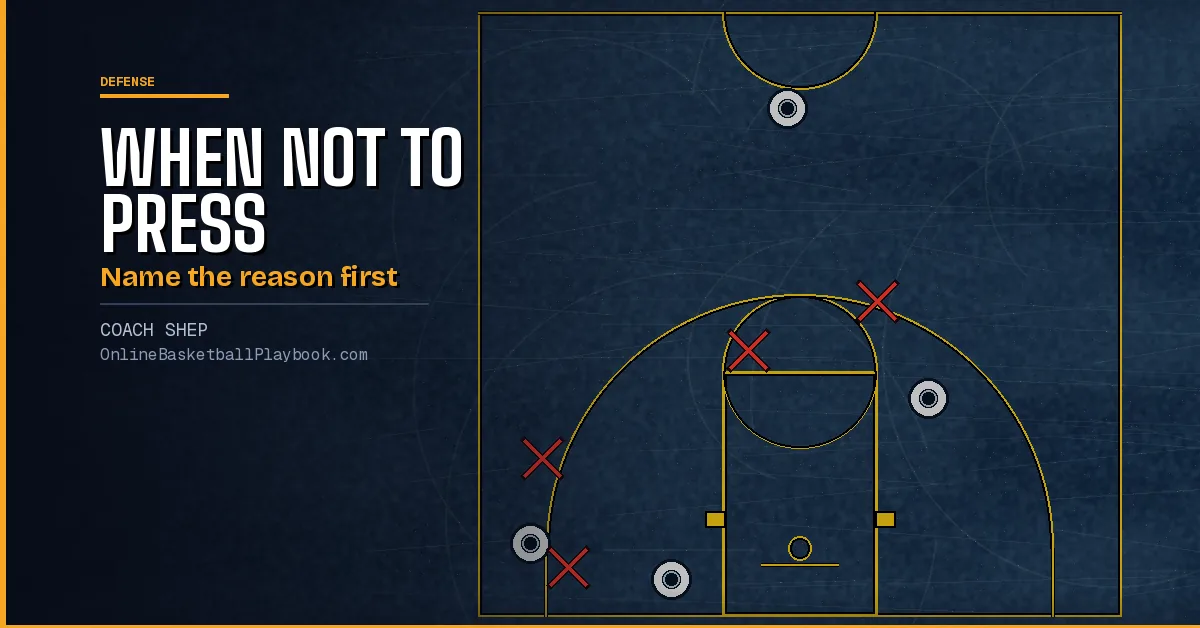
When Not to Press: Bad Reasons, Thin Benches, Poised Guards
When not to press in basketball: the bad reasons, the roster you need first, the opponents who beat it, the moments to drop it and the youth limits.