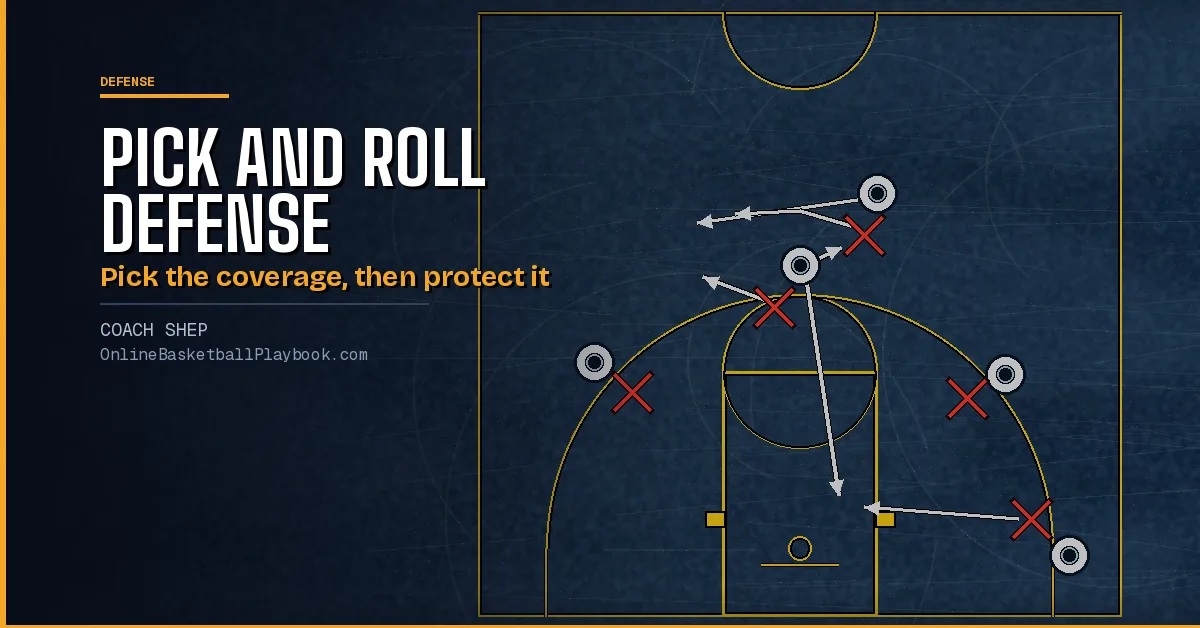
Pick and roll defense starts with a choice of coverage for the two defenders in the screen, then a plan for the three defenders behind it. No coverage takes everything away. Each one takes something and gives something up, so coaches choose by who has the ball, what the screener does, where the screen is set and how much time is on the clock.
This is the hub for every ball screen defense page in the defense section. It lays out drop, show or hedge, blitz, switch, ice and under side by side, then the base coverages programs built on, the zone answers, the protection behind each coverage, one table and where coaches split. The offense's answer to each coverage is on pick and roll reads.
The Three Parts of Pick and Roll Defense
Steve Clifford splits the play into three phases. Coverage is the two defenders on the ball. Protection is the three off it. Recovery is the closeouts and rotations after the pass. A staff using the split changes the scheme only after checking that the on-ball defender can do the job and that the team ran what it practiced, well enough and hard enough.
The Two Defenders' Jobs
The screener's defender calls it first, with a side. In the Pack Line the big calls the screen and its direction before it is set, so the on-ball defender's feet can move before contact. In drop coverage, "screen left" or "screen right" is the first step.
He arrives with the screen. A screener's defender who does not arrive with the screen is the number one killer of the coverage.
The on-ball defender never gets hit. Kelvin Sampson's guard jumps his chest into the handler, faces the sideline and makes him use the screen with his weak hand. Sampson names the two failures to prevent: getting rejected, when the handler goes away from the screen, and getting split, when he goes between the two defenders.
The technique for both defenders against every screen, on the ball and off it, is on defending screens in basketball.
Drop

The screener's defender drops to a level in the paint and the on-ball defender goes over the top to stop the pull-up, then sprints back in front so the big can recover to the roller. Scouting sets how deep he drops.
- Takes away: the easy shot at the rim, the lob to the roller and the driving lane.
- Gives up: a screener who pops for a shot, a handler with a strong mid-range or floater game, and the Spain pick and roll, where a back screen on the dropping big frees the roller for a lob. A handler who rejects the screen breaks it.
- Fits: a screener who scores on the roll and guards who like to drive. One European pro rule drops when the ball is caught high or the handler already has separation.
Full guide: drop coverage. Settle the depth in scouting, then hold it.
Show or Hedge

The screener's defender steps into the handler's path, the on-ball defender fights over the top, and the big gets back to his man.
Teach it in four steps: anticipate the screen, beat the dribbler to the spot, stay connected to the screener, and recover with arms up while the on-ball defender slides under him.
- Takes away: the handler's straight path. Messina's screener's defender makes a short "V" that forces a backup dribble.
- Gives up: a split if the hedger commits too far, and a slip if he shows before the screen is used. Messina says a passive hedge is worse than none because it gives the handler a rhythm jumper and still does not stop the roll.
- Hard or flat: the hard hedge faces the sideline to force extra steps toward half court. The flat hedge faces half court, level with the screen, and stays attached to a screener who rolls or pops.
Larry Brown goes over the top with a hard hedge and sends the rotator early against a big who can fade and shoot. Full guide: hedge basketball. Hedge with commitment or do not hedge.
Blitz or Trap

Both defenders trap the handler. Clifford's trappers get flat and eliminate three things: the drive away to space, the split, and the dribble around them, which he calls the killer. Jay Wright's trappers are deflectors who never foul or hunt steals.
- Takes away: the ball in the star's hands.
- Gives up: a 4 on 3 behind it. The answers are two retreat dribbles while the screener short-rolls a step, or two quick passes.
- Fits: the trigger is where coaches differ most, listed below.
When the blitz fires:
- Blitz as the base. Jay Wright's Villanova blitzes ball screens and handoffs when the ball is dribbled toward you, your man brings you to the ball, or the ball goes to the baseline.
- Blitz the star only. Jeff Van Gundy's outline blitzes the great player. Clifford traps the star in the scoring area and in the last 5 minutes.
- Blitz by the corner. Clifford plays drop with the ball-side corner filled and blitzes with it empty, so the defense is never spread out.
- Blitz by location. Dan Hurley drops or goes under far out and blitzes in the scoring area, about 80 percent of the time by his own estimate.
- Trap after the dribble dies. Sampson's Houston contains at the level of the screen and traps only once the handler picks up the ball.
Pick the trigger before the game, not during it.
Full guide: blitz and trap ball screens.
Switch

The two defenders trade men, and Messina has the screener's defender call it and jump the passing lane. Pressure defense makes contact switching its default and gives five reasons over show and recover: better denial of cutters, no hesitation, a broken screening rhythm, fewer fouls, and turnovers that turn into transition points.
- Takes away: the defenders' hesitation and the offense's screening rhythm.
- Gives up: the mismatch. On a big screening for a small on a high screen, the screener slides down and posts the smaller defender, which is why a coverage reference says NBA teams usually show and recover there instead.
- Fits: defenders who match in size and quickness, as USA Basketball puts it, and the end of the clock. Larry Brown switches everything late in the shot clock. Clifford's test is to switch only if you can do it without a clear mismatch and stay home.
Full guide: how to coach effective defensive switching. Switch on purpose, never by accident.
Ice or Down

On a side screen, the on-ball defender jumps to the middle the instant the screen is called. The ball now lives in a box whose four walls are the two defenders, the sideline and the baseline, and it leaves only by a pass. A nail defender at the foul line stunts at the screener if he catches. Other names for the same idea are down, blue and push.
- Takes away: the middle of the floor.
- Gives up: what it gives up is less documented. A counter attacks ice with a full fill-around to stop the weak-side tag.
- Fits: a team that already forces baseline, with quick-footed bigs, and it is stronger with the ball-side corner occupied because the box shrinks.
Decide before the first practice what the help does: stunt and recover, or a full rotation in which the nail defender takes the screener and every weak-side defender slides over one. ICE is called on the side screen and a separate coverage, WEAK, on the middle screen.
Full guide: ice coverage. Rep the stunt and recover until the nail defender reacts without a call.
Under

The on-ball defender goes below the screener and meets the handler on the far side.
- Takes away: in the version Frank Martin credits to Bill Self, the screener's defender bumps the screener's chest and the ball defender goes under to take away the inside hip.
- Gives up: the pull-up behind the screen. Ben Howland goes over instead because under gives the guard better vision.
- Fits: a handler who is not a shooting threat, which is when Messina goes underneath. Go under on a high screen and over on a mid one.
Full guide: how to go under a ball screen. Go under only when the handler will not punish it.
Get the next coaching guide in your inbox
One email when a new guide or diagram set goes up. Free.
Base Coverages Programs Built On
Contain at the level (Kelvin Sampson). Houston does not blitz. The screener's defender contains at the level of the screen, nose on the ball, feet square, low and wide, while the guard applies back pressure and makes the handler use the screen. No switching, no zone, and the trap comes only after the dribble dies.
Channel (Quin Snyder). Utah is a no-middle team. The guard's foot angles funnel the handler to one side, and the goal is to win the ball two on two before the help is needed.
Corral (Nate Oats). Alabama does not show on ball screens. Keep the ball in front, guard it with two and build back out to the shooters, with a veer-back switch if the handler curls hard into the big.
Zone Answers
Zones guard the screen too. In Flip Saunders' 1-2-2 matchup zone, the 1 guards whoever comes off the screen. A tandem 2-3 goes under with a stunt from a partner against a poor shooter and goes over against a good one.
Protection and Recovery
Someone owns the roller in every coverage, and the options differ:
- Clifford's low man. After the "down" call everyone calls low man, and the low man owns the roll and the short roll on switch, drop and blitz alike. Everyone moves on the pass in the direction of the pass and sprints to the ball. Against a shooting 5, stop the roll but get back to your man on a flare or give up the corner three.
- Sampson's split. A short roll toward the foul line goes to the top big. A long roll to the rim goes to the low tag man.
- Last and X-out. In a European pro system the Last owns the deep roll and the X-out sits in the hardest passing lane to take the first pass, with a new Last named on every pass.
- Tag height. The low tag sends a low weak-side player to the roller and the high tag sends a high one. Both are valid as long as the staff names its choice.
Over, trap and attack coverages need help-side rotation, while under and switch do not. The drills and closeout rules are on help defense principles, and the continuity teams that keep re-screening until a coverage breaks are covered on how to defend ball screen continuity.
Every Coverage in One Table
| Coverage | Takes away | Gives up | Fits |
|---|---|---|---|
| Drop | Rim shot, lob, driving lane | Pop, mid-range and floater, Spain lob | A rolling screener, a driving guard |
| Show or hedge | The handler's straight path | Split, slip, rhythm jumper if passive | Hard against the drive, flat against a roll or pop |
| Blitz | The ball in the star's hands | A 4 on 3 behind the trap | Base, star only, corner empty, or location |
| Switch | Hesitation, screening rhythm | The mismatch, the post-up on a small | Matched sizes, late clock |
| Ice | The middle | Fill-around against the tag | A force-baseline team with quick bigs |
| Under | The inside hip | Pull-up, guard's vision | A non-shooting handler |
| Contain at the level | Reject and split | The man farthest from the ball | A no-switch identity |
Where Coaches Split
Switch everything
Make contact switching the default and trap any mismatch, or switch ball screens by default and fall back to jam and under. Coaches who switch late in the clock or switch only equal sizes sit partway along.
Never switch
Sampson never switches a ball screen. Van Gundy's outline lists no switching. The Pack Line switches only by scout or a special case.
Make him use it or force him away. Sampson and Snyder make the handler use the screen. Ice and down coverages do the opposite and force the handler away so the screen never connects.
Hedge or no hedge. Messina and the Pack Line show with commitment. Oats does not show. Bill Self goes under with no hedge, because a hedge pulls the big away from the basket.
How to Choose
Questions to answer before the game:
- Who is the handler: a shooter, a driver or a passer?
- What does the screener do: roll, pop, slip or pass?
- Where do the other three stand, and is the ball-side corner filled?
- Is the screen in the middle or on the side, and inside the scoring area or far out?
- How much time is on the clock?
- Which two or three calls will the team carry? FIBA Europe's terminology notes most programs teach two or three coverages, and a team normally uses one or two in a game.
Once the coverages are named, rep them.
- Install in order. Clifford installs drop, then switch, then the blitz by day 3.
- Run it 2 on 2. With no help, the hedge, over and under must work alone.
- Build in steps. To add help, go 3 on 3 with a weak-side helper, then 4 on 4, then 5 on 5.
Drill write-ups: drills to teach ball screen defense and Ettore Messina's pick and roll defense drills. The offense's side is on pick and roll basketball and how to attack every ball screen coverage, and every screen type is on basketball screens. Rep each coverage until the two defenders move as one.
Questions Coaches Ask
What is the best way to defend the pick and roll?
Coaches do not agree on one. Coaches choose by the handler, the screener, the spot of the screen and the clock.
What are the ball screen coverages?
Drop, show or hedge, blitz or trap, switch, ice or down, and under, plus the zone answers. Names overlap by program, so an under on one team can be a jump switch on another.
How do you beat a blitz on the pick and roll?
The offense gets the ball out of the trap fast, with two retreat dribbles and a short roll or two quick passes, and plays 4 on 3.
Want the printable playbook packs?
OBP Pro members get the premium playbook packs: the zone attack, out of bounds and practice plan PDFs, plus each new pack as it is finished. The membership page lists what is in each one. Or draw your own version free in PlayDraw.
See what OBP Pro includesMore Core Coaching Guides
- What Is Spacing in Basketball? Distances, Gaps and Alignments
- Dribble Handoff: Types, Reads, Counters and How to Defend It
- Lock Left Defense: Force Direction, Rules and Help Rotations
- Pressure Defense Basketball: The SOS Man-to-Man System
Back to every Defense page.
Keep Building
Related breakdowns
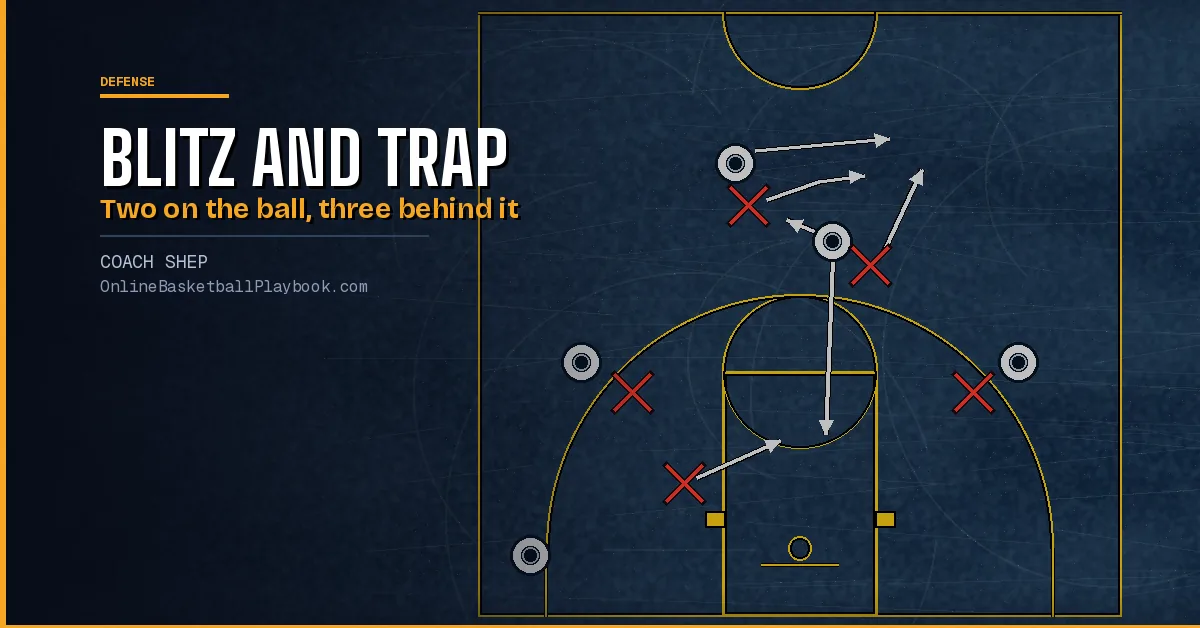
Blitz Pick and Roll Defense: How to Trap a Ball Screen
Blitz pick and roll defense explained: how to trap a ball screen, when the blitz fires, the rotation behind it, the offense's answers and the disguise.
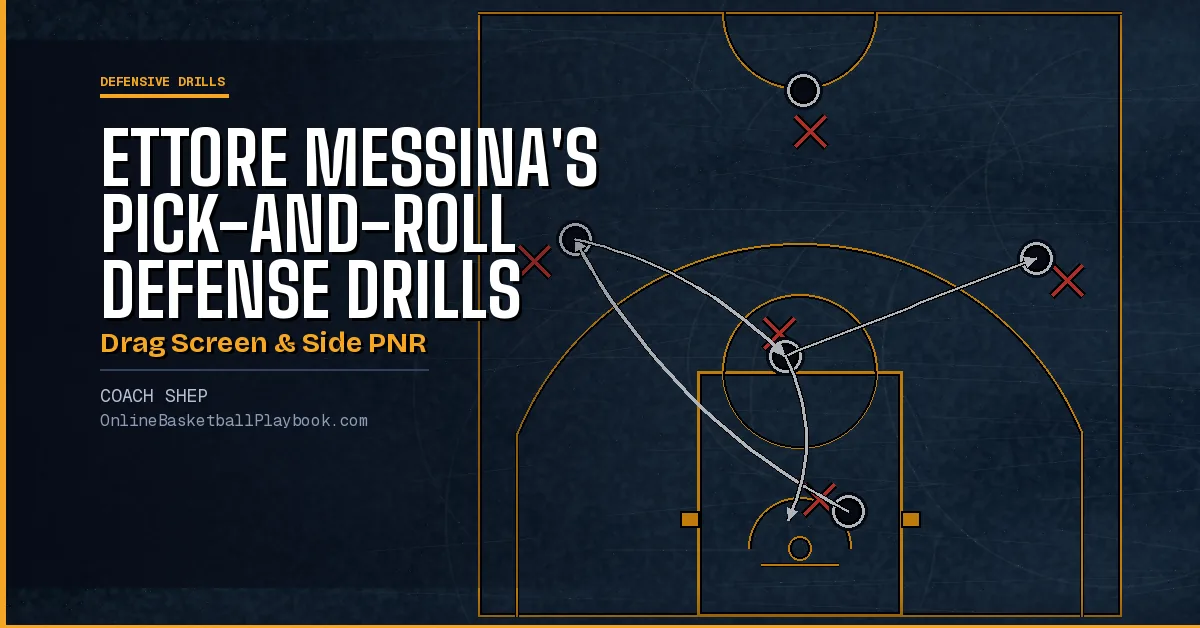
Ettore Messina's Pick-and-Roll Defense Drills: Drag Screen & Side PNR
Two 2-on-2 drills from Messina's clinic notes that fix the biggest reason teams give up easy buckets in transition: letting the ball handler reach the arc before the screen arrives.
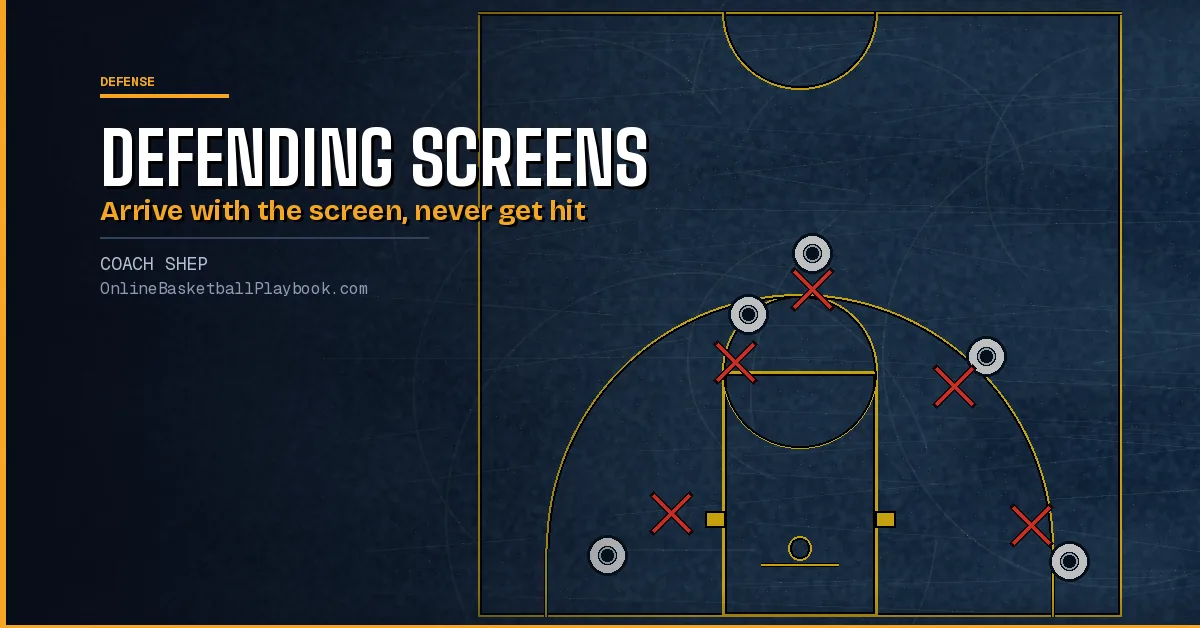
Defending Screens in Basketball: 5 Keys for Every Coverage
Defending screens in basketball comes down to five keys that hold under any coverage, for ball and off-ball screens, with the mistakes that cost baskets and drills.