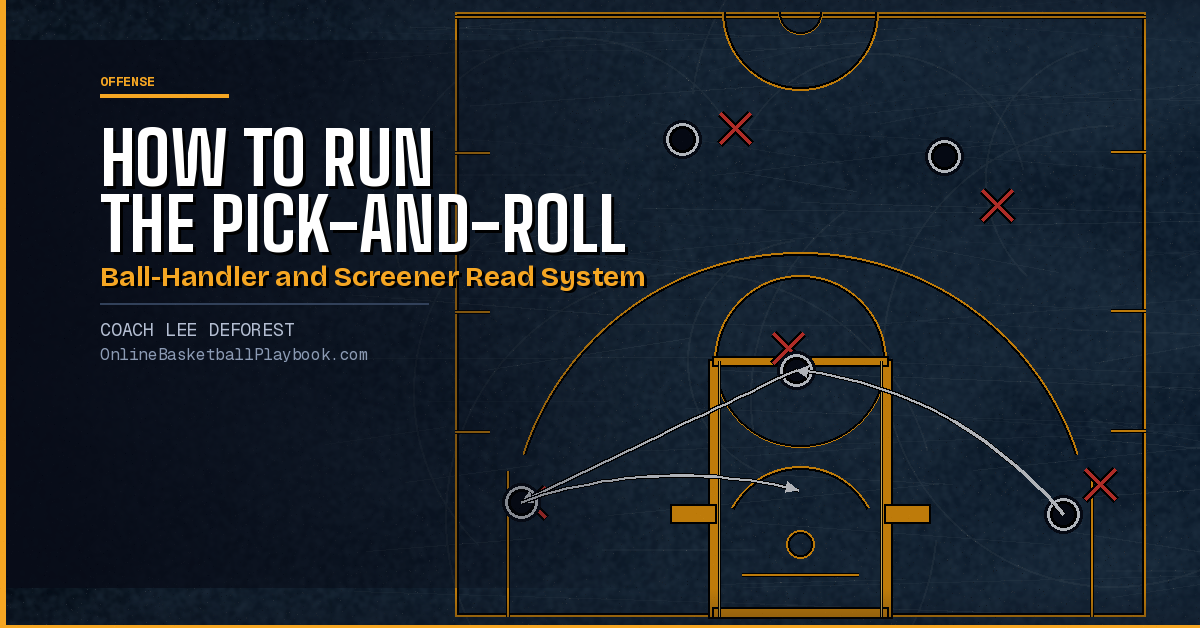

The pick-and-roll is the most-run action in basketball — and the least-taught. Most players know how to use a screen. Far fewer know how to read one.
The Three-Player Read System
The pick-and-roll is not a play — it is a read system involving at least three players simultaneously. The ball handler reads the defense coming off the screen. The screener reacts to how the two defenders play it. The spacing players — most critically the corner guard — relocate to maintain an open floor. When any one of these three reads breaks down, the action stalls into a two-man game against five defenders.
The clean teaching framework is this:
Ball-handler read: off the screen, attack the rim, dump to the post, or find the popping screener — based on how both defenders play it. The ball handler is not running a play; he is reading which of the two defenders gives him a lane.
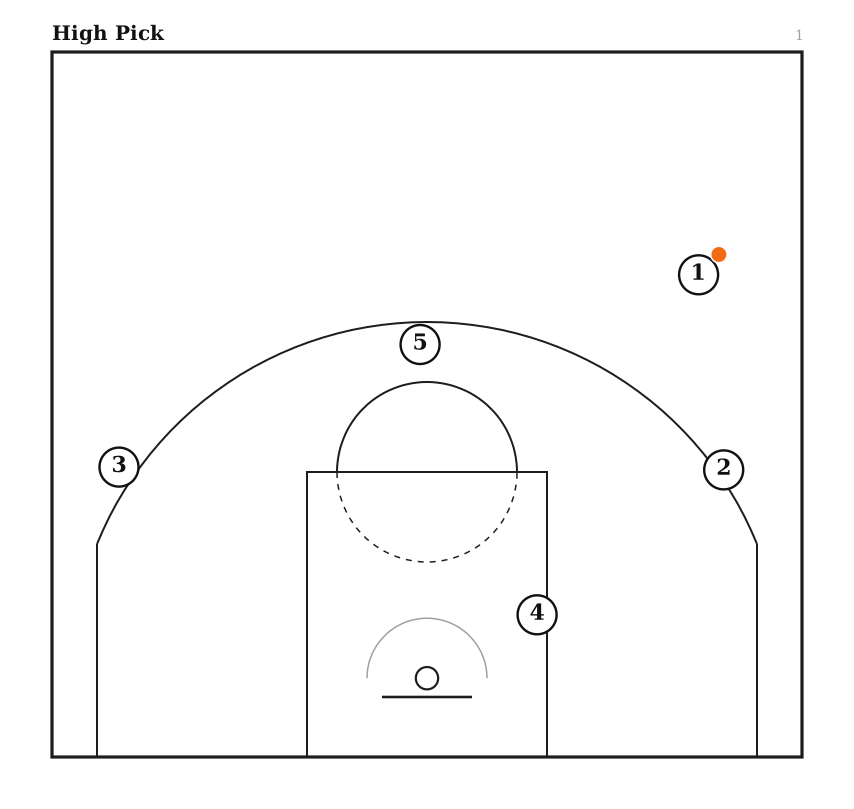
Screener read by defender height: if the defender hedges high, the screener slips to the basket automatically. If the defender contains or plays even, the screener rolls to the rim. If the defense switches or sags, the screener pops to the wing for a catch-and-shoot. This is not a guessing game — the screener reads the defender's stance, not the coach's call.
Corner lift as a rule: when the ball handler uses a wing pick-and-roll, the corner guard lifts into the vacated spot. This is not optional spacing — it guarantees a replacement shooter behind every drive and prevents the possession from dying if the ball handler's path closes.
The 8-Way Ball-Handler Taxonomy
Iowa's Todd Lickliter and Chad Walthall name and drill all eight ball-screen reads as distinct, practiced options. The goal: guards who can identify which situation they are in — and execute the matching read — instead of defaulting to one move regardless of coverage. All eight reads use the same screener alignment pre-condition: "low and wide," with the guard using shoulder-to-hip footwork at the screen and attacking one dribble to the paint as the target.
- Turn corner — the standard go-over. Drive off the screener's hip, turn the corner, attack the rim downhill when the defender goes over and the lane is open.
- Hesitate — change pace off the screen, then reject late. Slow the dribble to freeze the defender, then accelerate once the coverage commits.
- Split hedge — thread the dribble between the hedging big and the trailing on-ball defender when both hedge. Requires a tight dribble and a lane-level commitment. An underused but high-value read.
- Fake split — sell the split to draw the hedge, then kick to an open cutter or corner as the defense collapses.
- Reject — go away from the screen entirely when coverage shades hard toward the screen-side. Change direction and attack the opposite side.
- Shoot behind — stop and pull up using the screen as a legal pick on the trailing defender. Works when the on-ball defender is close enough to be screened.
- Re-screen — loop back for a second screen when the first is disrupted. Forces the defense to adjust twice and keeps the action alive.
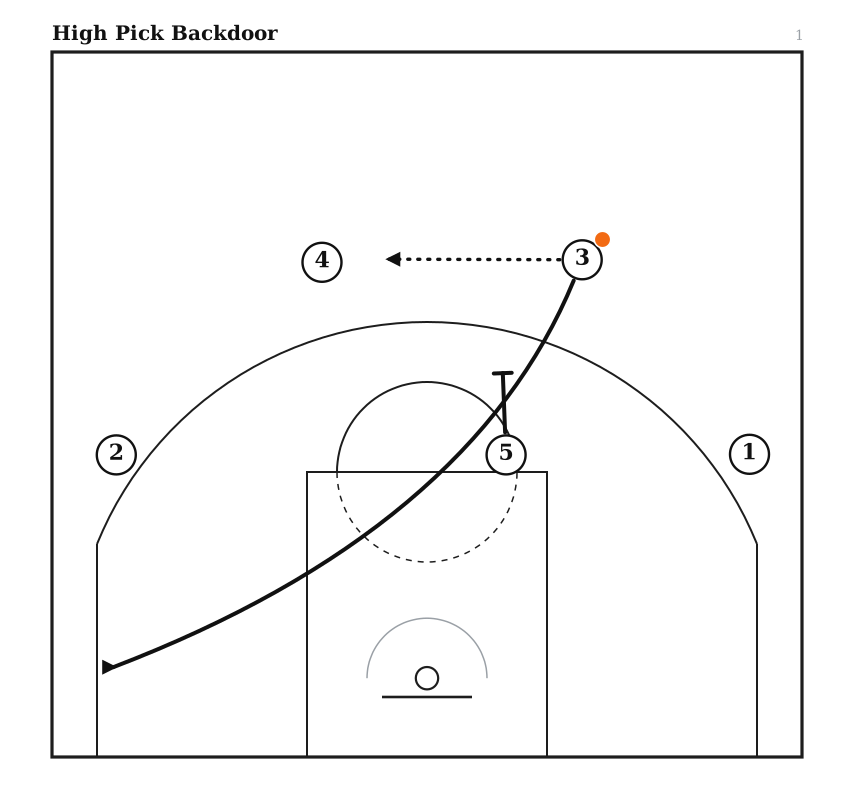
- Early slip — the screener reads the defender's stance as a high hedge and slips to the basket before the screen is fully set. Fires on the coverage tell, not after contact. This is the same principle as the Florida Spread's pre-read slip — the screener's job is to get ahead of the hedge.
"Tony Parker 'never expose yourself' — stop behind the screen if the defender goes under." — Kokoškov guard clinic, on the go-under-vs-over decision off a ball screen
The practical application: run a drill series that names all eight reads and practices each as a distinct situation. Guards who can say "I'm in a hesitate-and-go situation" make faster decisions than guards running one default move against every coverage.
Screener Reads: Six Options, Not Just Roll and Pop
The Euro ball-screen system (Lason Perkins / Basketball Immersion) names six distinct screener reads — not two. Teaching only "roll or pop" leaves four high-value options untaught and un-drilled.
Roll to rim — the default read against a show or hedge. When the defense commits two players to the ball handler, the roll opens behind both of them.
Pop to space — the switch and sag counter. A shooting screener who pops to the wing makes the switch coverage self-defeating — no separate play required, the pop is the built-in answer.
Short roll — hold position at the level of the ball handler to create a three-man passing triangle with the ball handler and a corner shooter. Used when the roll is clogged and the pop is covered; the short roll is the relief valve inside the action.
Re-screen — when the ball handler could not use the first screen, the screener turns and re-sets at a better angle. Forces a second defensive adjustment without requiring a new play.
Set flare screen — when the roll is covered, the screener pivots out and sets a flare screen for a third player. Turns a two-man game into a three-man action from one look.
Roll to opposite block — the cross-court post read when all other options are covered. The screener dives to the weak-side block and seals a smaller defender who has been dragged out of position.
The most undervalued screener read against a switching defense is the screener's pop to the three-point line. When the defense switches a smaller guard onto a big who can shoot, the pop isolates that mismatch before the help can rotate. No counter play is needed — the screener's existing read already defeats the switch. This is why versatile bigs who can shoot threes make the switching defense structurally unsound against a well-taught pick-and-roll.
Reading the Defense by Coverage
Advanced ball-screen execution means the guard identifies which of the six-plus defensive coverages is being shown, then picks from the matching read menu. The defense's answer tells the offense exactly what is open.
Drop coverage: the big drops under the screen to contain the drive. The pick-and-roll is no longer a pick-and-roll — it becomes a one-on-one situation against a deep-dropped big in space. Attack him directly; the rim is the target.
Show / Hedge: the big steps out aggressively to stall the ball handler. Wait at the screen; attack as the hedge recovers. The rolling screener is almost certainly open behind the show.
Blitz / Double-team: two defenders on the ball handler. Drive away to split the trap, dribble around the second defender, or throw back to the corner to trigger a "slice" cut to the rim. Never force a pass over two defenders.
Switch: post the smaller defender up; arc the big below the block to clear space; or run a "boomerang" back to the ball handler on the cleared side for an unguarded attack.
ICE / Denial of screener: the defense forces the ball handler baseline and denies the screener. Bypass the screener entirely; reverse to the wing or corner. Starting the screener lower in the set creates a bigger gap when the ICE is set.
- Drop: attack the big in space — it's now a 1-on-1, not a PnR
- Show/Hedge: wait, attack as it recovers, roller is likely open behind it
- Blitz/Double: drive away, split, or throw-back to corner + slice
- Switch: post the smaller man; pop the big; or boomerang to cleared side
- ICE: bypass the screener; reverse to wing or corner for a reset
Spacing Rules That Make It Work
The Florida spread offense treats spacing as the non-negotiable precondition of the pick-and-roll, not a byproduct of it. Two alignment rules govern the system.
The "Double Side" rule: when two players end up on the same side of the floor, one stays in the corner and the high guard holds the sideline. This preserves the pick-and-roll lane by preventing crowding. This is a named rule, not a read — players should be able to say "I'm holding the sideline" and understand exactly why. When two players drift to the same side, the ball handler's drive lane disappears before the screen is ever set.
Corner lift as a non-negotiable rotation: when the ball handler uses a wing pick-and-roll, the corner guard lifts into the vacated spot automatically. No decision is needed — this is a rule, and it guarantees a replacement shooter after every drive. Without this rotation, the offense produces one shot attempt off the action; with it, the action generates two read opportunities on the same possession.
The Florida spread runs two base alignments — 1-4 High and 4 Flat — specifically to guarantee four shootable spots are occupied before any screen fires. Spacing is designed before the ball moves, not scrambled into after the screen is set.
Countering the Blitz and the Double-Team
The blitz (or trap) is the coverage most likely to produce a turnover if the ball handler has no pre-planned answer. Two specific counters remove the panic.
Throw-back to the corner, slice to the rim: the ball handler dumps the ball to the corner, then immediately cuts ("slices") hard to the rim. The entire defense is momentarily committed toward the ball-side trap; the cut produces a layup opportunity before the help recovers.
Get it out of the two-on-one, get to four-on-three: against a hard blitz, two quick passes convert the trap into a numbers advantage behind the defense. The blitz pulls two defenders to one side of the floor. One outlet pass gets the ball free; the next pass finds the open man in the numbers advantage. Oats' system makes this explicit — the goal is not to survive the blitz, it is to convert it into a 4-on-3 before the defense recovers.
The Brad Stevens / Butler two-big system adds an important structural counter: a weakside big who is "lifted" drags his defender up and empties the rim area. When a show or hedge fires toward the roll, the rim is already cleared. The ball handler does not need to see through traffic — the open roll lane is a designed byproduct of where the second big is standing.
Ram, Spain, and Layered Pre-Triggers
The highest-level pick-and-roll systems add pre-triggers that force the defense to guard two screens simultaneously before the ball screen even fires.
Ram action: a guard is screened coming from the slot or corner, then immediately sets the ball screen — two defenders are already moving before the primary action begins. The defense cannot be set for the ball screen because they are reacting to the first screen.
Spain action: a third player back-screens the screener's defender simultaneously as the ball handler attacks off the ball screen. The defense must guard two screens at once with no recovery interval between them. Spain forces a choice — either the screener's defender helps on the roll, or the back-screen produces a lob at the rim.
Ram-Spain in sequence: both layers stack together. The defense is reacting to a screen before the screen, and simultaneously being back-screened during it. Against disciplined switching teams, this layering is the most reliable way to produce clean looks without executing a half-court play.
The Horns alignment from CSKA Moscow generates a 23-variant family where each named set is a specific coverage read: Ghost (defender went over early — reject the screen), Gut (hedge too aggressive — big slips under), Nash (first screen disrupted — big re-sets at better angle), Backdoor (wing is over-denied), Flare (screener's defender fights the roll — screener goes out). Installing Horns means teaching the counter menu, not just the base action.
How to Teach It — Progressions and Drills
The teaching progression that produces the fastest decision-making goes from 1-on-0 naming to live reads in three stages.
Stage 1 — 1-on-0 naming: the ball handler walks through each of the eight reads calling out its name before executing. No defense yet. The goal is vocabulary — a guard who can name the read executes it faster under pressure. Start here because it also builds the screener's habit: the screener narrates the defender's stance before deciding slip, roll, or pop.
Stage 2 — 2-on-2 with cued defenders: defenders give a specific coverage cue (show, drop, switch, blitz) so the offense can practice the exact matching read in a live-body context. Rotate coverages. The key coaching intervention is stopping the drill to confirm the ball handler saw the right cue and made the right read — not just whether the shot went in.
Stage 3 — 5-on-5 with named counters: the ball handler must verbally call the coverage as he comes off the screen. This forces conscious recognition in a game-speed environment. When a possession fails, the coaching question is which coverage the ball handler saw and whether the read matched it — not whether the shot went in.
The Timberwolves' "2 Man Sting" rule adds one zero-cost coaching habit: after the ball handler clears the alley screen, the screener turns and re-screens immediately. The defense has already committed to one assignment and must adjust twice. Teaching screeners to default to a re-screen after the first action is a habit that produces second-read opportunities inside any named set.
Common Mistakes That Kill the Action
The screener waits to see what happens. The screener's read must fire on the defender's stance, not after the outcome. A screener who watches the ball handler get hedged, then decides to roll, is a full step late. The slip and roll timing happens before contact.
The corner guard stays in the corner. When the corner guard does not lift after a wing pick-and-roll, the offense produces one shot opportunity on the action instead of two. The lift is not a reactive read — it is a mandatory rotation that fires every time the ball handler uses the screen.
The ball handler attacks the screener's defender. The ball handler's job is to attack the two gaps created by the screen — the rim gap and the pop gap. Going directly at the screener's defender collapses the action into a one-man play and signals to the defense that the pick-and-roll is not a threat.
No blitz counter installed. A team with no pre-planned blitz answer will turn the ball over the first time they face a hard double. The throw-back-and-slice takes five minutes to install and removes the highest-turnover situation from the whole offense.
Putting It All Together
The pick-and-roll is not fully installed until every player on the floor knows their role for every coverage. The ball handler needs all eight reads. The screener needs all six options. The corner guard needs the lift rule. The weak-side big needs to know when to duck in. The fifth player needs to know the cut-after-pickup rule when the drive is stopped.
Cut-after-pickup rule (Perkins): if the ball handler picks up his dribble in the downhill scoring area — the drive has stopped — the first cutter takes two cuts to the rim and the third player fills up. The second cutter takes three cuts and the second player fills up. This is a non-negotiable rotation that prevents a dead-ball possession from producing a held-ball or a rushed shot with three seconds left on the shot clock.
The dribble hand-off (DHO) is the highest-percentage trigger for the action at the NBA level. Nearly every elite ball-screen set fires a DHO before the ball screen — the DHO collapses one defender early, and the ball screen then hits a defense already in transition. Against a defense that is set and prepared, it is much harder to set up a drop or show coverage when the screen fires on moving feet.
Get Free Coaching Notes
Join the Online Basketball Playbook newsletter for new playbook breakdowns, drills, and practice-ready install ideas.
Get Free Coaching NotesSee it drawn up
Related diagrams
Keep Building
Related breakdowns
Advanced Strategies for Defending the Pick and Roll in Basketball
Advanced Strategies for Defending the Pick and Roll in Basketball