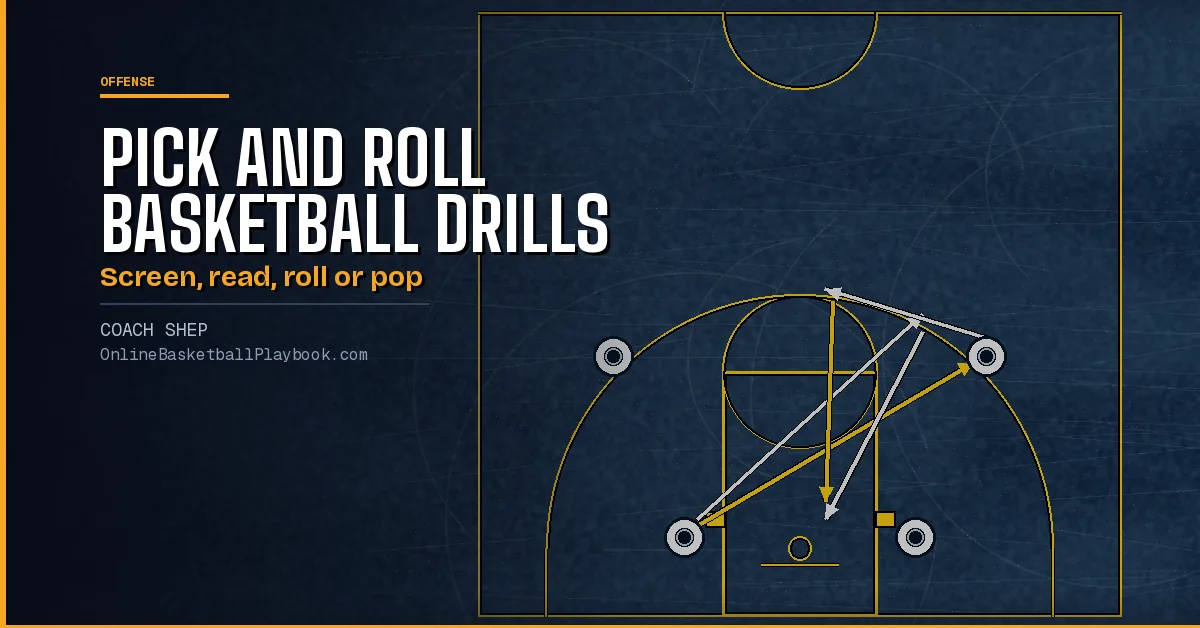
Pick and roll basketball drills turn the reads of a ball screen into habits. The drills on this page follow one order: the handler and screener work alone, then against a coach or a chair, then with a built-in advantage, then live against a defense that changes its coverage. Every screen in the diagrams is drawn where it is set.
The reads themselves, what to do against a hedge, a drop, a switch or a trap, are on pick and roll basketball, and the defensive side is on how to defend the pick and roll. This page is the practice plan between the two.
Pick and Roll Basketball Drills: The Install Ladder
Build the pick and roll as a decision-making progression. Each stage runs at 1, 2, 3 and 4 players before the team plays 5 on 5.
| Stage | What happens |
|---|---|
| Xv0 | The new skill with no defense, reps on fundamentals and reads |
| Xv coach | A coach steps in as the defender to guide each read in real time |
| Controlled advantage | The offense has one or two more players, such as 2 on 1, 3 on 2 or 4 on 3 |
| Game situation | Equal numbers and every read live |
The 1v0 stage lists what the handler and the screener each drill alone.
- Footwork. A two-foot stop and outside-in and inside-out steps.
- Dribbles. The handler takes short, long, stop-and-go and fast-and-slow dribbles, and the standard is the fewest dribbles possible before the pass or the shot.
- Passing menu. The pocket pass with the inside hand, the hook pass, a one-hand push pass, an underhand pass, an overhead jump pass and a spin push pass.
- Finishes. The regular, opposite-hand, power and reverse layups, the floater and the Euro step.
- Shots. A one- or two-dribble pull-up and a two-foot-stop jumper.
Design the action on a grid of five floor locations (corner, wing, the gap between wing and elbow, high elbow and middle) and four spacing patterns (an empty side and one, two or three shooters opposite). Decide which locations and spacing patterns you want before you design the drills.
Climb the ladder one stage at a time.
A Five-Drill Screener Series
This series puts a post on each block and a guard on each wing, and every drill uses the same rotation. Guards stay outside and switch sides, posts stay inside and switch sides, and the sides alternate each rep.
1. Pick and Roll
The post on the right block passes to the guard on the opposite wing, follows the pass and sets the ball screen.
The guard comes off it and the screener rolls in a straight line to the rim for the pass and the layup. Then the post on the left block passes to the right wing and runs it from that side. The guard can also hit the roller with a bounce pass around the free-throw line before he reaches the rim.

2 and 3. Short Roll, Step-Through or Jumper
The same action, but the screener stops his roll near the free-throw line, catches a bounce pass there and jump-stops. In drill 2 he shot-fakes and finishes with a step-through to the rim. In drill 3 he shoots the pull-up jumper.

4. Fake Screen and Slip
The screener fakes setting the screen and cuts sharply back to the rim for the pass and a layup or dunk. He has to sell the fake to beat his defender.

5. Pick and Pop for Three
The screener pops out to the arc instead of rolling. The guard takes a dribble or two over the screen and passes back to the post for the catch-and-shoot three.

A similar daily set works for bigs off a sprint screen, all from both sides of the floor:
- Roll and finish. Roll to the rim and finish.
- Roll into a second move. Roll to the rim into a second move against a manager playing weak-side help.
- Pop to the short corner. Pop to the short corner for a jumper.
- Pop, fake and drive. Pop to the short corner with a shot fake and drive.
Screening technique itself is on basketball screening technique. Run the same rotation in every drill.
Chair and Coverage Reads for the Handler
A guard can rep the handler's reads alone with a chair as the screener.
- Nine coverages in one drill. A scoring series has the guard score against a soft hedge, a hard hedge, a split, ice coverage, shooting behind the screen, rejecting the screen, an elbow bounce-out, putting the defender "in jail" and attacking a switch.
- Nine dribble reads. Turn the corner, bounce out, split, reject, shoot, running back, ice, cut back and bounce off.
The split has its own page, how to split a ball screen, and a fuller read list for guards is on pick and roll drills for guards.
Rep the reads alone before you add a live defender.
Get the next coaching guide in your inbox
One email when a new guide or diagram set goes up. Free.
Advantage Drills
Advantage drills manufacture the moment a real ball screen creates, a split second where the offense has two players on one defender, and make players find it before it closes.
Cone-Touch Ball Screen Advantage
It starts 2 on 2 with a coach as the feeder.
- Contested lead cut. The guard makes a contested lead cut from the elbow to catch the coach's pass.
- Screen and touch. On the catch, the second player sprints up to set the ball screen, and his defender must first touch a cone and sprint back into the play, so the offense has a brief 2 on 1 off the pick and roll.
- 3 on 3. A live player replaces the coach and the same rule applies to the screener's defender, which makes a momentary 3 on 2.
- 4 on 3. An undefended player passes to the guard and sprints to set the ball screen, and the guard reads where the advantage is.

One Read at a Time
The same idea runs one read at a time.
- 1v1. Reads against a downed ball screen, a pick and pop and a live ball screener.
- 2v1. Turning the corner against a corner defender who stunts and a pick-and-pop drive decision.
- 2v2. Attack the short roll.
- 3v2. A 6-second high ball screen, among others.
- 3v3. A hit-and-get ball screen.
- Chain the actions. A high ball screen into a handoff and a weak-side pin-down, so players see how one action creates the next read.
Find the advantage before it closes.
Live Coverage Drills
Once the reads are named, the defense has to stop being predictable.
- A new coverage every rep. Run a ball screen drill where the guard can go either way and hits the baseline player or the roller, while a defender on the screener plays a different coverage each time. The team rules say to make players run for dribbling to nowhere, turnovers and a few other habits.
- A screen-away drill that goes live. Start with three lines and a token defender: the point guard passes to the right wing, screens away for the left wing, and the screener rolls after the cutter clears. Once screening is clean it goes live 3 on 3, and the defense may fight through, slide behind or call a switch, so the coach teaches defensive coverage in the same rep.
- The switch counter. The on-ball drill has the screener set a front screen for the dribbler. If the defense does not switch, the dribbler drives for the layup and the screener rolls as the trailer for the rebound. If it switches, the screener seals the defender who switched and rolls to the rim for a bounce pass.
- A weekly schedule. A 12-week point guard calendar runs the basics on Mondays and the next level on Tuesdays and Wednesdays.

For the coverage names and every handler answer, see how to attack every ball screen coverage. For a full offense built on the action, see drills to teach ball screen continuity offense. The matching defensive drills are on drills to teach ball screen defense.
Change the coverage every rep so the reads stay honest.
Pick and Roll Drills for Youth Basketball
Youth programs put the ball screen later and keep the reads few.
- When it comes in. Add screening for ages 10 to 11. The tactics for that age include setting and using screens, defending screens, screening off the ball, fighting through screens and the pick and roll.
- Four reads in order. Give the handler four reads: turn the corner for a layup or floater when the defender goes under, a pull-up when the defender trails or the hedge retreats, a pocket pass to the roller when the defense collapses, and a skip pass when more than one defender rotates. The screener rolls the moment the guard turns the corner.
- The two youth errors. Watch for a handler who uses the screen before it is set and a screener who leaves before the guard turns the corner. Both produce a moving-screen call.
- One in, one out. After the action one player attacks the basket and one becomes a perimeter threat.
The moving-screen rule by level is on illegal screen in basketball.
Keep the reads few and the screens set.
Choices in Teaching the Pick and Roll
Start with defense or without?
- No defense first. Then a coach, then an advantage, then live.
- Change the coverage every rep. A live drill with a defender on the screener changing coverage every rep.
How to make the advantage?
- Touch a cone. The screener's defender touches a cone.
- Add a player. An extra offensive player, such as 4 on 3.
What does the screener drill?
- Roll, short roll, slip and pop. All off one setup.
- Roll and pop with a second move. Against a help defender, daily.
Switch answer
- Seal and roll. Seal the smaller defender and roll for a bounce pass.
- Pop to three. A shooting big pops to three.
Pick an answer for each question and teach it the same way all season.
Want the printable playbook packs?
OBP Pro members get the premium playbook packs: the zone attack, out of bounds and practice plan PDFs, plus each new pack as it is finished. The membership page lists what is in each one. Or draw your own version free in PlayDraw.
See what OBP Pro includesQuestions Coaches Ask
What are the best drills to teach the pick and roll?
A screener series off one setup (roll, short roll, slip and pop), chair reads for the handler, an advantage drill where the screener's defender must touch a cone, and a live drill where the coverage changes every rep.
How do you teach the pick and roll to youth players?
Add it after basic screening, keep four handler reads in order, and coach the two errors: using the screen before it is set and rolling before the guard turns the corner.
How do you practice the pick and roll alone?
Use a chair as the screener and work through a list of coverages, such as a soft hedge, a hard hedge, ice, a switch and shooting behind the screen.
What is a short roll?
The screener rolls only to about the free-throw line, catches and makes a play there with a jumper, a step-through or a pass.
When should the screener slip?
In the screener series, the screener fakes the screen and cuts back to the rim. Coverage reads that trigger a slip are on the pick and roll page.
How often should a team drill the pick and roll?
A 12-week development calendar puts it on three days a week, Monday for the basics and Tuesday and Wednesday for the next level.
More Guides From This Batch
- Basketball Speed and Agility Drills: Sprints, Starts and Stops
- Fast Break Basketball Drills for Youth and Varsity Teams
- Flagrant Foul in Basketball: Rule, Penalties and Calls by Level
- Jab Step Basketball: How to Do It and How to Teach It
Back to Basketball Screens and every Offense page.
Keep Building
Related breakdowns
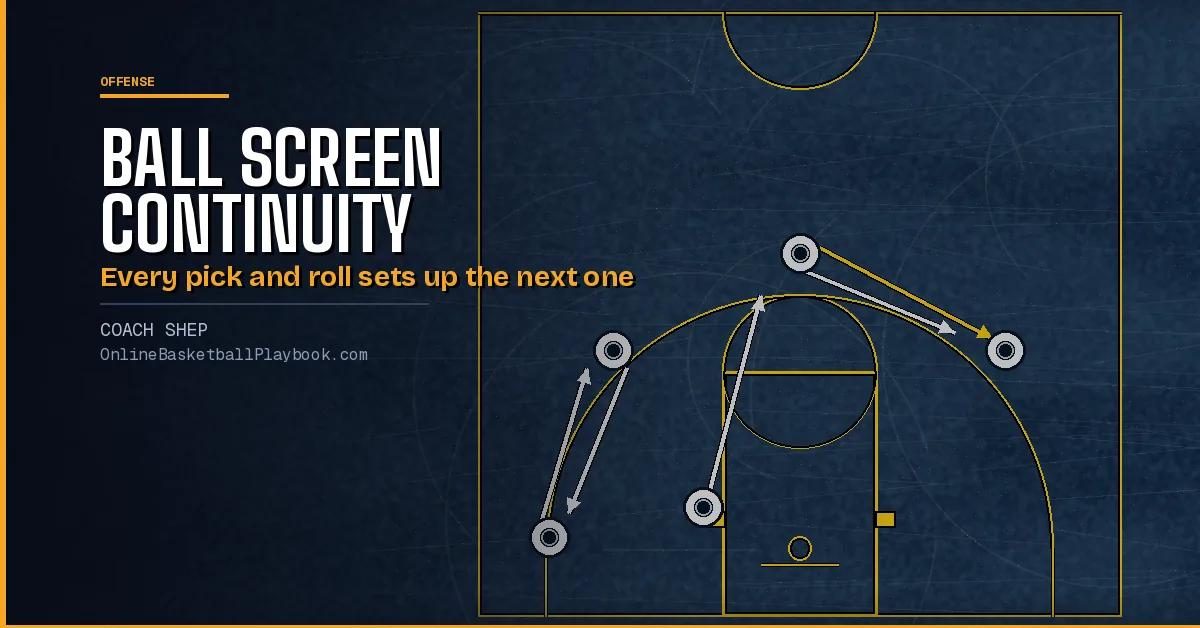
Ball Screen Continuity Offense: Pick and Roll Rules and Reads
Ball screen continuity offense in full: the 4-out and two-big engines, reload rules, spacing, angles, reads, counters, Spain, Ram, double drag and zone sets.
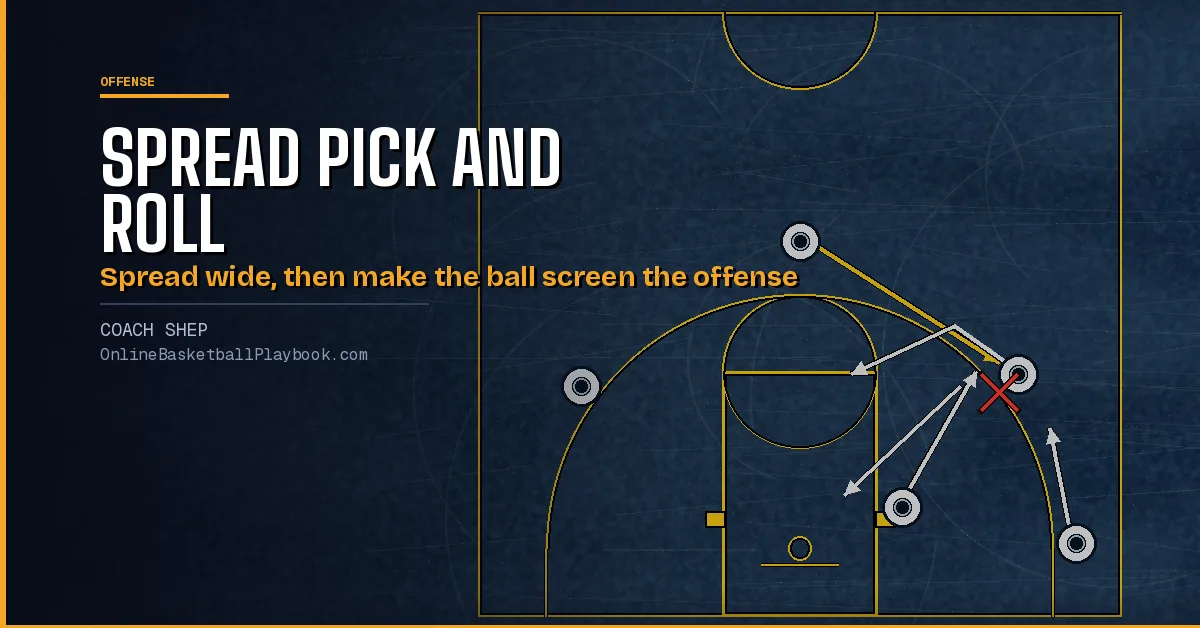
Spread Pick and Roll Offense: Flat Screens, Reads and Counters
Billy Donovan's spread pick and roll offense step by step: the trail pass, the angled wing screen, the second side, the flat screen and the counters.
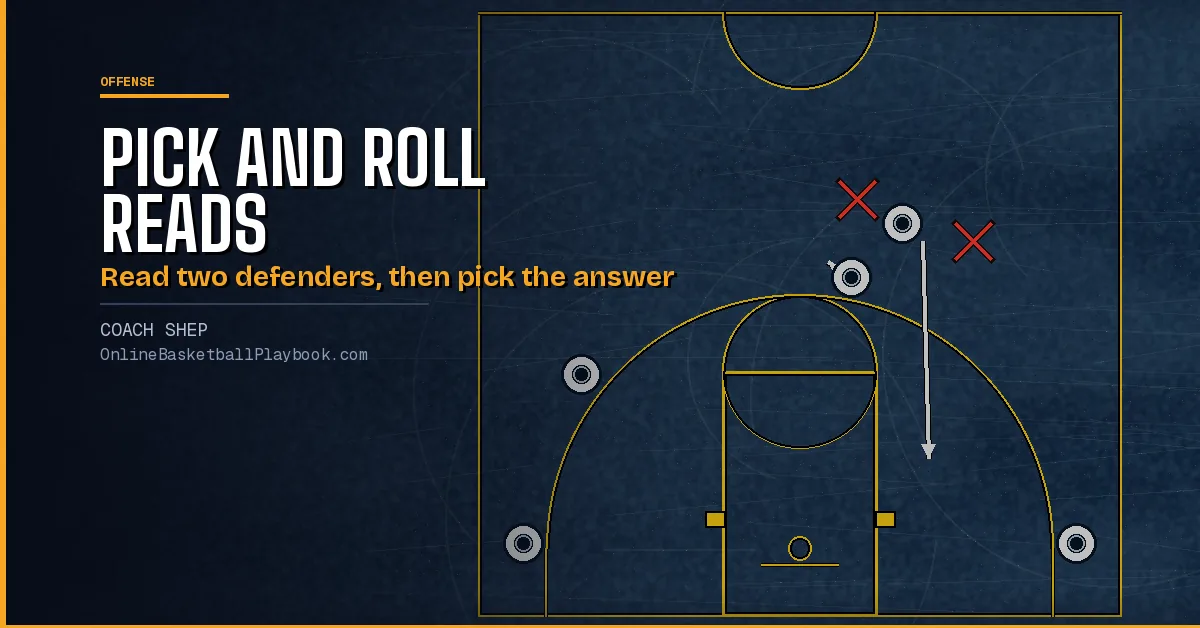
Pick and Roll Reads: Reading Ball Screens by Coverage
Pick and roll reads for the ball handler and the screener: the first read, every coverage and its answers, the third defender, the names and a teaching ladder.