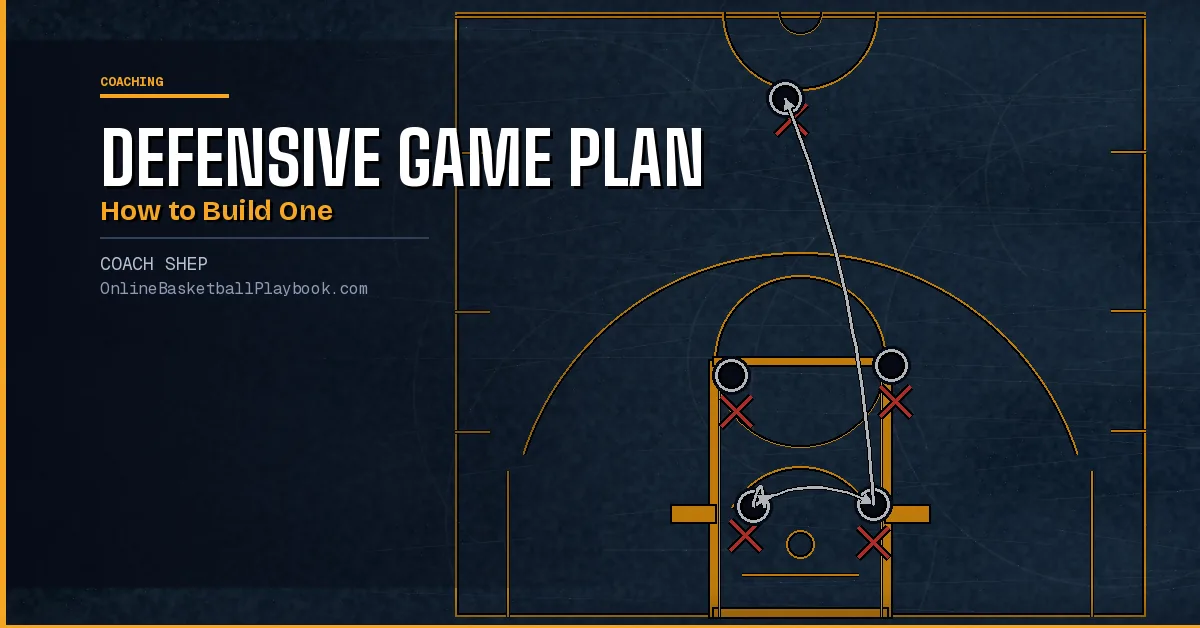
A defensive game plan is not a list of rules. It is a system. This guide walks you through choosing a base defense, scouting opponents, drilling your concepts, and teaching players to compete at game speed.
Start With Your Base Defense
Every defensive game plan starts with a foundational choice: what will you run every possession, regardless of opponent? Your base defense sets the vocabulary your players operate in. All adjustments, wrinkles, and game-to-game changes layer on top of that foundation. If you change the whole thing from week to week, players never develop true defensive instincts. They just memorize assignments.
The two most common base defenses are man-to-man and zone. Man-to-man defense demands individual accountability. Each defender owns a specific offensive player, reads their movements, and contests every shot. Zone defense divides the court into areas and teaches players to guard space rather than a person. Both have merit, and most programs run one as their primary and keep the other available as a change of pace.
When choosing your base, ask three honest questions. First, do your players have the athleticism to stay in front of quicker opponents in man coverage? Second, do they communicate well enough to execute zone rotations without breaking down? Third, which system can you actually teach in the time you have? A poorly executed man-to-man is worse than a well-drilled zone. Pick the defense your players can master, not the one that looks best on paper.
Once you settle on a base, commit to it. Post it in the locker room, drill it daily, and hold players accountable to its rules even in scrimmages. The goal is to build enough repetition that defensive decisions become automatic. When a player has to think about where to be, they are already a step behind.
Scouting and Opponent Preparation
A defensive game plan specific to a particular opponent begins with scouting. Your job is to identify their two or three most dangerous offensive threats and take those away without abandoning your system to do it. The biggest mistake coaches make is building an entirely new defense for each opponent. That approach confuses players and costs you more than the adjustments gain.
Start with their best scorer. Where do they get their points? Off the dribble from the wing? Post catches on the left block? Curl cuts off screens? Once you identify the locations and actions that fuel their offense, you can shade your coverages accordingly. You do not need to deny every touch. You need to make their preferred action difficult and force them into something less comfortable.
Next, look at their ball-screen game. Defending the pick and roll is the central challenge of modern basketball at every level. Does their point guard shoot well off the dribble, or does he prefer to attack downhill? Does the screener pop to the three-point line or roll to the basket? Your coverage (hedge and recover, drop, or switch) should be based on the specific personnel you are facing, not a blanket rule.
Finally, chart their transition offense. Do they push the pace immediately, or do they prefer to set up in the half-court? Teams that get easy points in transition will beat you before your defense even has a chance to organize. Understanding their habits lets you prioritize your defensive transition rules and your rebounding assignments after made baskets.
Installing the System in Practice
Knowing what you want to do defensively is only half the work. The other half is teaching it, and the best way to teach defense is through breakdown drills that isolate one habit at a time before putting the whole system together. The approach that works at every level is whole-part-whole: show players the complete picture, drill the individual pieces at high intensity, then reassemble in five-on-five.
A well-designed practice will include a daily defensive breakdown segment before live play. Spend eight to fifteen minutes on a specific skill: closeouts, on-ball footwork, help-side rotation, or trap coverage. Then take it five-on-five. Players need to see how the drill connects to the game, or the drill becomes an isolated exercise with no transfer.
Footwork is the foundation of every defensive skill. Before you teach rotations and stunts, you have to teach stance, slide, and recovery. Players who lunge with their feet tend to reach with their hands, and reaching leads to fouls and easy drives. Basketball footwork drills done daily create the muscle memory that holds up under game pressure when decisions have to be made in fractions of a second.
Closeouts deserve their own daily attention. The sprint-chop-contest sequence sounds simple, but players consistently over-run closeouts and leave themselves out of position to contest the shot. Teach them to sprint the first two-thirds of the distance, then break down into choppy steps with hands high. "Appear closer than you are." A defender in a good closeout position forces hesitation even before the shot goes up.
One rep at game intensity teaches more than ten reps at half speed. Coverage work, particularly ball-screen coverages, should be run at three-quarter speed with full communication required. If players are not talking (calling out the screen, the roll, the skip), the rep does not count. Defense is a communication sport. Silence is a breakdown waiting to happen.
Help Defense and Team Principles
Individual defense loses to good offenses. Team defense (built on shared principles, consistent rotations, and trust) is what stops disciplined opponents. Help defense principles are the connective tissue between individual matchups and team structure.
The most fundamental help principle is this: when the ball drives, the nearest off-ball defender drops into the paint to protect the basket. This is not optional. If your players help on contact only, or only when they feel like it, your defense will give up drive-and-kick threes all night. Help must be automatic, and it must happen before the drive reaches the paint, not after.
Equally important is the recovery after helping. A player who helps and does not recover becomes a liability. The sequence is help, stop the drive, sprint back to your assignment or cover the most dangerous open player. Teach this sequence so clearly that it becomes a habit. Then hold players accountable to it in every five-on-five rep. One lapse in recovery creates an open corner three, and that is a two-possession swing in the wrong direction.
The shell drill is the best tool in any defensive coach's kit for installing and reinforcing these principles. Four defenders, four offensive players, no scoring. Just movement, help, recover, and rotate. Run it slow enough to identify every error, then speed it up until players are executing the rotations by feel. The shell drill is where defensive culture gets built, one rep at a time.
Establish your non-negotiables clearly and post them where players see them every day. What does your defense never allow? Layups? Second chances? Transition threes? Having three or four hard rules that every player knows and that you enforce consistently creates defensive identity. A team with identity competes even when talent alone is not enough.
Defending Special Situations
A complete defensive game plan accounts for the situations that do not happen on every possession but determine outcomes: out-of-bounds plays, late-clock possessions, and opponent sets run at the end of halves. Teams that have practiced these situations stay composed. Teams that haven't panic and give up easy points at the worst possible moments.
Baseline out-of-bounds plays are among the most overlooked areas of defensive preparation. Many teams have automatic two- or three-point opportunities built into their baseline set (a back-screen followed by a lob, or a screen-the-screener action that springs a catch-and-shoot three). If you have not scouted an opponent's baseline sets, you are handing them free points. Watch their BLOB and SLOB sequences on film and build a specific coverage for the two or three most dangerous ones.
Late-shot-clock defense is a separate skill set. When the offense is desperate, they often abandon structure and go to their best player in isolation. Your defense needs to know when to switch everything to eliminate confusion, and your best on-ball defender should know those are his moments to take over. Establish a shot-clock cutoff. At eight seconds, call a cue word that tells players to lock into man no matter what.
End-of-half situations deserve a two-minute segment in practice every week. Many games are decided by what happens in the last thirty seconds before halftime. Do your players know when to foul and when to let time expire? Do they know the opponent's go-to action in a half-court set with five seconds on the clock? Walk through two or three scenarios each week so players are not making those decisions for the first time in a real game.
Adjustments and In-Game Decisions
No defensive plan survives the first five minutes of a game without needing some adjustment. What matters is how quickly you identify a problem and how clearly you communicate the fix. Halftime is the most obvious adjustment window, but the best defensive coaches make small corrections in real time (a thirty-second timeout, a substitution that changes the matchup, a quick signal from the bench that shifts the ball-screen coverage).
Watch for the pattern, not the single play. One open shot might be random. Three open shots from the same location in six minutes is a pattern, and you have to respond. If their point guard has twice gone left off the pick-and-roll and converted, your drop coverage is not working against this matchup. Switch to a hedge or a semi-hedge and see if that forces him into a different read.
Changing from your base to a zone or a press is a significant adjustment. Use it deliberately, not desperately. A 2-3 zone defense can throw off an opponent who has been reading your man coverage all game, but only if your players know the zone well enough to execute it under pressure. Switching defenses works as a change of pace; it fails when it exposes unfamiliarity. The same applies to a full court press defense: It can generate turnovers and change tempo, but it also creates fast-break opportunities for the opponent if your rotation breaks down.
Document your adjustments. After each game, note what the opponent did that hurt you, what adjustment you made, and whether it worked. Over a full season, that record becomes a coaching resource. You will start to see recurring problems your defense has against certain offensive styles, and you can address them in preseason before they cost you games.
Before tip-off, confirm your players know: the opponent's top scorer and how you are guarding them, the ball-screen coverage you are running tonight, who is your primary on-ball defender, your first-half transition defense rules, and which special situations you may see in the fourth quarter.
- Choose a base defense and stick to it: adjustments layer on top of a system, they don't replace it
- Scout their top two threats: identify the locations and actions that generate their best shots
- Run daily breakdown drills: eight to fifteen minutes of focused defensive skill work before live play
- Establish three non-negotiables: hard rules your defense never violates, posted and enforced every day
- Shell drill builds team defense: use it to install rotations, help principles, and recovery habits
- Prepare for special situations: practice baseline inbounds, late-clock defense, and end-of-half scenarios weekly
- Document in-game adjustments: build a season-long record of what hurt you and what fixed it
Get free play diagrams, drills, and coaching guides delivered weekly.
Draw this play free in the play drawer →
Membership: the full library, playbook packs, and Pro drawing tools →
Keep Building
Related breakdowns
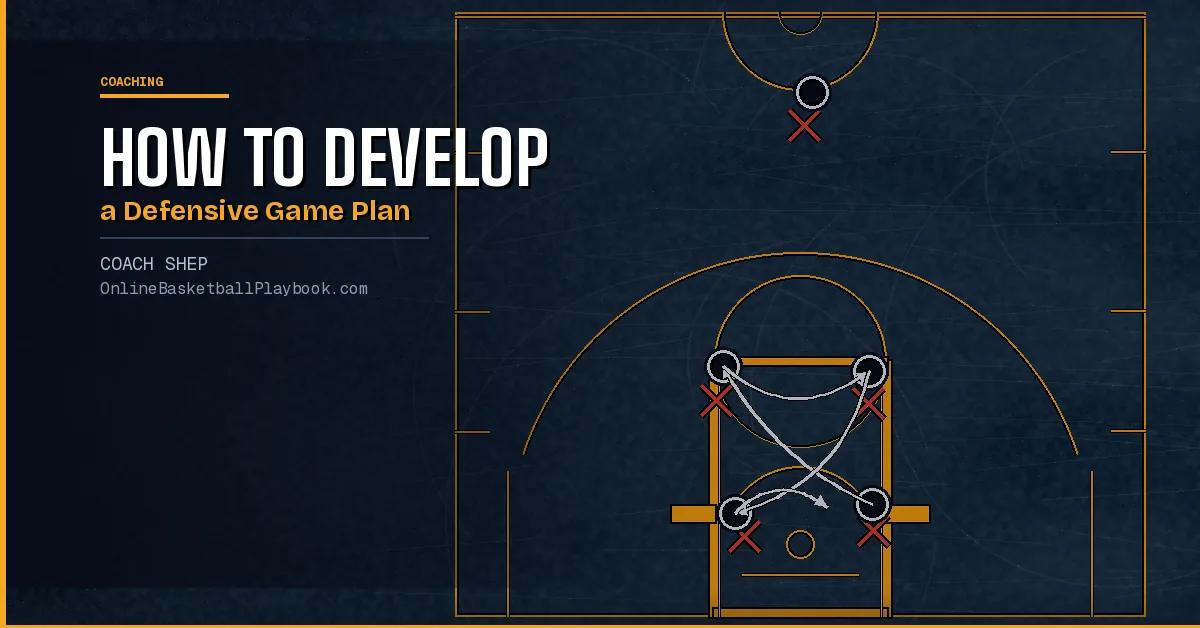
How to Develop and Implement a Defensive Game Plan
How to Develop and Implement a Defensive Game Plan
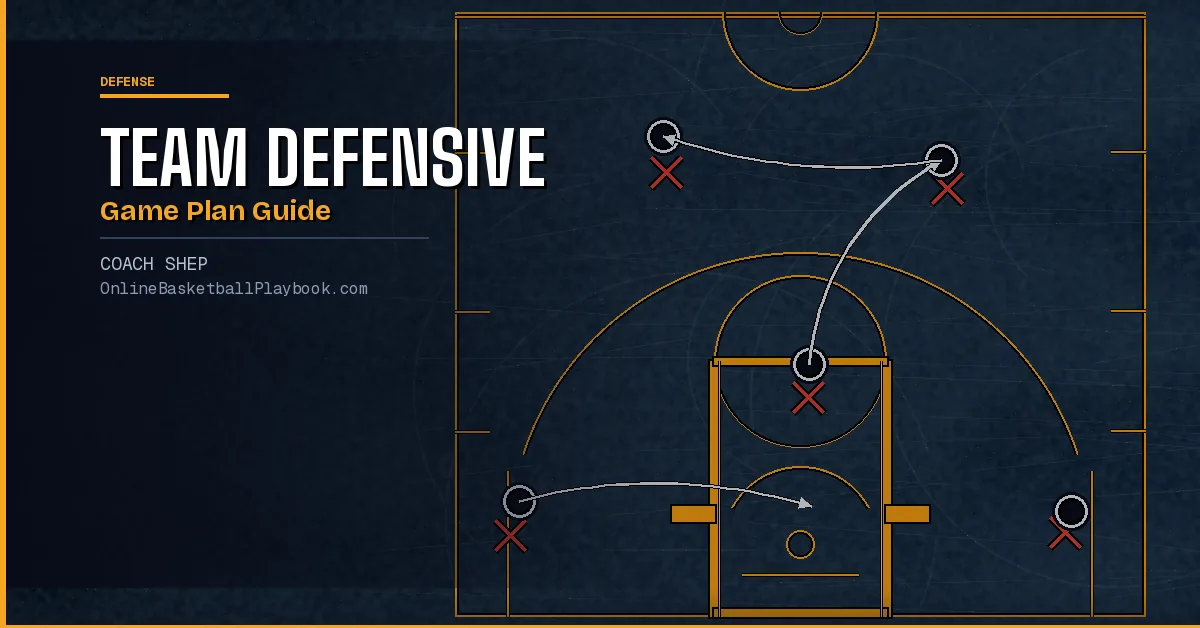
The Complete Team Basketball Defensive Game Plan
The Complete Team Basketball Defensive Game Plan
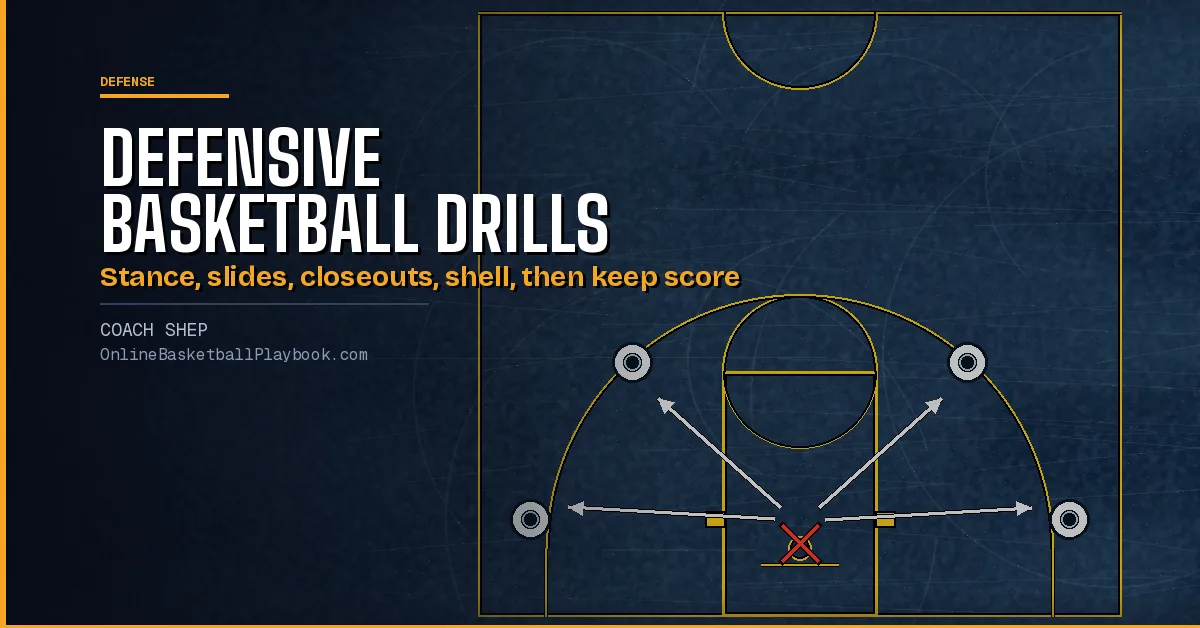
Defensive Basketball Drills: Slides, Closeouts, Shell and Games
Defensive basketball drills in teaching order, from stance and defensive slide drills to closeouts, pass denial, shell and scored games, with the versions coaches split on.