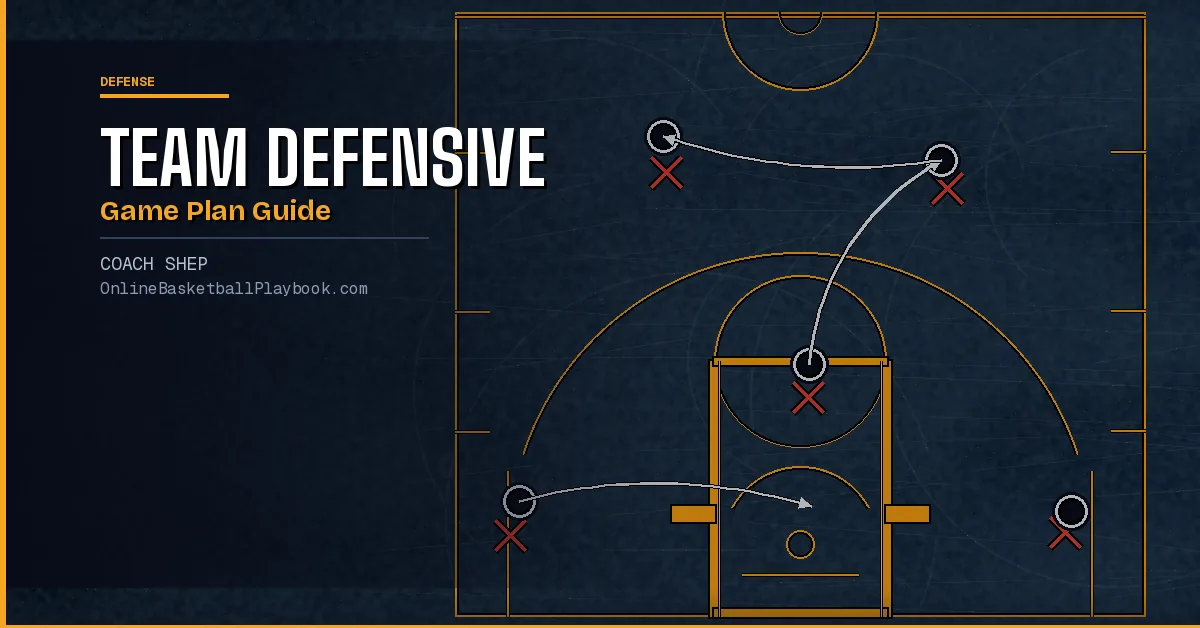
A great team defense is built on shared habits, not individual talent. This guide walks through every layer (principles, coverages, breakdown drills, and rotations) so your team plays as one connected unit on every possession.
The Foundation: Principles Every Player Must Know
Before you draw up a single coverage or rotation, every player on your roster needs to understand why your defense works the way it does. A defensive system without shared principles is just a collection of individual decisions, and individual decisions fall apart under pressure. Great teams defend with one mind because they have internalized the same values.
The first principle is ball pressure. Whoever is on the ball sets the tone for every other defender on the floor. Tight, active ball pressure forces the offense into longer holds, slower passes, and off-balance decisions. It gives your help defenders an extra half-second to recover, and it disrupts the timing that every well-coached offense depends on. When your on-ball defender is passive, the offense gets to run their sets exactly as designed, and that is when good offenses are at their most dangerous.
The second principle is vision. Every defender must see both their man and the ball at all times. Deny coverage only makes sense when players can track the skip pass and recover before the catch. Help rotations only work when the helper has already identified the danger before they rotate. The classic "ball-you-man" alignment keeps your defenders in the right position mentally and physically to make the next play, not reacting to what already happened.
The third principle is communication. Defense is the loudest thing on the floor when it is working. Screens must be called early. Switches must be announced. Rotations must be confirmed with voice before feet move. A team that communicates on defense catches ball screens before they happen, finds cutters before they receive, and closes out with purpose instead of panic. Build communication into your practice culture through basketball team culture habits from day one, not as an afterthought.
These three principles, ball pressure, vision, and communication, are the operating system. Every coverage, every rotation, every drill you install runs on top of them.
Building Your Man-to-Man System
Man-to-man defense is the foundation of nearly every serious defensive program because it forces individual accountability and creates the clearest path to development. When a player knows exactly who they are responsible for, there is no ambiguity about whether a breakdown was systemic or personal. That clarity is what makes man-to-man the best teaching defense at every level.
Your man-to-man defense needs three components to function: on-ball technique, off-ball positioning, and a defined approach to denial. On-ball, your players need a consistent stance, feet shoulder-width apart, weight on the balls of the feet, lead hand active in the passing lane. Off-ball, the rule is simple: the further your man is from the ball, the further you can sag toward the lane. One pass away means denial or at least tight positioning; two passes away means you can help load toward the paint while keeping vision on your man.
Denial defense works when your players are disciplined about their positioning relative to both the ball and their man. Denying the wing pass keeps the ball in the corner of the court where fewer scoring options exist. Denying the post feed forces the offense to operate above the three-point line instead of in the paint. But denial requires commitment. A player who half-denies gets beat by every back-cut. Teach your players to either be in full denial or drop to ball-side help. There is no middle ground that works consistently.
One of the most effective tools for building man-to-man is the shell drill. The shell drill teaches all four off-ball principles simultaneously: ball-you-man alignment, one-pass denial, help position at the elbow, and rotation on the drive. Running it daily for ten minutes installs the defensive structure faster than any lecture or whiteboard session. Players learn through reps, and the shell drill is the rep that builds every other defensive habit.
Help Defense and Rotation Rules
The single most important thing you can teach about help defense is that it has to be proactive, not reactive. A help defender who waits until the ball is already past the on-ball defender is too late. By that point, the offense has already won the exchange and the defense is scrambling. Great help defenders move before the drive happens. They read the angle, the body position of the ball handler, and the positioning of their own man, and they pre-load toward the help position before the drive is live.
Your help defense principles should define three things clearly: who helps, from where, and what triggers the rotation. The most straightforward system is the dig from the weak-side elbow. When the ball drives baseline, the high-side help defender digs from the lane line extended, while the opposite post defender covers the basket. When the ball drives middle, the weak-side player at the lane line provides help, and the corner defender on the weak side rotates toward the paint to prevent the kick to the corner three.
The close-out is the final piece of the help rotation system. After a skip pass or a kick-out from a drive, your defenders must close out under control, not in a straight-line sprint that sells out to a drive or a blow-by. Teach the two-thirds principle: sprint hard for the first two-thirds of the close-out distance, then break down into choppy steps with hands up to contest the shot without fouling. A poor close-out creates either a clean look or a foul. A disciplined close-out takes away the shot without giving up the lane.
Breakdown Drills That Install the System
The best defensive coaches in the game do not install defense with five-on-five scrimmage. They build it from the ground up using part-whole methodology: isolate a single skill, drill it at game-realistic intensity, then re-assemble the pieces into the full system. This approach speeds up learning because players are not trying to process the entire defense at once. They master one piece at a time, then connect it to the others.
The footwork progression is the starting point. Stance work, step-slides, and the one-step recovery drill must come before any concept work. Players who are not in an athletic stance and cannot move their feet are going to get beat regardless of how well they understand the system. Spend the first weeks of the season establishing the physical habits: feet shoulder-width, weight forward, slide without crossing feet, keep the hips low. These are the mechanics everything else runs on.
Trap-skill drills come next. Circle trap, sprint-out, and back-pursuit reps teach your players to be active in the passing lanes without fouling. The shared rule across all trap drills is steal off the ball, not on the ball. Going for the steal on a live dribble is a low-percentage gamble, but deflecting the pass out of a trap is a high-percentage play that creates turnovers at a sustainable rate.
The close-out drill ties the help system together. Tag each close-out with a defensive label so players know what their assignment is before they leave the floor. A Curry close-out (run completely off the line for a shooter) is different from a Wade close-out (get tight and contest on the rise) is different from a Rondo close-out (stay off a non-shooter, contest late, take away the drive). When your players know the label before the game starts, the close-out becomes a decision that was already made, not a split-second gamble.
Your basketball practice plan should reserve 10–15 minutes per session for defensive breakdown work. Separate it from five-on-five so the reps are focused and accountable. Then re-assemble in five-on-five at the end of practice so players see how the pieces fit together under competitive pressure.
Defending Ball Screens and the Pick-and-Roll
The pick-and-roll is the most common action in modern basketball at every level. If you do not have a defined coverage, and if your players have not drilled it, you will give up easy baskets against any team that runs it with discipline. There is no defensive scheme that eliminates the pick-and-roll entirely; the goal is to take away the best options and make the ball handler execute in a way that is comfortable for your defenders.
You need at least two coverages installed and available. The first is hedge-and-recover: the screener's defender steps out hard to cut off the drive, giving the on-ball defender time to fight over the screen and get back on the ball. This takes away the middle drive but requires the big to recover quickly before the ball handler can curl back and attack again. It works best when your bigs are mobile and when you have a guard who can navigate screens and stay attached.
The second is the drop coverage: the screener's defender drops to the level of the screen rather than stepping out, taking away the rolling lane and daring the ball handler to shoot a pull-up mid-range jump shot. Drop works best against non-shooting ball handlers and in situations where you want to protect the paint. Against elite shooters at the top of the key, the drop can create open three-point looks, which is why you need to know when to deploy each coverage based on personnel and scouting.
For a complete breakdown of how to defend the pick-and-roll with specific drills and coverage adjustments, build your practice around two-on-two ball-screen reps before you ever run the coverage in five-on-five. Two-on-two puts the exact skill set under pressure in isolation, so the habits are solid before they need to work against a full offense.
Review film on your next opponent specifically for their pick-and-roll tendencies: does the ball handler shoot off the screen, turn the corner, or reject back? Does the screener slip, pop, or roll? Tailor your coverage call to what they actually do, not what a generic offense does, and communicate it to your team before tip-off so no one is guessing in the moment.
Transition Defense and Getting Stops in the Open Court
You can play perfect half-court defense and still give up easy baskets if your transition defense breaks down. The two moments where teams are most vulnerable are immediately after a missed shot and immediately after a turnover. In both cases, the offense has a numerical advantage for a few seconds, and if your players are not trained to sprint back and organize quickly, those seconds become layups.
The first rule of transition defense is that everyone sprints back on the shot. Not the players who did not touch the ball. Not the players who were on the weak side of a drive. Everyone. One player who jogs on a rebound transition can turn a 3-on-4 defensive situation into a 3-on-2, and the offense will find that player every single time. Build a practice habit of tracking your team's sprint-back effort by calling it out in real time, not after the fact.
The second rule is that your safety must protect the paint first, not the three-point line. A layup is 2 points every time. A transition three is a low-percentage shot most of the time. If your safety has to choose between stopping the ball handler who has a step and closing out on a wing shooter, they stop the ball. The wing shooter might make one. The uncontested layup goes in at 90 percent.
The third rule is organized recovery. Once your team has slowed the primary break, they need to organize quickly into your half-court defense before the second wave of offense arrives. This means calling out assignments, switching if necessary, and communicating any mismatches before the offense can exploit them. Teams that are disorganized during the reset phase give up high-quality shots from a secondary break even when they technically stopped the primary transition.
Putting It Together: The Complete Game Plan
A defensive game plan has two layers. The first is your base system, the man-to-man principles, help rotations, and ball-screen coverages that you run every night. The second is your opponent-specific adjustments, the scouting report decisions that change which coverage you call on specific actions, which player you front in the post, and which shooter you make beat you from the corner versus the wing.
Build your base system first, because without it there is nothing to adjust. Spend the first month of your season installing the shell drill, the footwork progression, the close-out drill, and your two ball-screen coverages. Do not add opponent-specific wrinkles until your players are executing the base system automatically. Complexity in a defensive game plan only works when the foundation is solid. Otherwise, you are asking players to process too many variables under live-game pressure.
When you do introduce opponent-specific adjustments, keep them simple. Three or four specific rules per opponent is manageable. Twelve rules creates confusion and analysis paralysis. A focused game plan might look like this: deny their best shooter on the wing, switch all ball screens involving their lead guard, front their post player when the ball is above the elbow, and pack the paint against their transition offense because they cannot shoot the three at a high clip. Four rules, clearly communicated, consistently executed.
The final piece of the game plan is rebounding. A stop is not a stop until the defense has secured the ball. Box-out assignments should be built into your defensive system, not treated as an afterthought. Each player should know their box-out assignment on every half-court possession, and your transition defense system should account for the one player whose first priority is the offensive glass. A team that defends well but allows second-chance points is not getting stops. They are just delaying the offense's next possession by a second and a half.
Investing in basketball player development at the individual level pays compound dividends on defense. The more each player develops their footwork, anticipation, and basketball IQ, the less your system has to compensate for physical or mental gaps. Defense is the one side of the ball where effort, preparation, and system can consistently overcome raw athletic disadvantage. Build the system, install it with purpose, and your team will be harder to score on than opponents with better athletes who play without one.
- Ball pressure first: every defense starts with the on-ball defender making the ball handler uncomfortable. Passive ball pressure kills every rotation behind it.
- Sprint back every possession: transition defense accountability must be tracked in practice; one player jogging turns a five-on-four into a three-on-two in two seconds.
- Communicate screens early: "Screen left!" before contact is made, not after the screener is already set, gives the on-ball defender time to decide their coverage.
- Close out under control: sprint the first two-thirds, chop the last third with hands high. A straight-line close-out sells out to the drive and creates fouls.
- Box out before chasing the ball: every player secures a body before going for the rebound; one missed box-out turns a defensive stop into a second-chance point.
- Steal off the ball, not on the ball: going for the live dribble is a low-percentage foul gamble; deflecting a pass out of a trap is a high-percentage turnover that compounds over a game.
- Keep your game plan to four rules: three to four opponent-specific adjustments executed consistently beat twelve rules that nobody remembers on the second possession of the fourth quarter.
Get free play diagrams, drills, and coaching guides delivered weekly.
Draw this play free in the play drawer →
Membership: the full library, playbook packs, and Pro drawing tools →
Keep Building
Related breakdowns
How to Develop and Implement a Defensive Game Plan
How to Develop and Implement a Defensive Game Plan
Basketball Defensive Game Plan: How to Build One
Basketball Defensive Game Plan: How to Build One
Basketball Defensive Footwork: The Complete Guide
Basketball Defensive Footwork: The Complete Guide