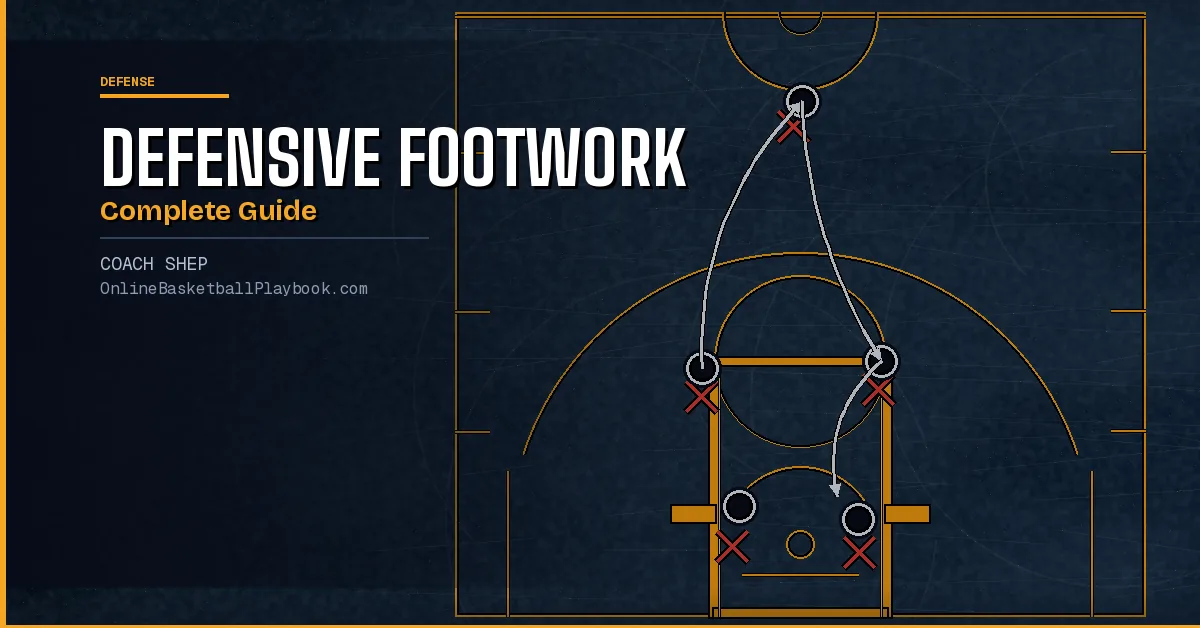
Good defense starts with your feet. Before you talk about schemes, rotations, or personnel, every player must own the fundamentals: stance, slides, closeouts, and help positioning. This guide covers all of it.
The Defensive Stance
Every rep of defensive footwork begins with the stance. Get the stance wrong and nothing downstream works (slides are slow, closeouts are off-balance, and the offense finds gaps they never earned).
The keys to a sound defensive stance are consistent and teachable. Feet are shoulder-width apart or slightly wider, weight distributed on the balls of the feet. Never the heels. Hips sit low, back stays flat, and the chest is up. Hands are active: one low (to mirror the ball and threaten a deflection) and one high (to contest a pass or shot). The feet should never be square; a slight stagger with one foot a half-step ahead helps the defender load weight and push off laterally without crossing over.
The most common mistake at every level is standing straight up between plays and only bending at the knees when a drive starts. By then it's too late. Defenders must hold an athletic, low base continuously: before the catch, during ball movement, and after a pass. This is conditioning as much as technique. Players who fatigue revert to an upright stance, which is why defensive footwork drills always finish with some element of cardiovascular stress.
A useful coaching cue: "sit in a chair you can't see." That mental image keeps hips back and down without over-bending at the knee. Another: "your nose should be over your toes." These short triggers fire during live play more reliably than technical multi-word reminders.
Stance width should also respond to the offensive player's position. Guarding a perimeter player with a live dribble calls for a slightly wider base to cut off the drive lane. Guarding a post player requires a lower, wider stance with a hand on the hip to feel movement. One defensive stance does not serve all situations equally. Players need to recognize the adjustment and make it automatically.
Defensive Slides and Lateral Movement
Once the stance is established, the slide is the primary movement tool for on-ball defense. A slide keeps the defender in their base, maintains a cushion in front of the offensive player, and denies straight-line drives to the basket. Done correctly, the slide is deceptively quick. Done wrong (with crossed feet, upright posture, or short choppy steps), the defender is beaten before the dribbler accelerates.
The mechanics of a defensive slide: push off the back foot, step laterally with the lead foot, and bring the back foot to close the gap. Feet never cross. The gap between feet stays consistent. It never narrows to the point where the defender is stranded on one leg. Push, step, recover. Push, step, recover. The rhythm is constant regardless of the offensive player's speed change.
Speed changes are the critical test. Offensive players use hesitations, gear-down, and explosive first steps specifically to disrupt slide rhythm. Defenders counter with a "drop step" or retreat step when an offensive player shows a drive: rather than sliding backward (which is slow), the defender drops the trail foot back and opens their hips slightly to turn and run if needed. This is not a retreat. It is a controlled decision to protect against the drive while remaining in position to recover to a close-out if the offensive player pulls up.
Lateral slide speed is a trainable physical attribute, but it is also heavily influenced by anticipation. Defenders who read the offensive player's hips, not their head or the ball, get an extra step of reaction time. The hips tell you where the body is going. Eyes on the midsection, not the eyes or the ball, is a teaching point that pays dividends immediately when players apply it for the first time in a live drill.
Closeout Technique
The closeout is one of the highest-leverage defensive footwork skills in the modern game. In any system that relies on ball movement and catch-and-shoot opportunities, defenders are closing out on open shooters multiple times per possession. Poor closeout technique costs two or three points per game in made threes alone at most competitive levels.
A closeout starts with a sprint and ends with a stutter. The defender sprints hard from their help position toward the ball-receiver. At roughly 8-10 feet, they chop their feet rapidly (shortening stride length dramatically) to regain control, absorb contact if needed, and arrive in a position where they are not flying past the shooter. The hand goes up toward the shooting hand without fouling. The defender must be low, balanced, and ready to slide if the ball-handler puts the ball on the floor.
The most common error is a closeout that ends flat-footed. The defender runs full speed and either overruns the shooter entirely or arrives upright with no ability to change direction. A flat-footed closeout gives the offense a live dribble with the defender off-balance, arguably worse than no closeout at all because it creates an open driving lane and often pulls an additional help defender out of position.
Closeout footwork must also account for the shooter's tendencies. If scouting tells a defender this player shoots quickly off the catch, the closeout should be more aggressive and earlier. If the player is primarily a driver, the defender can show hands and concede a slight step of space to protect the lane. These are real-time decisions built on preparation. The footwork is the delivery mechanism, but the read drives when and how to deploy it.
Teach closeouts in three segments: "sprint, chop, contest." Call them out loud in practice so players internalize the three-beat rhythm. When players skip the chop (going straight from sprint to contest), they arrive off-balance every time.
Help-Side Positioning and Rotations
Defensive footwork is not only about guarding your direct assignment. The majority of points scored at every level come from breakdowns in help positioning (defenders who are too far up the floor, too narrow to the ball, or standing flat-footed when a rotation is triggered). Help-side footwork is quiet, un-glamorous, and absolutely foundational.
The standard teaching is that off-ball defenders should split the difference between their assignment and the ball: one foot in the lane, one foot out, with eyes that can see both simultaneously. This is the "pistol" stance or "ball-you-man" positioning. From here the defender can step to help on a drive, recover to contest a kick-out pass, or rotate to cover an open cutter. The positioning is not static. It shifts as the ball moves, and players must continuously adjust their feet without losing track of their assignment.
Rotation footwork fires when a ball-handler beats the on-ball defender. The nearest help defender must close the gap with a direct step and stop the drive before it reaches the paint. This step must be decisive. A tentative half-step produces a driving lane and a foul risk at the same time, which is the worst of both outcomes. Good rotators step hard to cut off the drive angle, hands up, and redirect the ball-handler into a secondary defender or a contested floater.
After the rotation, weak-side defenders must shift. This is where teams give up easy corner threes: the rotation fires, the kick-out goes to the corner, and no one has moved to cover it because weak-side players stayed flat instead of reading the drive and already taking one slide toward their assignment. The footwork on rotation is a chain. Every player on the floor must move, not just the primary rotator.
Teaching help rotations effectively requires live 4-on-4 and 5-on-5 work rather than isolated drill work. Players can execute help-side positioning cleanly in a walk-through and break down completely in a scrimmage because they are tracking the ball, their assignment, and multiple other players simultaneously. The conditioning and communication required to maintain proper help positioning for a full shot clock, possession after possession, is the true test of a defensive unit's footwork depth.
On-Ball Defense Against Dribble Penetration
When the offensive player beats the initial on-ball stance and gets into the lane, the defensive footwork challenge changes. The defender must now recover, and recovery footwork is a skill that is rarely drilled enough relative to how often it matters in games.
Recovery starts with a sprint-and-turn. When the offensive player gets the initial step, the on-ball defender does not slide. They open their hips, turn, and run to cut off the angle. The goal is to get in front of or parallel to the offensive player before the paint, not to trail them into the lane and contest from behind. A trailing contest in the paint produces block-charge judgment calls at best and easy layups at worst.
The secondary objective in recovery is to use length. If the offensive player has the step and a recovery is impossible before the rim, the defender should sprint hard, get their hand up, and contest without fouling. The footwork here is about closing distance (getting as tight as possible in the shortest time) so the offensive player knows that the easy layup is not there and must make a decision: take the contested finish, pull up for a floater, or kick to a teammate. All three are acceptable outcomes for the defense relative to an uncontested drive layup.
Defenders who are consistently beaten on the drive should evaluate two things: stance width (too narrow produces a slow first step in response to a drive) and their initial position relative to the offensive player. Giving a step of space toward the baseline forces the offensive player to take the longer route to the rim. Defenders who are too tight and who shade too far toward the middle give up baseline drives that are hard to cut off because there is no help coming from the baseline side.
Footwork Drills for Practice
Drills only transfer to games if they replicate the demands of live play. The best defensive footwork drills are competitive, timed, and finish with a decision (not just a mechanical repetition with no opponent and no consequence). Here are five categories that cover the full footwork curriculum.
Stance holds. Players hold a proper defensive stance for 30–60 second intervals while coaches check posture, foot width, and hand placement. This is a conditioning drill as much as a technique drill. Fatigue is the point. Players who can maintain proper stance for 60 seconds are far more likely to hold it in the fourth quarter of a game.
Mirror slides. Two players face each other. One is the offense, one is the defense. Offense slides laterally without crossing feet; defense mirrors them, staying within arm's length. After 20–30 seconds, switch. Add a tennis ball for the offense to pass from hand to hand to add visual distraction.
Closeout series. Ball starts under the basket. Defender starts in help position at the elbow. Coach or offensive player catches a pass on the wing; defender sprints to close out, chops, contests, and then slides when the ball goes on the floor. Run to both sides.
Rotation shell. 4-on-4 shell drill with ball movement and no dribble until a coach calls "drive." On the drive call, the assigned ball-side player drives hard. All four defenders must respond: on-ball tries to stay in front, nearest help rotates, weak-side shifts. Coach evaluates every player's feet on each repetition, not just the primary defender.
1-on-1 full-length. Offense starts at half-court with a live dribble. Defense starts one step ahead. The entire play is contested end-line to end-line. This drill builds recovery footwork, sprint discipline, and composure after being beaten (the scenarios that matter most in games and that pure lane-width drills never replicate).
- Check stance width before every drill. Feet should match or exceed shoulder width.
- Cue "nose over toes" to fix upright posture without a long technical correction
- Never let players cross their feet in slides. Stop and reset immediately.
- Run closeout drills to both sides equally. Left-side closeouts are almost always weaker.
- Demand communication on every rotation. "Help!" and "I've got ball!" should be audible all practice.
- End each session's defensive footwork block with a competitive drill that has a clear winner because competition accelerates learning.
Want more defensive systems, drills, and play diagrams delivered to your inbox?
Join the Online Basketball Playbook newsletter →
Draw this play free in the play drawer →
Membership: the full library, playbook packs, and Pro drawing tools →
Keep Building
Related breakdowns
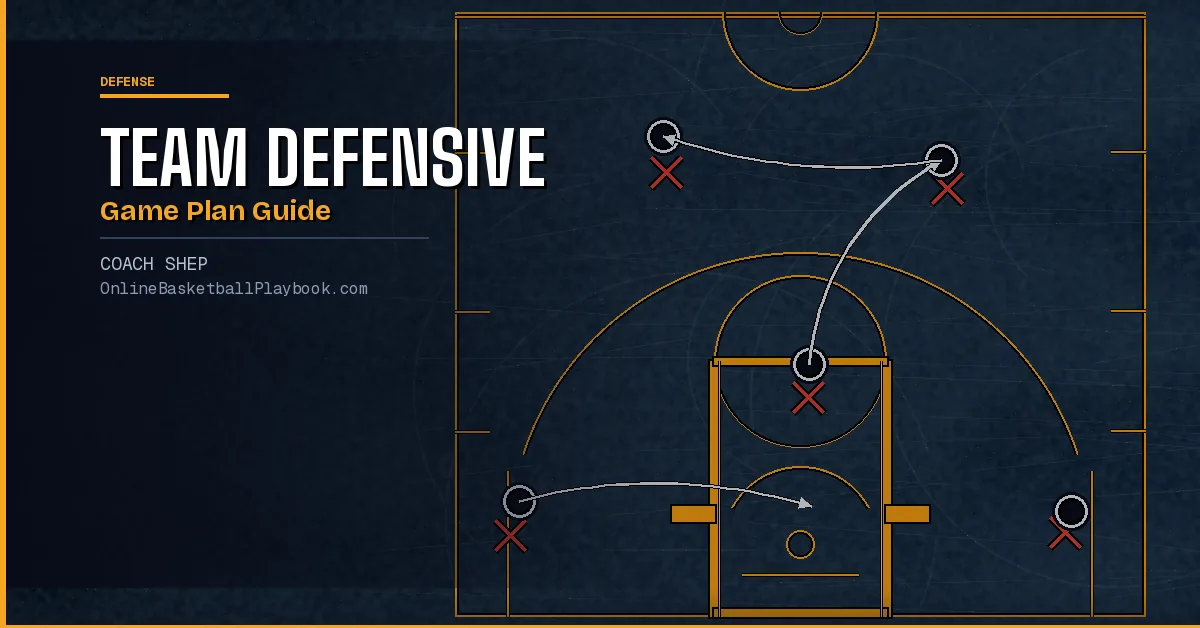
The Complete Team Basketball Defensive Game Plan
The Complete Team Basketball Defensive Game Plan
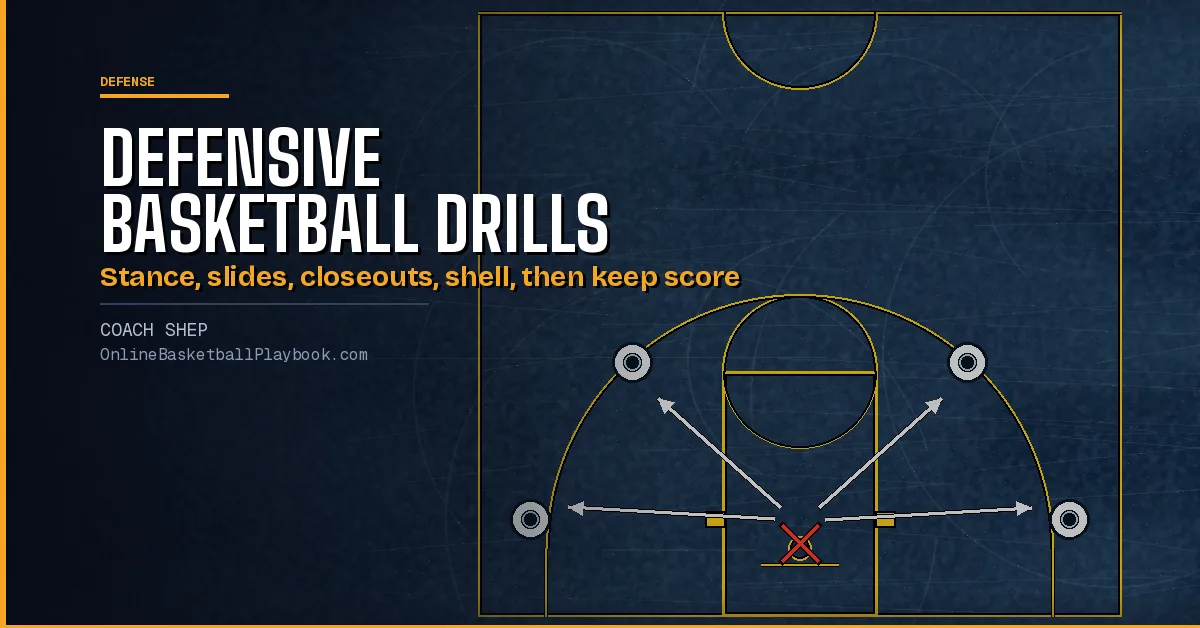
Defensive Basketball Drills: Slides, Closeouts, Shell and Games
Defensive basketball drills in teaching order, from stance and defensive slide drills to closeouts, pass denial, shell and scored games, with the versions coaches split on.
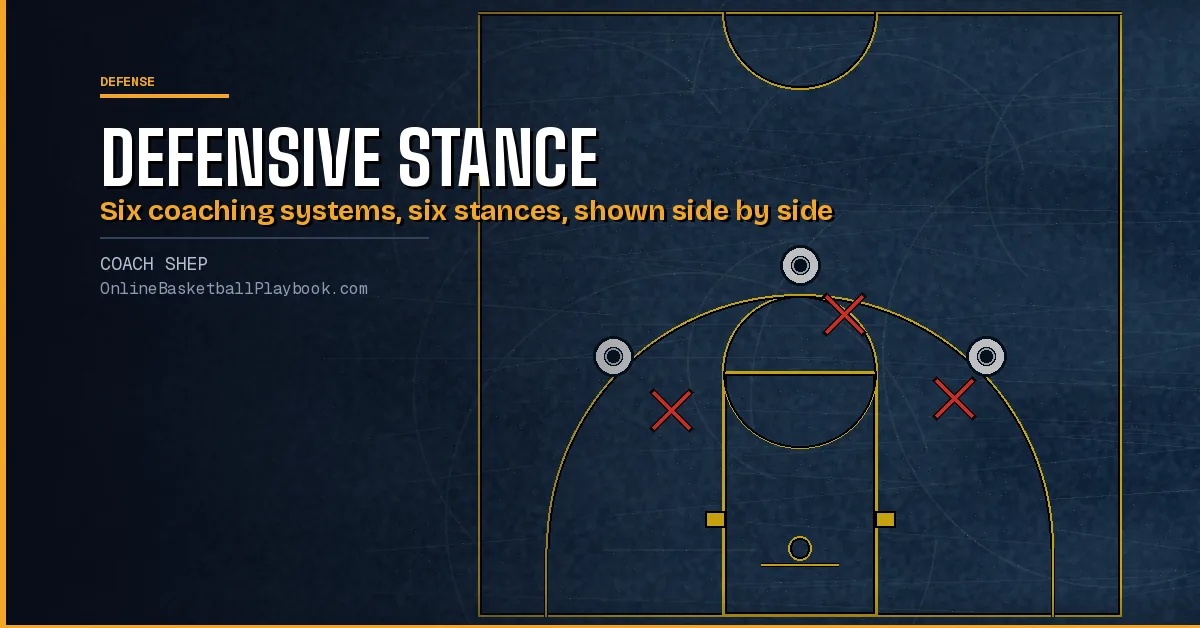
Defensive Stance in Basketball: Weight, Feet, Hands and Drills
Defensive stance in basketball: weight, feet, hands and eyes, the footwork out of the stance and the drills that build it.